Page 5 of 286
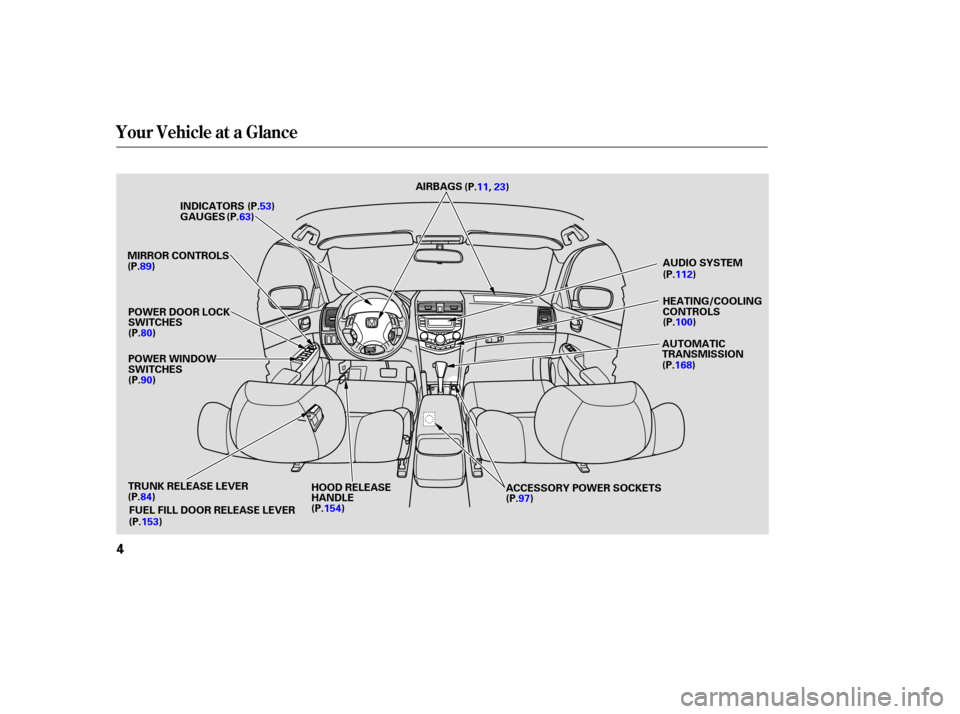
Your Vehicle at a Glance
4
HEATING/COOLING
CONTROLS
MIRROR CONTROLS
POWER WINDOW
SWITCHES GAUGES
HOOD RELEASE
HANDLE ACCESSORY POWER SOCKETSAUDIO SYSTEM
AUTOMATIC
TRANSMISSION
AIRBAGS
(P.11,23)
INDICATORS
TRUNK RELEASE LEVER FUEL FILL DOOR RELEASE LEVER (P.63)
(P.53)
(P.112)
(P.100)
(P.168)
(P.97)
(P.154)
(P.84)
(P.153)
(P.90) (P.80)
(P.89)
POWER DOOR LOCK
SWITCHES
�����—�
���—�����y���������������y���
�(���'�������y���������y
Page 14 of 286
�µ
CONT INUED
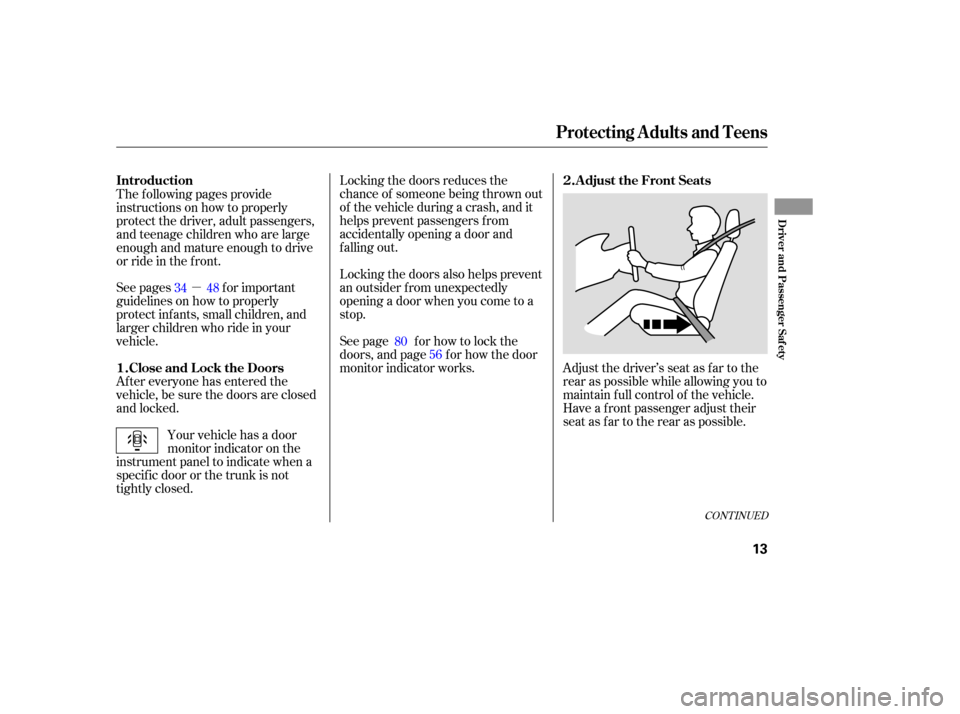
Adjust the driver’s seat as far to the
rear as possible while allowing you to
maintain f ull control of the vehicle.
Have a front passenger adjust their
seat as far to the rear as possible.
Locking the doors reduces the
chance of someone being thrown out
of the vehicle during a crash, and it
helps prevent passengers f rom
accidentally opening a door and
f alling out.
Locking the doors also helps prevent
an outsider f rom unexpectedly
opening a door when you come to a
stop.
The f ollowing pages provide
instructions on how to properly
protect the driver, adult passengers,
and teenage children who are large
enough and mature enough to drive
or ride in the f ront.
See pages f or important
guidelines on how to properly
protect inf ants, small children, and
larger children who ride in your
vehicle.
Af ter everyone has entered the
vehicle, be sure the doors are closed
and locked.
See page f or how to lock the
doors, and page f or how the door
monitor indicator works.
Your vehicle has a door
monitor indicator on the
instrument panel to indicate when a
specif ic door or the trunk is not
tightly closed. 34 48
8056
Protecting A dults and Teens
Introduction A djust the Front Seats
Close and L ock the Doors
1. 2.
Driver and Passenger Saf ety
13
�����—�
���—���
�y������
����
���y���
�(���'�������y�����
���y
Page 36 of 286

�µ
During a crash, the
belt could press deep into the child
and cause serious or fatal injuries.
If they do, they
could be very seriously injured in a
crash. If you are not wearing a
seat belt in crash, you could be
thrown f orward and crush the
child against the dashboard or a
seat-back. If you are wearing a
seat belt, the child can be torn
from your arms and be seriously
hurt or killed. This can prevent children
f rom accidentally f alling out (see
page ).
Leaving children without
adult supervision is illegal in most
states and Canadian provinces,
and can be very hazardous.
For example, infants and small
childrenleftinavehicleonahot
day can die f rom heatstroke. A
child lef t alone with the key in the
ignition can accidentally set the
vehicle in motion, possibly injuring
themselves or others. Children
who play in vehicles can
accidentally get trapped inside.
Teach your children not to play in
or around vehicles. Know how to
operate the emergency trunk
opener and decide if your children
should be shown how to use this
feature(seepage ).
Even very young
children learn how to unlock
vehicle doors, turn on the ignition
switch, and open the trunk, which
can lead to accidental injury or
death.
81
85
Additional Saf ety Precautions
Never put a seat belt over yourself
and a child.
Never let two children use thesame seat belt .
Neverholdaninfantorchildon
your lap. Use childproof door locks t o
prevent children f rom opening t hedoors.
Do not leave children alone in avehicle. L ock all doors and t he t runk when
your vehicle is not in use.
K eep vehicle keys and remot etransmitters out of the reach ofchildren.
Protecting Children General Guidelines
Driver and Passenger Saf ety
35
�����—���
�—�����y�
����
��������y���
�(���'�������y���������y
Page 50 of 286

Your vehicle’s exhaust contains
carbon monoxide gas. You should
have no problem with carbon
monoxide entering the vehicle in
normal driving if you maintain your
vehicle properly.High levels of carbon monoxide can
collect rapidly in enclosed areas,
such as a garage. Do not run the
engine with the garage door closed.
Even with the door open, run the
engine only long enough to move the
vehicle out of the garage.
Have the exhaust system inspected
f or leaks whenever:
With the trunk open, airf low can pull
exhaust gas into your vehicle’s
interior and create a hazardous
condition. If you must drive with the
trunk open, open all the windows and
set the climate control system as
shown below.
If you must sit in your parked vehicle
with the engine running, even in an
unconfined area, adjust the climate
control system as f ollows:
Select the f resh air mode.
Select the mode.
Turn the f an on high speed.
Set the temperature control to a
comfortable setting.
The vehicle is raised f or an oil
change.
You notice a change in the sound
of the exhaust.
The vehicle was in an accident
that may have damaged the
underside.
1.
2.
3.
4.
Carbon Monoxide Hazard
Driver and Passenger Saf ety
49
Carbon monoxide gas is toxic.
Breathing it can cause
unconsciousness and even kill
you.
Avoid any enclosed areas or
activities that expose you to
carbon monoxide.
�����—�
���—���
�y���������������y���
�(���'�������y���������y
Page 52 of 286
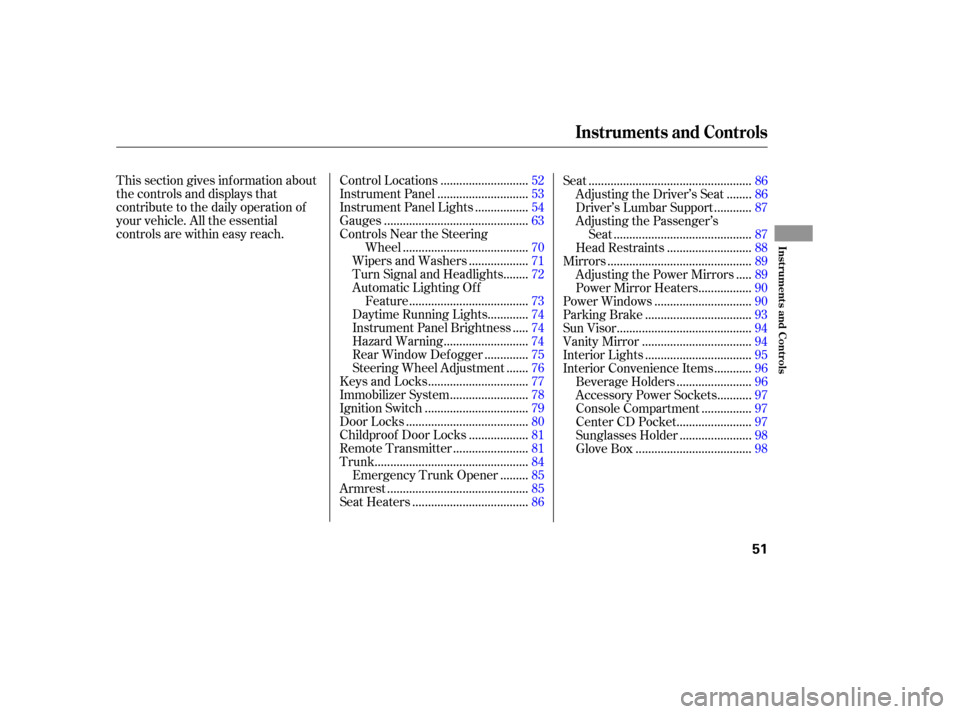
This section gives inf ormation about
the controls and displays that
contribute to the daily operation of
your vehicle. All the essential
controls are within easy reach............................
Control Locations .52
............................
Instrument Panel .53
................
Instrument Panel Lights .54
.............................................
Gauges .63
Controls Near the Steering
.......................................
Wheel .70
..................
Wipers and Washers .71
.......
Turn Signal and Headlights .72
Automatic Lighting Off
.....................................
Feature .73
............
Daytime Running Lights .74
....
Instrument Panel Brightness .74
..........................
Hazard Warning .74
.............
Rear Window Def ogger .75
......
Steering Wheel Adjustment .76
...............................
Keys and Locks .77
........................
Immobilizer System .78
................................
Ignition Switch .79
......................................
Door Locks .80
..................
Childproof Door Locks .81
.......................
Remote Transmitter .81
................................................
Trunk .84
........
Emergency Trunk Opener .85
............................................
Armrest .85
....................................
Seat Heaters .86 ...................................................
Seat .86
.......
Adjusting the Driver’s Seat .86
...........
Driver’s Lumbar Support .87
Adjusting the Passenger’s
...........................................
Seat .87
..........................
Head Restraints .88
.............................................
Mirrors .89
....
Adjusting the Power Mirrors .89
................
Power Mirror Heaters .90
..............................
Power Windows .90
.................................
Parking Brake .93
..........................................
Sun Visor .94
..................................
Vanity Mirror .94
.................................
Interior Lights .95
...........
Interior Convenience Items .96
.......................
Beverage Holders .96
..........
Accessory Power Sockets .97
...............
Console Compartment .97
.......................
Center CD Pocket .97
......................
Sunglasses Holder .98
....................................
Glove Box .98
Instruments and Controls
Inst rument s and Cont rols
51
�����—���
�—�����y�
����
��������y���
�(���'�������y���������y
Page 53 of 286
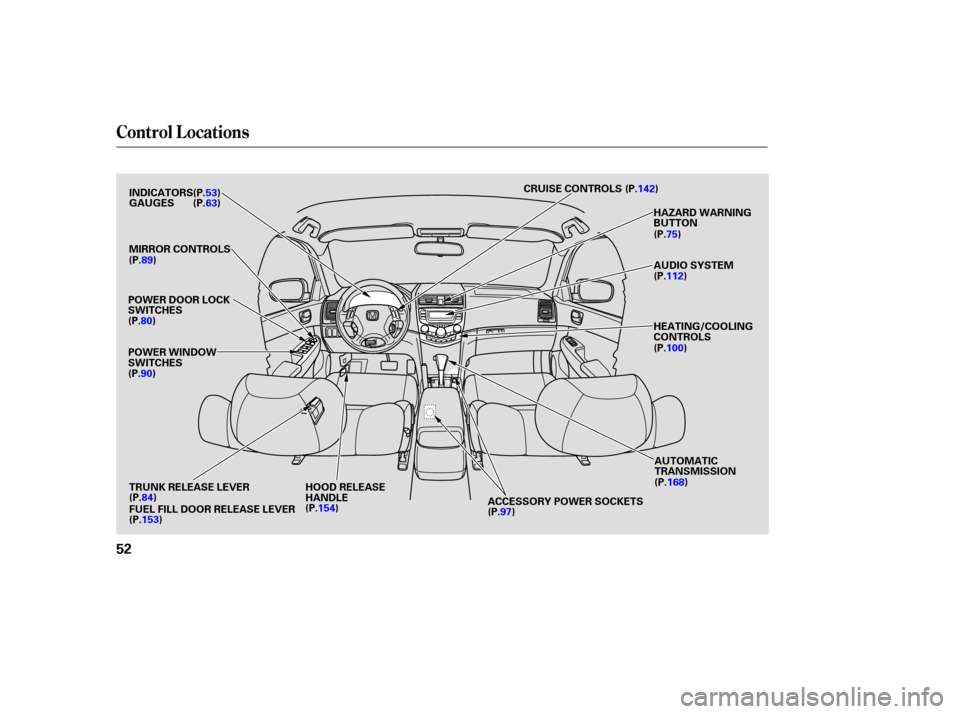
Control L ocations
52
POWER DOOR LOCK
SWITCHES
POWER WINDOW
SWITCHESMIRROR CONTROLS
ACCESSORY POWER SOCKETSAUDIO SYSTEM
HEATING/COOLING
CONTROLS HAZARD WARNING
BUTTON
CRUISE CONTROLS
TRUNK RELEASE LEVER HOOD RELEASE HANDLE
INDICATORS
GAUGES
FUEL FILL DOOR RELEASE LEVER (P.53)
(P.63)
(P.89)
(P.80)
(P.90)
(P.153) (P.154)
(P.97)(P.100) (P.112)
(P.142)
(P.84) AUTOMATIC
TRANSMISSION
(P.168)
(P.75)
�����—���
�—�����y�
����
��������y���
�(���'�������y���������y
Page 54 of 286
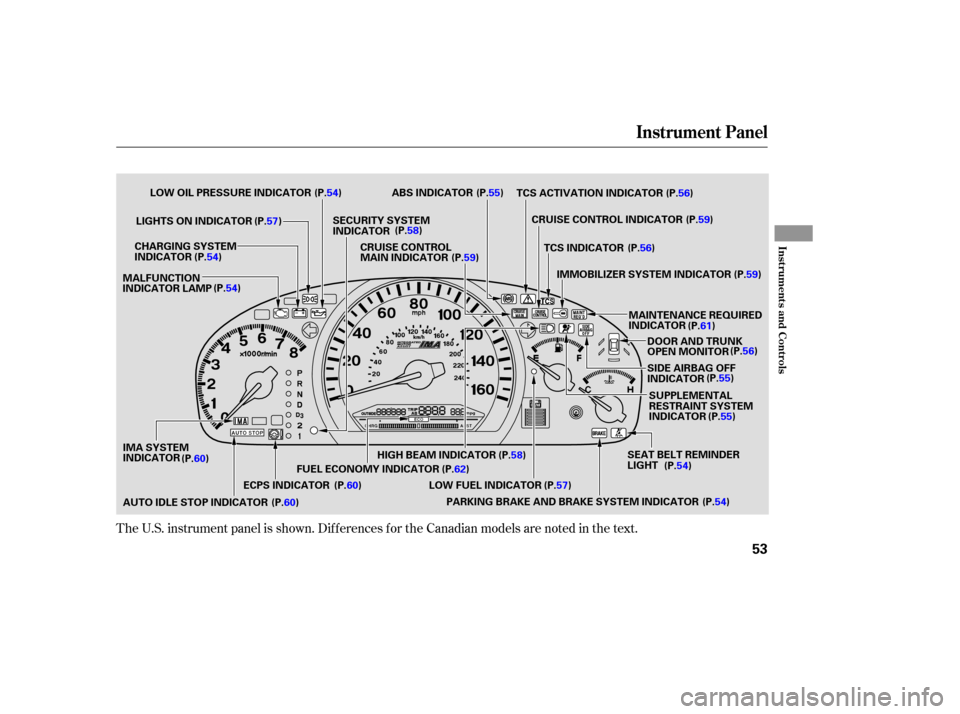
The U.S. instrument panel is shown. Dif f erences f or the Canadian models are noted in the text.
Instrument Panel
Inst rument s and Cont rols
53
MAINTENANCE REQUIRED
INDICATOR
MALFUNCTION
INDICATOR LAMP
CHARGING SYSTEM
INDICATOR
IMMOBILIZER SYSTEM INDICATOR
SUPPLEMENTAL
RESTRAINT SYSTEM
INDICATOR
DOOR AND TRUNK
OPEN MONITOR
LIGHTS ON INDICATOR
HIGH BEAM INDICATOR SIDE AIRBAG OFF
INDICATOR
AUTO IDLE STOP INDICATOR ECPS INDICATORSECURITY SYSTEM
INDICATOR
TCS ACTIVATION INDICATOR
CRUISE CONTROL INDICATOR
SEAT BELT REMINDER
LIGHT
LOW OIL PRESSURE INDICATOR (P.54) ABS INDICATOR (P.55)
(P.56)
(P.59)
TCS INDICATOR (P.56) (P.59)
(P.61) (P.56)
(P.55)
(P.55)
(P.54)
PARKING BRAKE AND BRAKE SYSTEM INDICATOR (P.54)
LOW FUEL INDICATOR (P.57) (P.58)
(P.60)
IMA SYSTEM
INDICATOR
(P.60)
(P.60)
(P.57)
(P.54) (P.54) (P.58)
CRUISE CONTROL
MAIN INDICATOR (P.59)
FUEL ECONOMY INDICATOR (P.62)
�����—�
���—�����y���������������y���
�(���'�������y���������y
Page 57 of 286

The appropriate indicator comes on
in this monitor if the trunk or either
door is not closed tightly.
All the indicators in the monitor
come on f or a f ew seconds when you
turn the ignition switch to ON (II).
This indicator has three f unctions:
Itcomesonasareminderthatyou
have turned off the traction
control system (TCS).
It f lashes when the TCS is
regulating wheelspin.
If itcomesonandstaysonwhen
the TCS is on, it indicates that
there is a problem in the TCS. This indicator normally comes on f or
a f ew seconds when you turn the
ignition switch to ON (II). If it comes
on and stays on when the Traction
Control System (TCS) is on, there is
a problem with the TCS. For more
inf ormation on the TCS, see page
.
This indicator also comes on f or a
f ew seconds when you turn the
ignition switch to ON (II). If it comes
on and stays on at any other time, or
it does not come on when you turn
the ignition switch to ON (II), there
is a problem with the TCS. Take the
vehicle to your dealer to have it
checked. See page f or more
inf ormation on the TCS. 1.
2.
3. 180
180 Door and T runk Open Monitor
Traction Control System
(T CS) Indicator
T CS A ctivation Indicator
Instrument Panel Indicators
56
�����—���
�—�����y�
����
��������y���
�(���'�������y���������y