Page 167 of 286

Youshoulddothefollowingchecks
and adjustments bef ore you drive
your vehicle.Make sure all windows, mirrors,
and outside lights are clean and
unobstructed. Remove f rost, snow,
or ice.
Make sure the doors are securely
closed and locked.
Fasten your seat belt. Check that
your passengers have f astened
their seat belts (see page ). Check the steering wheel
adjustment (see page ).
Check that the hood is f ully closed.
Check that the trunk is f ully
closed.
Visually check the tires. If a tire
looks low, use a gauge to check its
pressure.
Check that any items you may be
carrying are stored properly or
f astened down securely. Check the seat adjustment (see
pages to ).
Check the adjustment of the
inside and outside mirrors (see
pages and ).
When you start the engine, check
the gauges and indicators in the
instrument panel (see pages to
).
3. 2. 1.
4.
5. 6.
7.
8.
9.
11.
10. 16
89 90
76 54
69
86 88
Preparing to Drive
166
�����—���
�—�����y�
�������������y���
�(���'�������y���
�����y
Page 176 of 286

Always use the parking brake when
you park your vehicle. Make sure
the parking brake is set f irmly or
your vehicle may roll if it is parked
on an incline.
Set the parking brake bef ore you put
the transmission in Park. This keeps
the vehicle from moving and putting
pressure on the parking mechanism
in the transmission.Make sure the windows are closed.
Turn of f the lights.
Place any packages, valuables, etc.,
in the trunk or take them with you.
Lockthedoorswiththekeyorthe
remote transmitter.
Check the indicator on the
instrument panel to verif y that the
security system is set.
Never park over dry leaves, tall
grass, or other f lammable
materials. They may catch f ire
because of the extreme heat of the
three-way catalytic converter.If the vehicle is f acing uphill, turn
the f ront wheels away f rom the
curb.
If the vehicle is f acing downhill,
turn the front wheels toward the
curb.
Make sure the parking brake is
f ully released bef ore driving away.
Driving with the parking brake
partially set can overheat or
damage the rear brakes.
Parking T ips
Parking
Driving
175
�����—�
���—���
�y��������
������y���
�(���'�������y���
�����y
Page 185 of 286

Towing can require a variety of
equipment, depending on the size of
your trailer, how it will be used, how
much load you are towing, and
where you tow.
Discuss your needs with your trailer
sales or rental agency, and f ollow the
guidelines in the rest of this section.
Also make sure that all equipment is
properly installed and that it meets
f ederal, state, province, and local
regulations.Honda recommends that any trailer
having a total weight of 1,000 lbs
(450 kg) or more be equipped with
its own electric or surge-type brakes.
If you choose electric brakes, be
sure they are electrically actuated.
Do not attempt to tap into your
vehicle’s hydraulic system. No
matter how successf ul it may seem,
any attempt to attach trailer brakes
to your vehicle’s hydraulic system
will lower braking ef f ectiveness and
create a potential hazard.
Seeyourtrailerdealerformore
inf ormation on installing electric
brakes.
Any hitch used on your vehicle must
be properly bolted to the underbody.
Always use saf ety chains when you
tow a trailer. Make sure the chains
are secured to the trailer and hitch,
and that they cross under the tongue
and can catch the trailer if it
becomes unhitched. Leave enough
slack to allow the trailer to turn
corners easily, but do not let the
chains drag on the ground.
Towing a Trailer
T owing Equipment and
A ccessoriesTrailer Brakes
Hitches
Saf et y Chains
184
�����—�
���—���
�y���������������y���
�(���'�������y���
�����y
Page 187 of 286

When preparing to tow, and bef ore
driving away, be sure to check the
f ollowing:The vehicle has been properly
serviced, and the tires, brakes,
suspension, cooling system, and
lights are in good operating
condition. Your vehicle tires and spare are
properly inf lated (see page ),
and the trailer tires and spare are
trailer maker.
The lights and brakes on your
vehicle and the trailer are working
properly. All items in or on the trailer are
properly secured and cannot shif t
while you drive. Thehitch,safetychains,andany
other attachments are secure. All weights and loads are within
limits (see pages and ). The added weight, length, and
height of a trailer will af f ect your
vehicle’s handling and perf ormance,
so driving with a trailer requires
some special driving skills and
techniques.
Foryoursafetyandthesafetyof
others,taketimetopracticedriving
maneuvers bef ore heading f or the
open road, and f ollow the guidelines
below. Drive slower than normal in all
driving situations, and obey posted
speed limits f or vehicles with trailers.
If you have an automatic
transmission, use D position when
towing a trailer on level roads. D is
the proper shif t lever position to use
when towing a trailer in hilly terrain.
(See ‘‘ ’’ in the next
column f or additional gear
inf ormation.)
182 183 220
3
Pre-T ow Checklist
Driving Saf ely With a T railer
Towing a Trailer
T owing Speeds and Gears
Driving on Hills
186
�����—�
���—���
�y���������������y���
�(���'�������y���
�����y
Page 202 of 286
Oil is a major contributor to your
engine’s perf ormance and longevity.
Always use a premium-grade 5W-20
detergent oil displaying the API
Certif ication Seal. This seal indicates
the oil is energy conserving, and that
it meets the American Petroleum
Institute’s latest requirements.
Unscrew and remove the engine oil
fill cap on top of the valve cover.
Pour in the oil slowly and caref ully so
you do not spill. Clean up any spills
immediately. Spilled oil could
damage components in the engine
compartment. Install the engine oil f ill cap, and
tighten it securely. Wait a f ew
minutes, and recheck the oil level.
Do not f ill above the upper mark; you
could damage the engine.
Recommended Engine Oil
A dding Engine Oil
Maint enance
201
ENGINE OIL FILL CAP
�����—�
���—���
�y���������������y���
�(���'�������y���������y
Page 212 of 286
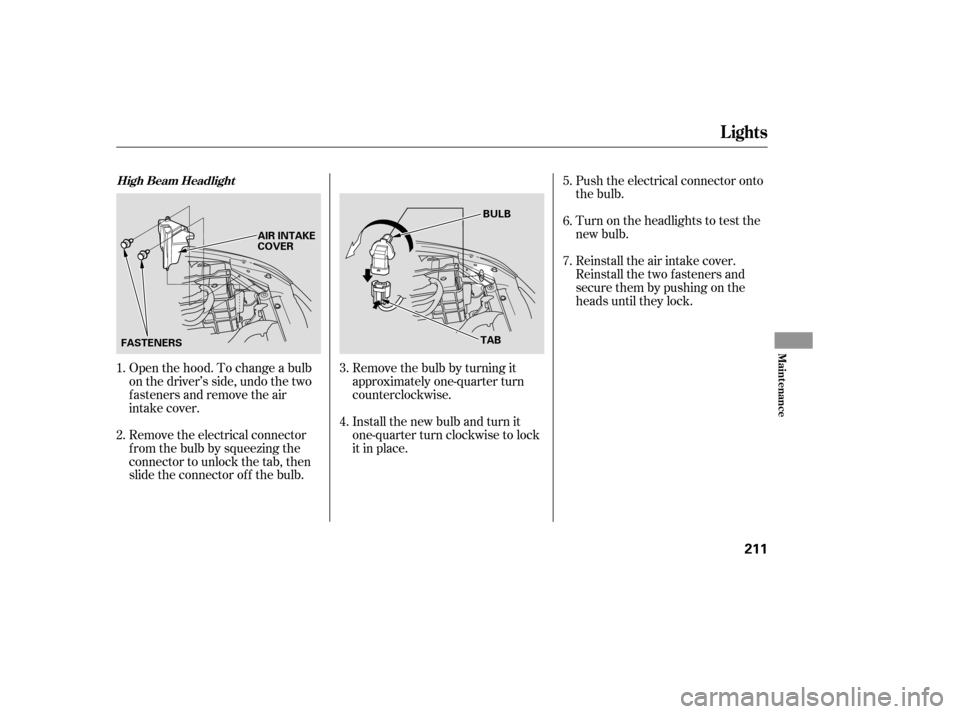
Remove the electrical connector
f rom the bulb by squeezing the
connector to unlock the tab, then
slide the connector of f the bulb.Remove the bulb by turning it
approximately one-quarter turn
counterclockwise.
Install the new bulb and turn it
one-quarter turn clockwise to lock
it in place.Push the electrical connector onto
the bulb.
Turn on the headlights to test the
new bulb.
Open the hood. To change a bulb
on the driver’s side, undo the two
f asteners and remove the air
intake cover. Reinstall the air intake cover.
Reinstall the two fasteners and
secure them by pushing on the
heads until they lock.
1. 3.
2. 4.5.
6.
7.
High Beam Headlight
Lights
Maint enance
211
AIR INTAKE
COVER
FASTENERS TABBULB
�����—�
���—���
�y���������������y���
�(���'�������y�����
���y
Page 225 of 286

When installing cables, f ollow the
manuf acturer’s instructions, and
mount them as tight as you can.
Make sure they are not contacting
the brake lines or suspension. Drive
slowly with them installed. If you
hear them coming into contact with
the body or chassis, stop and
investigate. Remove them as soon as
youbegindrivingonclearedroads.
Because your vehicle has limited tire
clearance, Honda strongly
recommends using the chains listed
below, made by Security Chain
Company (SCC). Mount snow chains on your tires
when required by driving conditions
or local laws. Install them only on the
f ront tires.
Cable-types: SCC Radial Chain
CH2311T or SCC SC Cable SC1030T ire Chains
Tires
224
Using the wrong chains, or not
properly installing chains, can
damage the brake lines and
cause a crash in which you can
be seriously injured or killed.
Follow all instructions in this
owner’s manual regarding the
selection and use of tire chains.
�����—�
���—���
�y�����������
���y���
�(���'�������y���������y
Page 240 of 286

Tighten the wheel nuts securely in
the same crisscross pattern. Have
the wheel nut torque checked at
the nearest automotive service
f acility.
Tighten the wheel nuts to:
Put on the spare tire. Put the
wheel nuts back on f inger-tight,
then tighten them in a crisscross
pattern with the wheel nut wrench
until the wheel is f irmly against
the hub. Do not try to tighten
them f ully.
Lower the vehicle to the ground
and remove the jack. Remove the center cap before
storing the f lat tire in the trunk
well.
Place the flat tire face down in the
spare tire well.
Remove the spacer cone f rom the
wing bolt, turn it over, and put it
back on the bolt.
Securetheflattirebyscrewing
the wing bolt back into its hole.
Store the jack in its holder. Turn
the jack’s end bracket to lock it in
place. Replace the cover. Store the
tools.
11.
12. 13.15.
16.
17.
18. 14.
CONT INUED
Changing a Flat Tire (Canadian Model)
T aking Care of t he Unexpect ed
239
WING BOLT
SPACER CONE
80 lbf·ft (108 N·m , 11 kgf·m)
�����—�
���—���
�y��������
������y���
�(���'�������y���������y