Page 341 of 468
{CAUTION:
Adding only plain water to your cooling
system can be dangerous. Plain water, or
some other liquid such as alcohol, can boil
before the proper coolant mixture will. Your
vehicle’s coolant warning system is set for the
proper coolant mixture. With plain water or the
wrong mixture, your engine could get too hot
but you would not get the overheat warning.
Your engine could catch re and you or others
could be burned. Use a 50/50 mixture of clean,
drinkable water and DEX-COOL
®coolant.
Notice:In cold weather, water can freeze and crack
the engine, radiator, heater core and other parts.
Use the recommended coolant and the proper
coolant mixture.
{CAUTION:
You can be burned if you spill coolant on hot
engine parts. Coolant contains ethylene glycol
and it will burn if the engine parts are hot
enough. Do not spill coolant on a hot engine.
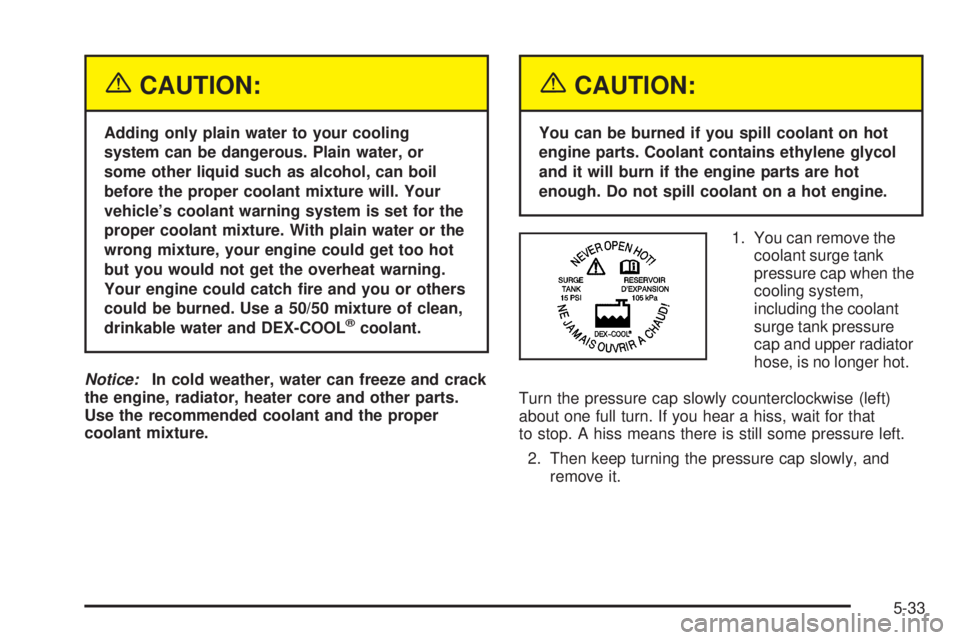
1. You can remove the
coolant surge tank
pressure cap when the
cooling system,
including the coolant
surge tank pressure
cap and upper radiator
hose, is no longer hot.
Turn the pressure cap slowly counterclockwise (left)
about one full turn. If you hear a hiss, wait for that
to stop. A hiss means there is still some pressure left.
2. Then keep turning the pressure cap slowly, and
remove it.
5-33
Page 359 of 468
A. Low-Beam Headlamp
B. High-Beam Headlamp
3. Pull the headlamp assembly out.
4. Unplug the electrical connector.
5. Turn the bulb counterclockwise and remove it from
the headlamp assembly.
6. Put the new bulb into the headlamp assembly and
turn it clockwise until it is tight. Use care not to
touch the bulb with your ngers or hands.
7. Plug in the electrical connector.
8. Put the headlamp assembly back into the vehicle.
9. Install and turn the two pins into the locking feature.
Front Turn Signal, Sidemarker and
Daytime Running Lamps
A. Sidemarker Lamp
B. Retainer Clip
C. Front Turn Signal Lamp
D. Daytime Running Lamp (DRL)
5-51
Page 360 of 468
To replace a front turn signal, sidemarker or DRL bulb,
do the following:
1. Remove the headlamp assembly as described
previously. SeeHeadlamps on page 5-50for
more information.
2. Press the retainer clip (B), located behind the turn
signal housing, towards the outside of the vehicle.
3. Pull the turn signal housing out of the vehicle.4. Press the locking release lever, turn the bulb socket
counterclockwise and remove it from the turn signal
housing.
5. Remove the old bulb from the bulb socket.
6. Put a new bulb into the bulb socket. Use care not
to touch the bulb with your ngers or hands.
7. Put the bulb socket back into the turn signal
housing and turn it clockwise until it locks.
8. Put the turn signal housing back into the vehicle
placing the hook and posts on the inner side into
the alignment holes rst, then the outer side into the
retainer bracket until you hear a click.
9. Put the headlamp assembly back into the vehicle.
5-52
Page 361 of 468
Taillamps
A. Turn Signal Lamp
B. Back-up Lamp
C. StoplampTo replace a taillamp bulb, do the following:
1. Remove the two
screws from the
taillamp assembly.
2. Remove the taillamp assembly.
3. Press the release tab and turn the bulb socket
counterclockwise to remove it from the taillamp
housing.
5-53
Page 362 of 468
4. Pull the old bulb
straight out from the
socket.
5. Press a new bulb into the socket, insert the socket
into the taillamp housing and turn the socket
clockwise into the taillamp housing until it clicks.
6. Reinstall the taillamp assembly.Replacement Bulbs
Exterior Lamp Bulb Number
Back-up Lamp 3157
Daytime Running Lamps (DRL) 4114K
Front Marker Lamp 194
Front Parking and Turn
Signal Lamp3157K or 3157
Headlamps
High-Beam 9005
Low-Beam9005 LL
(Long Life) or
9005
Rear Marker Lamp, Taillamp and
Stoplamp3157
Rear Turn Signal Lamp 3157
For replacement bulbs not listed here, contact your
dealer.
5-54
Page 371 of 468

A Tire and Loading Information label is attached to the
vehicle’s center pillar (B-pillar), below the driver’s door
lock post (striker). This label lists your vehicle’s original
equipment tires and their recommended cold tire ination
pressures. The recommended cold tire ination pressure,
shown on the label, is the minimum amount of air
pressure needed to support your vehicle’s maximum load
carrying capacity.
For additional information regarding how much weight
your vehicle can carry, and an example of the tire
and loading information label, seeLoading Your Vehicle
on page 4-44.
When to Check
Check your tires once a month or more. Do not forget
to check the spare tire. For additional information
regarding the spare tire, seeSpare Tire on page 5-94.
How to Check
Use a good quality pocket-type gage to check tire
pressure. You cannot tell if your tires are properly inated
simply by looking at them. Radial tires may look properly
inated even when they’re underinated. Check the tire’s
ination pressure when the tires are cold. Cold means
your vehicle has been sitting for at least three hours or
driven no more than 1 mile (1.6 km).Remove the valve cap from the tire valve stem. Press
the tire gage rmly onto the valve to get a pressure
measurement. If the cold tire ination pressure matches
the recommended pressure on the Tire and Loading
Information label, no further adjustment is necessary. If
the ination pressure is low, add air until you reach
the recommended amount.
If you overll the tire, release air by pushing on the
metal stem in the center of the tire valve. Recheck the
tire pressure with the tire gage.
Be sure to put the valve caps back on the valve stems.
They help prevent leaks by keeping out dirt and moisture.
Tire Pressure Monitor System
The Tire Pressure Monitor (TPM) system uses radio
and sensor technology to check tire pressure levels. If
your vehicle has this feature, sensors are mounted
on each tire and wheel assembly, except the spare tire.
The TPM sensors transmit tire pressure readings to
a receiver located in the vehicle.
When a low tire pressure condition is detected, the TPM
system will display the CHECK TIRE PRESSURE
warning message on the Driver Information Center (DIC);
and at the same time illuminate the low tire pressure
warning symbol. For additional information and details
about the DIC operation and displays, seeDIC Operation
and Displays on page 3-47andDIC Warnings and
Messages on page 3-50.
5-63
Page 383 of 468
{CAUTION:
Changing a tire can be dangerous. The vehicle
can slip off the jack and roll over or fall on you
or other people. You and they could be badly
injured or even killed. Find a level place to
change your tire. To help prevent the vehicle
from moving:
1. Set the parking brake rmly.
2. Put the shift lever in PARK (P).
3. Turn off the engine and do not restart
while the vehicle is raised.
4. Do not allow passengers to remain in the
vehicle.
To be even more certain the vehicle will not
move, you should put blocks at the front and
rear of the tire farthest away from the one
being changed. That would be the tire, on the
other side, at the opposite end of the vehicle.When you have a at tire, use the following example as a
guide to assist you in the placement of wheel blocks.
The following information will tell you next how to use
the jack and change a tire.
5-75
Page 384 of 468
Removing the Spare Tire and Tools
A. Retaining Bracket
and Wing Nut
B. Tool Kit and
Jack Tools
C. JackD. Wing Nut Holding
Tire Blocks
E. Wheel BlocksA. Knob
B. Removable Tray
C. Retaining Hook
D. Retaining Bracket
and Wing Nut
E. Tool Kit and
Jack ToolsF. Mounting Bracket
G. Wing Nut Holding
Tire Blocks
H. Wheel Blocks
I. Jack Yukon Denali Rear Access PanelYukon XL Denali
5-76


