2005 GMC SAFARI brakes
[x] Cancel search: brakesPage 268 of 370
Tire Size
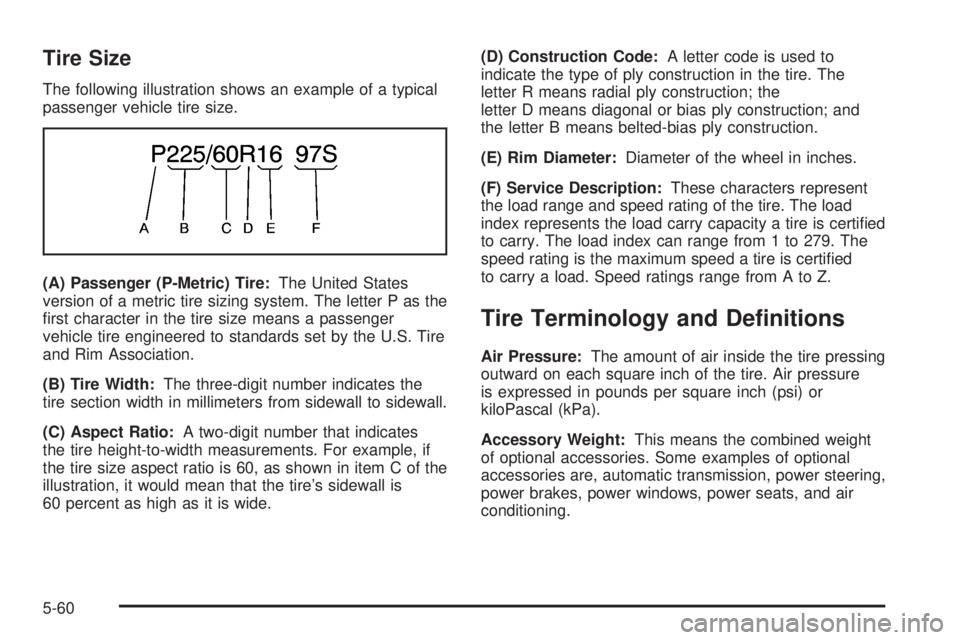
The following illustration shows an example of a typical
passenger vehicle tire size.
(A) Passenger (P-Metric) Tire:The United States
version of a metric tire sizing system. The letter P as the
rst character in the tire size means a passenger
vehicle tire engineered to standards set by the U.S. Tire
and Rim Association.
(B) Tire Width:The three-digit number indicates the
tire section width in millimeters from sidewall to sidewall.
(C) Aspect Ratio:A two-digit number that indicates
the tire height-to-width measurements. For example, if
the tire size aspect ratio is 60, as shown in item C of the
illustration, it would mean that the tire’s sidewall is
60 percent as high as it is wide.(D) Construction Code:A letter code is used to
indicate the type of ply construction in the tire. The
letter R means radial ply construction; the
letter D means diagonal or bias ply construction; and
the letter B means belted-bias ply construction.
(E) Rim Diameter:Diameter of the wheel in inches.
(F) Service Description:These characters represent
the load range and speed rating of the tire. The load
index represents the load carry capacity a tire is certied
to carry. The load index can range from 1 to 279. The
speed rating is the maximum speed a tire is certied
to carry a load. Speed ratings range from A to Z.
Tire Terminology and Denitions
Air Pressure:The amount of air inside the tire pressing
outward on each square inch of the tire. Air pressure
is expressed in pounds per square inch (psi) or
kiloPascal (kPa).
Accessory Weight:This means the combined weight
of optional accessories. Some examples of optional
accessories are, automatic transmission, power steering,
power brakes, power windows, power seats, and air
conditioning.
5-60
Page 304 of 370

Instrument Panel Fuse Block
The fuse block is located on the lower portion of the
instrument panel on the driver’s side.Fuse/Circuit
BreakerUsage
1Stop/Turn/Hazard Lamps,
Center High-Mounted Stop Lamp,
Anti-Lock Brakes
2Radio Accessory, Rear Seat Audio
Controls
3Courtesy Lamps, Glove Box Lamp,
Dome Reading Lamps, Vanity Mirror
Lamps, Courtesy Lamps
5-96
Page 317 of 370

Footnotes
†The U.S. Environmental Protection Agency or the
California Air Resources Board has determined that the
failure to perform this maintenance item will not nullify
the emission warranty or limit recall liability prior to
the completion of the vehicle’s useful life. We, however,
urge that all recommended maintenance services be
performed at the indicated intervals and the
maintenance be recorded.
#Lubricate the front suspension, ball joints and kingpin
bushings, steering linkage, parking brake cable
guides and brake pedal springs.
+A good time to check your brakes is during tire
rotation. See Brake System Inspection on page 6-29.
3,000 Miles (5 000 km)
❑Change engine oil and lter (or every 3 months,
whichever occurs rst).An Emission Control Service.
❑Lubricate chassis components (or every 3 months,
whichever occurs rst).(See footnote #.)
6,000 Miles (10 000 km)
❑Change engine oil and lter (or every 3 months,
whichever occurs rst).An Emission Control Service.
❑Lubricate chassis components (or every 3 months,
whichever occurs rst).(See footnote #.)
❑Rotate tires. SeeTire Inspection and Rotation on
page 5-64for proper rotation pattern and additional
information.(See footnote +.)
9,000 Miles (15 000 km)
❑Change engine oil and lter (or every 3 months,
whichever occurs rst).An Emission Control Service.
❑Lubricate chassis components (or every 3 months,
whichever occurs rst).(See footnote #.)
12,000 Miles (20 000 km)
❑Change engine oil and lter (or every 3 months,
whichever occurs rst).An Emission Control Service.
❑Lubricate chassis components (or every 3 months,
whichever occurs rst).(See footnote #.)
❑Rotate tires. SeeTire Inspection and Rotation on
page 5-64for proper rotation pattern and additional
information.(See footnote +.)
6-7
Page 326 of 370

Long Trip/Highway Scheduled
Maintenance
The services shown in this schedule up to 100,000 miles
(166 000 km) should be repeated after 100,000 miles
(166 000 km) at the same intervals for the life of
this vehicle. The services shown at 150,000 miles
(240 000 km) should be repeated at the same interval
after 150,000 miles (240 000 km) for the life of this
vehicle.
SeePart B: Owner Checks and Services on page 6-23
andPart C: Periodic Maintenance Inspections on
page 6-28.
Footnotes
†The U.S. Environmental Protection Agency or the
California Air Resources Board has determined that the
failure to perform this maintenance item will not nullify
the emission warranty or limit recall liability prior to
the completion of the vehicle’s useful life. We, however,
urge that all recommended maintenance services be
performed at the indicated intervals and the
maintenance be recorded.
#Lubricate the front suspension, ball joints and kingpin
bushings, steering linkage and transfer case shift
linkage, parking brake cable guides and brake
pedal springs.
+A good time to check your brakes is during tire
rotation. See Brake System Inspection on page 6-29.
6-16
Page 339 of 370

Throttle System Inspection
Inspect the throttle system for interference or binding,
and for damaged or missing parts. Replace parts
as needed. Replace any components that have high
effort or excessive wear. Do not lubricate accelerator
and cruise control cables.
Transfer Case and Front Axle
(All-Wheel Drive) Inspection
Every 12 months, or at engine oil change intervals,
check front axle and transfer case and add lubricant
when necessary. A uid loss could indicate a problem.
Check and have it repaired, if needed. Check vent
hose at transfer case for kinks and proper installation.
Brake System Inspection
Inspect the complete system. Inspect brake lines and
hoses for proper hook-up, binding, leaks, cracks,
chang, etc. Inspect disc brake pads for wear and rotors
for surface condition. Inspect other brake parts,
including calipers, parking brake, etc. Check parking
brake adjustment. You may need to have your brakes
inspected more often if your driving habits or
conditions result in frequent braking.
6-29
Page 355 of 370

Service Publications Ordering
Information
Service Manuals
Service Manuals have the diagnosis and repair
information on engines, transmission, axle suspension,
brakes, electrical, steering, body, etc.
Transmission, Transaxle, Transfer
Case Unit Repair Manual
This manual provides information on unit repair service
procedures, adjustments, and specications for GM
transmissions, transaxles, and transfer cases.
Service Bulletins
Service Bulletins give technical service information
needed to knowledgeably service General Motors cars
and trucks. Each bulletin contains instructions to
assist in the diagnosis and service of your vehicle.
In Canada, information pertaining to Product Service
Bulletins can be obtained by contacting your General
Motors dealer or by calling 1-800-GM-DRIVE
(1-800-463-7483).
7-11
Page 358 of 370

Audio System(s).............................................3-41
AM-FM Radio.............................................3-42
Care of Your CD Player...............................3-53
Care of Your CDs........................................3-53
Fixed Mast Antenna.....................................3-53
Radio with CD............................................3-44
Rear Seat Audio (RSA)................................3-49
Setting the Time for Radios with HR and
MN Buttons.............................................3-42
Setting the Time for Radios with the
Set Button..............................................3-42
Theft-Deterrent Feature................................3-50
Understanding Radio Reception.....................3-53
Automatic Headlamp System............................3-17
Automatic Transmission
Fluid..........................................................5-24
Operation...................................................2-20
B
Battery..........................................................5-42
Run-Down Protection...................................3-19
Before Leaving on a Long Trip.........................4-19
Bench Seat..................................................... 1-6
Brake
Anti-Lock Brake System (ABS)........................ 4-6
Emergencies................................................ 4-8
Parking......................................................2-23Brake (cont.)
System Inspection.......................................6-29
System Warning Light..................................3-30
Brakes..........................................................5-38
Braking........................................................... 4-5
Braking in Emergencies..................................... 4-8
Break-In, New Vehicle.....................................2-16
Bucket Seats, Rear.........................................1-12
Bulb Replacement...........................................5-50
Front Turn Signal and Parking Lamps.............5-54
Halogen Bulbs............................................5-50
Replacement Bulbs......................................5-56
Taillamps, Turn Signal, Stoplamps and
Back-up Lamps........................................5-54
Buying New Tires...........................................5-66
C
California Fuel.................................................. 5-6
Canadian Owners................................................ ii
Capacities and Specications..........................5-101
Carbon Monoxide...........................2-26, 4-22, 4-33
Care of
Safety Belts................................................5-88
Your CD Player...........................................3-53
Your CDs ...................................................3-53
Center Rear Passenger Position, Safety Belts.....1-29
Chains, Tire...................................................5-70
2