2005 GMC ENVOY XUV battery
[x] Cancel search: batteryPage 186 of 474

KEY FOB # BATTERY LOW
If a remote keyless entry transmitter battery is low,
this message will appear on the DIC. The battery
needs to be replaced in the transmitter. See “Battery
Replacement” underRemote Keyless Entry System
Operation on page 2-6. Pressing the select button will
acknowledge this message and clear it from the
DIC display.
LEFT REAR DOOR AJAR
If the driver’s side rear door is not fully closed this
message will appear on the display and you will hear a
chime. Stop and turn off the vehicle, check the door
for obstacles, and close the door again. Check to see if
the message still appears on the DIC. Pressing the
select button will acknowledge this message and clear it
from the DIC display.
OIL PRESSURE LOW/STOP ENGINE
If low oil pressure levels occur, this message will
be displayed on the DIC. Stop the vehicle as soon as
safely possible and do not operate it until the cause
of the low oil pressure has been corrected. Check your
oil as soon as possible and have your vehicle serviced
by your GM dealer. SeeEngine Oil on page 5-16.Notice:If you drive your vehicle while the engine
oil pressure is low, severe engine damage may
occur. If a low oil pressure warning appears on the
Driver Information Center (DIC), stop the vehicle
as soon as possible. Do not drive the vehicle until
the cause of the low oil pressure is corrected.
SeeEngine Oil on page 5-16for more information.
OPEN THE ROOF
The roof must be opened to enable future roof and/or
tailgate operations. SeePower Roof on page 2-18
andTailgate on page 2-14.
PARK TO OPERATE ROOF
Stop the vehicle and shift into PARK (P) to operate the
roof. SeePower Roof on page 2-18.
PASSENGER DOOR AJAR
If the passenger’s door is not fully closed, this message
will appear on the display and you will hear a chime.
Stop and turn off the vehicle, check the door for
obstacles, and close the door again. Check to see if the
message still appears on the DIC. Pressing the select
button will acknowledge this message and clear it
from the DIC display.
3-54
Page 296 of 474

Run your engine only as long as you must. This saves
fuel. When you run the engine, make it go a little
faster than just idle. That is, push the accelerator
slightly. This uses less fuel for the heat that you get
and it keeps the battery charged. You will need a
well-charged battery to restart the vehicle, and possibly
for signaling later on with your headlamps. Let the
heater run for a while.
Then, shut the engine off and close the window almost
all the way to preserve the heat. Start the engine
again and repeat this only when you feel really
uncomfortable from the cold. But do it as little as
possible. Preserve the fuel as long as you can.
To help keep warm, you can get out of the vehicle and
do some fairly vigorous exercises every half hour or
so until help comes.If You Are Stuck: In Sand, Mud,
Ice or Snow
In order to free your vehicle when it is stuck, you will
need to spin the wheels, but you do not want to
spin your wheels too fast. The method known as rocking
can help you get out when you are stuck, but you
must use caution.
{CAUTION:
If you let your tires spin at high speed, they can
explode, and you or others could be injured.
And, the transmission or other parts of the
vehicle can overheat. That could cause an
engine compartment re or other damage.
When you are stuck, spin the wheels as little as
possible. Do not spin the wheels above 35 mph
(55 km/h) as shown on the speedometer.
Notice:Spinning your wheels can destroy parts of
your vehicle as well as the tires. If you spin the
wheels too fast while shifting your transmission
back and forth, you can destroy your transmission.
For more information about using tire chains on your
vehicle, seeTire Chains on page 5-69.
4-42
Page 308 of 474
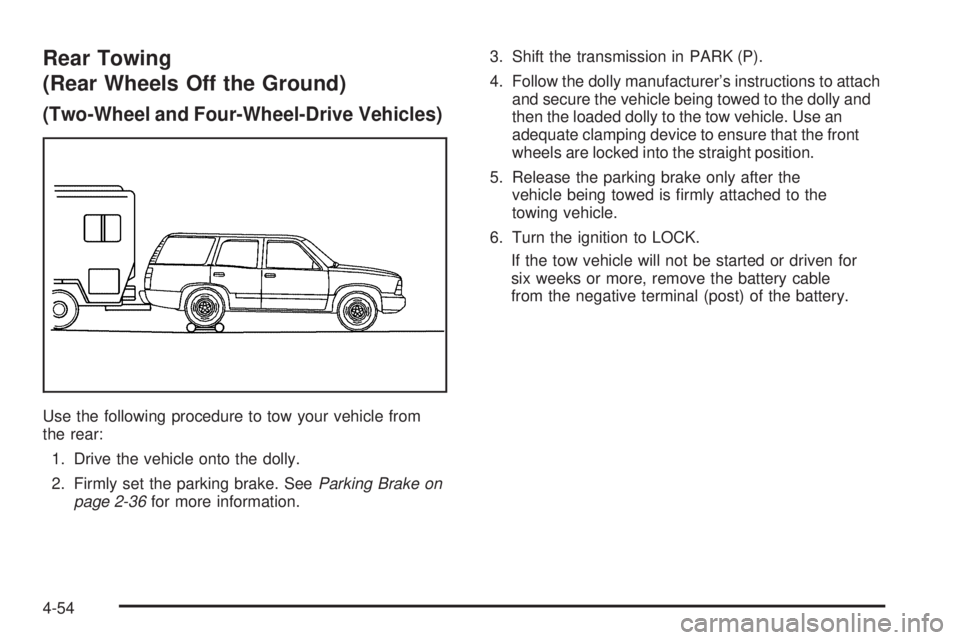
Rear Towing
(Rear Wheels Off the Ground)
(Two-Wheel and Four-Wheel-Drive Vehicles)
Use the following procedure to tow your vehicle from
the rear:
1. Drive the vehicle onto the dolly.
2. Firmly set the parking brake. SeeParking Brake on
page 2-36for more information.3. Shift the transmission in PARK (P).
4. Follow the dolly manufacturer’s instructions to attach
and secure the vehicle being towed to the dolly and
then the loaded dolly to the tow vehicle. Use an
adequate clamping device to ensure that the front
wheels are locked into the straight position.
5. Release the parking brake only after the
vehicle being towed is rmly attached to the
towing vehicle.
6. Turn the ignition to LOCK.
If the tow vehicle will not be started or driven for
six weeks or more, remove the battery cable
from the negative terminal (post) of the battery.
4-54
Page 319 of 474
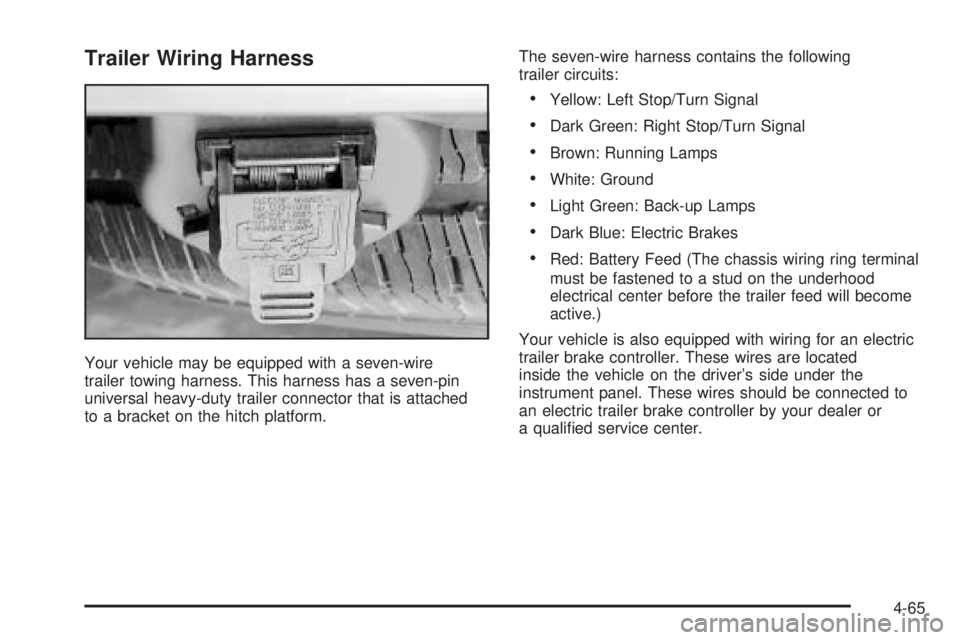
Trailer Wiring Harness
Your vehicle may be equipped with a seven-wire
trailer towing harness. This harness has a seven-pin
universal heavy-duty trailer connector that is attached
to a bracket on the hitch platform.The seven-wire harness contains the following
trailer circuits:
Yellow: Left Stop/Turn Signal
Dark Green: Right Stop/Turn Signal
Brown: Running Lamps
White: Ground
Light Green: Back-up Lamps
Dark Blue: Electric Brakes
Red: Battery Feed (The chassis wiring ring terminal
must be fastened to a stud on the underhood
electrical center before the trailer feed will become
active.)
Your vehicle is also equipped with wiring for an electric
trailer brake controller. These wires are located
inside the vehicle on the driver’s side under the
instrument panel. These wires should be connected to
an electric trailer brake controller by your dealer or
a qualied service center.
4-65
Page 321 of 474

Service............................................................5-3
Doing Your Own Service Work.........................5-4
Adding Equipment to the Outside of
Your Vehicle..............................................5-5
Fuel................................................................5-5
Gasoline Octane............................................5-5
Gasoline Specications....................................5-5
California Fuel...............................................5-6
Additives.......................................................5-6
Fuels in Foreign Countries...............................5-7
Filling Your Tank............................................5-8
Filling a Portable Fuel Container.....................5-10
Checking Things Under the Hood....................5-10
Hood Release..............................................5-11
Engine Compartment Overview.......................5-12
Engine Oil...................................................5-16
Engine Oil Life System..................................5-19
Engine Air Cleaner/Filter................................5-21
Automatic Transmission Fluid.........................5-22
Engine Coolant.............................................5-25
Radiator Pressure Cap..................................5-28
Engine Overheating.......................................5-28
Cooling System............................................5-30
Engine Fan Noise.........................................5-35
Power Steering Fluid.....................................5-36Windshield Washer Fluid................................5-37
Brakes........................................................5-38
Battery........................................................5-41
Jump Starting...............................................5-42
Rear Axle.......................................................5-47
Four-Wheel Drive............................................5-48
Front Axle......................................................5-49
Bulb Replacement..........................................5-50
Halogen Bulbs..............................................5-50
Headlamps, Front Turn Signal, and
Parking Lamps..........................................5-50
Taillamps, Turn Signal, and Stoplamps............5-51
Back-Up Lamps............................................5-52
Replacement Bulbs.......................................5-52
Windshield Wiper Blade Replacement..............5-53
Tires..............................................................5-55
Tire Sidewall Labelling...................................5-56
Tire Terminology and Denitions.....................5-59
Ination - Tire Pressure.................................5-61
Tire Inspection and Rotation...........................5-63
When It Is Time for New Tires.......................5-64
Buying New Tires.........................................5-65
Uniform Tire Quality Grading..........................5-66
Wheel Alignment and Tire Balance..................5-67
Section 5 Service and Appearance Care
5-1
Page 333 of 474

A. Engine Air Cleaner/Filter. SeeEngine Air
Cleaner/Filter on page 5-21.
B. Engine Coolant Recovery Tank. SeeCooling System
on page 5-30.
C. Windshield Washer Fluid Reservoir. See “Adding
Washer Fluid” underWindshield Washer Fluid
on page 5-37.
D. Power Steering Fluid Reservoir. SeePower Steering
Fluid on page 5-36.
E. Automatic Transmission Fluid Dipstick (Out of View).
See “Checking the Fluid Level” underAutomatic
Transmission Fluid on page 5-22.
F. Engine Oil Dipstick. See “Checking Engine Oil”
underEngine Oil on page 5-16.G. Radiator Pressure Cap. SeeRadiator Pressure Cap
on page 5-28.
H. Engine Oil Fill Cap. See “When to Add Engine Oil”
underEngine Oil on page 5-16.
I. Remote Negative (−) Terminal (Marked GND). See
Jump Starting on page 5-42.
J. Brake Master Cylinder Reservoir. See “Brake Fluid”
underBrakes on page 5-38.
K. Battery. SeeBattery on page 5-41.
L. Engine Compartment Fuse Block. SeeEngine
Compartment Fuse Block on page 5-97.
5-13
Page 335 of 474

A. Engine Coolant Recovery Tank. SeeCooling System
on page 5-30.
B. Engine Air Cleaner/Filter. SeeEngine Air
Cleaner/Filter on page 5-21.
C. Windshield Washer Fluid Reservoir. See “Adding
Washer Fluid” underWindshield Washer Fluid
on page 5-37.
D. Engine Oil Dipstick. See “Checking Engine Oil”
underEngine Oil on page 5-16.
E. Automatic Transmission Fluid Dipstick. See
“Checking the Fluid Level” underAutomatic
Transmission Fluid on page 5-22.
F. Engine Oil Fill Cap. See “When to Add Engine Oil”
underEngine Oil on page 5-16.G. Radiator Pressure Cap. SeeRadiator Pressure Cap
on page 5-28.
H. Remote Negative (−) Terminal (Marked GND). See
Jump Starting on page 5-42.
I. Power Steering Fluid Reservoir. SeePower Steering
Fluid on page 5-36.
J. Brake Master Cylinder Reservoir. See “Brake Fluid”
underBrakes on page 5-38.
K. Engine Compartment Fuse Block. SeeEngine
Compartment Fuse Block on page 5-97.
L. Battery. SeeBattery on page 5-41.
5-15
Page 361 of 474

For example, if someone puts in brake linings that are
wrong for your vehicle, the balance between your
front and rear brakes can change — for the worse.
The braking performance you have come to expect can
change in many other ways if someone puts in the
wrong replacement brake parts.
Battery
Your vehicle has a maintenance free battery. When it is
time for a new battery, get one that has the replacement
number shown on the original battery’s label. We
recommend an ACDelco
®replacement battery.
SeeEngine Compartment Overview on page 5-12
for battery location.
Warning:Battery posts, terminals and related
accessories contain lead and lead compounds,
chemicals known to the State of California to cause
cancer and reproductive harm. Wash hands after
handling.
Vehicle Storage
If you are not going to drive your vehicle for 25 days
or more, remove the black, negative (−) cable from
the battery. This will help keep your battery from
running down.
{CAUTION:
Batteries have acid that can burn you and gas
that can explode. You can be badly hurt if you
are not careful. SeeJump Starting on page 5-42
for tips on working around a battery without
getting hurt.
Also, for your audio system, seeTheft-Deterrent
Feature on page 3-119.
5-41