2005 FORD TAURUS belt
[x] Cancel search: beltPage 109 of 248
²side air bags (if equipped). Refer toSide air bag systemlater in this
chapter.
²one or more impact and safing sensors.
²the same indicator light, RCM (restraints control module) and
diagnostic unit used for the Personal safety system.
²Occupant Classification Sensor (OCS)
²Passenger air bag off indicator light.
The air bag supplemental restraints are an integral part of the Personal
Safety System. They are designed to be deployed in cases where the
Personal Safety System has determined the occupant conditions and
crash severity are appropriate to activate these devices. Refer to the
Personal Safety Systemsection in this chapter.
Important supplemental restraint system precautions
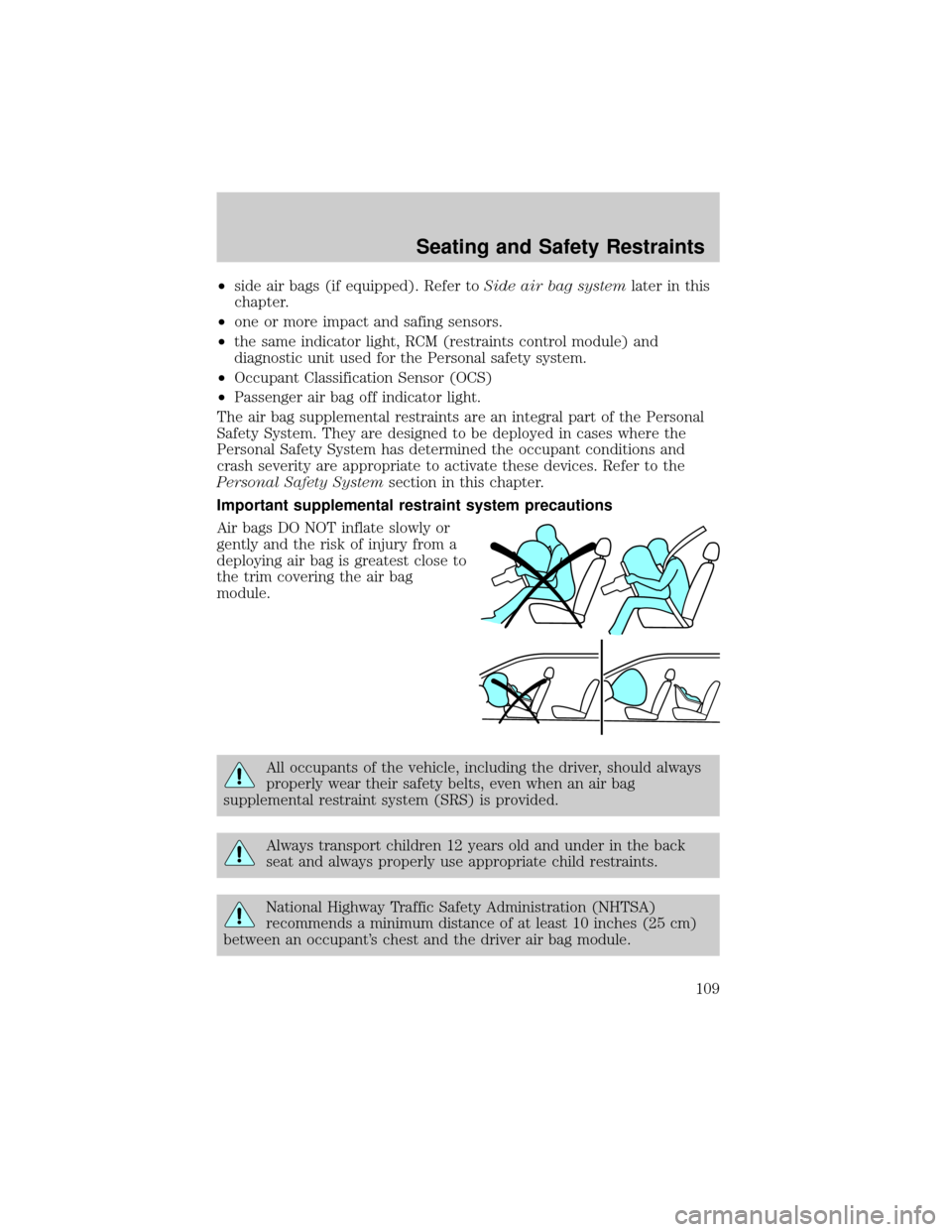
Air bags DO NOT inflate slowly or
gently and the risk of injury from a
deploying air bag is greatest close to
the trim covering the air bag
module.
All occupants of the vehicle, including the driver, should always
properly wear their safety belts, even when an air bag
supplemental restraint system (SRS) is provided.
Always transport children 12 years old and under in the back
seat and always properly use appropriate child restraints.
National Highway Traffic Safety Administration (NHTSA)
recommends a minimum distance of at least 10 inches (25 cm)
between an occupant's chest and the driver air bag module.
Seating and Safety Restraints
109
Page 112 of 248
are not properly restrained or are otherwise out of position at the time
of air bag deployment. Thus, it is extremely important that occupants be
properly restrained as far away from the air bag module as possible while
maintaining vehicle control.
Several air bag system components get hot after inflation. Do not
touch them after inflation.
If the air bag has deployed,the air bag will not function
again and must be replaced immediately.If the air bag is not
replaced, the unrepaired area will increase the risk of injury in a
collision.
Front passenger sensing system
The front passenger sensing system will turn off the front passenger's
frontal airbag under certain conditions. For side airbag equipped
vehicles, the front passenger sensing system will turn off the passenger
seat side airbag if the seat is empty (unless for some reason the safety
belt is properly buckled). The front passenger sensing system works with
sensors that are part of the front passenger's seat and safety belt. The
sensors are designed to detect the presence of a properly-seated
occupant and determine if the front passenger's frontal airbag should be
enabled (may inflate) or not.
The front passenger sensing system is designed to meet the regulatory
requirements of Federal Motor Vehicle Safety Standard (FMVSS) 208
and is designed to turn off the front passenger's frontal airbag if:
²the front passenger seat is unoccupied, or has small/medium objects in
the front seat,
²the system determines that an infant is present in a rear-facing infant
seat that is installed according to the manufacturer's instructions,
²the system determines that a small child is present in a forward-facing
child restraint that is installed according to the manufacturer's
instructions,
²the system determines that a small child is present in a booster seat,
²a front passenger takes his/her weight off of the seat for a period of
time,
Even with the front passenger sensing system, children 12 and
under should be properly restrained in the back seat.
Seating and Safety Restraints
112
Page 113 of 248
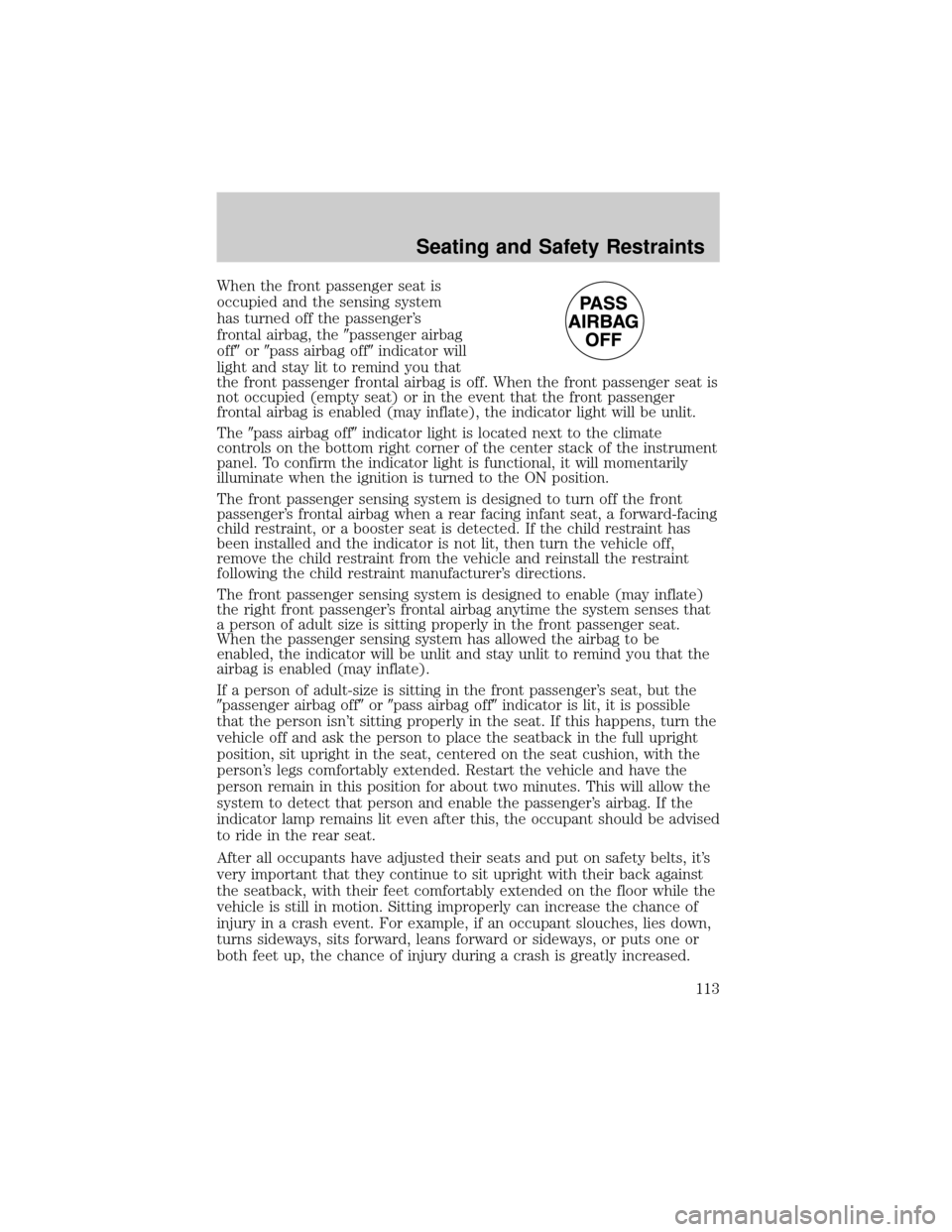
When the front passenger seat is
occupied and the sensing system
has turned off the passenger's
frontal airbag, the9passenger airbag
off9or9pass airbag off9indicator will
light and stay lit to remind you that
the front passenger frontal airbag is off. When the front passenger seat is
not occupied (empty seat) or in the event that the front passenger
frontal airbag is enabled (may inflate), the indicator light will be unlit.
The9pass airbag off9indicator light is located next to the climate
controls on the bottom right corner of the center stack of the instrument
panel. To confirm the indicator light is functional, it will momentarily
illuminate when the ignition is turned to the ON position.
The front passenger sensing system is designed to turn off the front
passenger's frontal airbag when a rear facing infant seat, a forward-facing
child restraint, or a booster seat is detected. If the child restraint has
been installed and the indicator is not lit, then turn the vehicle off,
remove the child restraint from the vehicle and reinstall the restraint
following the child restraint manufacturer's directions.
The front passenger sensing system is designed to enable (may inflate)
the right front passenger's frontal airbag anytime the system senses that
a person of adult size is sitting properly in the front passenger seat.
When the passenger sensing system has allowed the airbag to be
enabled, the indicator will be unlit and stay unlit to remind you that the
airbag is enabled (may inflate).
If a person of adult-size is sitting in the front passenger's seat, but the
9passenger airbag off9or9pass airbag off9indicator is lit, it is possible
that the person isn't sitting properly in the seat. If this happens, turn the
vehicle off and ask the person to place the seatback in the full upright
position, sit upright in the seat, centered on the seat cushion, with the
person's legs comfortably extended. Restart the vehicle and have the
person remain in this position for about two minutes. This will allow the
system to detect that person and enable the passenger's airbag. If the
indicator lamp remains lit even after this, the occupant should be advised
to ride in the rear seat.
After all occupants have adjusted their seats and put on safety belts, it's
very important that they continue to sit upright with their back against
the seatback, with their feet comfortably extended on the floor while the
vehicle is still in motion. Sitting improperly can increase the chance of
injury in a crash event. For example, if an occupant slouches, lies down,
turns sideways, sits forward, leans forward or sideways, or puts one or
both feet up, the chance of injury during a crash is greatly increased.
Seating and Safety Restraints
113
Page 114 of 248
Sitting improperly out of position or with the seat back reclined
too far can take off weight from the seat cushion and affect the
decision of the passenger sensing system, resulting in serious injury or
death in a crash. Always sit upright against your seatback, with your
feet on the floor.
The front passenger sensing system may detect small or medium objects
placed on the seat cushion. For most objects that are in the front
passenger seat, the passenger airbag will be disabled. Even though the
passenger airbag is disabled, the9pass airbag off9light may or may not
be illuminated according to the table below.
ObjectsPass Airbag Off
Indicator LightPassenger Airbag
Empty seat Unlit Disabled
Small (i.e. 3 ring
binder, small purse,
bottled water)Unlit Disabled
Medium (i.e. heavy
briefcase, fully packed
luggage)Lit Disabled
Empty seat, Small or
medium object with
safety belt buckledLit Disabled
In case there is a problem with the
passenger sensing system, the
airbag readiness light in the
instrument cluster will stay lit. DO
NOT attempt to repair or service the system; take your vehicle
immediately to the dealer.
The front passenger airbag is not designed to offer protection to
an occupant in the center seating position.
An out of position front center occupant could affect the
decision of the front passenger sensing system.
If it is necessary to modify an advanced front airbag system to
accommodate a person with disabilities, contact the Ford Customer
Seating and Safety Restraints
114
Page 116 of 248

Do not attempt to service, repair, or modify the air bag SRS, its
fuses or the seat cover on a seat containing an air bag. See your
Ford or Lincoln Mercury dealer.
All occupants of the vehicle should always wear their safety belts
even when an air bag SRS is provided.
How does the side air bag system work?
The side air bag system consists of
the following:
²An inflatable nylon bag (air bag)
with a gas generator concealed
behind the outboard bolster of
the driver and front passenger
seatbacks.
²A special seat cover designed to
allow air bag deployment.
²The same warning light,
electronic control and diagnostic unit as used for the front air bags.
²Two crash sensors located on the pillars between the front and rear
doors.
Side air bags, in combination with seat belts, can help reduce the risk of
severe injuries in the event of a significant side impact collision.
The side air bags are fitted on the outboard side of the seatbacks of the
front seats. In certain lateral collisions, the air bag on the side affected
by the collision will be inflated, even if the respective seat is not
occupied. The air bag was designed to inflate between the door panel
and occupant to further enhance the protection provided occupants in
side impact collisions.
The air bag SRS is designed to activate when the vehicle sustains lateral
deceleration sufficient to cause the sensors to close an electrical circuit
that initiates air bag inflation.
The fact that the air bags did not inflate in a collision does not mean that
something is wrong with the system. Rather, it means the forces were
not of the type sufficient to cause activation. Side air bags are designed
to inflate in side-impact collisions, not roll-over, rear-impact, frontal or
near-frontal collisions, unless the collision causes sufficient lateral
deceleration.
Seating and Safety Restraints
116
Page 118 of 248

Never let a passenger hold a child on his or her lap while the
vehicle is moving. The passenger cannot protect the child from
injury in a collision.
Always follow the instructions and warnings that come with any infant or
child restraint you might use.
Children and safety belts
If the child is the proper size, restrain the child in a safety seat. Children
who are too large for child safety seats (as specified by your child safety
seat manufacturer) should always wear safety belts.
Follow all the important safety restraint and air bag precautions that
apply to adult passengers in your vehicle.
If the shoulder belt portion of a combination lap and shoulder belt can
be positioned so it does not cross or rest in front of the child's face or
neck, the child should wear the lap and shoulder belt. Moving the child
closer to the center of the vehicle may help provide a good shoulder belt
fit.
Do not leave children, unreliable adults, or pets unattended in
your vehicle.
Child booster seats
Children outgrow a typical convertible or toddler seat when they weigh
40 pounds (18 kg) and are around 4 years of age. Although the
lap/shoulder belt will provide some protection, these children are still too
small for lap/shoulder belts to fit properly, which could increase the risk
of serious injury.
To improve the fit of both the lap and shoulder belt on children who
have outgrown child safety seats, Ford Motor Company recommends use
of a belt-positioning booster.
Booster seats position a child so that safety belts fit better. They lift the
child up so that the lap belt rests low across the hips and the knees
bend comfortably. Booster seats also make the shoulder belt fit better
and more comfortably for growing children.
When children should use booster seats
Children need to use booster seats from the time they outgrow the
toddler seat until they are big enough for the vehicle seat and
lap/shoulder belt to fit properly. Generally this is when they weigh about
80 lbs (36 kg) (about 8 to 12 years old).
Seating and Safety Restraints
118
Page 119 of 248
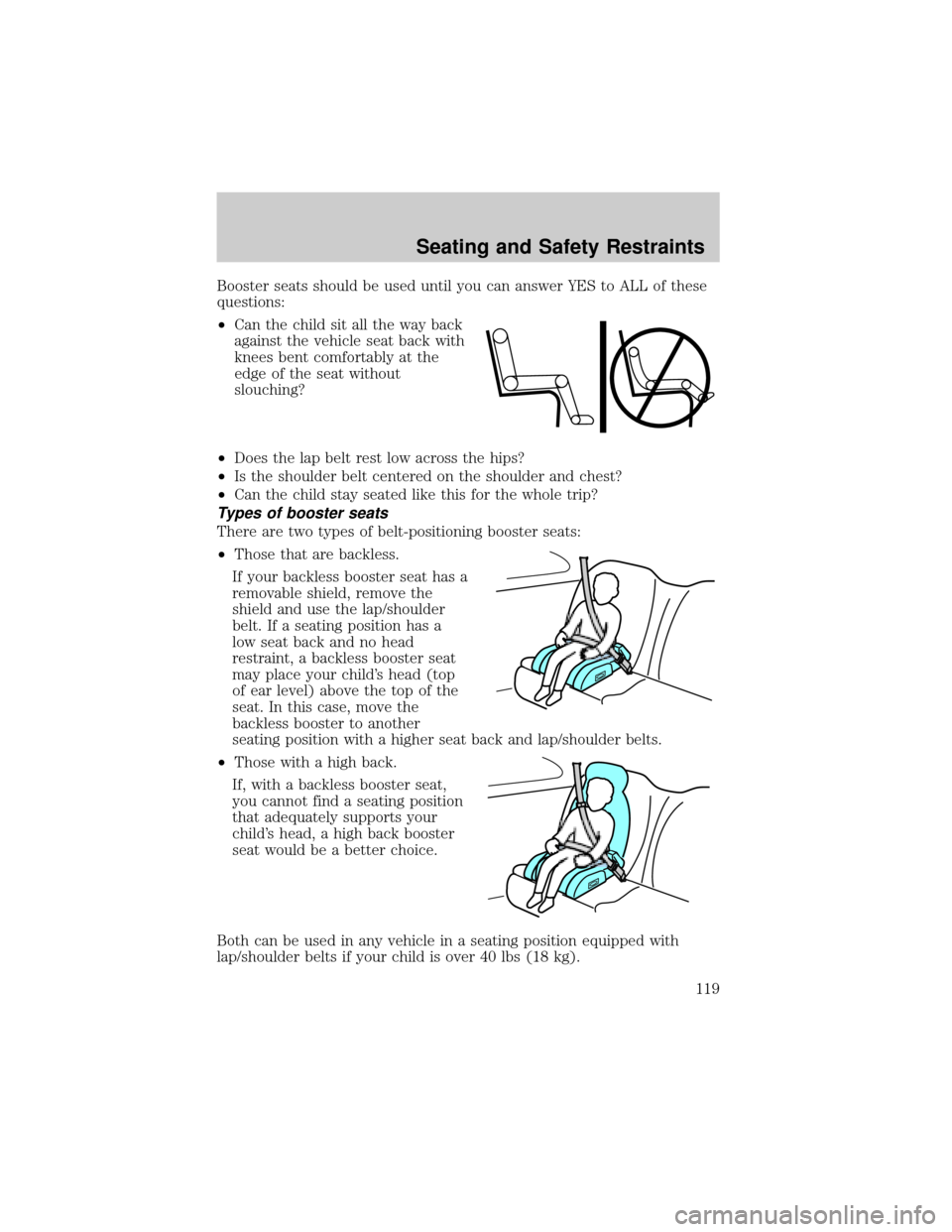
Booster seats should be used until you can answer YES to ALL of these
questions:
²Can the child sit all the way back
against the vehicle seat back with
knees bent comfortably at the
edge of the seat without
slouching?
²Does the lap belt rest low across the hips?
²Is the shoulder belt centered on the shoulder and chest?
²Can the child stay seated like this for the whole trip?
Types of booster seats
There are two types of belt-positioning booster seats:
²Those that are backless.
If your backless booster seat has a
removable shield, remove the
shield and use the lap/shoulder
belt. If a seating position has a
low seat back and no head
restraint, a backless booster seat
may place your child's head (top
of ear level) above the top of the
seat. In this case, move the
backless booster to another
seating position with a higher seat back and lap/shoulder belts.
²Those with a high back.
If, with a backless booster seat,
you cannot find a seating position
that adequately supports your
child's head, a high back booster
seat would be a better choice.
Both can be used in any vehicle in a seating position equipped with
lap/shoulder belts if your child is over 40 lbs (18 kg).
Seating and Safety Restraints
119
Page 120 of 248
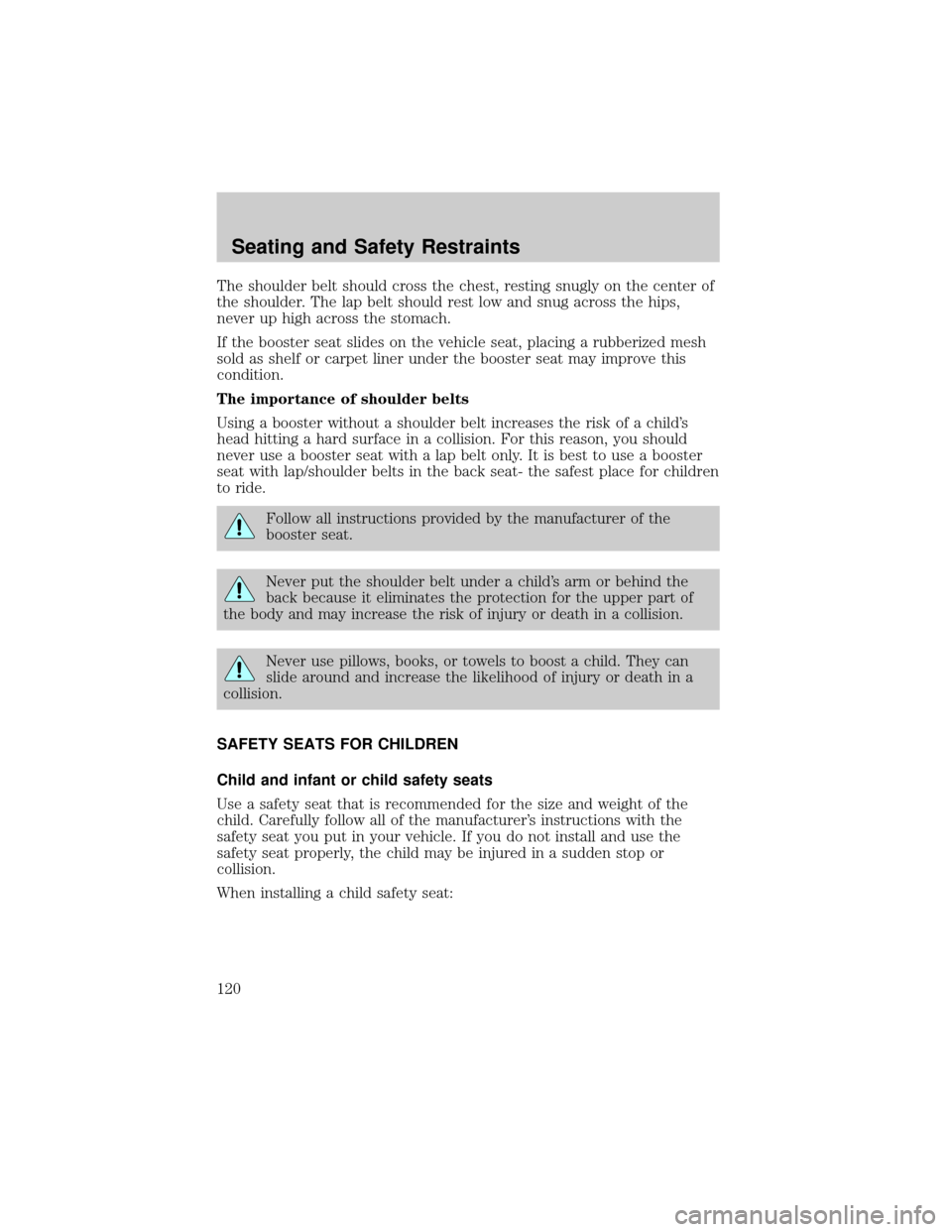
The shoulder belt should cross the chest, resting snugly on the center of
the shoulder. The lap belt should rest low and snug across the hips,
never up high across the stomach.
If the booster seat slides on the vehicle seat, placing a rubberized mesh
sold as shelf or carpet liner under the booster seat may improve this
condition.
The importance of shoulder belts
Using a booster without a shoulder belt increases the risk of a child's
head hitting a hard surface in a collision. For this reason, you should
never use a booster seat with a lap belt only. It is best to use a booster
seat with lap/shoulder belts in the back seat- the safest place for children
to ride.
Follow all instructions provided by the manufacturer of the
booster seat.
Never put the shoulder belt under a child's arm or behind the
back because it eliminates the protection for the upper part of
the body and may increase the risk of injury or death in a collision.
Never use pillows, books, or towels to boost a child. They can
slide around and increase the likelihood of injury or death in a
collision.
SAFETY SEATS FOR CHILDREN
Child and infant or child safety seats
Use a safety seat that is recommended for the size and weight of the
child. Carefully follow all of the manufacturer's instructions with the
safety seat you put in your vehicle. If you do not install and use the
safety seat properly, the child may be injured in a sudden stop or
collision.
When installing a child safety seat:
Seating and Safety Restraints
120