2005 FORD SUPER DUTY air condition
[x] Cancel search: air conditionPage 206 of 304
Avoid sudden braking as well. Although a 4WD vehicle may accelerate
better than a two-wheel drive vehicle in snow and ice, it won’t stop any
faster, because as in other vehicles, braking occurs at all four wheels. Do
not become overconfident as to road conditions.
Make sure you allow sufficient distance between you and other vehicles
for stopping. Drive slower than usual and consider using one of the lower
gears. In emergency stopping situations, avoid locking of the wheels. Use
a “squeeze” technique, push on the brake pedal with a steadily increasing
force which allows the wheels to brake yet continue to roll so that you
may steer in the direction you want to travel. If you lock the wheels,
release the brake pedal and repeat the squeeze technique. If your vehicle
is equipped with a Four Wheel Anti-Lock Brake System (ABS), apply the
brake steadily. Do not “pump” the brakes. Refer to theBrakessection of
this chapter for additional information on the operation of the anti-lock
brake system.
Never drive with chains on the front tires of 4WD vehicles without also
putting them on the rear tires. This could cause the rear to slide and
swing around during braking.
Maintenance and Modifications
The suspension and steering systems on your vehicle have been designed
and tested to provide predictable performance whether loaded or empty
and durable load carrying capability. For this reason, Ford Motor
Company strongly recommends that you do not make modifications such
as adding or removing parts (such as lift kits or stabilizer bars) or by
using replacement parts not equivalent to the original factory equipment.
Any modifications to a vehicle that raise the center of gravity can make
it more likely the vehicle will roll over as a result of a loss of control.
Ford Motor Company recommends that caution be used with any vehicle
equipped with a high load or device (such as ladder racks or pickup box
cover).
Failure to maintain your vehicle properly may void the warranty, increase
your repair cost, reduce vehicle performance and operational capabilities
and adversely affect driver and passenger safety. Frequent inspection of
vehicle chassis components is recommended if the vehicle is subjected to
heavy off-road usage.
VEHICLE USED AS A STATIONARY POWER SOURCE
Auxiliary equipment called power take-off, or PTO, is often added to the
engine or transmission to operate utility equipment. Examples include a
wheel-lift for tow trucks, tools for construction and cranes. PTO
REVIEW COPY
2005 F250/350/450/550(f23), Owners Guide (post-2002-fmt)(own2002),
Market:USA_English(fus)
Driving
206
Page 207 of 304
applications draw auxiliary horsepower from the powertrain, often while
the vehicle is stationary. In this condition, there is limited cooling air
flow through the radiator and around the vehicle that normally occurs
when a vehicle is moving. Depending on the level and duration of
auxiliary horsepower draw, vehicle conditions and surrounding
environmental conditions and other factors, this can contribute to
elevated transmission fluid temperatures and result in accelerated fluid
deterioration, fuel vapor over-pressurization, and other concerns. Ford
trucks are fully qualified for stationary PTO operation for 10 minutes or
less of continuous operation. For extended duration stationary PTO
operation (beyond 10 minutes), a diesel engine is recommended, and
further consult your aftermarket PTO installer.
Transmission Power Take-Off (PTO) Provision (if equipped)
Some vehicles with an automatic transmission may be equipped with a
“Transmission Power Take-Off Provision”, Option Code 62R. These
vehicles have a special transmission that includes a port on the left-hand
side to mount an aftermarket PTO, an internal PTO gear, and calibration
for PTO usage. The actual PTO and related equipment is not offered by
Ford Motor Company, but is installed by an aftermarket source. The PTO
gear in the transmission will drive the aftermarket PTO while driving the
vehicle. Therefore, some additional gear noise that may result is normal.
Also, the transmission upshift and downshift schedules will be reduced
by about 15% and may result in a firmer shift feel during PTO mobile
applications.
A more complete description of PTO operation is discussed in the Ford
Truck Body Builders Layout Book, found at
www.fleet.ford.com/truckbbas.
DRIVING THROUGH WATER
If driving through deep or standing water is unavoidable, proceed very
slowly especially when the depth is not known. Never drive through
water that is higher than the bottom of the hubs (for trucks) or the
bottom of the wheel rims (for cars). When driving through water,
traction or brake capability may be limited. Also, water may enter your
engine’s air intake and severely damage your engine or your vehicle may
stall.Driving through deep water where the transmission vent
tube is submerged may allow water into the transmission and
cause internal transmission damage.
Once through the water, always dry the brakes by moving your
vehicle slowly while applying light pressure on the brake pedal.
Wet brakes do not stop the vehicle as quickly as dry brakes.
REVIEW COPY
2005 F250/350/450/550(f23), Owners Guide (post-2002-fmt)(own2002),
Market:USA_English(fus)
Driving
207
Page 231 of 304
In some states (in the U.S.) you must directly notify Ford in writing
before pursuing remedies under your state’s warranty laws. Ford is also
allowed a final repair attempt in some states.
In the United States, a warranty dispute must be submitted to the
Dispute Settlement Board before taking action under the Magnuson-Moss
Warranty Act, or to the extent allowed by state law, before pursuing
replacement or repurchase remedies provided by certain state laws. This
dispute handling procedure is not required prior to enforcing state
created rights or other rights which are independent of the
Magnuson-Moss Warranty Act or state replacement or repurchase laws.
IN CALIFORNIA (U.S. ONLY)
California Civil Code Section 1793.2(d) requires that, if a manufacturer
or its representative is unable to repair a motor vehicle to conform to the
vehicle’s applicable express warranty after a reasonable number of
attempts, the manufacturer shall be required to either replace the
vehicle with one substantially identical or repurchase the vehicle and
reimburse the buyer in an amount equal to the actual price paid or
payable by the consumer (less a reasonable allowance for consumer
use). The consumer has the right to choose whether to receive a refund
or replacement vehicle.
California Civil Code Section 1793.22(b) presumes that the manufacturer
has had a reasonable number of attempts to conform the vehicle to its
applicable express warranties if, within the first 18 months of ownership
of a new vehicle or the first 18,000 miles (29,000 km), whichever occurs
first:
1. Two or more repair attempts are made on the same non-conformity
likely to cause death or serious bodily injury OR
2. Four or more repair attempts are made on the same nonconformity (a
defect or condition that substantially impairs the use, value or safety of
the vehicle) OR
3. The vehicle is out of service for repair of nonconformities for a total of
more than 30 calendar days (not necessarily all at one time)
In the case of 1 or 2 above, the consumer must also notify the
manufacturer of the need for the repair of the nonconformity at the
following address:
Ford Motor Company
16800 Executive Plaza Drive
Mail Drop 3NE-B
Dearborn, MI 48126
REVIEW COPY
2005 F250/350/450/550(f23), Owners Guide (post-2002-fmt)(own2002),
Market:USA_English(fus)
Customer Assistance
231
Page 260 of 304

What you should know about fail-safe cooling (if equipped)
If the engine coolant supply is depleted, this feature allows the vehicle to
be driven temporarily before incremental component damage is incurred.
The “fail-safe” distance depends on ambient temperatures, vehicle load
and terrain.
How fail-safe cooling works
If the engine begins to overheat:
•The engine coolant temperature
gauge will move to the red (hot)
area.
•The
andsymbol will
illuminate.
•TheService engine soon
indicator light will illuminate.
If the engine reaches a preset over-temperature condition, the engine
will automatically switch to alternating cylinder operation. Each disabled
cylinder acts as an air pump and cools the engine.
When this occurs the vehicle will still operate. However:
•The engine power will be limited.
•The air conditioning system will be disabled.
Continued operation will increase the engine temperature and the engine
will completely shut down, causing steering and braking effort to increase.
Once the engine temperature cools, the engine can be re-started. Take
your vehicle to a service facility as soon as possible to minimize engine
damage.
When fail-safe mode is activated
You have limited engine power when in the fail-safe mode, so drive the
vehicle with caution. The vehicle will not be able to maintain high-speed
operation and the engine will run rough. Remember that the engine is
capable of completely shutting down automatically to prevent engine
damage, therefore:
1. Pull off the road as soon as safely possible and turn off the engine.
2. Arrange for the vehicle to be taken to a service facility.
3. If this is not possible, wait a short period for the engine to cool.
4. Check the coolant level and replenish if low.
REVIEW COPY
2005 F250/350/450/550(f23), Owners Guide (post-2002-fmt)(own2002),
Market:USA_English(fus)
Maintenance and Specifications
260
Page 264 of 304
Choosing the right fuel
Use only UNLEADED FUEL. The use of leaded fuel is prohibited by law
and could damage your vehicle.
Your vehicle was not designed to use fuel or fuel additives with metallic
compounds, including manganese-based additives. Studies indicate that
these additives can cause your vehicle’s emission control system to
deteriorate more rapidly. In Canada, premium grade fuel generally
contains more metallic additives than regular fuel. We recommend using
regular grade fuel. In Canada, many fuels contain metallic additives, but
fuels free of such additives may be available; check with your local fuel
dealer.
Do not use fuel containing methanol. It can damage critical fuel system
components.
Repairs to correct the effects of using a fuel for which your vehicle was
not designed may not be covered by your warranty.
Octane recommendations
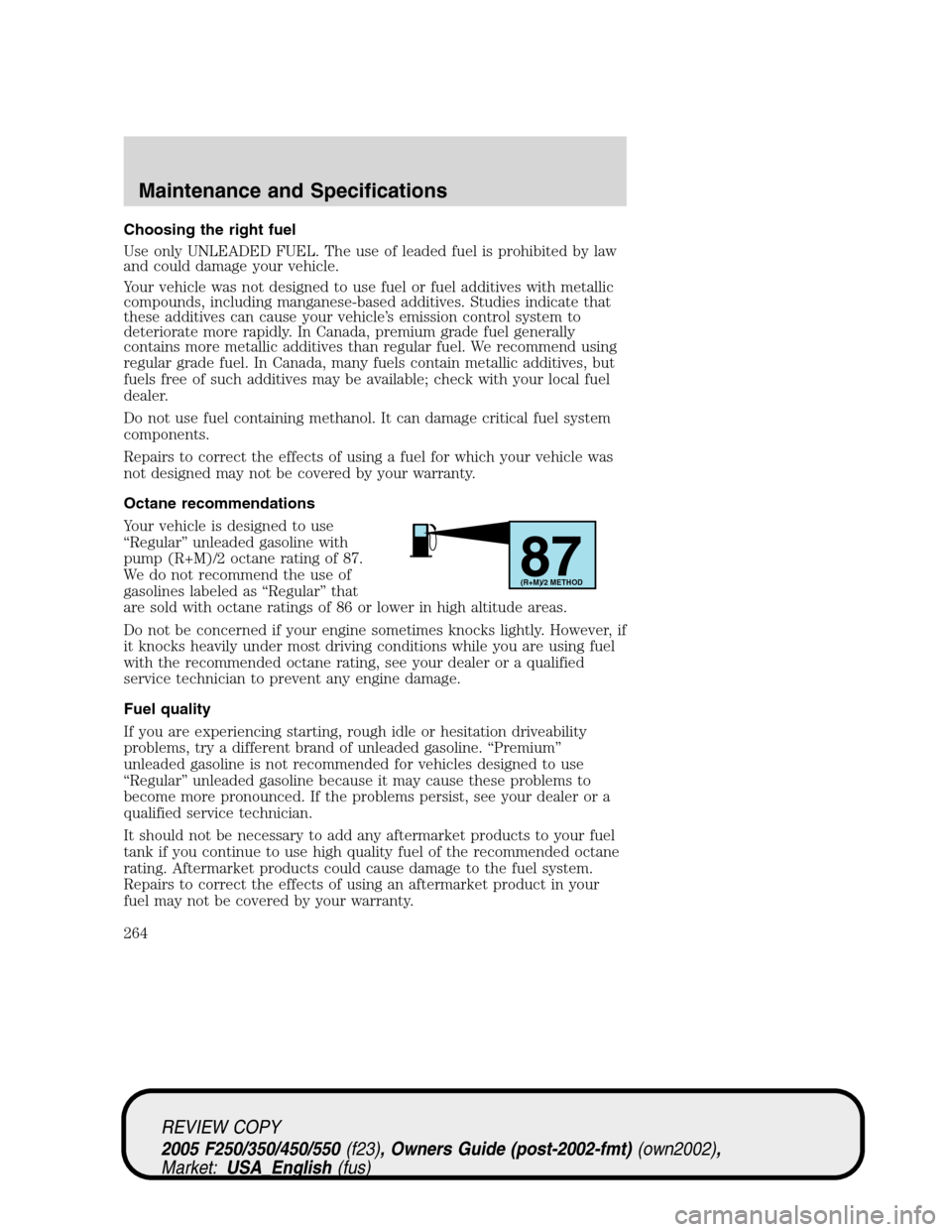
Your vehicle is designed to use
“Regular” unleaded gasoline with
pump (R+M)/2 octane rating of 87.
We do not recommend the use of
gasolines labeled as “Regular” that
are sold with octane ratings of 86 or lower in high altitude areas.
Do not be concerned if your engine sometimes knocks lightly. However, if
it knocks heavily under most driving conditions while you are using fuel
with the recommended octane rating, see your dealer or a qualified
service technician to prevent any engine damage.
Fuel quality
If you are experiencing starting, rough idle or hesitation driveability
problems, try a different brand of unleaded gasoline. “Premium”
unleaded gasoline is not recommended for vehicles designed to use
“Regular” unleaded gasoline because it may cause these problems to
become more pronounced. If the problems persist, see your dealer or a
qualified service technician.
It should not be necessary to add any aftermarket products to your fuel
tank if you continue to use high quality fuel of the recommended octane
rating. Aftermarket products could cause damage to the fuel system.
Repairs to correct the effects of using an aftermarket product in your
fuel may not be covered by your warranty.
87(R+M)/2 METHOD
REVIEW COPY
2005 F250/350/450/550(f23), Owners Guide (post-2002-fmt)(own2002),
Market:USA_English(fus)
Maintenance and Specifications
264
Page 267 of 304
5. Follow one of the simple calculations in order to determine fuel
economy:
Calculation 1:Divide total miles traveled by total gallons used.
Calculation 2:Multiply liters used by 100, then divide by total
kilometers traveled.
Keep a record for at least one month and record the type of driving (city
or highway). This will provide an accurate estimate of the vehicle’s fuel
economy under current driving conditions. Additionally, keeping records
during summer and winter will show how temperature impacts fuel
economy. In general, lower temperatures give lower fuel economy.
Driving style — good driving and fuel economy habits
Give consideration to the lists that follow and you may be able to change
a number of variables and improve your fuel economy.
Habits
•Smooth, moderate operation can yield up to 10% savings in fuel.
•Steady speeds without stopping will usually give the best fuel
economy.
•Idling for long periods of time (greater than one minute) may waste
fuel.
•Anticipate stopping; slowing down may eliminate the need to stop.
•Sudden or hard accelerations may reduce fuel economy.
•Slow down gradually.
•Driving at reasonable speeds (traveling at 55 mph [88 km/h] uses 15%
less fuel than traveling at 65 mph [105 km/h]).
•Revving the engine before turning it off may reduce fuel economy.
•Using the air conditioner or defroster may reduce fuel economy.
•You may want to turn off the speed control in hilly terrain if
unnecessary shifting between third and fourth gear occurs.
Unnecessary shifting of this type could result in reduced fuel
economy.
•Warming up a vehicle on cold mornings is not required and may
reduce fuel economy.
•Resting your foot on the brake pedal while driving may reduce fuel
economy.
•Combine errands and minimize stop-and-go driving.
REVIEW COPY
2005 F250/350/450/550(f23), Owners Guide (post-2002-fmt)(own2002),
Market:USA_English(fus)
Maintenance and Specifications
267
Page 299 of 304

A
Accessory delay ..........................60
Air bag supplemental
restraint system ................108–109
and child safety seats ............110
description ..............................109
disposal ....................................112
driver air bag ..........................111
indicator light .........................112
operation .................................111
passenger air bag ...................111
passenger deactivation
switch ......................................113
Air cleaner filter ...............278, 280
Air conditioning ..........................37
Ambulance packages ....................8
Antifreeze (see
Engine coolant) ........................255
Anti-lock brake system
(see Brakes) ..............................181
Audio system
(see Radio) ................20, 22, 25, 28
Automatic transmission ............184
driving an automatic
overdrive .................................186
fluid, adding ............................273
fluid, checking ........................273
fluid, refill capacities ..............281
fluid, specification ..................287
Auxiliary power point .................58
Axle
lubricant specifications ..283, 287
refill capacities ........................281
traction lok ..............................183
B
Battery .......................................253acid, treating emergencies .....253
jumping a disabled battery ....221
maintenance-free ....................253
replacement, specifications ...280
servicing ..................................253
BeltMinder .................................104
Brakes ........................................181
anti-lock ...................................181
anti-lock brake system
(ABS) warning light ...............181
fluid, checking and adding ....272
fluid, refill capacities ..............281
fluid, specifications .........283, 287
lubricant specifications ..283, 287
parking ....................................182
shift interlock ..........................184
Break-in period .............................5
Bulbs ............................................47
C
Capacities for refilling fluids ....281
Cassette tape player .......20, 22, 25
Cell phone use ............................67
Certification Label ....................294
Child safety restraints ..............118
child safety belts ....................118
Child safety seats ......................120
attaching with tether straps ..124
in front seat ............................122
in rear seat ..............................122
Cleaning your vehicle
engine compartment ..............239
instrument panel ....................241
interior .....................................241
interior trim ............................241
plastic parts ............................240
safety belts ..............................241
washing ....................................238
REVIEW COPY
2005 F250/350/450/550(f23), Owners Guide (post-2002-fmt)(own2002),
Market:USA_English(fus)
Index
Index
299
Page 300 of 304

waxing .....................................238
wheels ......................................239
wiper blades ............................241
Climate control (see Air
conditioning or Heating) ............37
Clutch
fluid ..........................................272
operation while driving ..........188
recommended shift speeds ....189
Compass, electronic
set zone adjustment .................71
Console ........................................67
overhead ....................................57
Controls
steering column ........................66
Coolant
checking and adding ..............255
refill capacities ................259, 281
specifications ..................283, 287
Cruise control (see
Speed control) ............................63
Customer Assistance ................211
Ford accessories for your
vehicle .....................................244
Ford Extended Service
Plan ..........................................235
Getting assistance outside
the U.S. and Canada ..............236
Getting roadside assistance ...211
Getting the service
you need .................................229
Ordering additional
owner’s literature ...................236
The Dispute Settlement
Board .......................................232
Utilizing the Mediation/
Arbitration Program ...............234D
Daytime running lamps
(see Lamps) ................................41
Dipstick
automatic transmission fluid .273
engine oil .................................249
Doors
lubricant specifications ..........283
Driveline universal joint
and slip yoke .............................277
Driving under special
conditions ..................188, 201, 204
sand .........................................203
snow and ice ...........................205
through water .................203, 207
E
Electronic message center ...67, 69
Emergencies, roadside
jump-starting ..........................221
Emergency Flashers .................212
Emission control system ..........269
Engine ........................................287
cleaning ...................................239
coolant .....................................255
diesel ...........................................8
fail-safe coolant ......................260
idle speed control ...................253
lubrication
specifications ..................283, 287
refill capacities ........................281
service points ..................247–248
starting after a collision .........213
Engine block heater .................180
Engine oil ..................................249
checking and adding ..............249
dipstick ....................................249
REVIEW COPY
2005 F250/350/450/550(f23), Owners Guide (post-2002-fmt)(own2002),
Market:USA_English(fus)
Index
300