2005 FORD RANGER 4 wheel drive
[x] Cancel search: 4 wheel drivePage 160 of 256
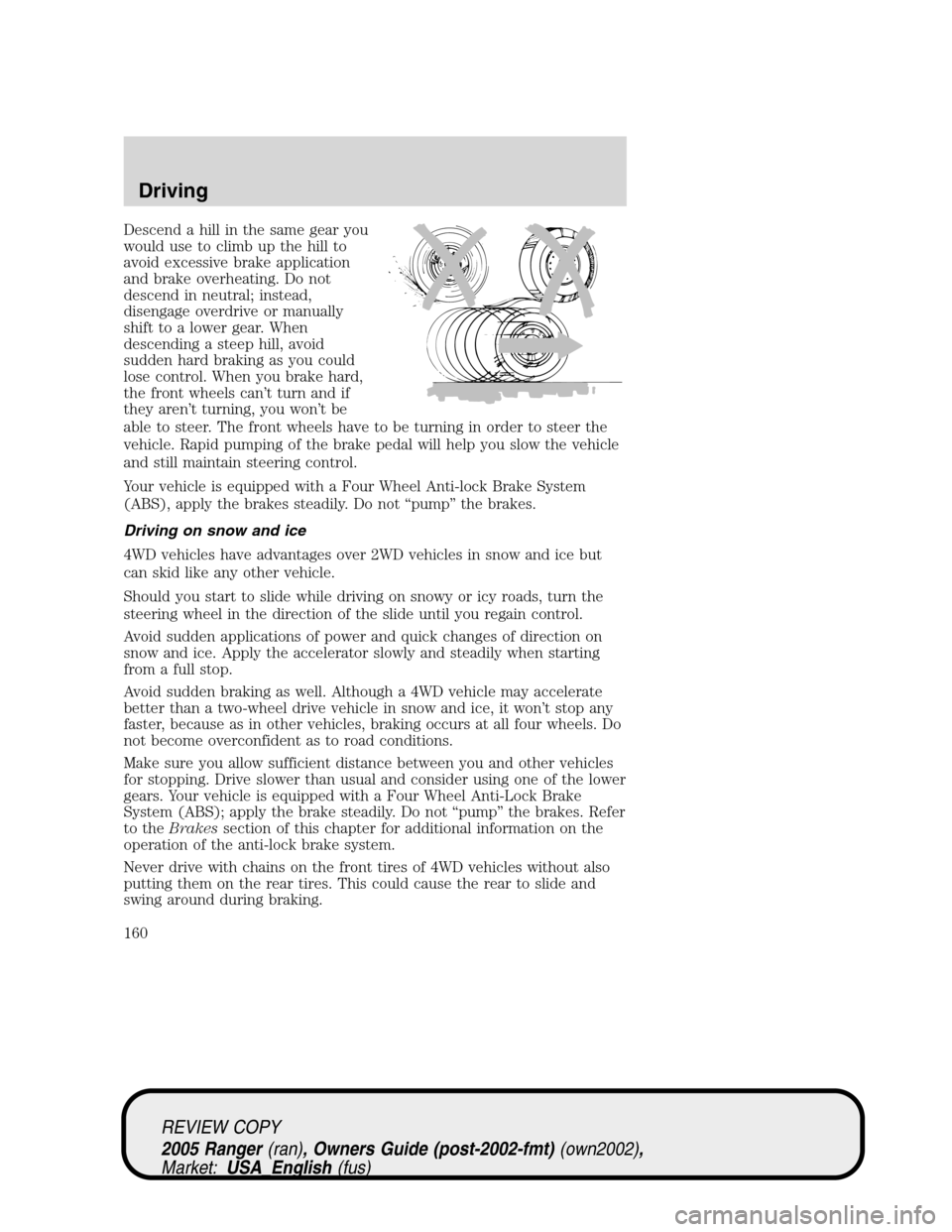
Descend a hill in the same gear you
would use to climb up the hill to
avoid excessive brake application
and brake overheating. Do not
descend in neutral; instead,
disengage overdrive or manually
shift to a lower gear. When
descending a steep hill, avoid
sudden hard braking as you could
lose control. When you brake hard,
the front wheels can’t turn and if
they aren’t turning, you won’tbe
able to steer. The front wheels have to be turning in order to steer the
vehicle. Rapid pumping of the brake pedal will help you slow the vehicle
and still maintain steering control.
Your vehicle is equipped with a Four Wheel Anti-lock Brake System
(ABS), apply the brakes steadily. Do not“pump”the brakes.
Driving on snow and ice
4WD vehicles have advantages over 2WD vehicles in snow and ice but
can skid like any other vehicle.
Should you start to slide while driving on snowy or icy roads, turn the
steering wheel in the direction of the slide until you regain control.
Avoid sudden applications of power and quick changes of direction on
snow and ice. Apply the accelerator slowly and steadily when starting
from a full stop.
Avoid sudden braking as well. Although a 4WD vehicle may accelerate
better than a two-wheel drive vehicle in snow and ice, it won’t stop any
faster, because as in other vehicles, braking occurs at all four wheels. Do
not become overconfident as to road conditions.
Make sure you allow sufficient distance between you and other vehicles
for stopping. Drive slower than usual and consider using one of the lower
gears. Your vehicle is equipped with a Four Wheel Anti-Lock Brake
System (ABS); apply the brake steadily. Do not“pump”the brakes. Refer
to theBrakessection of this chapter for additional information on the
operation of the anti-lock brake system.
Never drive with chains on the front tires of 4WD vehicles without also
putting them on the rear tires. This could cause the rear to slide and
swing around during braking.
REVIEW COPY
2005 Ranger(ran), Owners Guide (post-2002-fmt)(own2002),
Market:USA_English(fus)
Driving
160
Page 161 of 256

Maintenance and Modifications
The suspension and steering systems on your vehicle have been designed
and tested to provide predictable performance whether loaded or empty
and durable load carrying capability. For this reason, Ford Motor
Company strongly recommends that you do not make modifications such
as adding or removing parts (such as lift kits or stabilizer bars) or by
using replacement parts not equivalent to the original factory equipment.
Any modifications to a vehicle that raise the center of gravity can make
it more likely the vehicle will roll over as a result of a loss of control.
Ford Motor Company recommends that caution be used with any vehicle
equipped with a high load or device (such as ladder racks or pickup box
cover).
Failure to maintain your vehicle properly may void the warranty, increase
your repair cost, reduce vehicle performance and operational capabilities
and adversely affect driver and passenger safety. Frequent inspection of
vehicle chassis components is recommended if the vehicle is subjected to
heavy off-road usage.
DRIVING THROUGH WATER
If driving through deep or standing water is unavoidable, proceed very
slowly especially if the depth is not known. Never drive through water
that is higher than the bottom of the hubs (for trucks) or the bottom of
the wheel rims (for cars). Traction or brake capability may be limited
and your vehicle may stall. Water may also enter your engine’s air intake
and severely damage your engine.
Once through the water, always dry the brakes by moving your vehicle
slowly while applying light pressure on the brake pedal. Wet brakes do
not stop the vehicle as quickly as dry brakes.Driving through deep
water where the transmission vent tube or transfer case vent
tube (4x4 vehicles only) are submerged may allow water into the
transmission or transfer case and cause internal
transmission/transfer case damage.
CAMPER BODIES
Your Ranger Pickup is not recommended for slide–in camper bodies.
REVIEW COPY
2005 Ranger(ran), Owners Guide (post-2002-fmt)(own2002),
Market:USA_English(fus)
Driving
161
Page 190 of 256

PAINT CHIPS
Your dealer has touch-up paint and sprays to match your vehicle’s color.
Take your color code (printed on a sticker in the driver’s door jam) to
your dealer to ensure you get the correct color.
•Remove particles such as bird droppings, tree sap, insect deposits, tar
spots, road salt and industrial fallout before repairing paint chips.
•Always read the instructions before using the products.
ALUMINUM WHEELS AND WHEEL COVERS
Aluminum wheels and wheel covers are coated with a clearcoat paint
finish. In order to maintain their shine:
•Clean weekly with Motorcraft Wheel and Tire Cleaner (ZC-37–A),
which is available from your dealer. Heavy dirt and brake dust
accumulation may require agitation with a sponge. Rinse thoroughly
with a strong stream of water.
•Never apply any cleaning chemical to hot or warm wheel rims or
covers.
•Some automatic car washes may cause damage to the finish on your
wheel rims or covers. Chemical-strength cleaners, or cleaning
chemicals, in combination with brush agitation to remove brake dust
and dirt, could wear away the clearcoat finish over time.
•Do not use hydrofluoric acid-based or high caustic-based wheel
cleaners, steel wool, fuels or strong household detergent.
•To remove tar and grease, use Motorcraft Bug and Tar Remover
(ZC-42), available from your dealer.
ENGINE
Engines are more efficient when they are clean because grease and dirt
buildup keep the engine warmer than normal. When washing:
•Take care when using a power washer to clean the engine. The
high-pressure fluid could penetrate the sealed parts and cause
damage.
•Do not spray a hot engine with cold water to avoid cracking the
engine block or other engine components.
•Spray Motorcraft Engine Shampoo and Degreaser (ZC-20) on all parts
that require cleaning and pressure rinse clean.
•Cover the highlighted areas to prevent water damage when cleaning
the engine.
REVIEW COPY
2005 Ranger(ran), Owners Guide (post-2002-fmt)(own2002),
Market:USA_English(fus)
Cleaning
190
Page 193 of 256

•Avoid cleaners or polish that increase the gloss of the upper portion of
the instrument panel. The dull finish in this area helps protect the
driver from undesirable windshield reflection.
Do not use chemical solvents or strong detergents when cleaning
the steering wheel or instrument panel to avoid contamination of
the air bag system.
•
Be certain to wash or wipe your hands clean if you have been in
contact with certain products such as insect repellent and suntan lotion
in order to avoid possible damage to the interior painted surfaces.
INTERIOR
For fabric, carpets, cloth seats and safety belts:
•Remove dust and loose dirt with a vacuum cleaner.
•Remove light stains and soil with Motorcraft Extra Strength
Upholstery Cleaner (ZC-41).
•If grease or tar is present on the material, spot-clean the area first
with Motorcraft Spot and Stain Remover (ZC-14).
•Never saturate the seat covers with cleaning solution.
•Do not use household cleaning products or glass cleaners, which can
stain and discolor the fabric and affect the flame retardant abilities of
the seat materials.
Do not use cleaning solvents, bleach or dye on the vehicle’s
seatbelts, as these actions may weaken the belt webbing.
LEATHER SEATS (IF EQUIPPED)
Your leather seating surfaces have a clear, protective coating over the
leather.
•To clean, use a soft cloth with Motorcraft Deluxe Leather and Vinyl
Cleaner (ZC-11–A). Dry the area with a soft cloth.
•To help maintain its resiliency and color, use the Motorcraft Deluxe
Leather Care Kit (ZC-11–D), available from your authorized dealer.
•Do not use household cleaning products, alcohol solutions, solvents or
cleaners intended for rubber, vinyl and plastics, or oil/petroleum-based
leather conditioners. These products may cause premature wearing of
the clear, protective coating.
REVIEW COPY
2005 Ranger(ran), Owners Guide (post-2002-fmt)(own2002),
Market:USA_English(fus)
Cleaning
193
Page 223 of 256

•Perform all regularly scheduled maintenance items. Follow the
recommended maintenance schedule and owner maintenance checks
found in your vehicle scheduled maintenance guide.
Conditions
•Heavily loading a vehicle or towing a trailer may reduce fuel economy
at any speed.
•Carrying unnecessary weight may reduce fuel economy (approximately
1 mpg [0.4 km/L] is lost for every 400 lb [180 kg] of weight carried).
•Adding certain accessories to your vehicle (for example bug
deflectors, rollbars/light bars, running boards, ski/luggage racks) may
reduce fuel economy.
•Using fuel blended with alcohol may lower fuel economy.
•Fuel economy may decrease with lower temperatures during the first
8–10 miles (12–16 km) of driving.
•Driving on flat terrain offers improved fuel economy as compared to
driving on hilly terrain.
•Transmissions give their best fuel economy when operated in the top
cruise gear and with steady pressure on the gas pedal.
•Four-wheel-drive operation (if equipped) is less fuel efficient than
two-wheel-drive operation.
•Close windows for high speed driving.
EPA window sticker
Every new vehicle should have the EPA window sticker. Contact your
dealer if the window sticker is not supplied with your vehicle. The EPA
window sticker should be your guide for the fuel economy comparisons
with other vehicles.
It is important to note the box in the lower left corner of the window
sticker. These numbers represent the Range of MPG (L/100 km)
expected on the vehicle under optimum conditions. Your fuel economy
may vary depending upon the method of operation and conditions.
EMISSION CONTROL SYSTEM
Your vehicle is equipped with various emission control components and a
catalytic converter which will enable your vehicle to comply with
applicable exhaust emission standards. To make sure that the catalytic
converter and other emission control components continue to work
properly:
REVIEW COPY
2005 Ranger(ran), Owners Guide (post-2002-fmt)(own2002),
Market:USA_English(fus)
Maintenance and Specifications
223
Page 247 of 256

A
Air bag supplemental restraint
system ..........................................72
and child safety seats ..............74
description ................................72
disposal ......................................77
driver air bag ............................75
indicator light ...........................76
operation ...................................75
passenger air bag .....................75
passenger deactivation
switch ........................................77
Air cleaner filter ...............232–233
Ambulance packages ....................7
Antifreeze
(see Engine coolant) ................209
Anti-lock brake system
(see Brakes) ......................144–145
Audio system
(see Radio) ..........16, 18, 21, 25, 28
Automatic transmission ............147
driving an automatic
overdrive .................................148
fluid, refill capacities ..............234
fluid, specification ..................240
Auxiliary power point .................48
Axle
lubricant specifications ..237, 240
refill capacities ........................234
traction lok ..............................146
B
Battery .......................................207
acid, treating emergencies .....207
jumping a disabled battery ....174
maintenance-free ....................207
replacement, specifications ...233
servicing ..................................207Bed extender ..............................53
BeltMinder ...................................68
Brakes ........................................144
anti-lock ...........................144–145
anti-lock brake system (ABS)
warning light ...........................145
fluid, checking and adding ....227
fluid, refill capacities ..............234
fluid, specifications .........237, 240
lubricant specifications ..237, 240
parking ....................................145
shift interlock ..........................147
Bulbs ............................................41
C
Capacities for refilling fluids ....234
Cargo area shade ........................53
Cargo net .....................................53
Cell phone use ............................52
Certification Label ....................242
Changing a tire .........................102
Child safety restraints ................82
child safety belts ......................82
Child safety seats ........................85
attaching with tether straps ....88
in front seat ..............................86
in rear seat ................................86
Cleaning your vehicle
engine compartment ..............190
instrument panel ....................192
interior .....................................193
plastic parts ............................192
safety belts ..............................193
washing ....................................189
waxing .....................................189
wheels ......................................190
wiper blades ............................192
REVIEW COPY
2005 Ranger(ran), Owners Guide (post-2002-fmt)(own2002),
Market:USA_English(fus)
Index
Index
247
Page 249 of 256

Fluid capacities .........................234
Foglamps .....................................37
Four-Wheel Drive vehicles .......153
driving off road .......................155
electronic shift ........................154
indicator light .........................153
preparing to drive your
vehicle .....................................147
Fuel ............................................216
calculating fuel economy .......220
cap ...........................................218
capacity ...................................234
choosing the right fuel ...........218
comparisons with EPA fuel
economy estimates .................223
detergent in fuel .....................220
filling your vehicle with
fuel ...........................216, 218, 220
filter, specifications ........220, 233
fuel pump shut-off switch .....163
improving fuel economy ........220
octane rating ...................219, 240
quality ......................................219
running out of fuel .................220
safety information relating to
automotive fuels .....................216
Fuel pump shut-off switch .......163
Fuses ..................................164–165
G
Gas cap (see Fuel cap) ............218
Gas mileage
(see Fuel economy) .................220
Gauges .........................................14
H
Hazard flashers .........................163
Headlamps ...................................37aiming ........................................38
bulb specifications
....................41
daytime running lights
.............37
flash to pass
..............................38
high beam
.................................38
replacing bulbs
.........................42
turning on and off
....................37
Heating
heating and air
conditioning system
...........34–35
Hood
..........................................196
I
Ignition
...............................140, 240
Infant seats
(see Safety seats)
.......................85
Inspection/maintenance (I/M)
testing
........................................225
Instrument panel
cleaning
...................................192
cluster
........................................10
lighting up panel and
interior
.......................................38
J
Jack
............................................102
positioning
.......................102, 106
storage
.............................102, 104
Jump-starting your vehicle
......174
K
Keys
positions of the ignition
.........140
REVIEW COPY
2005 Ranger(ran), Owners Guide (post-2002-fmt)(own2002),
Market:USA_English(fus)
Index
249