Page 152 of 256

Upshifts when accelerating (for best fuel economy)
Maximum downshift speeds
Shift from:Transfer case position (if equipped)
2H or 4H 4L
5 (Overdrive) - 4 55 mph (88 km/h) 22 mph (34 km/h)
4 - 3 45 mph (72 km/h) 18 mph (27 km/h)
3 - 2 35 mph (56 km/h) 14 mph (21 km/h)
2 - 1 20 mph (32 km/h) 8 mph (11 km/h)
Reverse
1. Make sure that your vehicle is at a complete stop before you shift into
R (Reverse). Failure to do so may damage the transmission.
2. Move the gearshift lever into the neutral position and wait at least
three seconds before shifting into R (Reverse).
•The gearshift lever can only be moved into R (Reverse) by moving it
from left of 3 (Third) and 4 (Fourth) before shifting into R (Reverse).
This is a lockout feature that protects the transmission from
accidentally being shifted into R (Reverse) from 5 (Overdrive).
Parking your vehicle
1. Apply the brake and shift into the neutral position.
2. Fully apply the parking brake, then shift into 1 (First).
3. Turn the ignition off.
Do not park your vehicle in Neutral, it may move unexpectedly
and injure someone. Use 1 (First) gear and set the parking brake
fully.
REVIEW COPY
2005 Ranger(ran), Owners Guide (post-2002-fmt)(own2002),
Market:USA_English(fus)
Driving
152
Page 162 of 256

GETTING ROADSIDE ASSISTANCE
To fully assist you should you have a vehicle concern, Ford Motor
Company offers a complimentary roadside assistance program. This
program is separate from the New Vehicle Limited Warranty. The service
is available:
•24–hours, seven days a week
•for the New Vehicle Limited Warranty period of three years or 36,000
miles (60,000 km), whichever occurs first on Ford and Mercury
vehicles, and four years or 50,000 miles (80,000 km) on Lincoln
vehicles.
Roadside assistance will cover:
•a flat tire change with a good spare (except Ford GT which has a tire
inflation kit)
•battery jump start
•lock-out assistance (key replacement cost is the customer’s
responsibility)
•fuel delivery (2.0 gallons [7.5L], maximum two occurrences within 12
month period)
•towing of your disabled vehicle to the nearest Ford Motor Company
dealership, or your selling dealer if within 35 miles (56.3 km) of the
nearest Ford Motor Company dealership (one tow per disablement).
Even non-warranty related tows, like accidents, are covered (some
exclusions apply, such as impound towing or repossession).
Canadian customers refer to your Owner Information Guide for
information on:
•coverage period
•exact fuel amounts
•towing of your disabled vehicle
•emergency travel expense reimbursement
•travel planning benefits
USING ROADSIDE ASSISTANCE
Complete the roadside assistance identification card and place it in your
wallet for quick reference. In the United States, this card is found in the
Owner Guide portfolio in the glove compartment. In Canada, the card is
found in theOwner Information Guidein the glove compartment.
U.S. Ford or Mercury vehicle customers who require roadside assistance,
call 1–800–241–3673; Lincoln vehicle customers call 1–800–521–4140.
REVIEW COPY
2005 Ranger(ran), Owners Guide (post-2002-fmt)(own2002),
Market:USA_English(fus)
Roadside Emergencies
Roadside Emergencies
162
Page 163 of 256
Canadian customers who require roadside assistance, call
1–800–665–2006.
If you need to arrange roadside assistance for yourself, Ford Motor
Company will reimburse a reasonable amount. To obtain reimbursement
information, U.S. Ford or Mercury vehicles customers call
1-800-241-3673; Lincoln vehicle customers call 1–800–521–4140.
Canadian customers who need to obtain reimbursement information, call
1–800–665–2006.
ROADSIDE COVERAGE BEYOND BASIC WARRANTY
In the United States, you may purchase additional roadside assistance
coverage beyond this period through the Ford Auto Club by contacting
your Ford or Lincoln Mercury dealer.
Similarly in Canada, for uninterrupted Roadside Assistance coverage, you
may purchase extended coverage prior to your Basic Warranty’s Roadside
Assistance expiring. For more information and enrollment, contact
1–877–294–2582 or visit our website at www.ford.ca.
HAZARD FLASHER
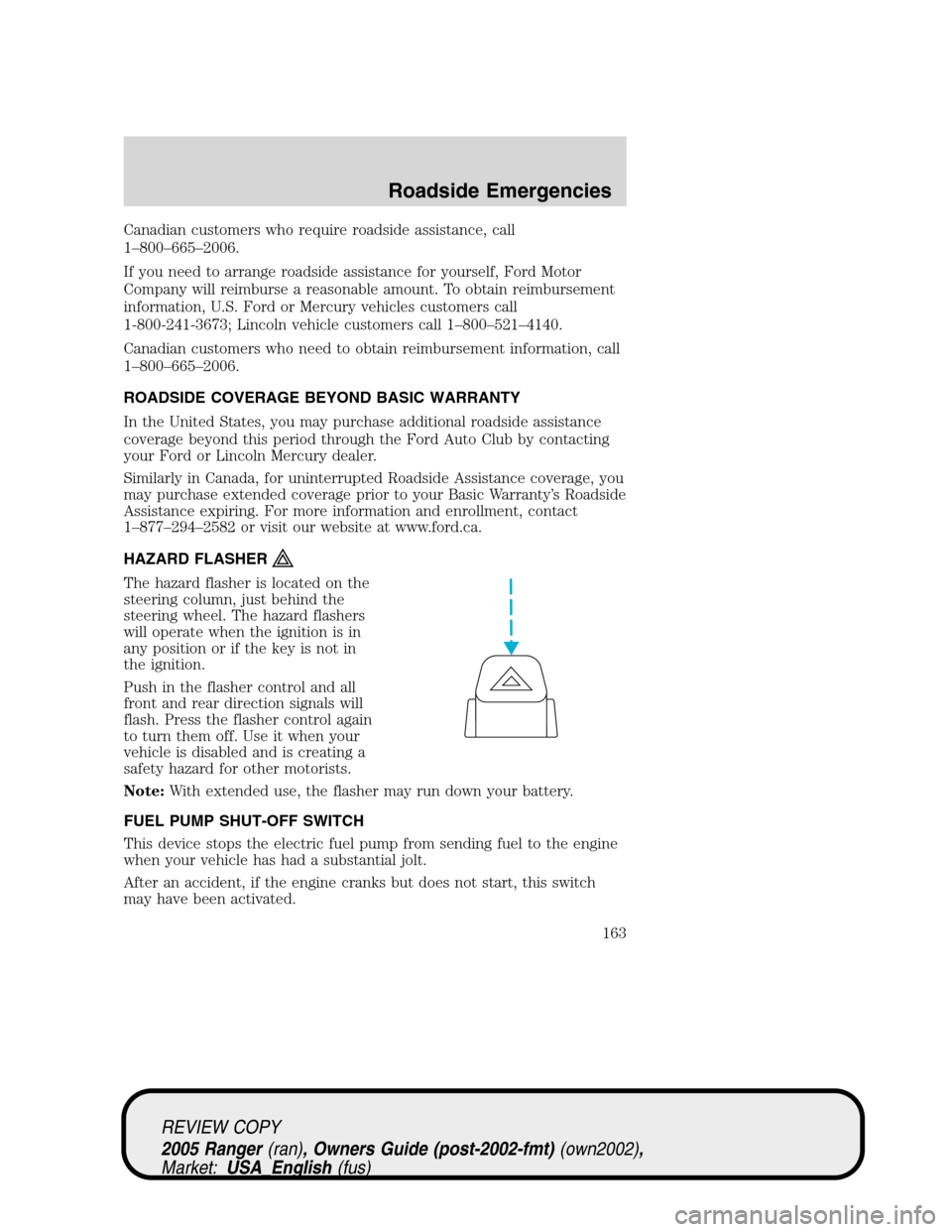
The hazard flasher is located on the
steering column, just behind the
steering wheel. The hazard flashers
will operate when the ignition is in
any position or if the key is not in
the ignition.
Push in the flasher control and all
front and rear direction signals will
flash. Press the flasher control again
to turn them off. Use it when your
vehicle is disabled and is creating a
safety hazard for other motorists.
Note:With extended use, the flasher may run down your battery.
FUEL PUMP SHUT-OFF SWITCH
This device stops the electric fuel pump from sending fuel to the engine
when your vehicle has had a substantial jolt.
After an accident, if the engine cranks but does not start, this switch
may have been activated.
REVIEW COPY
2005 Ranger(ran), Owners Guide (post-2002-fmt)(own2002),
Market:USA_English(fus)
Roadside Emergencies
163
Page 164 of 256
This switch is located under the
right-hand side of the glove box,
just above the carpet.
To reset the switch:
1. Turn the ignition OFF.
2. Check the fuel system for leaks.
3. If no leaks are apparent, reset the
switch by pushing in on the reset
button.
4. Turn the ignition ON.
5. Wait a few seconds and return
the key to OFF.
6. Make another check for leaks.
FUSES AND RELAYS
Fuses
If electrical components in the
vehicle are not working, a fuse may
have blown. Blown fuses are
identified by a broken wire within
the fuse. Check the appropriate
fuses before replacing any electrical
components.
Note:Always replace a fuse with one that has the specified amperage
rating. Using a fuse with a higher amperage rating can cause severe wire
damage and could start a fire.
15
REVIEW COPY
2005 Ranger(ran), Owners Guide (post-2002-fmt)(own2002),
Market:USA_English(fus)
Roadside Emergencies
164
Page 170 of 256
Fuse/Relay
LocationFuse Amp
RatingPower Distribution Box Description
14—Not used
15—Not used
16—Not used
17 40A** ABS (motor)
18—Not used
19 20A** Engine fan
20—Not used
21 10A* PCM
22—Not used
23 20A* Fuel pump
24—Not used
25 10A* A/C clutch solenoid
26—Not used
27—Not used
28—Not used
29—Not used
30—Not used
31—Not used
32—Not used
33 30A* Anti-lock Brake System (ABS) (solenoids)
34—Not used
35—Not used
36—Not used
37—Not used
38 7.5A* Trailer tow (right turn)
39—Not used
40—Not used
41 15A* Heated Exhaust Gas Oxygen (HEGO)
sensors, EVAP canister vent valve,
Exhaust Gas Recirculation (EGR) stepper
motor, Transmission
REVIEW COPY
2005 Ranger(ran), Owners Guide (post-2002-fmt)(own2002),
Market:USA_English(fus)
Roadside Emergencies
170
Page 171 of 256
Fuse/Relay
LocationFuse Amp
RatingPower Distribution Box Description
42 7.5A* Trailer tow (left turn)
43—Not used
44—Not used
45A—Wiper HI/LO relay
45B—Wiper Park/Run relay
46A—Fuel pump relay
46B—Washer pump relay
47—Engine fan relay
48—Starter relay
49—Not used
50—Not used
51—Not used
52—Not used
53—Not used
54—PCM relay
55—Blower relay
56A—A/C clutch solenoid relay
56B—Not used
* Mini Fuses ** Maxi Fuses
REVIEW COPY
2005 Ranger(ran), Owners Guide (post-2002-fmt)(own2002),
Market:USA_English(fus)
Roadside Emergencies
171
Page 173 of 256
Fuse/Relay
LocationFuse Amp
RatingPower Distribution Box Description
15—Not used
16—Not used
17 40A** ABS (motor)
18—Not used
19—Not used
20—Not used
21 10A* PCM
22—Not used
23 20A* Fuel pump
24—Not used
25 10A* A/C clutch solenoid
26—Not used
27 20A* 4x4 module
28—Not used
29—Not used
30—Not used
31 15A* Foglamps
32—Not used
33 30A* Anti-lock Brake System (ABS) (solenoids)
34—Not used
35—Not used
36—Not used
37—Not used
38 7.5A* Trailer tow (right turn)
39—Not used
40—Not used
41 15A* Heated Exhaust Gas Oxygen (HEGO)
sensors, EVAP canister vent valve,
Exhaust Gas Recirculation (EGR) stepper
motor, Transmission
42 7.5A* Trailer tow (left turn)
REVIEW COPY
2005 Ranger(ran), Owners Guide (post-2002-fmt)(own2002),
Market:USA_English(fus)
Roadside Emergencies
173
Page 174 of 256

Fuse/Relay
LocationFuse Amp
RatingPower Distribution Box Description
43—Not used
44—Not used
45A—Wiper HI/LO relay
45B—Wiper Park/Run relay
46A—A/C clutch solenoid
46B—Washer pump relay
47—PCM relay
48A—Fuel pump relay
48B—Fog lamp relay
51—Not used
52—Not used
53—Not used
54—Not used
55—Blower relay
56—Starter relay
* Mini Fuses ** Maxi Fuses
JUMP STARTING YOUR VEHICLE
The gases around the battery can explode if exposed to flames,
sparks, or lit cigarettes. An explosion could result in injury or
vehicle damage.
Batteries contain sulfuric acid which can burn skin, eyes and
clothing, if contacted.
Do not attempt to push-start your vehicle. Automatic
transmissions do not have push-start capability; doing so may
damage the catalytic converter.
Preparing your vehicle
When the battery is disconnected or a new battery is installed, the
transmission must relearn its shift strategy. As a result, the transmission
may have firm and/or soft shifts. This operation is considered normal and
will not affect function or durability of the transmission. Over time, the
adaptive learning process will fully update transmission operation.
REVIEW COPY
2005 Ranger(ran), Owners Guide (post-2002-fmt)(own2002),
Market:USA_English(fus)
Roadside Emergencies
174


