2005 FORD GT wheel
[x] Cancel search: wheelPage 70 of 200
higher than the manufacturer’s recommended cold inflation pressure
which can be found on either the tire label or certification label which is
located on the B-Pillar or the edge of the driver ’s door. The cold inflation
pressure should never be set lower than the recommended pressure on
the tire label or certification label.
When weather temperature changes occur, tire inflation pressures also
change. A 10 °F(6 °C) temperature drop can cause a corresponding
drop of 1 psi (7 kPa) in inflation pressure. Check your tire pressures
frequently and adjust them to the proper pressure which can be found
on the tire label or certification label.
If you are checking tire pressure when the tire is hot, (i.e. driven more
than 1 mile [1.6 km]), never “bleed ”or reduce air pressure. The tires are
hot from driving and it is normal for pressures to increase above
recommended cold pressures. A hot tire at or below recommended cold
inflation pressure could be significantly under-inflated.
To check the pressure in your tire(s):
1. Make sure the tires are cool, meaning they are not hot from driving
even a mile.
Note: If you have to drive a distance to get air for your tire(s), check
and record the tire pressure first and add the appropriate air pressure
when you get to the pump. It is normal for tires to heat up and the air
pressure inside to go up as you drive. Never “bleed ”or reduce air
pressure when tires are hot.
2. Remove the cap from the valve on one tire, then firmly press the tire
gauge onto the valve and measure the pressure with the tire gauge.
3. Add enough air to reach the recommended air pressure
Note: If you overfill the tire, release air by pushing on the metal stem in
the center of the valve. Then recheck the pressure with your tire gauge.
4. Replace the valve cap.
5. Repeat this procedure for each tire, including the spare.
Note: Some spare tires require higher inflation pressure than the other
tires. Check the tire label on the B pillar or the edge of the driver ’s door
for the recommended spare tire pressure.
6. Visually inspect the tires to make sure there are no nails or other
objects embedded that could poke a hole in the tire and cause an air
leak.
7. Check the sidewalls to make sure there are no gouges, cuts or bulges.
2005 GT(gto)
Owners Guide (post-2002-fmt)
USA_English (fus)
Tires, Wheels and Loading
70
Page 71 of 200
TIRE REPLACEMENT REQUIREMENTS
Your vehicle is equipped with tires designed to provide a safe ride and
handling capability.
Only use replacement tires and wheels that are the same size
and type (such as P-metric versus LT-metric or all-season versus
all-terrain) as those originally provided by Ford. Use of any tire or
wheel not recommended by Ford can affect the safety and
performance of your vehicle, which could result in an increased risk of
loss of vehicle control, vehicle rollover, personal injury and death.
Additionally the use of non-recommended tires and wheels could cause
steering, suspension, axle or transfer case/power transfer unit failure. If
you have questions regarding tire replacement, see an authorized Ford
or Lincoln/Mercury dealer.
Make sure all tires and wheels on the vehicle are of the same size, type,
tread design, brand, load-carrying capacity and speed rating because it
can affect the safety and performance of your vehicle, which could result
in an increased risk of loss of vehicle control, vehicle rollover, personal
injury and death.
CHANGING A FLAT TIRE
If you get a flat tire while driving:
• do not brake heavily.
• gradually decrease the vehicle ’s speed.
• hold the steering wheel firmly.
• slowly move to a safe place on the side of the road.
Note: This vehicle is not equipped with a spare tire, but does include an
emergency tire inflation kit that can be used to repair one flat tire. Read
the entire Tire inflation kit section that follows before attempting to
repair a flat tire.
2005 GT(gto)
Owners Guide (post-2002-fmt)
USA_English (fus)
Tires, Wheels and Loading
71
Page 72 of 200
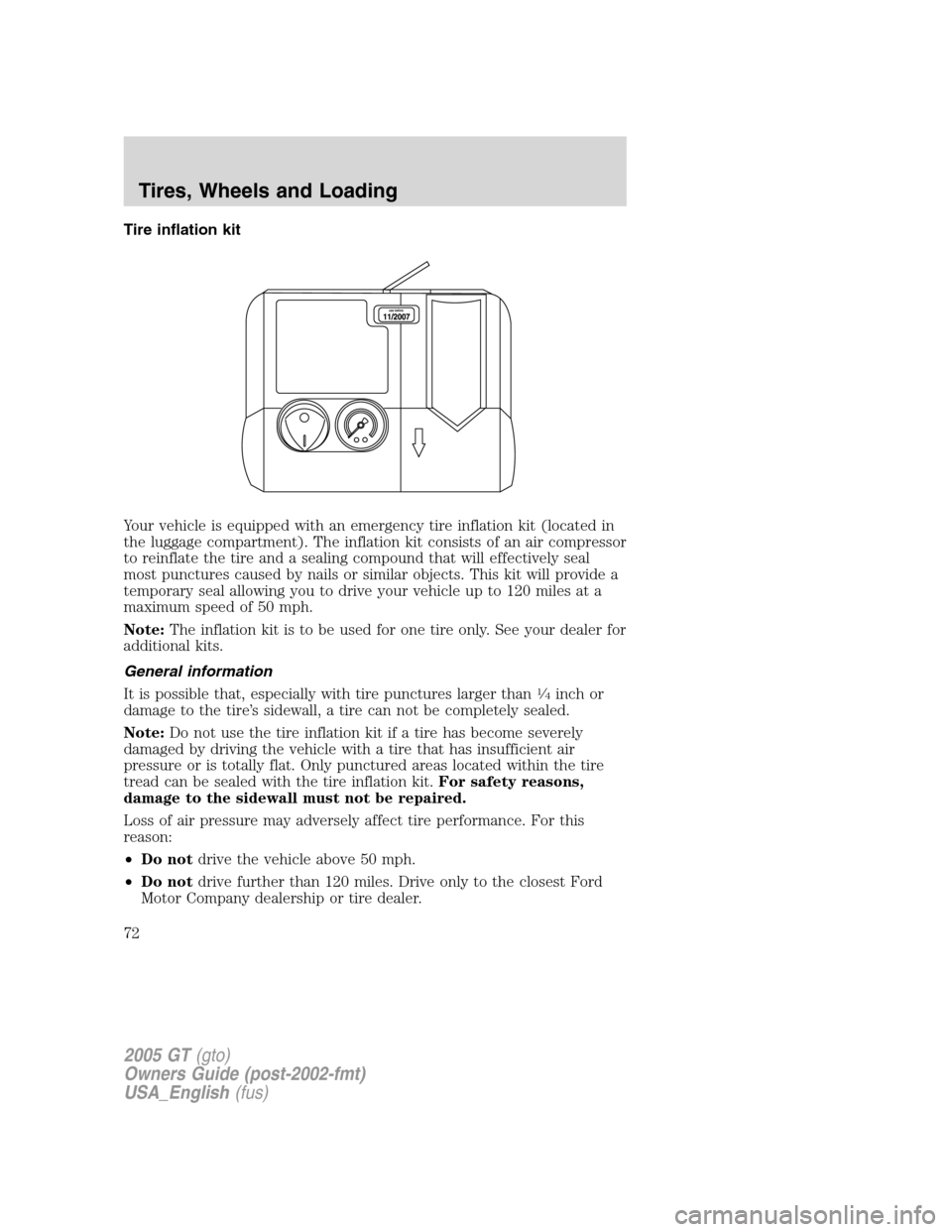
Tire inflation kit
Your vehicle is equipped with an emergency tire inflation kit (located in
the luggage compartment). The inflation kit consists of an air compressor
to reinflate the tire and a sealing compound that will effectively seal
most punctures caused by nails or similar objects. This kit will provide a
temporary seal allowing you to drive your vehicle up to 120 miles at a
maximum speed of 50 mph.
Note:The inflation kit is to be used for one tire only. See your dealer for
additional kits.
General information
It is possible that, especially with tire punctures larger than
1⁄4inch or
damage to the tire’s sidewall, a tire can not be completely sealed.
Note: Do not use the tire inflation kit if a tire has become severely
damaged by driving the vehicle with a tire that has insufficient air
pressure or is totally flat. Only punctured areas located within the tire
tread can be sealed with the tire inflation kit. For safety reasons,
damage to the sidewall must not be repaired.
Loss of air pressure may adversely affect tire performance. For this
reason:
• Do not drive the vehicle above 50 mph.
• Do not drive further than 120 miles. Drive only to the closest Ford
Motor Company dealership or tire dealer.
2005 GT(gto)
Owners Guide (post-2002-fmt)
USA_English (fus)
Tires, Wheels and Loading
72
Page 73 of 200
•Drive carefully and avoid abrupt steering maneuvers.
• Periodically monitor tire inflation pressure in the affected tire; if the
tire is losing pressure, have the vehicle towed.
• Read the information in the Tips for use of the tire inflation kit
section to ensure safe operation of the tire inflation kit and your
vehicle.
Tips for use of the tire inflation kit
Read the following list of tips to ensure safe operation of the tire
inflation kit:
• Before operating the inflation kit, make sure your vehicle is safely off
the road and away from moving traffic.
• Always set the parking brake to ensure the vehicle doesn ’t move
unexpectedly.
• Do not remove any foreign objects, such as nails or screws, from the
tire.
• When using the inflation kit, leave the engine running (only if the
vehicle is outdoors or in a well-ventilated area) so the
compressor doesn ’t drain the vehicle ’s battery.
• Do not allow the compressor to operate continuously for more than 10
minutes; this will help prevent the compressor from overheating.
• Never leave the inflation kit unattended when it is operating.
• Keep the inflation kit away from children.
• Only use the inflation kit when the ambient temperature is above
–20 °F.
• Only use the inflation kit for sealing/inflating the tires on your vehicle.
Do not use the kit for inflating tires on motorcycles, bicycles or any
other type of tire.
• Only use the sealing compound before the expiration date. The
expiration date is labeled on the unit.
• Do not store the inflation kit inside the passenger compartment of the
vehicle as it may cause injury during a sudden stop or collision. Store
the kit in its proper location.
2005 GT(gto)
Owners Guide (post-2002-fmt)
USA_English (fus)
Tires, Wheels and Loading
73
Page 74 of 200
What to do when a tire is punctured
A tire puncture within the tire’s tread area can be repaired in two stages
with the tire inflation kit:
• In the first stage, the tire will be reinflated with a sealing compound
and air. After the tire has been reinflated, you will need to drive the
vehicle a short distance (approximately two miles) to activate the
sealing compound inside the tire.
• In the second stage, you will need to check the tire pressure and, if
necessary, adjust tire inflation to its proper pressure.
First stage: Reinflating the tire with sealing compound and air
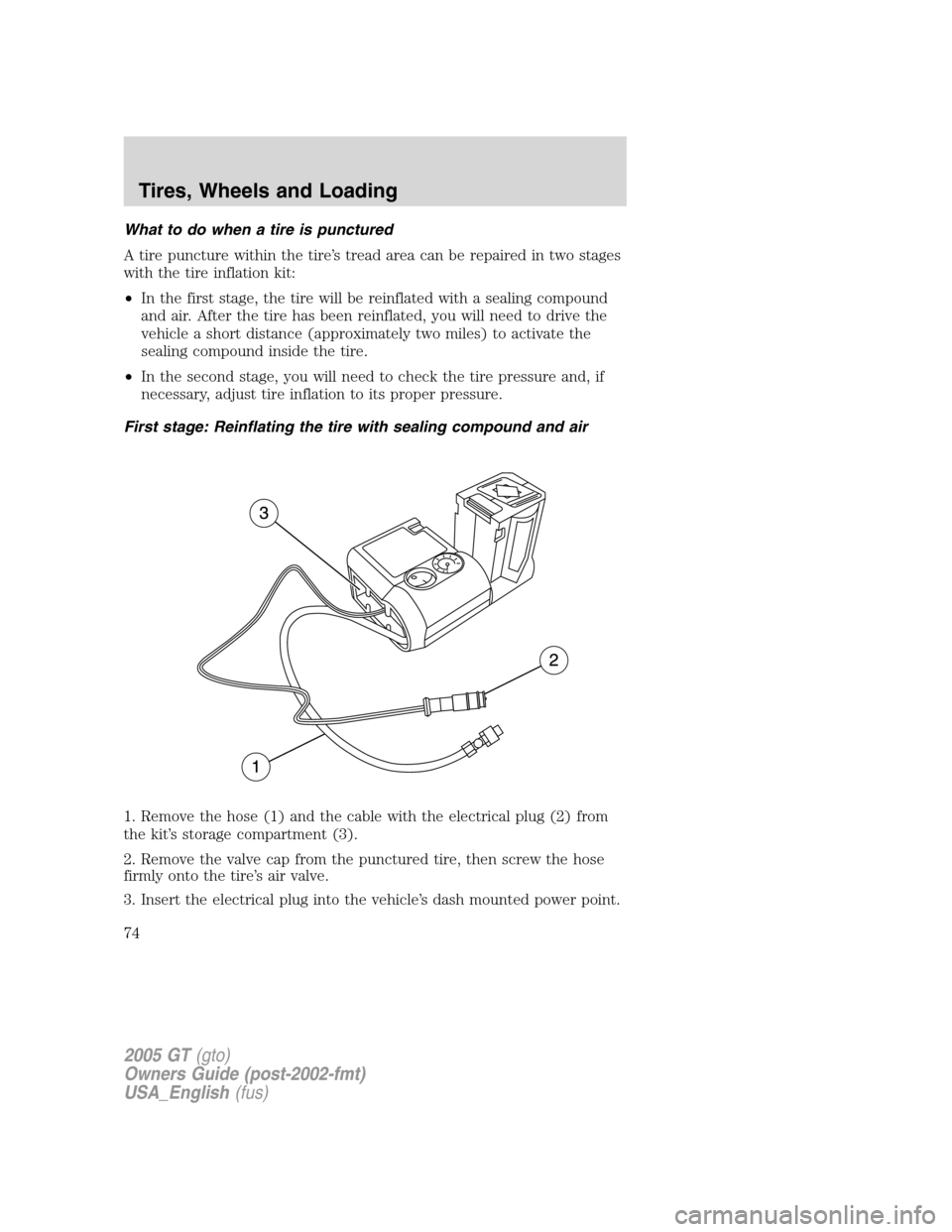
1. Remove the hose (1) and the cable with the electrical plug (2) from
the kit ’s storage compartment (3).
2. Remove the valve cap from the punctured tire, then screw the hose
firmly onto the tire ’s air valve.
3. Insert the electrical plug into the vehicle ’s dash mounted power point.
2005 GT(gto)
Owners Guide (post-2002-fmt)
USA_English (fus)
Tires, Wheels and Loading
74
Page 75 of 200
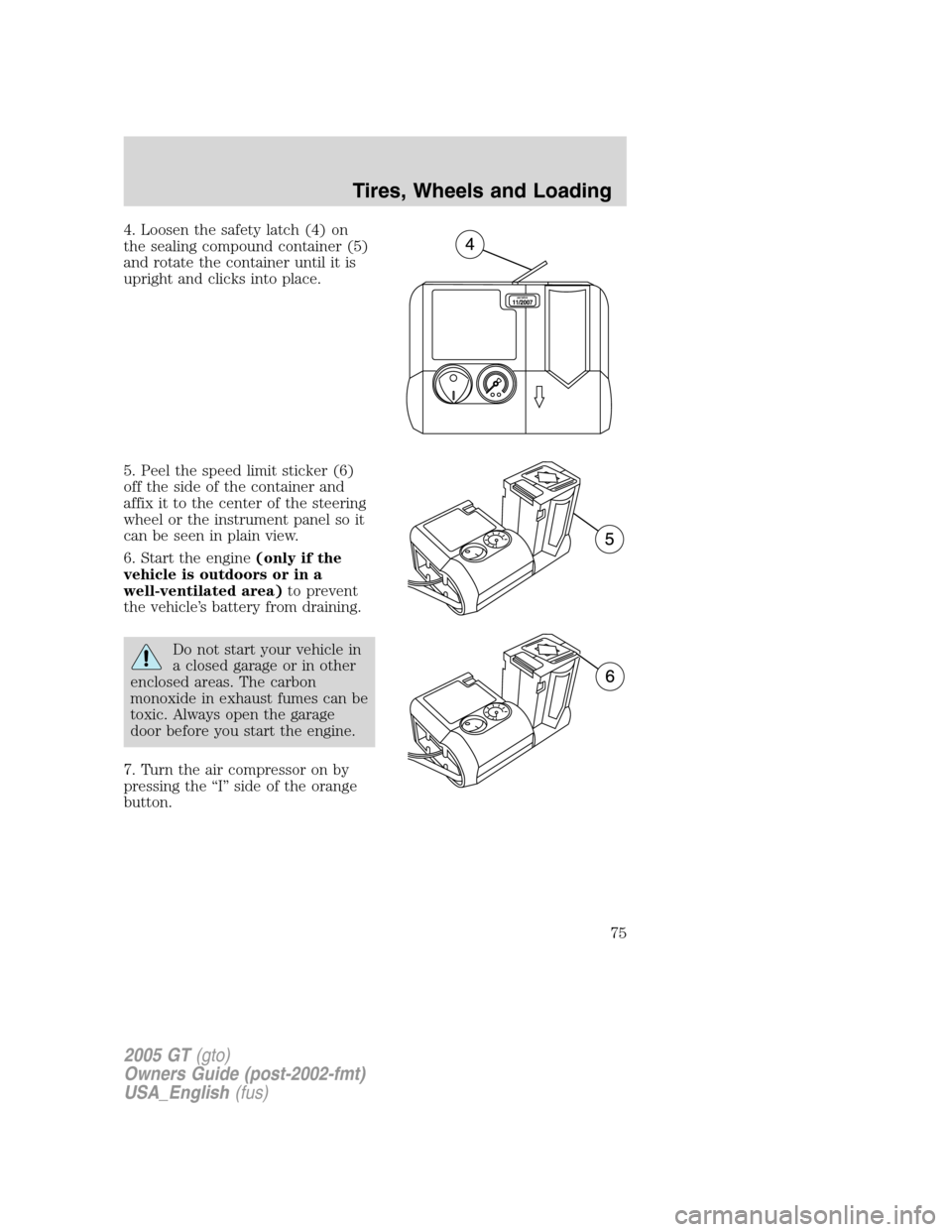
4. Loosen the safety latch (4) on
the sealing compound container (5)
and rotate the container until it is
upright and clicks into place.
5. Peel the speed limit sticker (6)
off the side of the container and
affix it to the center of the steering
wheel or the instrument panel so it
can be seen in plain view.
6. Start the engine(only if the
vehicle is outdoors or in a
well-ventilated area) to prevent
the vehicle ’s battery from draining.
Do not start your vehicle in
a closed garage or in other
enclosed areas. The carbon
monoxide in exhaust fumes can be
toxic. Always open the garage
door before you start the engine.
7. Turn the air compressor on by
pressing the “I” side of the orange
button.
2005 GT(gto)
Owners Guide (post-2002-fmt)
USA_English (fus)
Tires, Wheels and Loading
75
Page 76 of 200
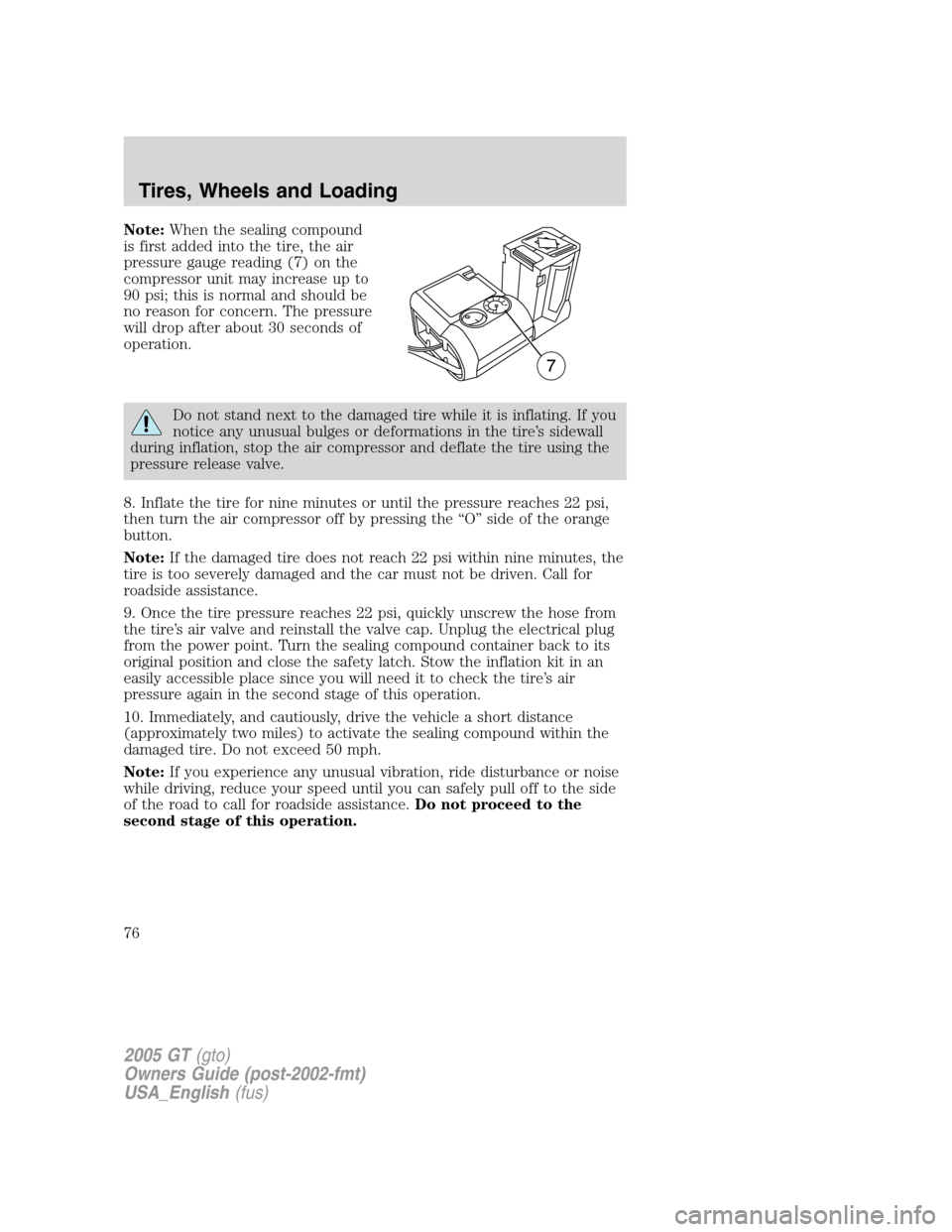
Note:When the sealing compound
is first added into the tire, the air
pressure gauge reading (7) on the
compressor unit may increase up to
90 psi; this is normal and should be
no reason for concern. The pressure
will drop after about 30 seconds of
operation.
Do not stand next to the damaged tire while it is inflating. If you
notice any unusual bulges or deformations in the tire ’s sidewall
during inflation, stop the air compressor and deflate the tire using the
pressure release valve.
8. Inflate the tire for nine minutes or until the pressure reaches 22 psi,
then turn the air compressor off by pressing the “O ” side of the orange
button.
Note: If the damaged tire does not reach 22 psi within nine minutes, the
tire is too severely damaged and the car must not be driven. Call for
roadside assistance.
9. Once the tire pressure reaches 22 psi, quickly unscrew the hose from
the tire ’s air valve and reinstall the valve cap. Unplug the electrical plug
from the power point. Turn the sealing compound container back to its
original position and close the safety latch. Stow the inflation kit in an
easily accessible place since you will need it to check the tire ’s air
pressure again in the second stage of this operation.
10. Immediately, and cautiously, drive the vehicle a short distance
(approximately two miles) to activate the sealing compound within the
damaged tire. Do not exceed 50 mph.
Note: If you experience any unusual vibration, ride disturbance or noise
while driving, reduce your speed until you can safely pull off to the side
of the road to call for roadside assistance. Do not proceed to the
second stage of this operation.
2005 GT(gto)
Owners Guide (post-2002-fmt)
USA_English (fus)
Tires, Wheels and Loading
76
Page 77 of 200

Second stage: Checking tire pressure
1. Stop driving after approximately two miles. Refer to theTips for use
of the tire inflation kit for safe operation of the tire inflation kit. Then
check the air pressure of the damaged tire as follows:
• Ensure the compressor is turned off by pressing the “O ” side of the
orange button.
• Remove the hose and the cable with the electrical plug from the kit ’s
storage compartment.
• Remove the valve cap from the sealed tire, then screw the hose firmly
onto the tire ’s air valve.
• Start the engine (only if the vehicle is outdoors or in a
well-ventilated area) to prevent the vehicle’s battery from draining.
• Insert the electrical plug into the vehicle ’s power point.
• Read the air pressure gauge on the inflation kit.
2. If the air pressure reads 19 psi or higher, switch the air compressor on
by pressing the “I” side of the orange button and adjust the air pressure
to the recommended pressure. This pressure can be found on a label
affixed to the B-Pillar. If the air pressure is higher than the label states,
reduce the excess pressure by pressing down on the pressure release
valve (8).
2005 GT(gto)
Owners Guide (post-2002-fmt)
USA_English (fus)
Tires, Wheels and Loading
77