2005 FORD FREESTAR spare wheel
[x] Cancel search: spare wheelPage 201 of 312
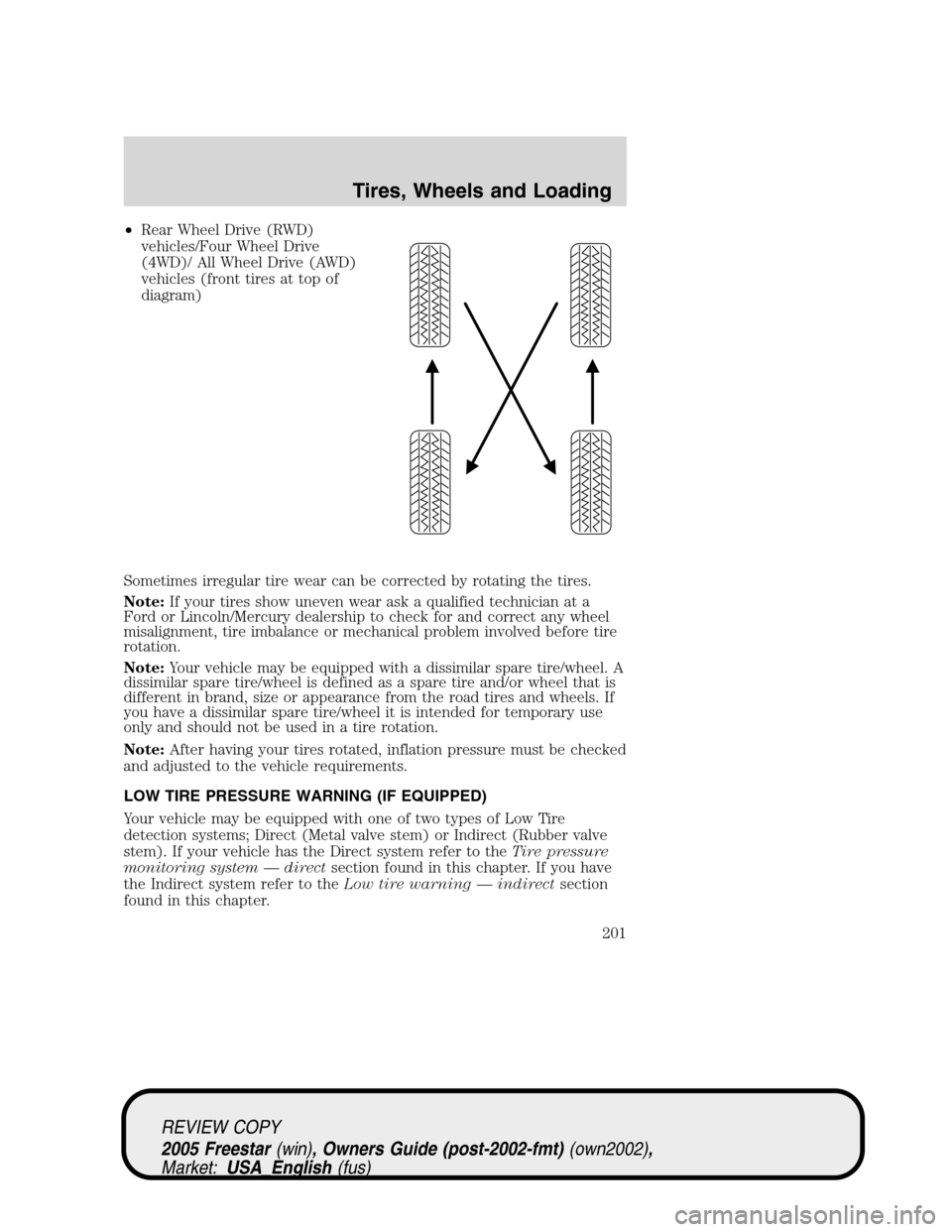
•Rear Wheel Drive (RWD)
vehicles/Four Wheel Drive
(4WD)/ All Wheel Drive (AWD)
vehicles (front tires at top of
diagram)
Sometimes irregular tire wear can be corrected by rotating the tires.
Note:If your tires show uneven wear ask a qualified technician at a
Ford or Lincoln/Mercury dealership to check for and correct any wheel
misalignment, tire imbalance or mechanical problem involved before tire
rotation.
Note:Your vehicle may be equipped with a dissimilar spare tire/wheel. A
dissimilar spare tire/wheel is defined as a spare tire and/or wheel that is
different in brand, size or appearance from the road tires and wheels. If
you have a dissimilar spare tire/wheel it is intended for temporary use
only and should not be used in a tire rotation.
Note:After having your tires rotated, inflation pressure must be checked
and adjusted to the vehicle requirements.
LOW TIRE PRESSURE WARNING (IF EQUIPPED)
Your vehicle may be equipped with one of two types of Low Tire
detection systems; Direct (Metal valve stem) or Indirect (Rubber valve
stem). If your vehicle has the Direct system refer to theTire pressure
monitoring system—directsection found in this chapter. If you have
the Indirect system refer to theLow tire warning—indirectsection
found in this chapter.
REVIEW COPY
2005 Freestar(win), Owners Guide (post-2002-fmt)(own2002),
Market:USA_English(fus)
Tires, Wheels and Loading
201
Page 202 of 312

Tire pressure monitoring system (TPMS) (Direct system)
(if equipped)
When the Tire Pressure Monitoring
System warning light is lit, one or
more of your tires is significantly
under-inflated. You should stop and
check your tires as soon as possible,
and inflate them to the proper pressure as indicated on the vehicle’s tire
information placard (label). Driving on a significantly under-inflated tire
causes the tire to overheat and can eventually lead to tire failure.
Under-inflation also reduces fuel efficiency and tire tread life, and may
affect the vehicle’s handling and stopping ability. Even if your vehicle is
equipped with a Tire Pressure Monitoring System, it is still important
that you manually check the inflation pressure of your tires regularly.
Each tire, including the spare, should be checked monthly when cold and
set to the recommended inflation pressure as specified on the vehicle
placard (label) and in the owner’s manual.
The Tire Pressure Monitoring System is NOT a substitute for
manually checking tire pressure. The tire pressure should be
checked periodically (at least monthly) using a tire gauge, see
Inspecting and inflating your tiresin this chapter. Failure to
properly maintain your tire pressure could increase the risk of tire
failure, loss of control, vehicle rollover and personal injury.
Changing tires with TPMS
It is recommended that you always
have your tires serviced by a dealer
or qualified technician.Each road
tire is equipped with a tire
pressure sensor mounted on the
wheel inside the tire connected
to the valve stem. The tire
pressure sensor must be
unbolted from the wheel prior to
tire removal. The sensor can be
removed by loosening the nut at the valve stem. Failure to
remove the sensor may damage it.The rubber grommet (washer)
between the wheel and the tire pressure sensor needs to be replaced
whenever the sensor is removed to minimize air leaks.
REVIEW COPY
2005 Freestar(win), Owners Guide (post-2002-fmt)(own2002),
Market:USA_English(fus)
Tires, Wheels and Loading
202
Page 203 of 312

The tire pressure should be checked periodically (at least monthly) using
an accurate tire gauge, refer toInspecting and inflating your tiresin
this chapter.
Understanding your Tire Pressure Monitoring System (TPMS)
The Tire Pressure Monitoring System measures pressure in your four
road tires and sends the tire pressure readings to your vehicle every
minute while you are driving and once an hour when your vehicle is
parked. The Low Tire Warning Lamp will turn ON if the tire pressure is
25% below the pressure listed on the tire label (approximately 6 to 9 psi
below the manufacturer’s recommend tire pressure). If the tire pressure
increases 2 psi above the“Light ON”threshold, then the TPMS light will
turn OFF. Once the light is illuminated, your tires are under inflated and
need to be inflated to the manufacturer’s recommended tire pressure.
Even if the light turns ON and a short time later turns OFF, your tire
pressure still needs to be checked.
In short, once the light has turned ON, at least one tire may be under
inflated.
When your temporary spare tire is installed
When one of your road tires needs to be replaced with the temporary
spare, the TPMS system will continue to identify an issue to remind you
that the damaged road wheel/tire needs to be repaired and put back on
your vehicle. During this time, the low tire warning light can periodically
return or stay on, depending on the state of the damaged road
wheel/tire. This will include the message center messages (if equipped).
To restore the full functionality of the Tire Pressure Monitoring System,
have the damaged road wheel/tire repaired and remounted on your
vehicle. For additional information, refer toChanging tires with TPMS
in this section.
When you believe your system is not operating properly
The main function of the Tire Pressure Monitoring System is to warn you
when your tires need air. It can also warn you in the event the system is
no longer capable of functioning as intended. Please refer to the
following chart for information concerning your Tire Pressure Monitoring
System:
REVIEW COPY
2005 Freestar(win), Owners Guide (post-2002-fmt)(own2002),
Market:USA_English(fus)
Tires, Wheels and Loading
203
Page 204 of 312

Low Tire Warning
LightCustomer Action Required
Solid Warning Light 1. Check your tire pressure to ensure they are
properly inflated, refer toInspecting and
inflating your tiresin this chapter. Ford
recommends the use of a digital or dial type
tire pressure gauge rather than a stick type
tire pressure gauge for increased accuracy.
2. After inflating your tires to the
manufacturer’s recommended air pressure as
shown on the Tire Label (located on the
driver’s door or the B-Pillar), the vehicle must
be driven for at least two minutes at 20 mph
(32 km/h) to guarantee that the light will turn
off.
3. If the light remains on even after these
steps have been taken, have the system
inspected by your servicing dealership
Flashing Warning Light
(flashes for 20 to 30
seconds either at
start-up or while
driving)1. Your spare tire is in use. Repair the
damaged road wheel and re-mount it on the
vehicle to restore system functionality. For a
description of how the system functions under
these conditions, refer to When You Have a
Flat Tire in this section.
2. If your tires are inflated to the
manufacturer’s recommended tire pressure,
and your spare tire is not in use, and a
flashing low time warning light is still present,
have the system inspected by your servicing
dealership.
When inflating your tires
When putting air into your tires (such as at a gas station or in your
garage), the Tire Pressure Monitoring System may not respond
immediately to the air added to your tires. Here are the details:
•The tire pressure monitor sensors mounted in your wheels updates
your vehicle with tire pressure information only once every minute,
REVIEW COPY
2005 Freestar(win), Owners Guide (post-2002-fmt)(own2002),
Market:USA_English(fus)
Tires, Wheels and Loading
204
Page 206 of 312

interference, and (2) This device must accept any interference received,
including interference that may cause undesired operation.
The Tire Pressure Monitoring System is NOT a substitute for
manually checking tire pressure. The tire pressure should be
checked periodically (at least monthly) using a tire gauge, see
Inspecting and inflating your tiresin this chapter. Failure to
properly maintain your tire pressure could increase the risk of tire
failure, loss of control, vehicle rollover and personal injury.
Low tire warning—indirect (if equipped)
The low tire warning system is designed to detect a significant loss of
inflation inany one of your tireson your vehicle. The system uses the
Anti-lock brake wheel speed sensors to detect a change in wheel speed
due to tire deflation.
When a tire loses inflation, the low
tire warning system detects the
change and illuminates the low tire
warning indicator light as shown.
If the light remains on while driving,
check the tire pressure refer to“Checking the tire pressure”in this
chapter. The low tire warning indicator light will also illuminate when
using a temporary spare, refer to“Changing the tires”in theRoadside
emergencieschapter.
The low tire warning system may not detect an under-inflated
tire under all conditions and is not a substitute for manually
checking tires regularly for proper inflation.
When to RESET the Low Tire Warning System:
after any of the following
•Tire rotation
•One or more tires have been replaced
•Tire balancing
•Wheel alignment
•Adjusting the pressure on one or more tires (note: tire pressures are
often adjusted during oil change service)
•Inflating a low tire will not clear the Low Tire Warning indicator light.
Only resetting the system will clear the light.
REVIEW COPY
2005 Freestar(win), Owners Guide (post-2002-fmt)(own2002),
Market:USA_English(fus)
Tires, Wheels and Loading
206
Page 307 of 312

Remote entry system .................99illuminated entry ......47, 102 –103
locking/unlocking doors .....95, 99
Reverse sensing system ...........228
Roadside assistance ..................231
Roof rack .....................................93
S
Safety Belt Maintenance ..........148
Safety belts (see Safety
restraints) ..................135, 138 –142
Safety Canopy ...........................158
Safety defects, reporting ..........256
Safety restraints ........135, 138 –142
belt minder .............................144
extension assembly ................148
for adults .........................139 –141
for children .............................162
Occupant Classification
Sensor ......................................136
safety belt maintenance .........148
warning light and chime 143 –144
Safety seats for children ..........165
Seat belts
(see Safety restraints) .............135
Seats ..........................................112 child safety seats ....................165
front seats ...............112, 114 –115
memory seat ...................105, 115
second row seats ............118, 121
third row seats ...............121, 128, 132–133
SecuriLock passive anti-theft
system ........................................109
Servicing your vehicle ..............263
Spare tire
(see Changing the Tire) ...182, 184 Spark plugs,
specifications .....................293, 297
Specification chart,
lubricants ...........................295, 297
Speed control ..............................71
Starting your vehicle ........217
–219
jump starting ..........................241
Steering wheel controls ......................................74
tilting .........................................57
T
Tilt steering wheel ......................57
Tire Pressure Monitoring
System (TPMS) Maintenance and
Specifications ..........................202
Tire warning ..............................206
Tires ...........................176 –177, 206
alignment ................................199
care ..........................................197
changing ..................182, 184, 187
checking the pressure ............179
inspecting and inflating .........178
label .........................................197
replacing ..................................180
rotating ....................................199
safety practices .......................198
sidewall information ...............192
snow tires and chains ............208
spare tire .................................183
terminology .............................177
tire grades ...............................177
treadwear ........................176, 197
Towing .......................................213 recreational towing .................216
trailer towing ..........................213
wrecker ....................................247
REVIEW COPY
2005 Freestar (win), Owners Guide (post-2002-fmt) (own2002),
Market: USA_English (fus)
Index
307