2005 FORD EXPLORER heating
[x] Cancel search: heatingPage 224 of 320
possibly rolling over. Whenever driving on a hill, determine beforehand
the route you will use. Do not drive over the crest of a hill without
seeing what conditions are on the other side. Do not drive in reverse
over a hill without the aid of an observer.
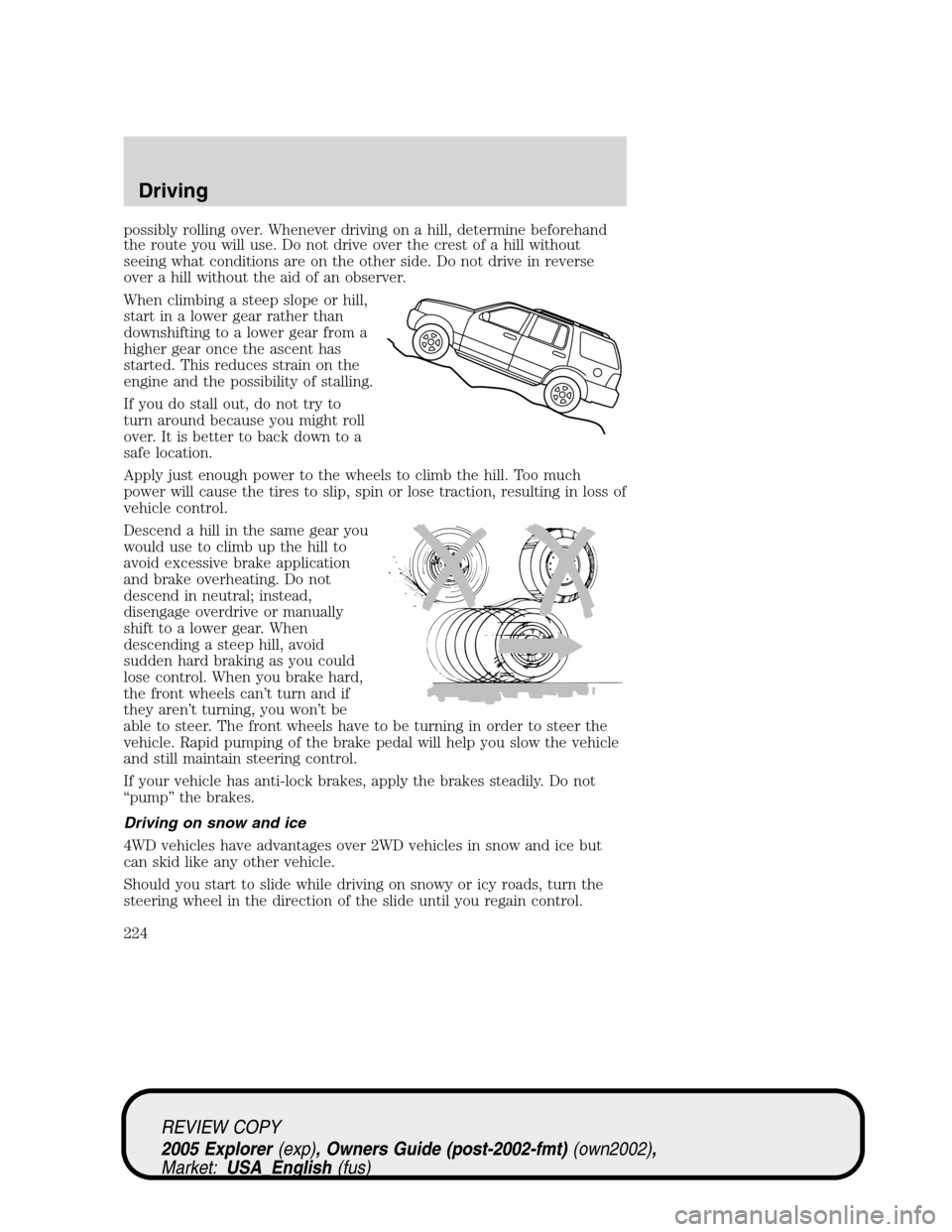
When climbing a steep slope or hill,
start in a lower gear rather than
downshifting to a lower gear from a
higher gear once the ascent has
started. This reduces strain on the
engine and the possibility of stalling.
If you do stall out, do not try to
turn around because you might roll
over. It is better to back down to a
safe location.
Apply just enough power to the wheels to climb the hill. Too much
power will cause the tires to slip, spin or lose traction, resulting in loss of
vehicle control.
Descend a hill in the same gear you
would use to climb up the hill to
avoid excessive brake application
and brake overheating. Do not
descend in neutral; instead,
disengage overdrive or manually
shift to a lower gear. When
descending a steep hill, avoid
sudden hard braking as you could
lose control. When you brake hard,
the front wheels can’t turn and if
they aren’t turning, you won’t be
able to steer. The front wheels have to be turning in order to steer the
vehicle. Rapid pumping of the brake pedal will help you slow the vehicle
and still maintain steering control.
If your vehicle has anti-lock brakes, apply the brakes steadily. Do not
“pump” the brakes.
Driving on snow and ice
4WD vehicles have advantages over 2WD vehicles in snow and ice but
can skid like any other vehicle.
Should you start to slide while driving on snowy or icy roads, turn the
steering wheel in the direction of the slide until you regain control.
REVIEW COPY
2005 Explorer(exp), Owners Guide (post-2002-fmt)(own2002),
Market:USA_English(fus)
Driving
224
Page 231 of 320
Apply just enough power to the wheels to climb the hill. Too much
power will cause the tires to slip, spin or lose traction, resulting in loss of
vehicle control.
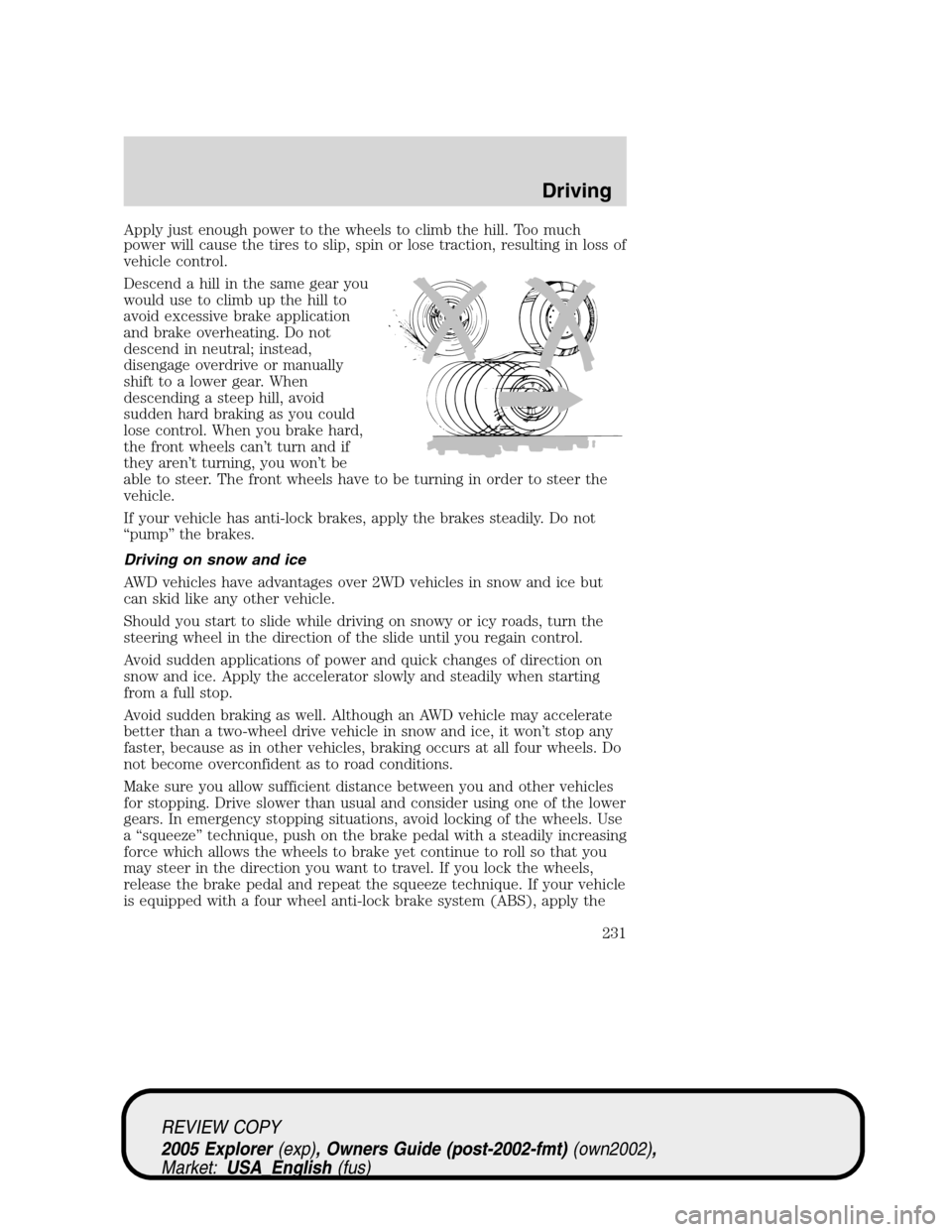
Descend a hill in the same gear you
would use to climb up the hill to
avoid excessive brake application
and brake overheating. Do not
descend in neutral; instead,
disengage overdrive or manually
shift to a lower gear. When
descending a steep hill, avoid
sudden hard braking as you could
lose control. When you brake hard,
the front wheels can’t turn and if
they aren’t turning, you won’t be
able to steer. The front wheels have to be turning in order to steer the
vehicle.
If your vehicle has anti-lock brakes, apply the brakes steadily. Do not
“pump” the brakes.
Driving on snow and ice
AWD vehicles have advantages over 2WD vehicles in snow and ice but
can skid like any other vehicle.
Should you start to slide while driving on snowy or icy roads, turn the
steering wheel in the direction of the slide until you regain control.
Avoid sudden applications of power and quick changes of direction on
snow and ice. Apply the accelerator slowly and steadily when starting
from a full stop.
Avoid sudden braking as well. Although an AWD vehicle may accelerate
better than a two-wheel drive vehicle in snow and ice, it won’t stop any
faster, because as in other vehicles, braking occurs at all four wheels. Do
not become overconfident as to road conditions.
Make sure you allow sufficient distance between you and other vehicles
for stopping. Drive slower than usual and consider using one of the lower
gears. In emergency stopping situations, avoid locking of the wheels. Use
a “squeeze” technique, push on the brake pedal with a steadily increasing
force which allows the wheels to brake yet continue to roll so that you
may steer in the direction you want to travel. If you lock the wheels,
release the brake pedal and repeat the squeeze technique. If your vehicle
is equipped with a four wheel anti-lock brake system (ABS), apply the
REVIEW COPY
2005 Explorer(exp), Owners Guide (post-2002-fmt)(own2002),
Market:USA_English(fus)
Driving
231
Page 282 of 320
Do not add engine coolant when the engine is hot. Steam and
scalding liquids released from a hot cooling system can burn you
badly. Also, you can be burned if you spill coolant on hot engine parts.
Do not put engine coolant in the windshield washer fluid
container. If sprayed on the windshield, engine coolant could
make it difficult to see through the windshield.
•Add Motorcraft Premium Gold Engine Coolant
(yellow-colored), VC-7–A (U.S., except CA and OR), VC-7–B
(CA and OR only), meeting Ford Specification
WSS-M97B51–A1.
Note:Use of Motorcraft Cooling System Stop Leak Pellets, VC-6, may
darken the color of Motorcraft Premium Gold Engine Coolant from
yellow to golden tan.
•Do not add/mix an orange-colored, extended life coolant such
as Motorcraft Speciality Orange Engine Coolant, VC-2 (US) or
CXC-209 (Canada), meeting Ford specification WSS-M97B44–D
with the factory-filled coolant.Mixing Motorcraft Speciality Orange
Engine Coolant or any orange-colored extended life product with your
factory filled coolant can result in degraded corrosion protection.
•A large amount of water without engine coolant may be added, in case
of emergency, to reach a vehicle service location. In this instance, the
cooling system must be drained and refilled with a 50/50 mixture of
engine coolant and distilled water as soon as possible. Water alone
(without engine coolant) can cause engine damage from corrosion,
overheating or freezing.
•Do not use alcohol, methanol, brine or any engine coolants
mixed with alcohol or methanol antifreeze (coolant).Alcohol
and other liquids can cause engine damage from overheating or
freezing.
•Do not add extra inhibitors or additives to the coolant.These
can be harmful and compromise the corrosion protection of the engine
coolant.
For vehicles with overflow coolant systems with a non-pressurized cap
on the coolant recovery system, add coolant to the coolant recovery
reservoir when the engine is cool. Add the proper mixture of coolant and
water to the “FULL COLD” level. For all other vehicles, which have a
coolant degas system with a pressurized cap, or if it is necessary to
REVIEW COPY
2005 Explorer(exp), Owners Guide (post-2002-fmt)(own2002),
Market:USA_English(fus)
Maintenance and Specifications
282
Page 283 of 320
remove the coolant pressure relief cap on the radiator of a vehicle with
an overflow system, follow these steps to add engine coolant.
To reduce the risk of personal injury, make sure the engine is
cool before unscrewing the coolant pressure relief cap. The
cooling system is under pressure; steam and hot liquid can come out
forcefully when the cap is loosened slightly.
1. Before you begin, turn the engine off and let it cool.
2. When the engine is cool, wrap a thick cloth around the coolant
pressure relief cap on the coolant reservoir (a translucent plastic bottle).
Slowly turn cap counterclockwise (left) until pressure begins to release.
3. Step back while the pressure releases.
4. When you are sure that all the pressure has been released, use the
cloth to turn it counterclockwise and remove the cap.
5. Fill the coolant reservoir slowly with the proper coolant mixture (see
above), to within the “COLD FILL RANGE” or the “FULL COLD” level on
the reservoir. If you removed the radiator cap in an overflow system, fill
the radiator until the coolant is visible and radiator is almost full.
6. Replace the cap. Turn until tightly installed (until “clicks” are heard).
(Cap must be tightly installed to prevent coolant loss.)
After any coolant has been added, check the coolant concentration, refer
toChecking engine coolantsection. If the concentration is not 50/50
(protection to –34° F/–36° C), drain some coolant and adjust the
concentration. It may take several drains and additions to obtain a 50/50
coolant concentration.
Whenever coolant has been added, the coolant level in the coolant
reservoir should be checked the next few times you drive the vehicle. If
necessary, add enough 50/50 concentration of engine coolant and
distilled water to bring the liquid level to the proper level.
If you have to add more than 1.0 quart (1.0 liter) of engine coolant per
month, have your dealer check the engine cooling system. Your cooling
system may have a leak. Operating an engine with a low level of coolant
can result in engine overheating and possible engine damage.
Recycled engine coolant
Ford Motor Company does NOT recommend the use of recycled engine
coolant in vehicles originally equipped with Motorcraft Premium Gold
Engine Coolant since a Ford-approved recycling process is not yet
available.
REVIEW COPY
2005 Explorer(exp), Owners Guide (post-2002-fmt)(own2002),
Market:USA_English(fus)
Maintenance and Specifications
283
Page 314 of 320
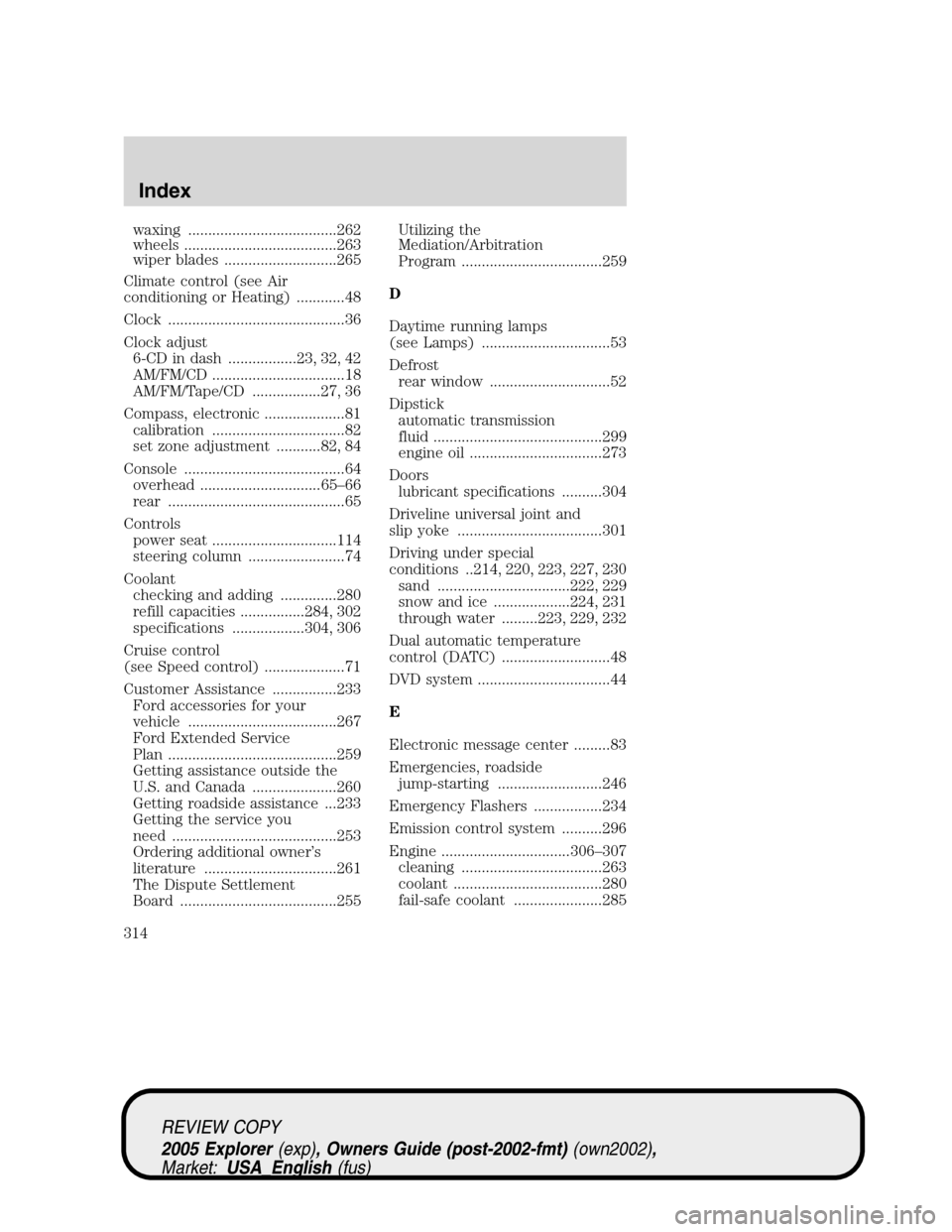
waxing .....................................262
wheels ......................................263
wiper blades ............................265
Climate control (see Air
conditioning or Heating) ............48
Clock ............................................36
Clock adjust
6-CD in dash .................23, 32, 42
AM/FM/CD .................................18
AM/FM/Tape/CD .................27, 36
Compass, electronic ....................81
calibration .................................82
set zone adjustment ...........82, 84
Console ........................................64
overhead ..............................65–66
rear ............................................65
Controls
power seat ...............................114
steering column ........................74
Coolant
checking and adding ..............280
refill capacities ................284, 302
specifications ..................304, 306
Cruise control
(see Speed control) ....................71
Customer Assistance ................233
Ford accessories for your
vehicle .....................................267
Ford Extended Service
Plan ..........................................259
Getting assistance outside the
U.S. and Canada .....................260
Getting roadside assistance ...233
Getting the service you
need .........................................253
Ordering additional owner’s
literature .................................261
The Dispute Settlement
Board .......................................255Utilizing the
Mediation/Arbitration
Program ...................................259
D
Daytime running lamps
(see Lamps) ................................53
Defrost
rear window ..............................52
Dipstick
automatic transmission
fluid ..........................................299
engine oil .................................273
Doors
lubricant specifications ..........304
Driveline universal joint and
slip yoke ....................................301
Driving under special
conditions ..214, 220, 223, 227, 230
sand .................................222, 229
snow and ice ...................224, 231
through water .........223, 229, 232
Dual automatic temperature
control (DATC) ...........................48
DVD system .................................44
E
Electronic message center .........83
Emergencies, roadside
jump-starting ..........................246
Emergency Flashers .................234
Emission control system ..........296
Engine ................................306–307
cleaning ...................................263
coolant .....................................280
fail-safe coolant ......................285
REVIEW COPY
2005 Explorer(exp), Owners Guide (post-2002-fmt)(own2002),
Market:USA_English(fus)
Index
314
Page 316 of 320

Heating
heating and air conditioning
system .................................46, 48
Homelink wireless control
system ..........................................77
Hood ..........................................269
I
Ignition .......................200, 306–307
Infant seats
(see Safety seats) .....................146
Inspection/maintenance (I/M)
testing ........................................297
Instrument panel
cleaning ...................................265
cluster ........................................10
J
Jack ....................................164, 167
positioning .......................164, 169
storage .....................164, 166–167
Jump-starting your vehicle ......246
K
Keyless entry system ...............105
autolock ...................................107
Keys
positions of the ignition .........200
L
Lamps
bulb replacement
specifications chart ..................57
daytime running light ...............53
fog lamps ...................................53
interior lamps ...........................56Liftgate ................................95, 102
Lights, warning and indicator ....10
anti-lock brakes (ABS) ..........204
Limited-slip axle .......................217
Load limits .................................187
Loading instructions .................193
Locks
autolock ...................................107
childproof ................................100
doors ..........................................99
Lubricant specifications ...304, 306
Lug nuts ....................................172
Luggage rack ...............................97
Lumbar support,
seats ...........................114, 116–117
M
Message center ...........................83
english/metric button ...............89
system check button ................89
warning messages .....................90
Mirrors ...................................67, 70
automatic dimming rearview
mirror ........................................70
fold away ...................................70
heated ........................................70
side view mirrors (power) .......69
Moon roof ....................................76
Motorcraft parts ................292, 301
O
Octane rating ............................289
Oil (see Engine oil) ..................273
P
Parking brake ............................205
REVIEW COPY
2005 Explorer(exp), Owners Guide (post-2002-fmt)(own2002),
Market:USA_English(fus)
Index
316