Page 268 of 368

Do not alter or modify your vehicle’s suspension or steering; the
resulting changes to the vehicle’s handling can adversely affect
the AdvanceTrac�with Roll Stability Control system. Also, do
not install a stereo loudspeaker near the front center console or
under either front seat. The speaker vibrations can adversely
affect the AdvanceTrac�with Roll Stability Control sensors
located in this area.
Note:Pressing the AdvanceTrac�with RSC button will disable the
AdvanceTrac�with RSC system.
Aggressive driving in any road conditions can cause you to lose
control of your vehicle increasing the risk of severe personal
injury or property damage. The occurrence of an AdvanceTrac�with
Roll Stability Control event is an indication that at least some of the
tires have exceeded their ability to grip the road; this may lead to an
increased risk of loss of vehicle control, vehicle rollover, personal injury
and death. If you experience a severe road event, SLOW DOWN.
AUTOMATIC TRANSMISSION OPERATION
Brake-shift interlock
This vehicle is equipped with a park/brake-shift interlock feature that
prevents the gearshift lever from being moved from P (Park) when the
ignition is in the ON position unless brake pedal is depressed.
If you cannot move the gearshift lever out of P (Park) with ignition in
the ON position and the brake pedal depressed, or when the ignition is
in the OFF position, it is possible that a fuse has blown or the vehicle’s
brakelamps are not operating properly. Refer toFuses and relaysin the
Roadside Emergencieschapter.
If the fuse is not blown, perform the following procedure:
1. Apply the parking brake, turn the ignition to OFF, then remove the
key.
2. Push the tilt steering lever down and tilt the steering column all the
way up.
REVIEW COPY
2005 Expedition(exd), Owners Guide (post-2002-fmt)(own2002),
Market:USA_English(fus)
Driving
268
Page 269 of 368
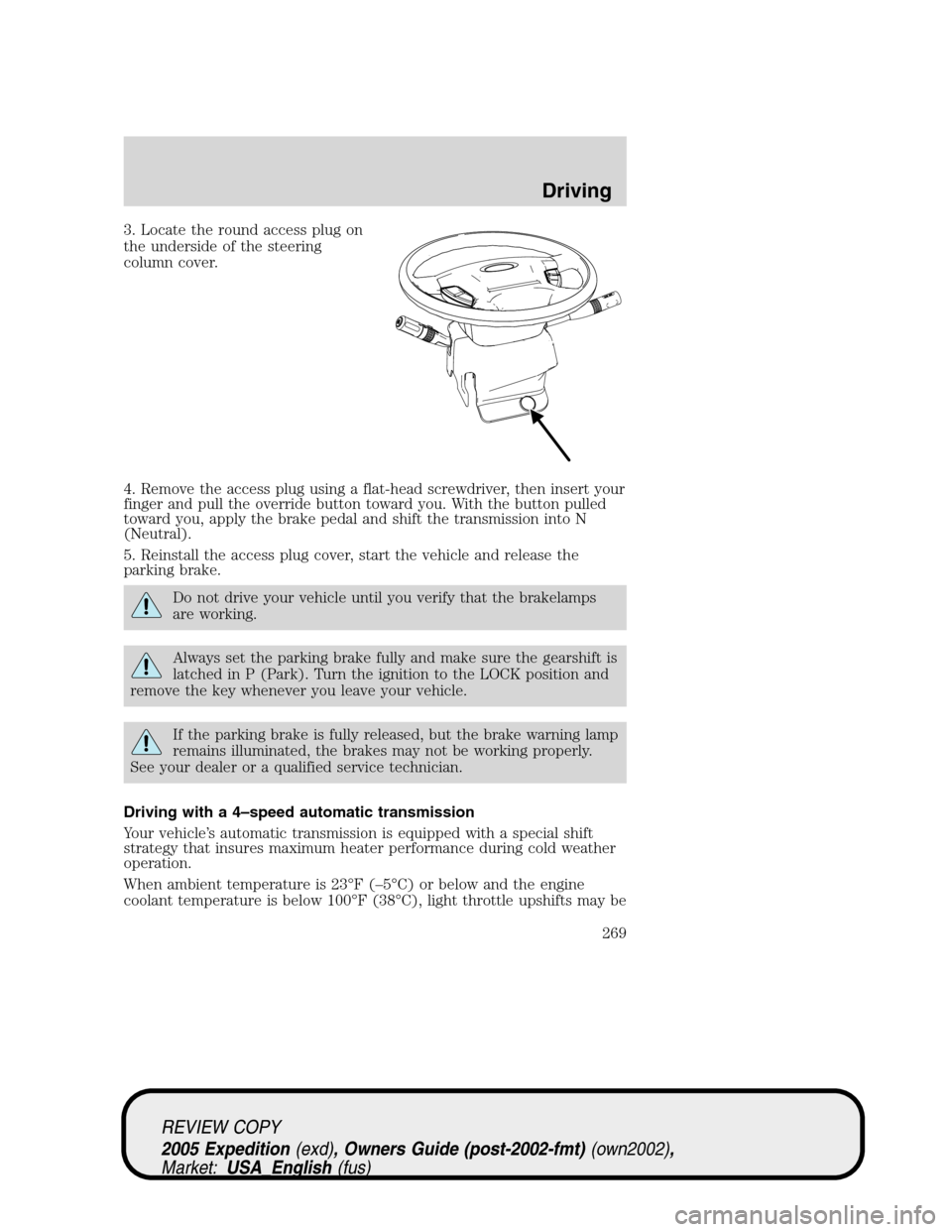
3. Locate the round access plug on
the underside of the steering
column cover.
4. Remove the access plug using a flat-head screwdriver, then insert your
finger and pull the override button toward you. With the button pulled
toward you, apply the brake pedal and shift the transmission into N
(Neutral).
5. Reinstall the access plug cover, start the vehicle and release the
parking brake.
Do not drive your vehicle until you verify that the brakelamps
are working.
Always set the parking brake fully and make sure the gearshift is
latched in P (Park). Turn the ignition to the LOCK position and
remove the key whenever you leave your vehicle.
If the parking brake is fully released, but the brake warning lamp
remains illuminated, the brakes may not be working properly.
See your dealer or a qualified service technician.
Driving with a 4–speed automatic transmission
Your vehicle’s automatic transmission is equipped with a special shift
strategy that insures maximum heater performance during cold weather
operation.
When ambient temperature is 23°F (–5°C) or below and the engine
coolant temperature is below 100°F (38°C), light throttle upshifts may be
REVIEW COPY
2005 Expedition(exd), Owners Guide (post-2002-fmt)(own2002),
Market:USA_English(fus)
Driving
269
Page 271 of 368
D (Drive) with Overdrive
The normal driving position for the
best fuel economy. Transmission
operates in gears one through four.
D (Drive) without Overdrive
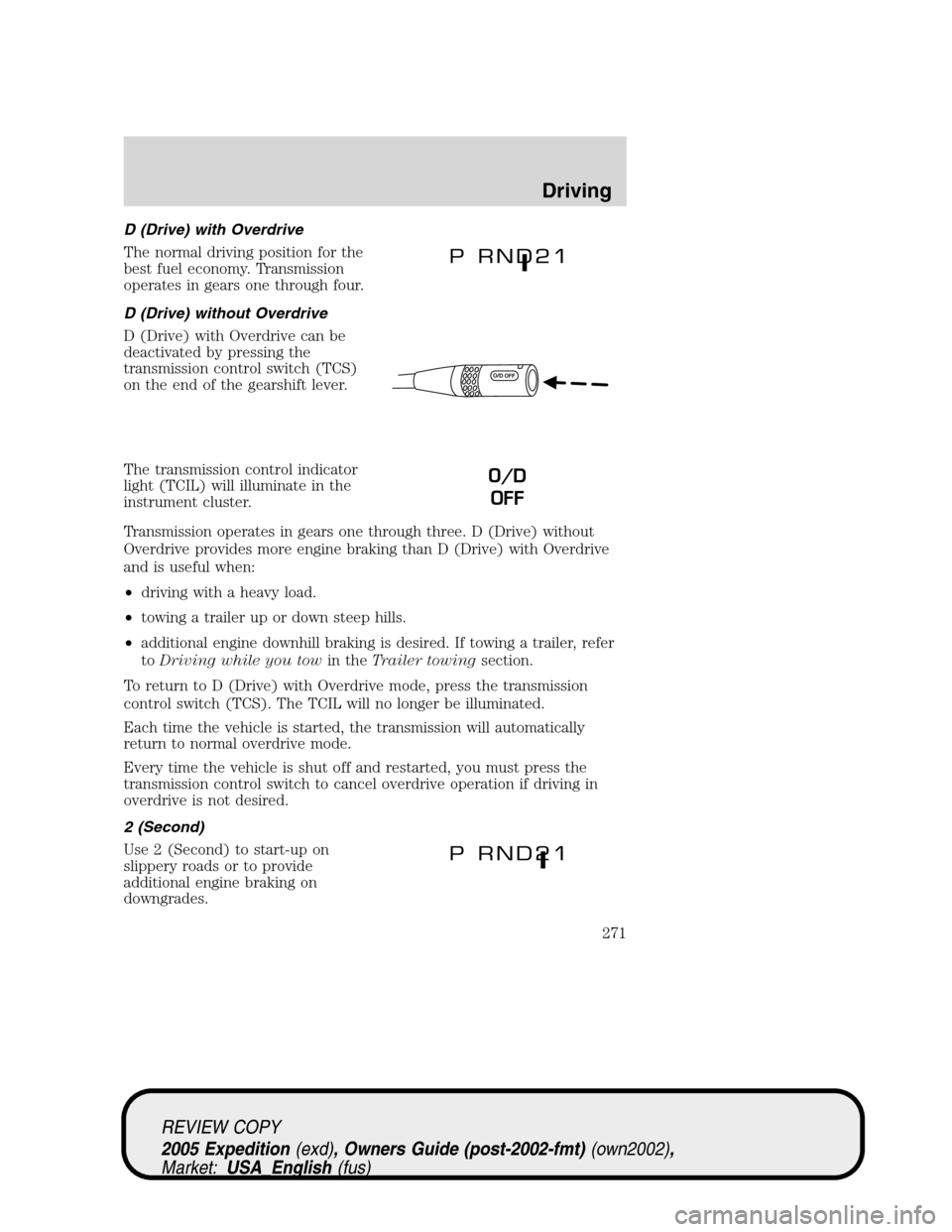
D (Drive) with Overdrive can be
deactivated by pressing the
transmission control switch (TCS)
on the end of the gearshift lever.
The transmission control indicator
light (TCIL) will illuminate in the
instrument cluster.
Transmission operates in gears one through three. D (Drive) without
Overdrive provides more engine braking than D (Drive) with Overdrive
and is useful when:
•driving with a heavy load.
•towing a trailer up or down steep hills.
•additional engine downhill braking is desired. If towing a trailer, refer
toDriving while you towin theTrailer towingsection.
To return to D (Drive) with Overdrive mode, press the transmission
control switch (TCS). The TCIL will no longer be illuminated.
Each time the vehicle is started, the transmission will automatically
return to normal overdrive mode.
Every time the vehicle is shut off and restarted, you must press the
transmission control switch to cancel overdrive operation if driving in
overdrive is not desired.
2 (Second)
Use 2 (Second) to start-up on
slippery roads or to provide
additional engine braking on
downgrades.
O/D
OFF
REVIEW COPY
2005 Expedition(exd), Owners Guide (post-2002-fmt)(own2002),
Market:USA_English(fus)
Driving
271
Page 298 of 368

Fuse/Relay
LocationFuse Amp
RatingPassenger Compartment Fuse
Panel Description
R203 PCM relay Fuse 32, Fuse 34, PCM solenoids
and sensors
R301 Trailer tow
back-up lamp
relayTrailer tow 7–wire connector
(back-up lamps)
R302 Heated PCV
valve relayHeated PCV valve
R303 Fuel pump relay Fuel pump shut-off switch, PCM
(fuel pump monitor), Fuel pump,
Fuel pump driver module
R304 Battery saver
relayRoof rail lamps, Vanity mirror
lamps, Map/Dome lamp, Glove box
lamp, Cargo area lamp, Outside
mirror puddle lamps, Instrument
cluster (interior lamps)
R305 Horn relay Dual note horn
* Mini Fuses ** Maxi Fuses
Note:Relays R301–R305 are not serviceable components; see your
dealer or a qualified technician for assistance.
JUMP STARTING YOUR VEHICLE
The gases around the battery can explode if exposed to flames,
sparks, or lit cigarettes. An explosion could result in injury or
vehicle damage.
Batteries contain sulfuric acid which can burn skin, eyes and
clothing, if contacted.
Do not attempt to push-start your vehicle. Automatic
transmissions do not have push-start capability; doing so may
damage the catalytic converter.
REVIEW COPY
2005 Expedition(exd), Owners Guide (post-2002-fmt)(own2002),
Market:USA_English(fus)
Roadside Emergencies
298
Page 305 of 368
If the vehicle is towed by other means or incorrectly, vehicle
damage may occur.
With a disabled vehicle (without access to wheel dollies, car hauling
trailer or flatbed transport vehicle) your vehicle can be towed (all wheels
on the ground) under the following conditions:
Special Conditions:
•Release the parking brake.
•Turn the air suspension (if equipped) control to OFF.
•Turn the ignition to the OFF/UNLOCKED position.
•Place the transmission in N (Neutral).
If the vehicle’s battery is discharged, refer toAutomatic transmission
operationin theDrivingchapter for directions on how to move the
gearshift lever out of the P (Park) position, for proper towing.
•Do not exceed a distance of 50 miles (80 km).
•Do not exceed 35 mph (56 km/h) vehicle speed.
Ford Motor Company produces a towing manual for all authorized tow
truck operators. Have your tow truck operator refer to this manual for
proper hook-up and towing procedures for your vehicle.
REVIEW COPY
2005 Expedition(exd), Owners Guide (post-2002-fmt)(own2002),
Market:USA_English(fus)
Roadside Emergencies
305
Page 323 of 368
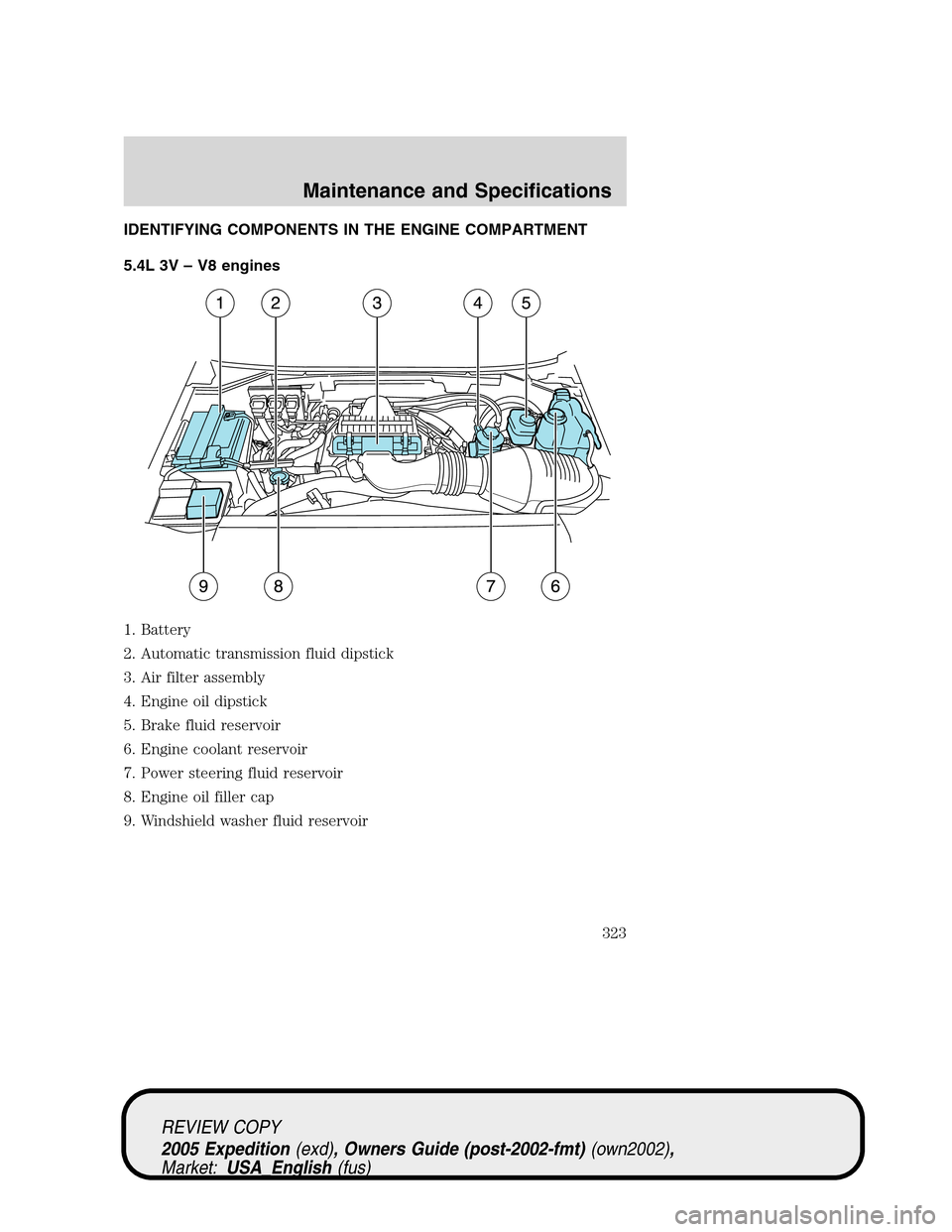
IDENTIFYING COMPONENTS IN THE ENGINE COMPARTMENT
5.4L 3V – V8 engines
1. Battery
2. Automatic transmission fluid dipstick
3. Air filter assembly
4. Engine oil dipstick
5. Brake fluid reservoir
6. Engine coolant reservoir
7. Power steering fluid reservoir
8. Engine oil filler cap
9. Windshield washer fluid reservoir
REVIEW COPY
2005 Expedition(exd), Owners Guide (post-2002-fmt)(own2002),
Market:USA_English(fus)
Maintenance and Specifications
323
Page 328 of 368
Note: Electrical or electronic accessories or components added to
the vehicle by the dealer or the owner may adversely affect
battery performance and durability.
Batteries normally produce explosive gases which can cause
personal injury. Therefore, do not allow flames, sparks or lighted
substances to come near the battery. When working near the battery,
always shield your face and protect your eyes. Always provide proper
ventilation.
When lifting a plastic-cased battery, excessive pressure on the
end walls could cause acid to flow through the vent caps,
resulting in personal injury and/or damage to the vehicle or battery.
Lift the battery with a battery carrier or with your hands on opposite
corners.
Keep batteries out of reach of children. Batteries contain sulfuric
acid. Avoid contact with skin, eyes or clothing. Shield your eyes
when working near the battery to protect against possible splashing of
acid solution. In case of acid contact with skin or eyes, flush
immediately with water for a minimum of 15 minutes and get prompt
medical attention. If acid is swallowed, call a physician immediately.
Battery posts, terminals and related accessories contain lead and
lead compounds.Wash hands after handling.
For information on transmission operation after the battery has been
disconnected, refer toShift strategyin theDrivingchapter.
To account for customer driving habits and conditions, your automatic
transmission (4R70W) electronically controls the shift quality by using an
adaptive learning strategy. The adaptive learning strategy is maintained
by power from the battery. When the battery is disconnected or a new
battery is installed, the transmission must relearn its adaptive strategy.
Optimal shifting will resume within a few hundred kilometers (miles) of
operation.
If the shift quality does not improve within a few hundred
kilometers (miles) of operation, or if the downshifts and other
throttle conditions do not function normally or after a long
deceleration period, see your dealer or a qualified service
technician as soon as possible.
REVIEW COPY
2005 Expedition(exd), Owners Guide (post-2002-fmt)(own2002),
Market:USA_English(fus)
Maintenance and Specifications
328
Page 346 of 368
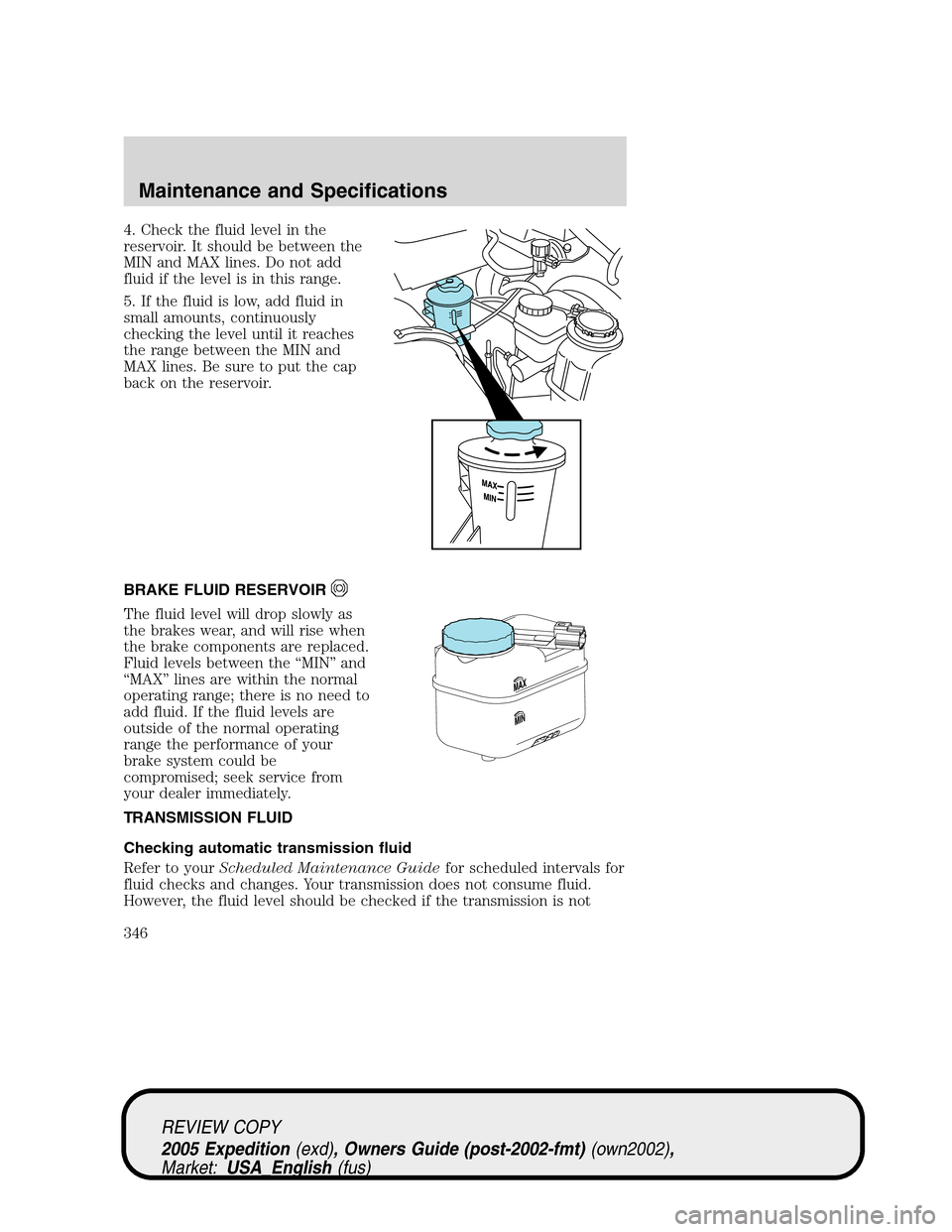
4. Check the fluid level in the
reservoir. It should be between the
MIN and MAX lines. Do not add
fluid if the level is in this range.
5. If the fluid is low, add fluid in
small amounts, continuously
checking the level until it reaches
the range between the MIN and
MAX lines. Be sure to put the cap
back on the reservoir.
BRAKE FLUID RESERVOIR
The fluid level will drop slowly as
the brakes wear, and will rise when
the brake components are replaced.
Fluid levels between the “MIN” and
“MAX” lines are within the normal
operating range; there is no need to
add fluid. If the fluid levels are
outside of the normal operating
range the performance of your
brake system could be
compromised; seek service from
your dealer immediately.
TRANSMISSION FLUID
Checking automatic transmission fluid
Refer to yourScheduled Maintenance Guidefor scheduled intervals for
fluid checks and changes. Your transmission does not consume fluid.
However, the fluid level should be checked if the transmission is not
REVIEW COPY
2005 Expedition(exd), Owners Guide (post-2002-fmt)(own2002),
Market:USA_English(fus)
Maintenance and Specifications
346