Page 88 of 272

Note:The hood, each door and the liftgate arm individually, and if any
of them are open, they must be closed in order to be armed.
When you lock the vehicle using any of the three methods above:
•the park lamps will flash once to indicate the hood, each door and the
liftgate are closed.
•the park lamps willnotflash if the hood, any door or the liftgate are
open. Once all doors, hood and liftgate are closed, the park lamps will
flash to confirm the alarm has been set.
When you press the
control on the remote entry transmitter twice
within three seconds, the horn will chirp once to confirm the doors, hood
and liftgate are closed and locked and the alarm is set.
Disarming the system
You can disarm the system by any of the following actions:
•Unlock the doors by pressing the
control on your remote entry
transmitter.
•Unlock the doors with a key. Turn the key full travel (toward the front
of the vehicle) to ensure the alarm disarms.
Triggering the anti-theft system
The armed system will be triggered if any door, liftgate or the hood is
opened without using the key or the remote entry transmitter.
2005 Escape(204)
Owners Guide (post-2002-fmt)
USA English(fus)
Locks and Security
88
Page 94 of 272
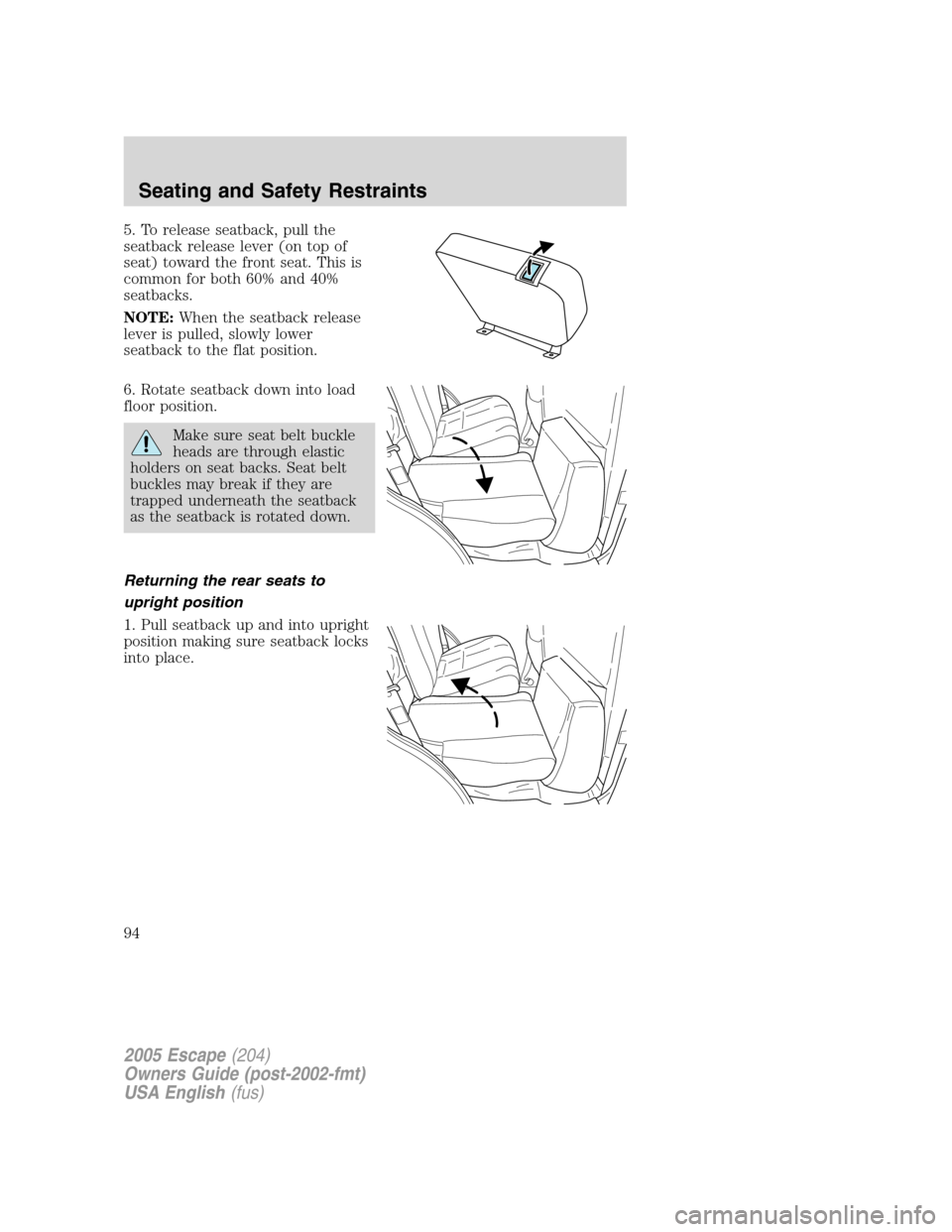
5. To release seatback, pull the
seatback release lever (on top of
seat) toward the front seat. This is
common for both 60% and 40%
seatbacks.
NOTE:When the seatback release
lever is pulled, slowly lower
seatback to the flat position.
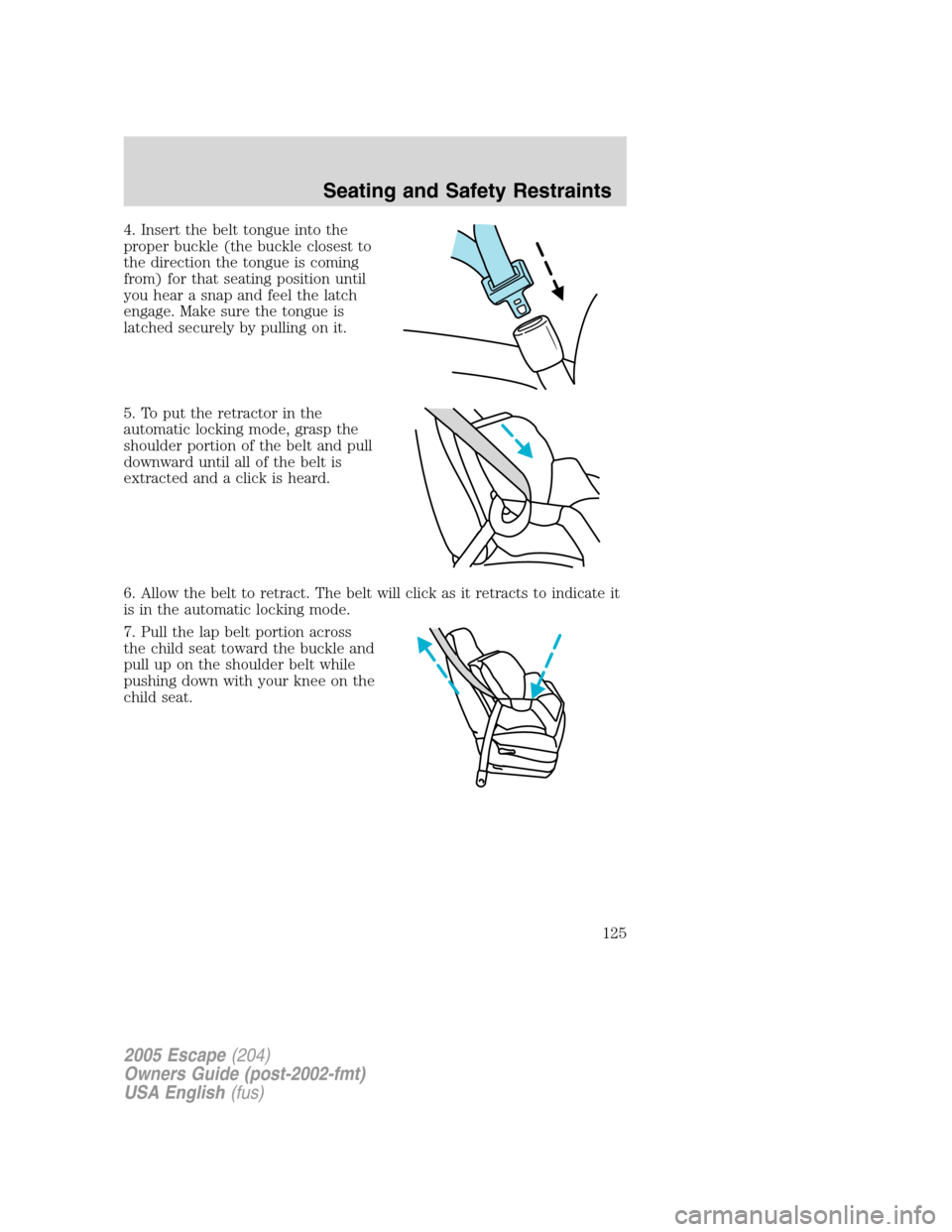
6. Rotate seatback down into load
floor position.
Make sure seat belt buckle
heads are through elastic
holders on seat backs. Seat belt
buckles may break if they are
trapped underneath the seatback
as the seatback is rotated down.
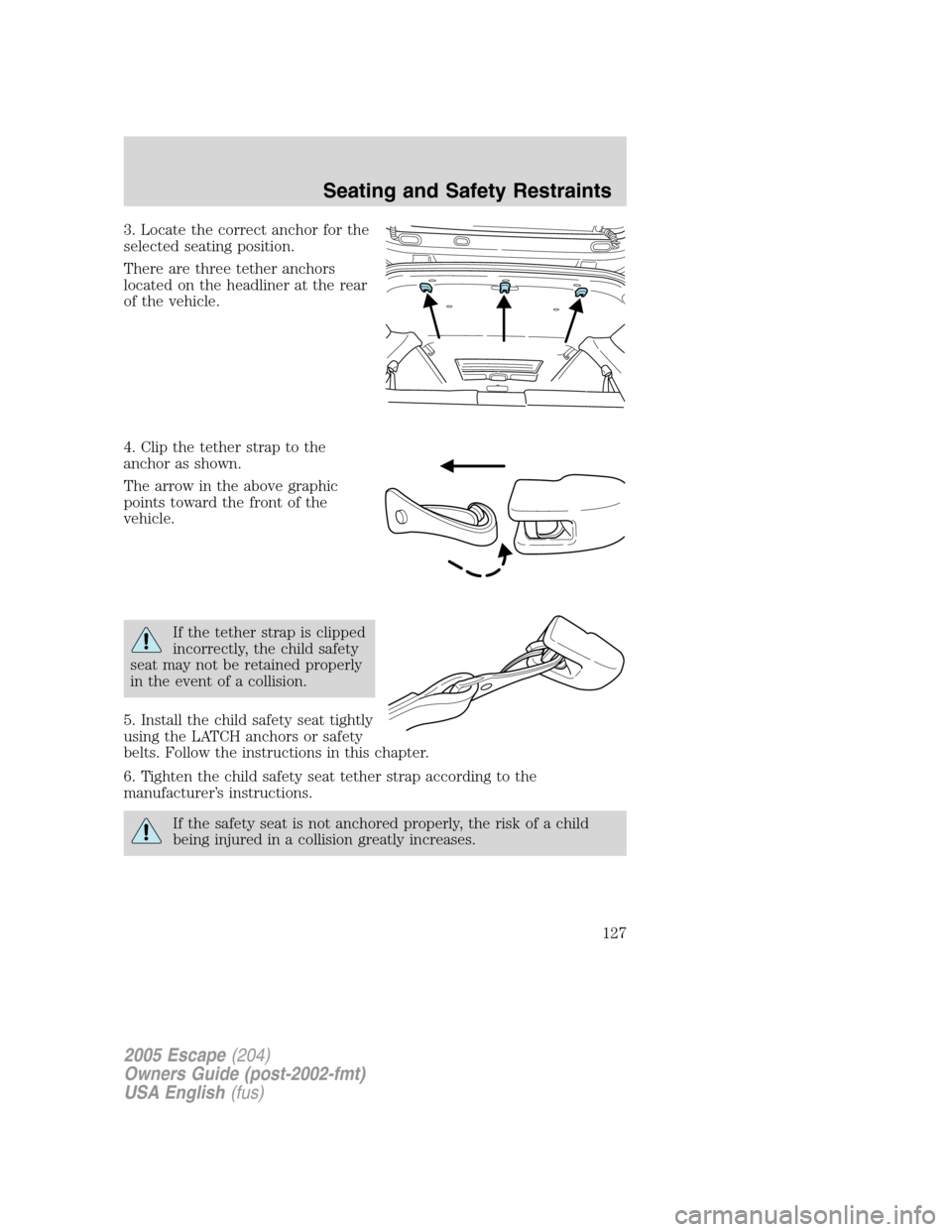
Returning the rear seats to
upright position
1. Pull seatback up and into upright
position making sure seatback locks
into place.
2005 Escape(204)
Owners Guide (post-2002-fmt)
USA English(fus)
Seating and Safety Restraints
94
Page 111 of 272

Do not attempt to service, repair, or modify the air bag
supplemental restraint systems or its fuses. See your Ford or
Lincoln Mercury dealer.
Modifications to the front end of the vehicle, including frame,
bumper, front end body structure, tow hooks and B-pillar
surrounding parts may affect the performance of the air bag sensors
increasing the risk of injury. Do not modify the front end of the
vehicle.
Additional equipment may affect the performance of the air bag
sensors increasing the risk of injury. Please refer to theBody
Builders Layout Bookfor instructions about the appropriate
installation of additional equipment.
Children and air bags
Children must always be properly
restrained. Accident statistics
suggest that children are safer when
properly restrained in the rear
seating positions than in the front
seating position. Failure to follow
these instructions may increase the
risk of injury in a collision.
Air bags can kill or injure a
child in a child seat.
NEVERplace a rear-facing child
seat in front of an active air bag. If
you must use a forward-facing
child seat in the front seat, move
the seat all the way back.
2005 Escape(204)
Owners Guide (post-2002-fmt)
USA English(fus)
Seating and Safety Restraints
111
Page 122 of 272
Follow all instructions provided by the manufacturer of the
booster seat.
Never put the shoulder belt under a child’s arm or behind the
back because it eliminates the protection for the upper part of
the body and may increase the risk of injury or death in a collision.
Never use pillows, books, or towels to boost a child. They can
slide around and increase the likelihood of injury or death in a
collision.
SAFETY SEATS FOR CHILDREN
Child and infant or child safety seats
Use a safety seat that is recommended for the size and weight of the
child. Carefully follow all of the manufacturer’s instructions with the
safety seat you put in your vehicle. If you do not install and use the
safety seat properly, the child may be injured in a sudden stop or
collision.
When installing a child safety seat:
•Review and follow the information
presented in theAir bag
supplemental restraint system
(SRS) section in this chapter.
•Use the correct safety belt buckle
for that seating position (the
buckle closest to the direction the
tongue is coming from).
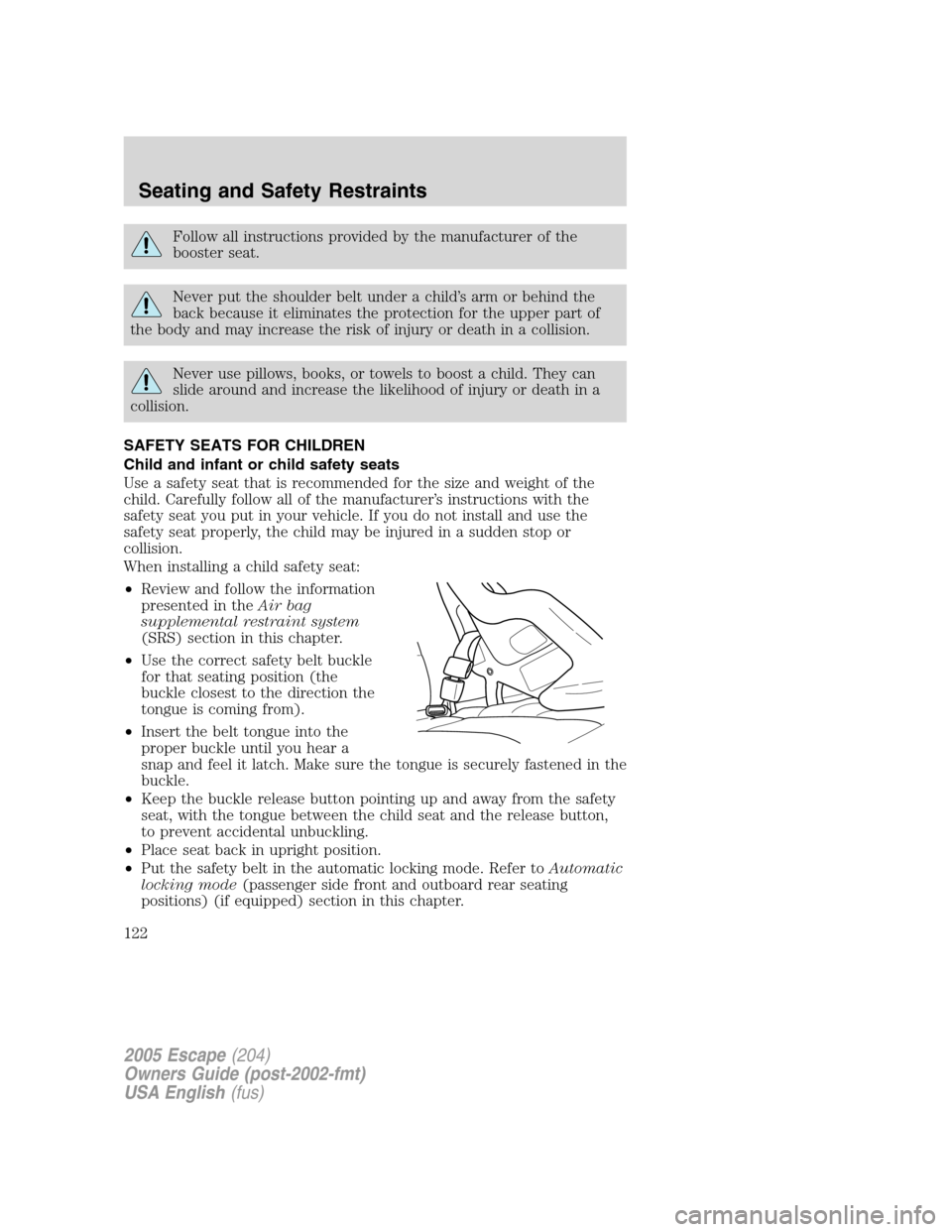
•Insert the belt tongue into the
proper buckle until you hear a
snap and feel it latch. Make sure the tongue is securely fastened in the
buckle.
•Keep the buckle release button pointing up and away from the safety
seat, with the tongue between the child seat and the release button,
to prevent accidental unbuckling.
•Place seat back in upright position.
•Put the safety belt in the automatic locking mode. Refer toAutomatic
locking mode(passenger side front and outboard rear seating
positions) (if equipped) section in this chapter.
2005 Escape(204)
Owners Guide (post-2002-fmt)
USA English(fus)
Seating and Safety Restraints
122
Page 125 of 272
4. Insert the belt tongue into the
proper buckle (the buckle closest to
the direction the tongue is coming
from) for that seating position until
you hear a snap and feel the latch
engage. Make sure the tongue is
latched securely by pulling on it.
5. To put the retractor in the
automatic locking mode, grasp the
shoulder portion of the belt and pull
downward until all of the belt is
extracted and a click is heard.
6. Allow the belt to retract. The belt will click as it retracts to indicate it
is in the automatic locking mode.
7. Pull the lap belt portion across
the child seat toward the buckle and
pull up on the shoulder belt while
pushing down with your knee on the
child seat.
2005 Escape(204)
Owners Guide (post-2002-fmt)
USA English(fus)
Seating and Safety Restraints
125
Page 127 of 272
3. Locate the correct anchor for the
selected seating position.
There are three tether anchors
located on the headliner at the rear
of the vehicle.
4. Clip the tether strap to the
anchor as shown.
The arrow in the above graphic
points toward the front of the
vehicle.
If the tether strap is clipped
incorrectly, the child safety
seat may not be retained properly
in the event of a collision.
5. Install the child safety seat tightly
using the LATCH anchors or safety
belts. Follow the instructions in this chapter.
6. Tighten the child safety seat tether strap according to the
manufacturer’s instructions.
If the safety seat is not anchored properly, the risk of a child
being injured in a collision greatly increases.
2005 Escape(204)
Owners Guide (post-2002-fmt)
USA English(fus)
Seating and Safety Restraints
127
Page 140 of 272

To put your vehicle in gear:
•Start the engine
•Depress the brake pedal
•Move the gearshift lever into the desired gear
To put your vehicle in P (Park):
•Come to a complete stop
•Move the gearshift lever and securely latch it in P (Park)
Always set the parking brake fully and make sure the gearshift is
latched in P (Park). Turn the ignition to the LOCK position and
remove the key whenever you leave your vehicle.
R (Reverse)
With the gearshift lever in R (Reverse), the vehicle will move backward.
Always come to a complete stop before shifting into and out of R
(Reverse).
N (Neutral)
With the gearshift lever in N (Neutral), the vehicle can be started and is
free to roll. Hold the brake pedal down while in this position.
D (Overdrive)
The normal driving position for the
best fuel economy. Transaxle
operates in gears one through four.
D (Overdrive) can be deactivated by
pressing the O/D OFF switch on the
side of the gearshift lever. This will
illuminate the O/D OFF light and
activate Drive.
Drive (O/D OFF switch pressed)
Drive is activated when the O/D OFF switch is pressed.
•This position allows for all forward gears except overdrive.
•O/D OFF light is illuminated.
•Provides engine braking.
•Use when driving conditions cause excessive shifting from O/D to
other gears. Examples: city traffic, hilly terrain, heavy loads, trailer
towing and when engine braking is required.
2005 Escape(204)
Owners Guide (post-2002-fmt)
USA English(fus)
Driving
140
Page 158 of 272
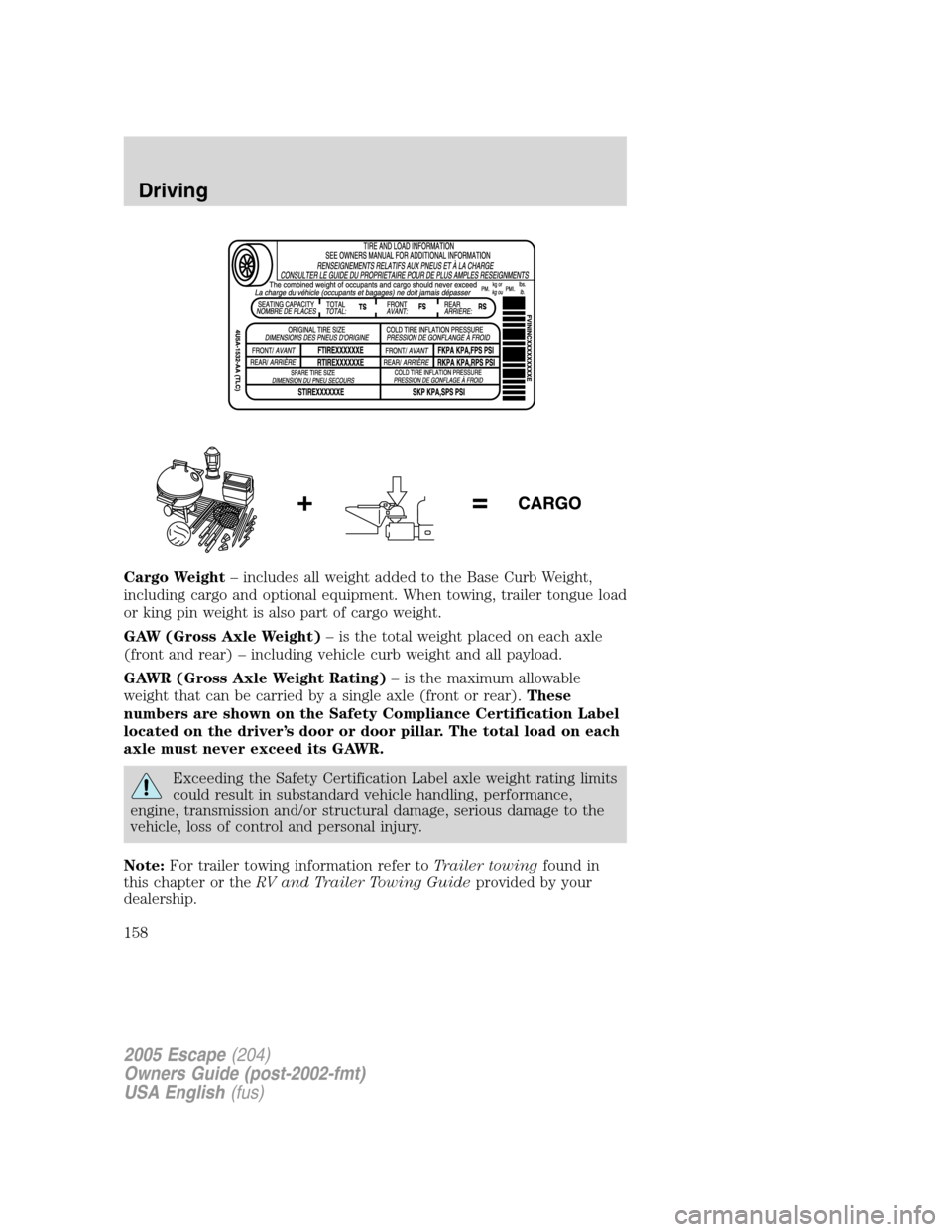
Cargo Weight–includes all weight added to the Base Curb Weight,
including cargo and optional equipment. When towing, trailer tongue load
or king pin weight is also part of cargo weight.
GAW (Gross Axle Weight)–is the total weight placed on each axle
(front and rear)–including vehicle curb weight and all payload.
GAWR (Gross Axle Weight Rating)–is the maximum allowable
weight that can be carried by a single axle (front or rear).These
numbers are shown on the Safety Compliance Certification Label
located on the driver’s door or door pillar. The total load on each
axle must never exceed its GAWR.
Exceeding the Safety Certification Label axle weight rating limits
could result in substandard vehicle handling, performance,
engine, transmission and/or structural damage, serious damage to the
vehicle, loss of control and personal injury.
Note:For trailer towing information refer toTrailer towingfound in
this chapter or theRV and Trailer Towing Guideprovided by your
dealership.
2005 Escape(204)
Owners Guide (post-2002-fmt)
USA English(fus)
Driving
158