2005 FORD E SERIES brakes
[x] Cancel search: brakesPage 152 of 248

Parking brake
To set the parking brake (1), press
the parking brake pedal down until
the pedal stops.
To release, pull the lever (2).
Always set the parking
brake fully and make sure
that the gearshift is securely
latched in P (Park).
The BRAKE warning lamp will
illuminate and will remain
illuminated until the parking brake
is released.
The parking brake is not recommended to stop a moving vehicle.
However, if the normal brakes fail, the parking brake can be used to stop
your vehicle in an emergency. Since the parking brake applies only the
rear brakes, the vehicle’s stopping distance will increase greatly and the
handling of your vehicle will be adversely affected.
STEERING
To prevent damage to the power steering system:
•Never hold the steering wheel at its furthest turning points (until it
stops) for more than a few seconds when the engine is running.
•Do not operate the vehicle with a low power steering pump fluid level
(If the fluid level is below the FULL COLD range on the dipstick).
If the power steering system breaks down (or if the engine is turned
off), you can steer the vehicle manually, but it takes more effort.
If the steering wanders or pulls, check for:
•an improperly inflated tire
•uneven tire wear
•loose or worn suspension components
•loose or worn steering components
•improper steering alignment
P!
BRAKE
REVIEW COPY
2005 Econoline(eco), Owners Guide (post-2002-fmt)(own2002),
Market:USA_English(fus)
Driving
152
Page 155 of 248

•If the vehicle goes from one type of surface to another (i.e., from
concrete to gravel) there will be a change in the way the vehicle
responds to a maneuver (steering, acceleration or braking). Again,
avoid these abrupt inputs.
AUTOMATIC TRANSMISSION OPERATION
Brake-shift interlock
This vehicle is equipped with a brake-shift interlock feature that prevents
the gearshift lever from being moved from P (Park) when the ignition is
in the ON position unless brake pedal is depressed.
If you cannot move the gearshift lever out of P (Park) with ignition in
the ON position and the brake pedal depressed:
1. Apply the parking brake, turn ignition key to LOCK, then remove the
key.
2. Insert the key and turn it to OFF.Apply the brake pedal and shift
to N (Neutral).
When the key is in the ignition and in the OFF position, the
automatic transmission shift lever can be moved from the P
(Park) position without the brake pedal depressed. To avoid unwanted
vehicle movement, always set the parking brake.
3. Start the vehicle.
If it is necessary to use the above procedure to move the gearshift lever,
it is possible that a fuse has blown or the vehicle’s brakelamps are not
operating properly. Refer toFuses and relaysin theRoadside
Emergencieschapter.
Do not drive your vehicle until you verify that the brakelamps
are working.
Always set the parking brake fully and make sure the gearshift is
latched in P (Park). Turn the ignition to the LOCK position and
remove the key whenever you leave your vehicle.
If the parking brake is fully released, but the brake warning lamp
remains illuminated, the brakes may not be working properly.
See your dealer or a qualified service technician as soon as possible.
REVIEW COPY
2005 Econoline(eco), Owners Guide (post-2002-fmt)(own2002),
Market:USA_English(fus)
Driving
155
Page 164 of 248

VEHICLE USED AS A STATIONARY POWER SOURCE
Auxiliary equipment called power take-off, or PTO, is often added to the
engine or transmission to operate utility equipment. Examples include
wheel-lift for tow trucks, tools for construction, and cranes. PTO
applications draw auxiliary horsepower from the powertrain, often while
the vehicle is stationary. In this condition there is limited cooling air flow
through the radiator and around the vehicle that normally occurs when a
vehicle is moving. Depending on the level and duration of auxiliary
horsepower draw, vehicle and surrounding environmental conditions, and
other factors, this can contribute to elevated transmission fluid
temperatures and resultant accelerated fluid deterioration, fuel vapor
over-pressurization, and other concerns. Ford trucks are fully qualified
for stationary PTO operation for 10 minutes or less of continuous
operation. For extended duration stationary PTO operation (beyond 10
minutes) diesel engine is recommended, and further consult your
aftermarket PTO installer.
A more complete description of PTO operation is discussed in the Ford
Truck Body Builders Layout Book, found at
www.fleet.ford.com/truckbbas.
DRIVING THROUGH WATER
If driving through deep or standing water is unavoidable, proceed very
slowly especially when the depth is not known. Never drive through
water that is higher than the bottom of the hubs (for trucks) or the
bottom of the wheel rims (for cars). When driving through water,
traction or brake capability may be limited. Also, water may enter your
engine’s air intake and severely damage your engine or your vehicle may
stall.Driving through deep water where the transmission vent
tube is submerged may allow water into the transmission and
cause internal transmission damage.
Once through the water, always dry the brakes by moving your
vehicle slowly while applying light pressure on the brake pedal.
Wet brakes do not stop the vehicle as quickly as dry brakes.
REVIEW COPY
2005 Econoline(eco), Owners Guide (post-2002-fmt)(own2002),
Market:USA_English(fus)
Driving
164
Page 222 of 248

5. Recheck the fluid level on the dipstick. Do not add fluid if the level is
between the arrows in the FULL COLD range.
6. If the fluid is low, add fluid in small amounts, continuously checking
the level until it reaches the FULL COLD range. Be sure to put the
dipstick back in the reservoir.
BRAKE FLUID RESERVOIR
The fluid level will drop slowly as
the brakes wear, and will rise when
the brake components are replaced.
Fluid levels below the “MAX” line
that do not trigger the brake system
warning lamp are within the normal
operating range, there is no need to
add fluid. If the fluid levels are outside of the normal operating range,
the performance of your brake system could be compromised, seek
service from your dealer immediately.
DRIVELINE UNIVERSAL JOINT AND SLIP YOKE
Your vehicle may be equipped with universal joints that require
lubrication. Refer to theScheduled Maintenance Guidefor
maintenance intervals. If the original universal joints are replaced with
universal joints equipped with grease fittings, lubrication will also be
necessary.
TRANSMISSION FLUID
Checking automatic transmission fluid (if equipped)
Refer to yourScheduled Maintenance Guidefor scheduled intervals for
fluid checks and changes. Your transmission does not consume fluid.
However, the fluid level should be checked if the transmission is not
working properly, i.e., if the transmission slips or shifts slowly or if you
notice some sign of fluid leakage.
Automatic transmission fluid expands when warmed. To obtain an
accurate fluid check, drive the vehicle until it is at normal operating
temperature (approximately 30 km [20 miles]). If your vehicle has been
operated for an extended period at high speeds, in city traffic during hot
weather or pulling a trailer, the vehicle should be turned off for about 30
minutes to allow fluid to cool before checking.
1. Drive the vehicle 30 km (20 miles) or until it reaches normal operating
temperature.
M
AX
REVIEW COPY
2005 Econoline(eco), Owners Guide (post-2002-fmt)(own2002),
Market:USA_English(fus)
Maintenance and Specifications
222
Page 243 of 248

A
Accessory delay ..........................57
Air bag supplemental restraint
system ..........................................83
and child safety seats ..............85
description ................................83
disposal ......................................87
driver air bag ............................85
indicator light ...........................87
operation ...................................85
passenger air bag .....................85
Air cleaner filter ...............226–227
Ambulance packages ....................8
Antifreeze
(see Engine coolant) ................205
Anti-lock brake system
(see Brakes) ..............................151
Audio system
(see Radio) ....18, 20, 22, 25, 28, 33
Automatic transmission
driving an automatic
overdrive .................156, 158, 161
fluid, adding ............................222
fluid, checking ........................222
fluid, refill capacities ..............228
fluid, specification ..................236
Auxiliary power point .................56
Axle
lubricant specifications ..233, 236
refill capacities ........................228
traction lok ..............................153
B
Battery .......................................203
acid, treating emergencies .....203
jumping a disabled battery ....176
maintenance-free ....................203replacement, specifications ...227
servicing ..................................203
BeltMinder ...................................78
Brakes ........................................151
anti-lock ...................................151
anti-lock brake system (ABS)
warning light ...........................151
fluid, checking and adding ....222
fluid, refill capacities ..............228
fluid, specifications .........233, 236
lubricant specifications ..233, 236
parking ....................................152
shift interlock ..........................155
Break-in period .............................5
Bulbs ............................................47
C
Capacities for refilling fluids ....228
Cell phone use ............................56
Child safety restraints ................88
child safety belts ......................88
Child safety seats ........................91
in front seat ..............................92
in rear seat ................................92
tether anchorage hardware .....95
Cleaning your vehicle
engine compartment ..............193
exterior ....................................195
instrument panel ....................194
interior .....................................195
interior trim ............................194
plastic parts ............................193
safety belts ..............................195
washing ....................................191
waxing .....................................191
wheels ......................................192
wiper blades ............................194
REVIEW COPY
2005 Econoline(eco), Owners Guide (post-2002-fmt)(own2002),
Market:USA_English(fus)
Index
Index
243
Page 246 of 248
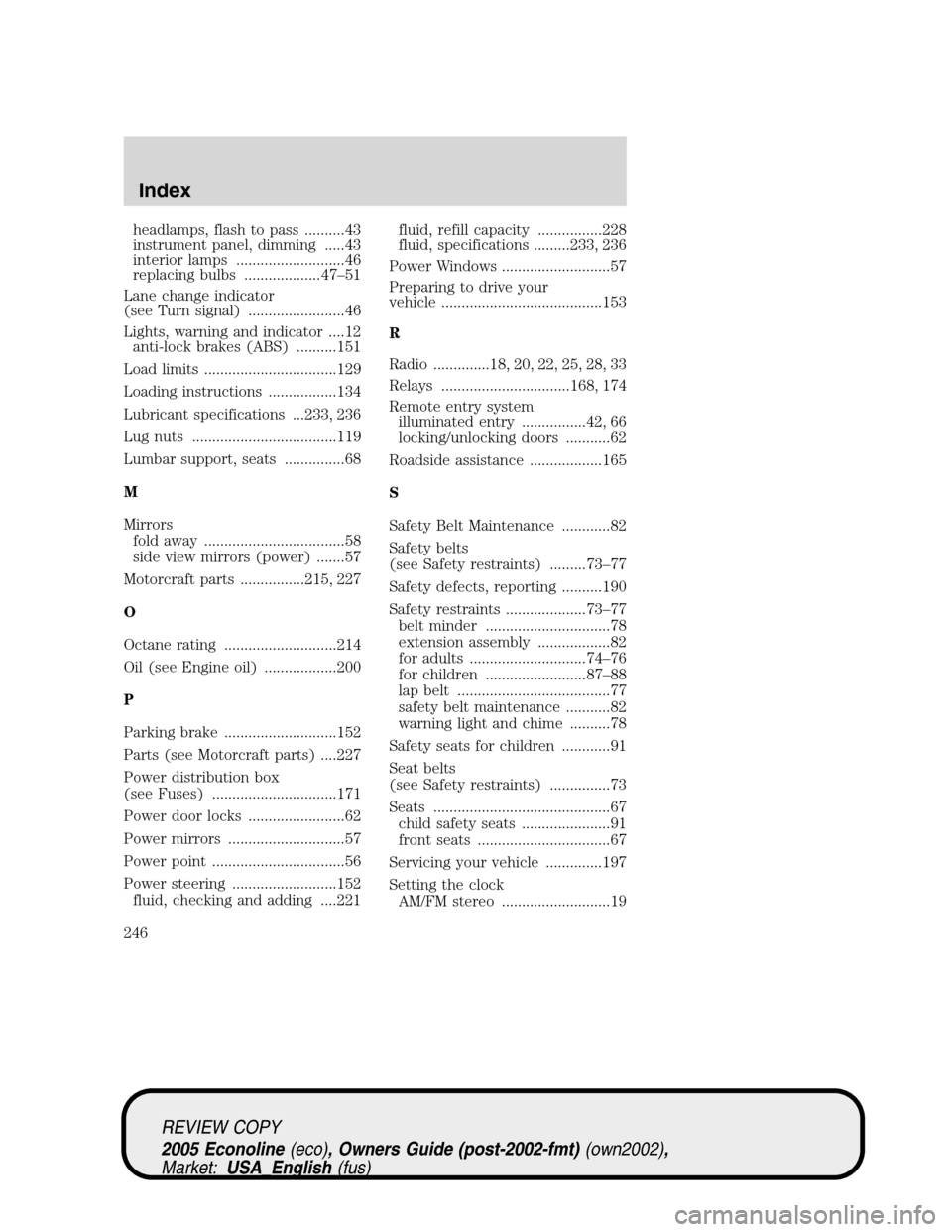
headlamps, flash to pass ..........43
instrument panel, dimming .....43
interior lamps ...........................46
replacing bulbs ...................47–51
Lane change indicator
(see Turn signal) ........................46
Lights, warning and indicator ....12
anti-lock brakes (ABS) ..........151
Load limits .................................129
Loading instructions .................134
Lubricant specifications ...233, 236
Lug nuts ....................................119
Lumbar support, seats ...............68
M
Mirrors
fold away ...................................58
side view mirrors (power) .......57
Motorcraft parts ................215, 227
O
Octane rating ............................214
Oil (see Engine oil) ..................200
P
Parking brake ............................152
Parts (see Motorcraft parts) ....227
Power distribution box
(see Fuses) ...............................171
Power door locks ........................62
Power mirrors .............................57
Power point .................................56
Power steering ..........................152
fluid, checking and adding ....221fluid, refill capacity ................228
fluid, specifications .........233, 236
Power Windows ...........................57
Preparing to drive your
vehicle ........................................153
R
Radio ..............18, 20, 22, 25, 28, 33
Relays ................................168, 174
Remote entry system
illuminated entry ................42, 66
locking/unlocking doors ...........62
Roadside assistance ..................165
S
Safety Belt Maintenance ............82
Safety belts
(see Safety restraints) .........73–77
Safety defects, reporting ..........190
Safety restraints ....................73–77
belt minder ...............................78
extension assembly ..................82
for adults .............................74–76
for children .........................87–88
lap belt ......................................77
safety belt maintenance ...........82
warning light and chime ..........78
Safety seats for children ............91
Seat belts
(see Safety restraints) ...............73
Seats ............................................67
child safety seats ......................91
front seats .................................67
Servicing your vehicle ..............197
Setting the clock
AM/FM stereo ...........................19
REVIEW COPY
2005 Econoline(eco), Owners Guide (post-2002-fmt)(own2002),
Market:USA_English(fus)
Index
246