2005 FORD CROWN VICTORIA park assist
[x] Cancel search: park assistPage 165 of 264
Trailer lamps
Trailer lamps are required on most towed vehicles. Make sure all running
lights, brake lights, turn signals and hazard lights are working. See your
dealer or trailer rental agency for proper instructions and equipment for
hooking up trailer lamps.
Driving while you tow
When towing a trailer:
•Turn off the speed control. The speed control may shut off
automatically when you are towing on long, steep grades.
•Consult your local motor vehicle speed regulations for towing a trailer.
•To eliminate excessive shifting, use a lower gear. This will also assist
in transmission cooling. (For additional information, refer to
Understanding the gearshift positions of the 4–speed automatic
transmissionin theDriving chapter.
•Anticipate stops and brake gradually.
•Do not exceed the GCWR rating or transmission damage may occur.
Servicing after towing
If you tow a trailer for long distances, your vehicle will require more
frequent service intervals. Refer to yourScheduled Maintenance
Informationfor more information.
Trailer towing tips
•Practice turning, stopping and backing up before starting on a trip to
get the feel of the vehicle trailer combination. When turning, make
wider turns so the trailer wheels will clear curbs and other obstacles.
•Allow more distance for stopping with a trailer attached.
•If you are driving down a long or steep hill, shift to a lower gear. Do
not apply the brakes continuously, as they may overheat and become
less effective.
•The trailer tongue weight should be 10–15% of the loaded trailer
weight.
•After you have traveled 50 miles (80 km), thoroughly check your
hitch, electrical connections and trailer wheel lug nuts.
•To aid in engine/transmission cooling and A/C efficiency during hot
weather while stopped in traffic, place the gearshift lever in P (Park).
•Vehicles with trailers should not be parked on a grade. If you must
park on a grade, place wheel chocks under the trailer’s wheels.
2005 Crown Victoria(cro)
Owners Guide (post-2002-fmt)
USA(fus)
Tires, Wheels and Loading
165
Page 189 of 264
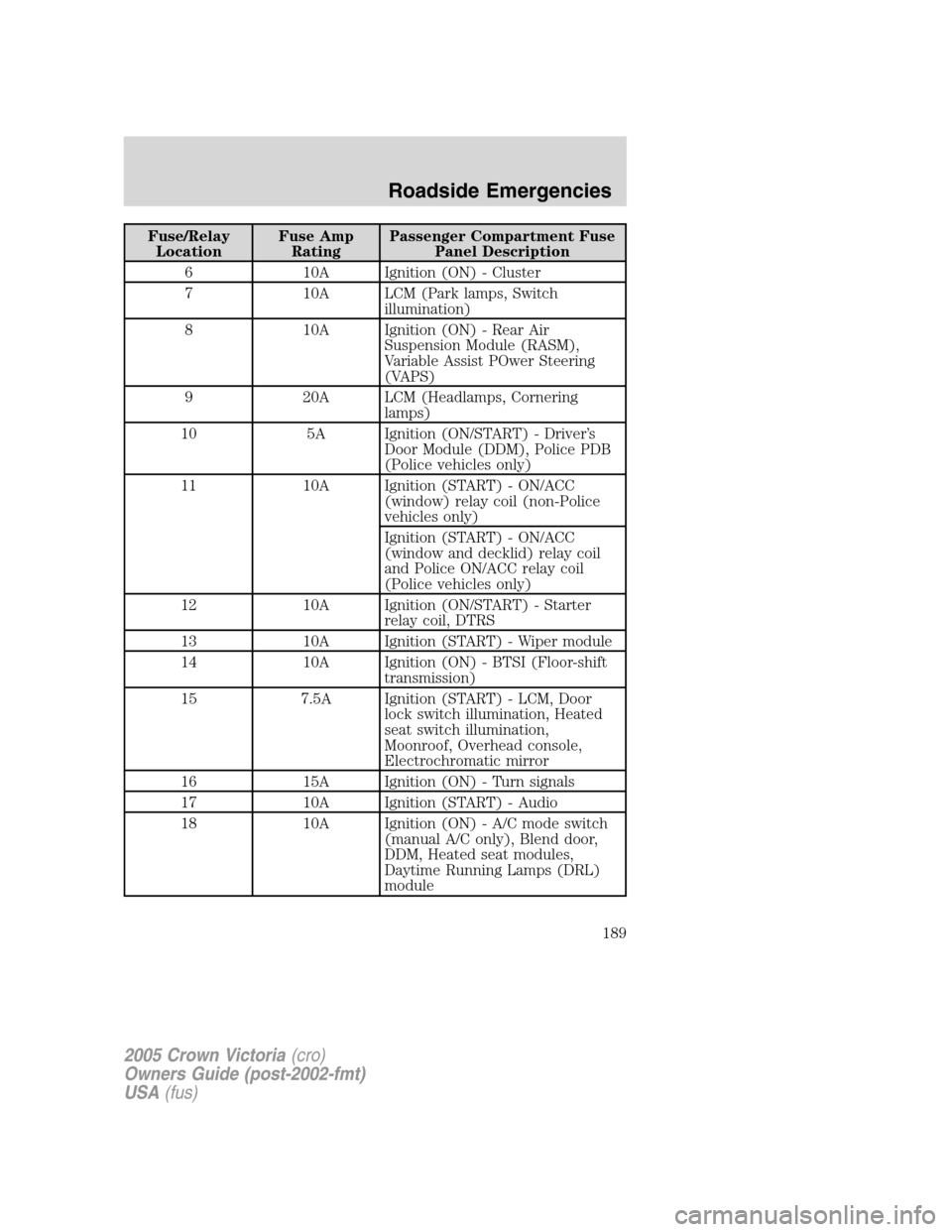
Fuse/Relay
LocationFuse Amp
RatingPassenger Compartment Fuse
Panel Description
6 10A Ignition (ON) - Cluster
7 10A LCM (Park lamps, Switch
illumination)
8 10A Ignition (ON) - Rear Air
Suspension Module (RASM),
Variable Assist POwer Steering
(VAPS)
9 20A LCM (Headlamps, Cornering
lamps)
10 5A Ignition (ON/START) - Driver’s
Door Module (DDM), Police PDB
(Police vehicles only)
11 10A Ignition (START) - ON/ACC
(window) relay coil (non-Police
vehicles only)
Ignition (START) - ON/ACC
(window and decklid) relay coil
and Police ON/ACC relay coil
(Police vehicles only)
12 10A Ignition (ON/START) - Starter
relay coil, DTRS
13 10A Ignition (START) - Wiper module
14 10A Ignition (ON) - BTSI (Floor-shift
transmission)
15 7.5A Ignition (START) - LCM, Door
lock switch illumination, Heated
seat switch illumination,
Moonroof, Overhead console,
Electrochromatic mirror
16 15A Ignition (ON) - Turn signals
17 10A Ignition (START) - Audio
18 10A Ignition (ON) - A/C mode switch
(manual A/C only), Blend door,
DDM, Heated seat modules,
Daytime Running Lamps (DRL)
module
2005 Crown Victoria(cro)
Owners Guide (post-2002-fmt)
USA(fus)
Roadside Emergencies
189
Page 197 of 264
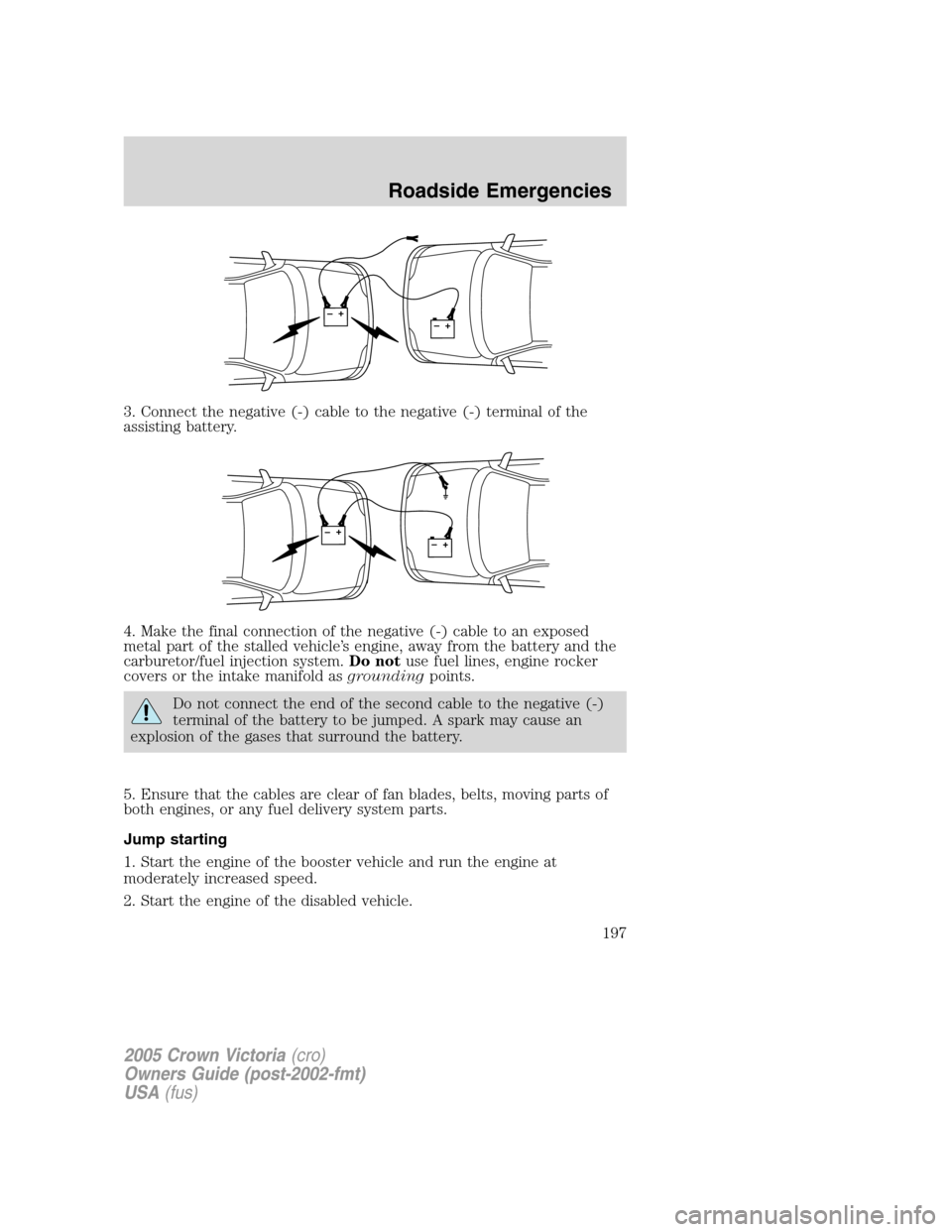
3. Connect the negative (-) cable to the negative (-) terminal of the
assisting battery.
4. Make the final connection of the negative (-) cable to an exposed
metal part of the stalled vehicle’s engine, away from the battery and the
carburetor/fuel injection system.Do notuse fuel lines, engine rocker
covers or the intake manifold asgroundingpoints.
Do not connect the end of the second cable to the negative (-)
terminal of the battery to be jumped. A spark may cause an
explosion of the gases that surround the battery.
5. Ensure that the cables are clear of fan blades, belts, moving parts of
both engines, or any fuel delivery system parts.
Jump starting
1. Start the engine of the booster vehicle and run the engine at
moderately increased speed.
2. Start the engine of the disabled vehicle.
+–+–
+–+–
2005 Crown Victoria(cro)
Owners Guide (post-2002-fmt)
USA(fus)
Roadside Emergencies
197
Page 208 of 264
information is subject to change, please ask your dealer for complete
details about Ford Extended Service Plan coverage options, or visit the
Ford ESP website at www.ford-esp.com.
GETTING ASSISTANCE OUTSIDE THE U.S. AND CANADA
Before exporting your vehicle to a foreign country, contact the
appropriate foreign embassy or consulate. These officials can inform you
of local vehicle registration regulations and where to find unleaded fuel.
If you cannot find unleaded fuel or can only get fuel with an anti-knock
index lower than is recommended for your vehicle, contact a regional
office or owner relations/customer relationship office.
The use of leaded fuel in your vehicle without proper conversion may
damage the effectiveness of your emission control system and may cause
engine knocking or serious engine damage. Ford Motor Company/Ford of
Canada is not responsible for any damage caused by use of improper
fuel. Using leaded fuel may also result in difficulty importing your vehicle
back into the U.S.
If your vehicle must be serviced while you are traveling or living in
Central or South America, the Caribbean, or the Middle East, contact the
nearest Ford dealership. If the dealership cannot help you, write or call:
FORD MOTOR COMPANY
WORLDWIDE DIRECT MARKET OPERATIONS
1555 Fairlane Drive
Fairlane Business Park #3
Allen Park, Michigan 48101
U.S.A.
Telephone: (313) 594-4857
FAX: (313) 390-0804
If you are in another foreign country, contact the nearest Ford
dealership. If the dealership employees cannot help you, they can direct
you to the nearest Ford affiliate office.
If you buy your vehicle in North America and then relocate outside of
the U.S. or Canada, register your vehicle identification number (VIN) and
new address with Ford Motor Company Worldwide Direct Market
Operations.
ORDERING ADDITIONAL OWNER’S LITERATURE
To order the publications in this portfolio, contact Helm, Incorporated at:
HELM, INCORPORATED
P.O. Box 07150
Detroit, Michigan 48207
2005 Crown Victoria(cro)
Owners Guide (post-2002-fmt)
USA(fus)
Customer Assistance
208
Page 239 of 264
emission control, such non-Ford parts should be equivalent to genuine
Ford Motor Company parts in performance and durability.
Do not park, idle, or drive your vehicle in dry grass or other dry
ground cover. The emission system heats up the engine
compartment and exhaust system, which can start a fire.
Illumination of the “Check Engine” light, charging system warning light
or the temperature warning light, fluid leaks, strange odors, smoke or
loss of engine power, could indicate that the emission control system is
not working properly.
Exhaust leaks may result in entry of harmful and potentially
lethal fumes into the passenger compartment.
Do not make any unauthorized changes to your vehicle or engine. By
law, vehicle owners and anyone who manufactures, repairs, services,
sells, leases, trades vehicles, or supervises a fleet of vehicles are not
permitted to intentionally remove an emission control device or prevent
it from working. Information about your vehicle’s emission system is on
the Vehicle Emission Control Information Decal located on or near the
engine. This decal identifies engine displacement and gives some tune up
specifications.
Please consult yourWarranty Guidefor complete emission warranty
information.
On board diagnostics (OBD-II)
Your vehicle is equipped with a computer that monitors the engine’s
emission control system. This system is commonly known as the On
Board Diagnostics System (OBD-II). This OBD-II system protects the
environment by ensuring that your vehicle continues to meet
government emission standards. The OBD-II system also assists the
service technician in properly servicing your vehicle. When theCheck
engine/Service engine soonlight illuminates, the OBD-II system has
detected a malfunction. Temporary malfunctions may cause yourCheck
engine/Service engine soonlight to illuminate. Examples are:
1. The vehicle has run out of fuel. (The engine may misfire or run
poorly.)
2. Poor fuel quality or water in the fuel.
3. The fuel cap may not have been securely tightened. SeeFuel filler
capin this chapter.
2005 Crown Victoria(cro)
Owners Guide (post-2002-fmt)
USA(fus)
Maintenance and Specifications
239
Page 259 of 264
Rear window defroster ...............42
Relays ................................186, 195
Remote entry system .................84
illuminated entry ......................88
locking/unlocking doors ...........85
opening the trunk .....................86
replacement/additional
transmitters ...............................87
Roadside assistance ..................184
S
Safety Belt Maintenance ..........114
Safety belts (see Safety
restraints) ..........100, 103, 105–107
Safety defects, reporting ..........209
Safety
restraints ...........100, 103, 105–107
belt minder .............................109
extension assembly ................113
for adults .........................105–107
for children .............................125
lap belt ....................................108
Occupant Classification
Sensor ......................................101
safety belt maintenance .........114
warning light and
chime ...............................108–109
Safety seats for children ..........128
Safety Compliance
Certification Label ....................250
Seat belts
(see Safety restraints) .............100
Seats ............................................95
child safety seats ....................128
front seats .................................95
SecuriLock passive anti-theft
system ..........................................93Servicing your vehicle ..............216
Setting the clock
AM/FM single CD .....................27
AM/FM stereo ...........................21
AM/FM/Cassette ........................22
AM/FM/In-dash 6 CD ................36
AM/FM/Tape/CD .......................31
Spark plugs,
specifications .....................245, 249
Specification chart,
lubricants ...........................247, 249
Speed control ..............................67
Starting your
vehicle ........................167–168, 170
jump starting ..........................195
Steering
speed sensitive .......................176
Steering wheel
controls ......................................70
tilting .........................................54
T
Tilt steering wheel ......................54
Tires ...........................136–137, 141
alignment ................................154
care ..........................................153
changing ..........................141, 143
checking the pressure ............139
inspecting and inflating .........138
label .........................................152
replacing ..................................140
rotating ....................................155
safety practices .......................154
sidewall information ...............147
snow tires and chains ............156
spare tire .........................141–142
terminology .............................137
tire grades ...............................137
treadwear ........................136, 153
2005 Crown Victoria(cro)
Owners Guide (post-2002-fmt)
USA(fus)
Index
259