Page 124 of 258

123GETTING THE BEST OUT OF YOUR VEHICLE
– if you are forced to stop your ve-
hicle (breakdown, limited visibility,
etc.) try to stop off the road. Turn on
the hazard lights and, if possible, the
dipped beam headlights. Rhythmically
sound the horn if you release anoth-
er vehicle is coming.
DRIVING IN THE
MOUNTAINS
– Check fluid levels (oil, brake fluid,
coolant) and tyre wear before driving
in the mountains;
– when driving downhill use the en-
gine braking effect by engaging a low
gear so as not to overheat the brakes;
– under no circumstances should you
drive downhill with the engine off or
with the gear in neutral, let alone with
the ignition key out;
– drive at moderate speed and avoid
“cutting” corners;
– remember that overtaking while
going uphill is slower and therefore re-
quires more free road. If you are be-
ing overtaken while driving uphill,
make it easier for the other vehicle
to pass.DRIVING ON SNOW
AND ICE
Here are some tips for driving in
these conditions:
– keep your speed down;
– use chains if the roads are covered
with snow;
– do not park the vehicle with the
engine running for long periods of
time: snow could divert exhaust fumes
into the passenger compartment;
– mainly use the braking effect of the
engine and under all circumstances
avoid braking sharply;
– when braking a vehicle not fitted
with ABS, reduce the possibility of the
wheels locking by varying the pressure
you exert on the brake pedal;
– do not accelerate suddenly and
avoid swerving;– in the winter, even apparently dry
roads may have icy patches. Be care-
ful therefore when driving over
stretches that do not get much expo-
sure to the sun or are lined with trees
or rocks where ice might not have
melted;
– keep a good distance from the ve-
hicles in front.
DRIVING WITH ABS
– ABS is a braking system that es-
sentially offers two advantages:
1) It prevents wheel lock and con-
sequent skidding in emergency stops,
particularly when the road does not
offer much grip.
2) it makes it possible to brake and
steer at the same time and direct the
vehicle where you want while braking.
Page 139 of 258

138IN AN EMERGENCY
1. STOP THE VEHICLE
– Stop the vehicle in a position that
is not dangerous for oncoming traffic
where you can change the wheel safe-
ly. The ground should be flat and ad-
equately firm. If you have to change
the wheel at night, choose a lit area if
possible.
– Turn the engine off and pull up the
handbrake.
– Engage first or reverse gear.
– Alert other drivers that the vehicle
is stationary in compliance with local
regulations: hazard warning lights,
warning triangle, etc.
Any passengers should get out and
wait as far away as possible from the
danger of traffic.
If the road is sloping or bumpy, place
wedges or other suitable material to
prevent the vehicle from moving, un-
der the wheels.2. TAKE OUT THE TOOLS,
JACK AND SPARE WHEEL
The tools are in the cab near the
seats.
Please note:
– the jack weights 4.2 kg;
– the jack requires no adjustments;
– the jack cannot be repaired. If it
breaks it must be replaced with a new
jack;
– no other tool, apart from the ex-
tension and the ratchet wrench shown
in this chapter can be fitted to the jack.
The spare wheel is located under the
rear part of the load bed.
Do not lubricate the bolt
threads before fitting
them back: they could come
loose.
WARNING
Check tyre pressure and
spare wheel pressure regu-
larly. Refer to section “Technical
Specifications”.
WARNING
Page 159 of 258
158IN AN EMERGENCY
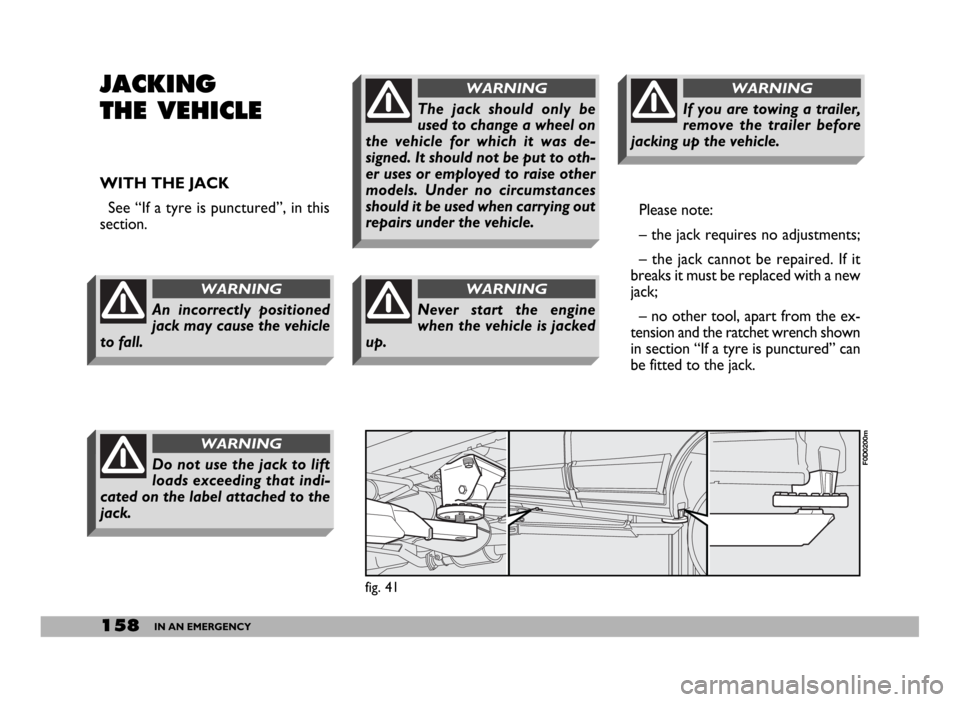
JACKING
THE VEHICLE
WITH THE JACK
See “If a tyre is punctured”, in this
section.Please note:
– the jack requires no adjustments;
– the jack cannot be repaired. If it
breaks it must be replaced with a new
jack;
– no other tool, apart from the ex-
tension and the ratchet wrench shown
in section “If a tyre is punctured” can
be fitted to the jack.
fig. 41
F0D0200mDo not use the jack to lift
loads exceeding that indi-
cated on the label attached to the
jack.
WARNING
The jack should only be
used to change a wheel on
the vehicle for which it was de-
signed. It should not be put to oth-
er uses or employed to raise other
models. Under no circumstances
should it be used when carrying out
repairs under the vehicle.
WARNING
Never start the engine
when the vehicle is jacked
up.
WARNING
An incorrectly positioned
jack may cause the vehicle
to fall.
WARNING
If you are towing a trailer,
remove the trailer before
jacking up the vehicle.
WARNING