2005 FIAT DUCATO 244 condition
[x] Cancel search: conditionPage 171 of 258
170VEHICLE MAINTENANCE
Engine oil consumption
Maximum engine oil consumption is
approx. 450 grams every 1000 Km.
During the beginning of the vehicle’s
life the engine is tuning in. Engine oil
consumption can only be considered
stabilised after the first 5,000 - 6,000
km.
IMPORTANTEngine oil consump-
tion depends on the conditions the ve-
hicle is being used in.ENGINE COOLANT
Check coolant level when the engine
is cold. The level should be included
between the MIN and MAXrefer-
ence lines on the reservoir.
If the level is low, loosen the expan-
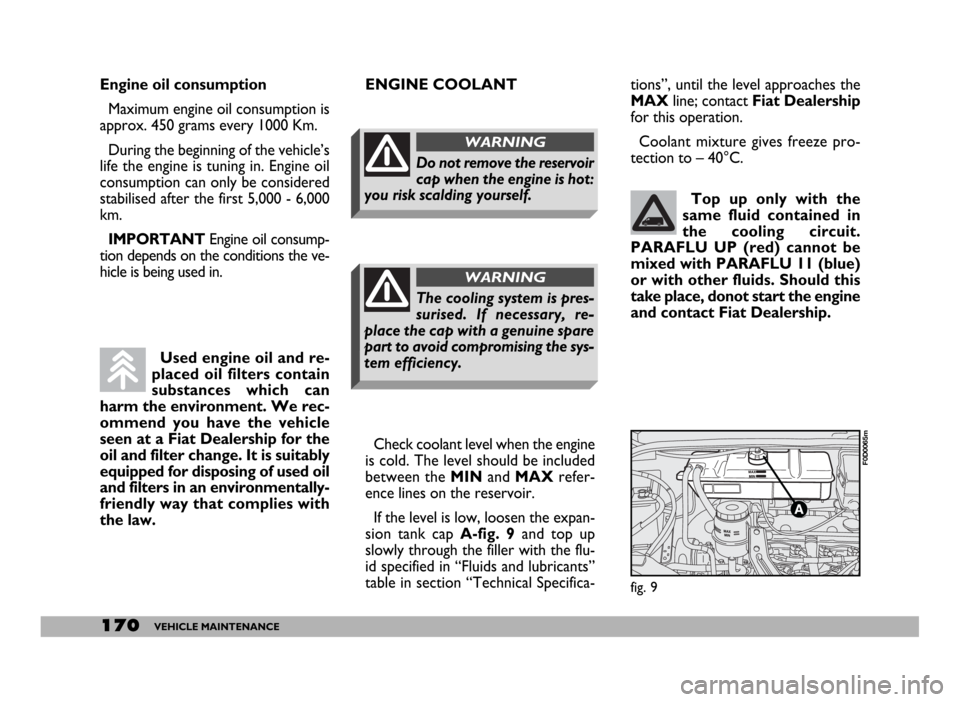
sion tank cap A-fig. 9and top up
slowly through the filler with the flu-
id specified in “Fluids and lubricants”
table in section “Technical Specifica-tions”, until the level approaches the
MAX line; contact Fiat Dealership
for this operation.
Coolant mixture gives freeze pro-
tection to – 40°C.
Used engine oil and re-
placed oil filters contain
substances which can
harm the environment. We rec-
ommend you have the vehicle
seen at a Fiat Dealership for the
oil and filter change. It is suitably
equipped for disposing of used oil
and filters in an environmentally-
friendly way that complies with
the law.
fig. 9
F0D0065m
The cooling system is pres-
surised. If necessary, re-
place the cap with a genuine spare
part to avoid compromising the sys-
tem efficiency.
WARNING
Do not remove the reservoir
cap when the engine is hot:
you risk scalding yourself.
WARNING
Top up only with the
same fluid contained in
the cooling circuit.
PARAFLU UP (red) cannot be
mixed with PARAFLU 11 (blue)
or with other fluids. Should this
take place, donot start the engine
and contact Fiat Dealership.
Page 175 of 258

174VEHICLE MAINTENANCE
REPLACING THE BATTERY
If required, replace the battery with
a genuine spare part presenting the
same specifications. If a battery with
different specifications is fitted, the fre-
quencies shown in the “Service Sched-
ule” will no longer be valid. Refer to
the instructions provided by the bat-
tery manufacturer.
Batteries contain sub-
stances that are very
harmful for the environ-
ment. You are advised to have the
battery changed at a Fiat Dealer-
ship. It is properly equipped for
disposing of used batteries in an
environmentally-friendly way that
complies with the law.
Incorrect fitting of elec-
trical and electronic ac-
cessories can seriously
damage the vehicle. If you want
to add accessories after buying
the vehicle antitheft system, ra-
dio, free-hand phone kit, etc.) vis-
it a Fiat Dealership. They can sug-
gest the most suitable acces-
sories to get and check whether
the electric system can support
the required load or whether a
higher capacity battery is re-
quired.
The liquid in the battery is
poisonous and corrosive.
Do not let it touch the skin or eyes.
Do not bring naked flames or pos-
sible sources or sparks near the bat-
tery: risk of fire and explosion.
WARNING
fig. 15
F0D0244m
BATTERY
Fiat Ducato battery is of the “Limit-
ed maintenance” and is fitted with in-
dicator A-fig. 15to check the elec-
trolyte level and the charge.
Under normal conditions of use it
does not require topping up with dis-
tilled water. However, check it peri-
odically through the control optical in-
dicator that is placed on the battery
cover and must be dark with a cen-
tral green area.
If the indicator is a bright colour, or
dark without the green central area,
contact a Fiat Dealership.
Page 182 of 258
181VEHICLE MAINTENANCE
SPRAY NOZZLES
Windscreen washer
If there is no jet of liquid, first make
sure that there is liquid in the reser-
voir: see “Checking fluid levels” in this
section. Then make sure that the
holes in the nozzles are not clogged
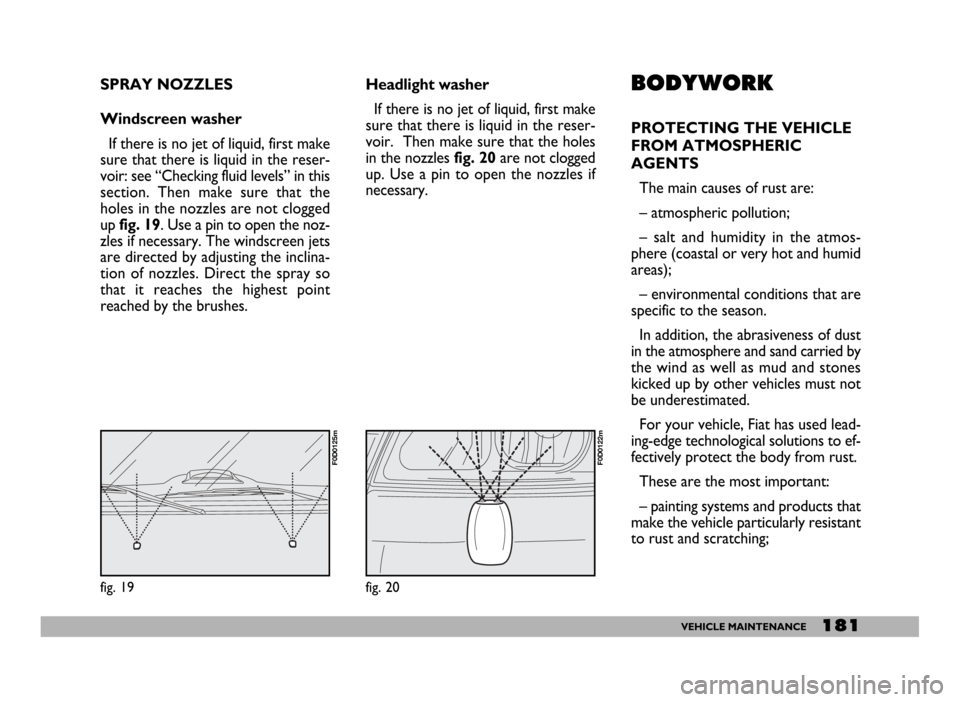
upfig. 19. Use a pin to open the noz-
zles if necessary. The windscreen jets
are directed by adjusting the inclina-
tion of nozzles. Direct the spray so
that it reaches the highest point
reached by the brushes.Headlight washer
If there is no jet of liquid, first make
sure that there is liquid in the reser-
voir. Then make sure that the holes
in the nozzles fig. 20are not clogged
up. Use a pin to open the nozzles if
necessary.BODYWORK
PROTECTING THE VEHICLE
FROM ATMOSPHERIC
AGENTS
The main causes of rust are:
– atmospheric pollution;
– salt and humidity in the atmos-
phere (coastal or very hot and humid
areas);
– environmental conditions that are
specific to the season.
In addition, the abrasiveness of dust
in the atmosphere and sand carried by
the wind as well as mud and stones
kicked up by other vehicles must not
be underestimated.
For your vehicle, Fiat has used lead-
ing-edge technological solutions to ef-
fectively protect the body from rust.
These are the most important:
– painting systems and products that
make the vehicle particularly resistant
to rust and scratching;
fig. 20
F0D0122m
fig. 19
F0D0125m
Page 183 of 258

182VEHICLE MAINTENANCE
– the use of zinc-plated sheet steel
which is highly resistant to rust;
– the spraying of the underbody, en-
gine compartment, inside the wheel-
houses and other parts with wax-
based products with a high protective
capacity;
– spraying plastic-coating materials
to protect the most exposed points:
under the door, inside the wings, the
edges, etc.;
– the use of “open” box sections to
prevent condensation and water from
building up and rusting the inside of
the parts.
BODY AND UNDERBODY
WARRANTY
Your Ducato is covered by warranty
against any original structural or body
part being perforated by rust. Refer to
the Warranty Booklet for the general
terms.TIPS FOR KEEPING THE BODY
IN GOOD CONDITIONS
Paintwork
The paintwork is not only to make
your vehicle look attractive but also
to protect the steel.
If the paint is scuffed or scratched
deeply you are therefore advised to
touch up as necessary to prevent rust
from forming.
Only use genuine products when
touching up the paintwork (see sec-
tion “Technical Specifications”).
Ordinary maintenance of the paint-
work means washing it. The frequency
you should do this depends on the
conditions and the environment the
vehicle is driven in.
For example:
– areas with a high level of air-pollu-
tion;
– roads sprinkled with road saltwash;
– parking under trees which drop
resin. In these cases, wash your vehi-
cle more frequently.To wash the vehicle properly:
1)wash the body using a low pres-
sure jet of water;
2) wipe a sponge with a slightly
soapy solution over the bodywork,
frequently rinsing the sponge;
3) rinse well with water and dry
with a jet of air or a chamois leather.
When drying the vehicle, be careful
to get at those parts which are not so
easily seen, e.g. the door frames, bon-
net and around the headlights where
water can most readily collect. You
should leave the vehicle out in the
open so that any water remaining can
evaporate more easily.
Page 244 of 258

243TECHNICAL SPECIFICATIONS
FUEL CONSUMPTION - CO2EMISSIONS
RUNNING AND USE CONDITIONS AFFECTING FUEL CONSUMPTION
(examples and differences with respect to goods transportation vehicle data)
IMPORTANT
Although fuel consumption mea-
surements procedure aim at defining
realistic values, fuel consumption is in-
fluenced by factors such as:
Driving style and vehicle usehigh
speed, frequent acceleration, frequent
gear shifting, door-to-door deliveries,
etc.
Just for passenger transportation
versions with 2.3 and 2.8 JTD engines,
reduced consumption can be obtained
by starting (on level road) in 2nd gear
instead of 1st gear.
Traffic and road conditions
queues, bending roads, steep roads,
bad road surface, etc.Weather conditions and tem-
peratures
low temperatures, thinner air, wind,
rain etc…;
Vehicle conditions
Poor maintenance (tyre pressure, fil-
ters, spark plugs, etc.), damaged body-
work
Load conditions
Heavy weights, not optimal load dis-
tribution, large weights on roof rack,
etc.
Use of electric devices
Climate control, heater and electric
devices in general
Special conditions of use
Special vehicle conditions of use: roof
rack, trailer, open side windows, type
of tyres, etc.Special trim and adaptations
caravan, motor home, mega box, can-
vas cover, etc.
Some of these conditions are illus-
trated in these figures on the next
pages.
For more information, refer to the
advice in the chapter “Cheap running
that respects the environment.
The fuel consumption values shown
in the table in following pages were de-
fined according to the type-approval
specifications in European Directives.
Consumption values are defined by
means of the following procedures:
– an urban cycle: consisting of a
cold start and a simulated drive in city
streets;
– an extra-urban cycle: consisting
in frequent accelerations, in all gears,
Page 245 of 258

244TECHNICAL SPECIFICATIONS
simulating normal conditions of use.
Speed ranges from 0 to 120 km/h;
– average combined cyclecon-
sisting of 37% urban cycle and 63% ex-
tra-urban cycle.
IMPORTANT Road and traffic
conditions, weather, general con-
ditions of the vehicle, drivingstyle, fittings and accessories, use
of the climate control system,
load, roof racks and other situa-
tions penalising aerodynamic
penetration and effecting rolling
resistance will influence fuel con-
sumption rates which can be dif-
ferent from the values shown inthe table (see “Cheap running
that respects the environment”
in “Driving your car” chapter).
CO
2EMISSIONS AT EXHAUST
The maximum CO
2emission values
shown in the following table refer to
the average combined cycle.
Consumption according to Directive Urban Extra-urban Combined CO
2emissions at exhaust
99/100/EC (litres/100 km)according to Directive
99/100/EC (g/km)
Engine 2.0
Version 11Panorama short wheelbase 16.1 11.2 13.0 306
Combi short wheelbase 15.9 11.0 12.8 301
Panorama short wheelbase 4x4 16,3 11.4 13.2 311
Version 15Combi medium wheelbase 15.911.012.8 301
Combi medium wheelbase
high sided 16
.111.213.0 306
Panorama medium wheelbase 16
.311.413.2 311
Combi short wheelbase 4x4 16
.111.213.0 306
Combi medium wheelbase 4x4 16.111.213.0 306
Engine 2.0 JTD
Version 11Panorama short wheelbase 10.6 8.1 9.0 239
Combi short wheelbase 10.2 7.8 8.7 230
Version 15Combi medium wheelbase 10.68.19.0 239
Page 248 of 258
247INDEX
I I
N N
D D
E E
X X
Bodywork ..................................... 181
- maintenance ............................ 181
- tips for keeping the body
in good conditions ................. 182
- versions .................................... 187
- warranty ................................... 182
Bodywork paint identification
plate ............................................. 186
Bodywork versions ..................... 187
Bonnet ........................................... 84
Bottle holder ................................ 74
Brake fluid level ........................... 172
Brake light replacement ............. 146
Brakes
- handbrake ......................... 108-216
- service and
emergency brake ................... 216
Bulb replacement ........................ 141
Bulb types ..................................... 142
Bump starting ............................... 137Capacities ................................... 239
Ceiling light .................................... 71
Cellular phone set-up ................ 100
Central door locking system .... 83
Changing a wheel ........................ 137
Cheap running that respects
the environment ....................... 127
Checking fluid levels ................... 167
Child restraint systems .............. 22
Cigar lighter ................................. 77
Cleaning seats and fabrics ......... 184
Cleaning the plastic parts .......... 184
Climate control system ............. 57
Clutch ............................................ 216
Controls ........................................ 71
Consumption
- engine oil .................................. 170
- fuel ............................................. 243
Coolant temperature gauge ..... 30ABS .............................................. 88
Additional heater ........................ 58
Adjusting the headlight beam ... 86
Airbags (front and side) ............. 90
Air cleaner .................................... 173
Air vents ........................................ 54
Annual inspection schedule ...... 165
Ashtray .......................................... 77
ASR system ................................... 96
At the filling station .................... 102
Automatic electronic gearbox .. 110
Battery ........................................ 174
- battery cut out ....................... 73
- checking the charge ............... 175
- jump starting .................... 136-157
- recharging ................................ 157
- replacement ............................ 174
- useful advice ............................ 175
Page 256 of 258

The engine of your car is factory filled with Selenia,
a range of lubricants which satisfies the most advanced
international specifications. Specific tests and high technical
characteristicss allow the Seleniarange to guarantee
theoptimumandtop quality performanceof your engine.
SELENIA 20K
API SL lubricant ,which guarantees optimum
performance and maximum wear protection to
aspirated, turbocharged or multivalve petrol engines.
SELENIA PERFORMER
Is particularly ideal for the protection of new
generation petrol engines,
Very effective even in the most severe weather
conditions. It guaranteees a reduction in fuel
consumption (Energy conserving ). SELENIA TD
Oil for aspirated turbocharged or multivalve diesel
engines, guarantees maximum engine cleanliness
and stability at high temperatures.
SELENIA WR
Oil which has been specifically designed for use in
common rail andMultijet diesel engines. Effective dur-
ing cold starts it offers maximim wear protection,
hydraulic tappets control, consumption reduction
and stability at high temperatures.
Oil change? The experts reccomend Selenia.
The Selenia range includes a number of of technologically advanced products:
For further information on Selenia products, please visit the website www.flselenia.com. The complete Selenia range also includes Selenia 20K Alfa Romeo, Selenia Performer 5W-40, Selenia Racing and Selenia Digitech.