Page 132 of 258
131GETTING THE BEST OUT OF YOUR VEHICLE
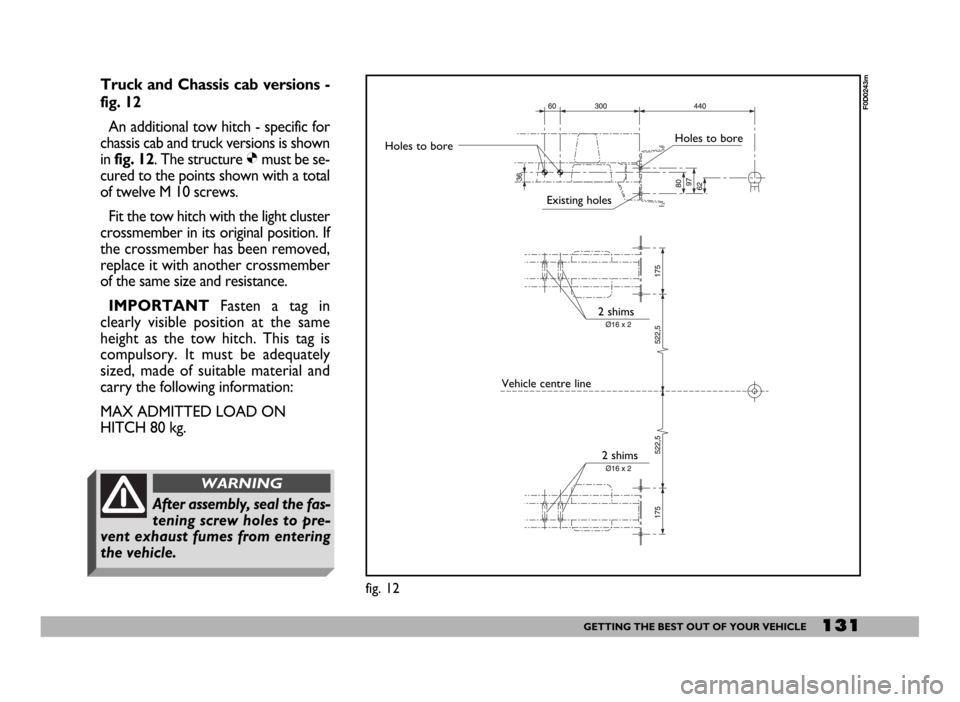
Truck and Chassis cab versions -
fig. 12
An additional tow hitch - specific for
chassis cab and truck versions is shown
in fig. 12. The structure Ømust be se-
cured to the points shown with a total
of twelve M 10 screws.
Fit the tow hitch with the light cluster
crossmember in its original position. If
the crossmember has been removed,
replace it with another crossmember
of the same size and resistance.
IMPORTANTFasten a tag in
clearly visible position at the same
height as the tow hitch. This tag is
compulsory. It must be adequately
sized, made of suitable material and
carry the following information:
MAX ADMITTED LOAD ON
HITCH 80 kg.
fig. 12
F0D0243m
Holes to boreHoles to bore
Existing holes
2 shims
Vehicle centre line
2 shims
After assembly, seal the fas-
tening screw holes to pre-
vent exhaust fumes from entering
the vehicle.
WARNING
Page 138 of 258
137IN AN EMERGENCY
BUMP STARTING IF A TYRE IS
PUNCTURED
General instructions
Observe the instruc-
tions on this and the fol-
lowing pages to use the
jack and spare wheel correctly.Catalysed vehicles must
not be bump started
(pushed, towed or
coasted downhill) as this could
cause fuel to flow into the cat-
alytic exhaust system and dam-
age it beyond repair.
Never start the engine
when the vehicle is jacked
up.
WARNING
Remember that until the
engine has started the
brake booster and power steering
systems will not work and a greater
effort will therefore be required to
depress the brake pedal or turn the
steering wheel.
WARNING
If you are towing a trailer,
remove the trailer before
jacking up the vehicle.
WARNING
The jack should only be
used to changed a wheel on
the vehicle for which it was de-
signed. It should not be put to oth-
er uses or employed to raise other
models. Under no circumstances
should it be used when carrying out
repairs under the vehicle. An incor-
rectly positioned jack may cause
the vehicle to fall. Do not use the
jack to lift loads exceeding that in-
dicated on the label attached to the
to the jack itself.
WARNING
Page 139 of 258

138IN AN EMERGENCY
1. STOP THE VEHICLE
– Stop the vehicle in a position that
is not dangerous for oncoming traffic
where you can change the wheel safe-
ly. The ground should be flat and ad-
equately firm. If you have to change
the wheel at night, choose a lit area if
possible.
– Turn the engine off and pull up the
handbrake.
– Engage first or reverse gear.
– Alert other drivers that the vehicle
is stationary in compliance with local
regulations: hazard warning lights,
warning triangle, etc.
Any passengers should get out and
wait as far away as possible from the
danger of traffic.
If the road is sloping or bumpy, place
wedges or other suitable material to
prevent the vehicle from moving, un-
der the wheels.2. TAKE OUT THE TOOLS,
JACK AND SPARE WHEEL
The tools are in the cab near the
seats.
Please note:
– the jack weights 4.2 kg;
– the jack requires no adjustments;
– the jack cannot be repaired. If it
breaks it must be replaced with a new
jack;
– no other tool, apart from the ex-
tension and the ratchet wrench shown
in this chapter can be fitted to the jack.
The spare wheel is located under the
rear part of the load bed.
Do not lubricate the bolt
threads before fitting
them back: they could come
loose.
WARNING
Check tyre pressure and
spare wheel pressure regu-
larly. Refer to section “Technical
Specifications”.
WARNING
Page 159 of 258
158IN AN EMERGENCY
JACKING
THE VEHICLE
WITH THE JACK
See “If a tyre is punctured”, in this
section.Please note:
– the jack requires no adjustments;
– the jack cannot be repaired. If it
breaks it must be replaced with a new
jack;
– no other tool, apart from the ex-
tension and the ratchet wrench shown
in section “If a tyre is punctured” can
be fitted to the jack.
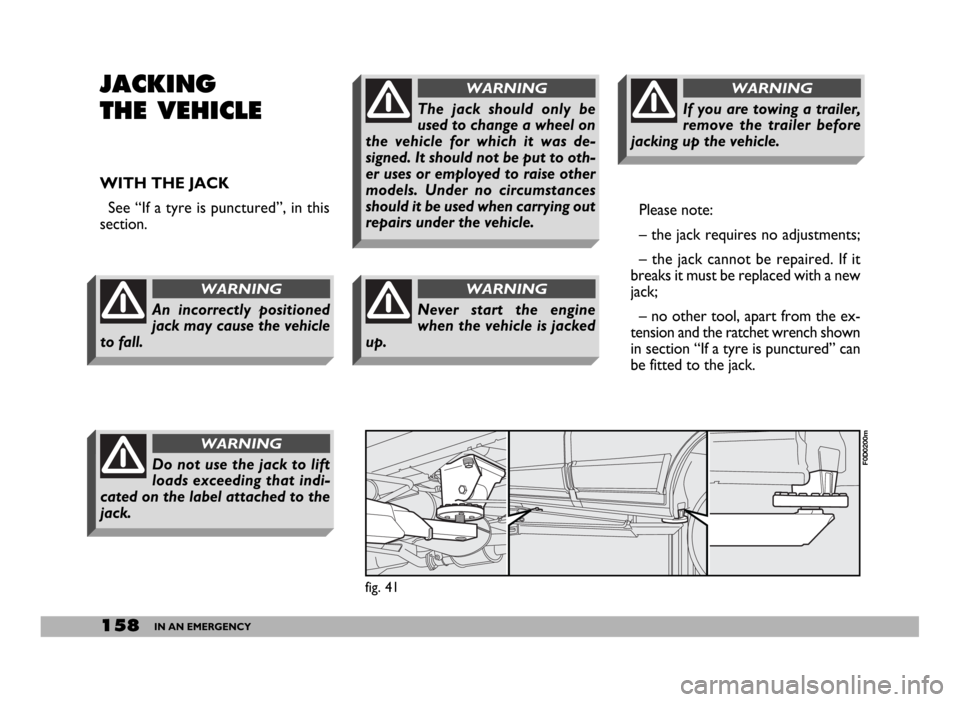
fig. 41
F0D0200mDo not use the jack to lift
loads exceeding that indi-
cated on the label attached to the
jack.
WARNING
The jack should only be
used to change a wheel on
the vehicle for which it was de-
signed. It should not be put to oth-
er uses or employed to raise other
models. Under no circumstances
should it be used when carrying out
repairs under the vehicle.
WARNING
Never start the engine
when the vehicle is jacked
up.
WARNING
An incorrectly positioned
jack may cause the vehicle
to fall.
WARNING
If you are towing a trailer,
remove the trailer before
jacking up the vehicle.
WARNING
Page 164 of 258

163VEHICLE MAINTENANCE
SERVICE SCHEDULE
thousands of kilometres
Check tyre conditions and wear and adjust pressure, if required
Check lighting system operation (headlights, direction indicators, hazard lights,
load compartment light, ceiling lights, warning lights, etc.)
Check windscreen wiper/washer operation, adjust nozzles
Check windscreen/rear window wiper blade position/wear
Check front and rear (where fitted) disc brake pad conditions and wear
Check rear drum brake linings conditions and wear (where fitted)
Inspect conditions and soundness of:
– outer bodywork and underbody protection;
– piping (exhaust - fuel feed and brakes)
– rubber parts (boots, sleeves, bushings, etc.)
– fuel feed and braking system hosing
Check tension and conditions of various control belts and adjust, if required
(excluding engines with automatic belt tighteners)
Check accelerator pedal stroke and adjust, if required
Check handbrake lever stroke and adjust, if required
Check tappet clearance and adjust, if required (2.8 JTD version)
Check tappet clearance and adjust, if required (petrol versions)
Check exhaust emissions
30 60 90 120 150 180
●●●●●●
●●●●●●
●●●●●●
●●●●●●
●●●●●●
●●●
●●●●●●
●●
●●●●●●
●●●●●●
●
●●●●●●
●●●●●●
Page 175 of 258

174VEHICLE MAINTENANCE
REPLACING THE BATTERY
If required, replace the battery with
a genuine spare part presenting the
same specifications. If a battery with
different specifications is fitted, the fre-
quencies shown in the “Service Sched-
ule” will no longer be valid. Refer to
the instructions provided by the bat-
tery manufacturer.
Batteries contain sub-
stances that are very
harmful for the environ-
ment. You are advised to have the
battery changed at a Fiat Dealer-
ship. It is properly equipped for
disposing of used batteries in an
environmentally-friendly way that
complies with the law.
Incorrect fitting of elec-
trical and electronic ac-
cessories can seriously
damage the vehicle. If you want
to add accessories after buying
the vehicle antitheft system, ra-
dio, free-hand phone kit, etc.) vis-
it a Fiat Dealership. They can sug-
gest the most suitable acces-
sories to get and check whether
the electric system can support
the required load or whether a
higher capacity battery is re-
quired.
The liquid in the battery is
poisonous and corrosive.
Do not let it touch the skin or eyes.
Do not bring naked flames or pos-
sible sources or sparks near the bat-
tery: risk of fire and explosion.
WARNING
fig. 15
F0D0244m
BATTERY
Fiat Ducato battery is of the “Limit-
ed maintenance” and is fitted with in-
dicator A-fig. 15to check the elec-
trolyte level and the charge.
Under normal conditions of use it
does not require topping up with dis-
tilled water. However, check it peri-
odically through the control optical in-
dicator that is placed on the battery
cover and must be dark with a cen-
tral green area.
If the indicator is a bright colour, or
dark without the green central area,
contact a Fiat Dealership.
Page 177 of 258

176VEHICLE MAINTENANCE
Furthermore, remember that high in-
take electric devices (such as baby bot-
tle warmers, vacuum cleaners, cellular
phones, mini-fridges, etc.) powered
when the engine is offcan deploy
the battery.
IMPORTANTWhen installing ad-
ditional systems on the vehicle, bear
in mind that improper branches on
connections of the vehicle wiring are
dangerous, particularly if safety devices
are involved.
Battery
60 Ah
88 Ah
100 Ah
The total intake of these systems
(factory and after-market) must be
less than 0.6 mA x Ah (of the bat-
tery) as shown in the following table:
Maximum
admitted stand-by
intake
36 mA
52.8 mA
60 mA
If the vehicle is inactive for a long pe-
riod of time, refer to the “Vehicle stor-
age” paragraph in section “Getting the
best out of you vehicle”.
Before performing any operation on
the electrical system, disconnect the
battery negative cable.
Battery terminals shall always be
perfectly separated.
If you want to add accessories after
buying the vehicle (antitheft system,
free-hand phone kit, radio navigator,
etc.) visit a Fiat Dealership. They
can suggest the most suitable acces-
sories to get and check whether the
electric system can support the
required load or whether a higher
capacity battery is required.
These devices will, in fact, run off
the battery even when the key is not
inserted (vehicle parked, engine off).
Page 179 of 258
178VEHICLE MAINTENANCE
WHEELS AND
TYRES
Check the pressure of each tyre, in-
cluding the spare, every two weeks
and before long journeys.
The pressure must be checked when
the tyre is rested and cold.
It is normal for pressure to rise
when you are driving. If you have to
check or restore the pressure when
the tyres are warm, remember that
the pressure value must be 0.3 bar
above the specified value.
See “Wheels” in “Technical specifi-
cations” chapter for the correct tyre
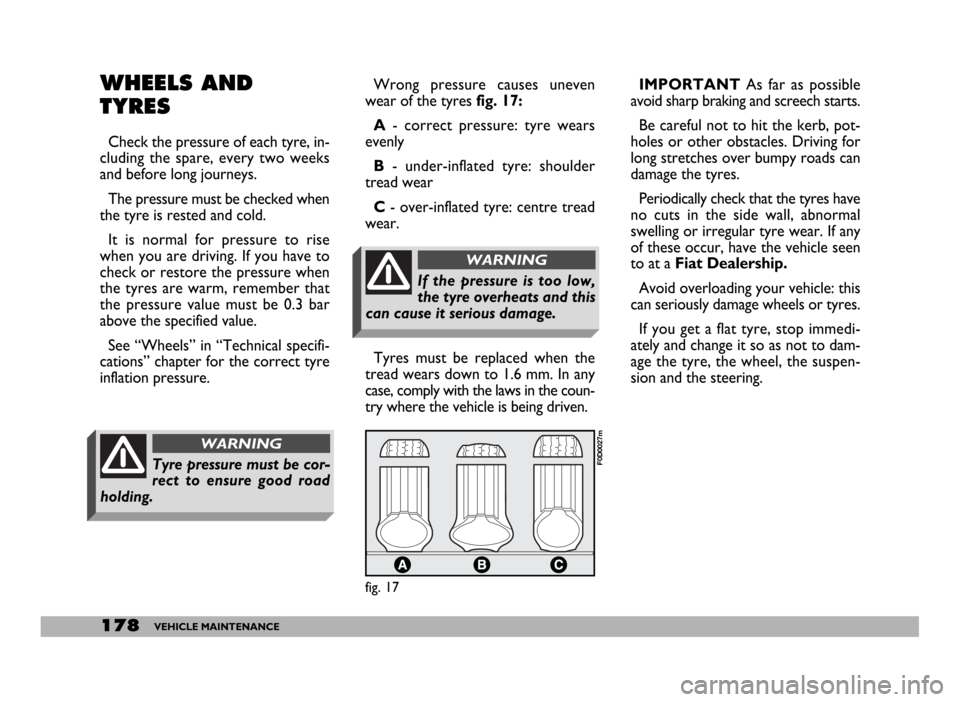
inflation pressure.Wrong pressure causes uneven
wear of the tyres fig. 17:
A- correct pressure: tyre wears
evenly
B- under-inflated tyre: shoulder
tread wear
C- over-inflated tyre: centre tread
wear.IMPORTANTAs far as possible
avoid sharp braking and screech starts.
Be careful not to hit the kerb, pot-
holes or other obstacles. Driving for
long stretches over bumpy roads can
damage the tyres.
Periodically check that the tyres have
no cuts in the side wall, abnormal
swelling or irregular tyre wear. If any
of these occur, have the vehicle seen
to at a Fiat Dealership.
Avoid overloading your vehicle: this
can seriously damage wheels or tyres.
If you get a flat tyre, stop immedi-
ately and change it so as not to dam-
age the tyre, the wheel, the suspen-
sion and the steering.
fig. 17
F0D0027m
If the pressure is too low,
the tyre overheats and this
can cause it serious damage.
WARNING
Tyre pressure must be cor-
rect to ensure good road
holding.
WARNING
Tyres must be replaced when the
tread wears down to 1.6 mm. In any
case, comply with the laws in the coun-
try where the vehicle is being driven.