2005 FIAT DUCATO 244 Side light
[x] Cancel search: Side lightPage 121 of 258

120GETTING THE BEST OUT OF YOUR VEHICLE
BEFORE GETTING BEHIND
THE WHEEL
– Make sure all light, including the
headlights, are working properly;
– adjust the position of seats and dri-
ving and door mirrors properly for the
best driving position;
– make sure that nothing (mats, etc.)
gets in the way of the pedals when
they are pushed down;
– make sure that any child restraint
systems (child seats, cradles, etc.) are
properly fixed;
– place any objects in the load com-
partment in such a way that they can-
not be thrown forwards in the event
of an accident;
– light eating will help keep your re-
flexes prompt. Above all, do not have
anything alcoholic to drink.
Remember to periodically check:
– tyre pressure,
– engine oil level,
– engine coolant level and cooling
system conditions,– brake fluid level,
– windscreen washer fluid level.
WHEN TRAVELLING
– The first rule of safe driving is pru-
dence;
– prudence also means putting your-
self into a position where you can pre-
dict wrong or imprudent behaviour
from other drivers;
– stick closely to the rules of the
road in the particular country where
the vehicle is being driven and, above
all, do not exceed speed limits;
– ensure that, besides yourself, all the
other passengers in the vehicle have
their seat belts fastened, that children
are sitting in the appropriate child
seats and any animals in the vehicle are
placed in suitable compartment;
– you should be physically fit and
mentally alert before setting out on
long journeys.
Always fasten both front
and back seat belts
(Panorama, Minibus, Combi and
Crew Cab versions). Travelling with
the seat belts unfastened increas-
es the risk of injury or death if you
are in a collision.
WARNING
Driving while drunk or un-
der the influence of drugs
or certain medicines is dangerous
for both you and other road users.
WARNING
Page 122 of 258

121GETTING THE BEST OUT OF YOUR VEHICLE
– Do not drive too many hours at a
time but stop at intervals to stretch
your legs and recoup your energy;
– make sure the air in the passenger’s
compartment is being changed
continuously;
– never coast downhill (i.e. with the
engine off): if you do, you lose the aid
of engine braking, power brakes and
power steering so that braking re-
quires greater effort on the pedal and
steering requires greater effort on the
steering wheel.DRIVING AT NIGHT
These are the main rules to follow
when you are driving at night:
– drive especially carefully: it is hard-
er to drive at night;
– slow down especially if the road is
not lit;
– at the first signs of sleepiness, stop:
continuing would be a risk for yourself
and everybody else. Only start driving
again when you have had enough rest;
– keep a greater safety distance from
the vehicles in front of you than dur-
ing daylight hours: it is hard to judge
how fast other vehicles are going when
all you can see are their lights;
– make sure the headlights beams are
properly positioned: if they are too
low, they reduce visibility and strain
your eyes. If they are too high they can
dazzle other drivers. Adjust headlight
beam according to transported load;
– only use main beam headlights
when you are driving outside town
and when you are sure they do not an-
noy other drivers. dip your headlights
Water, ice or salt sprinkled
on the road can deposit on
the brake discs and reduce effi-
ciency of the first braking.
WARNING
Do not drive with objects
on the floor in front of the
driver’s seat: they could caught un-
der the pedals making braking or
accelerating impossible.
WARNING
Pay attention to the mats:
even a small problem to the
braking system may require in-
creased brake pedal stroke with re-
spect to normal.
WARNING
Page 125 of 258

124GETTING THE BEST OUT OF YOUR VEHICLE
To get the most out of ABS:
– During emergency stops or when
grip conditions are poor, you will feel
a slight pulsation on the brake pedal.
This is the sign that the ABS is work-
ing. Do not release the brake pedal but
continue to press so as not to inter-
rupt the braking action;
– ABS enables you to brake and steer
at the same time. If you meet an un-
expected obstacle you can therefore
steer around it;
– the ABS prevents the wheels from
locking but it does not increase actu-
al grip conditions between tyre and
road. Therefore, even if your vehicle
is fitted with ABS, keep a safe distance
from the vehicle in front of you and
keep your speed down when driving
into bends.
ABS serves to increase your control
over the vehicle, not to enable you to
go faster.Some suggestions which may help
you to keep the running costs of the
vehicle down and lower the amount
of toxic emissions released into the at-
mosphere are given below.
GENERAL
CONSIDERATIONS
Vehicle maintenance
Carry out the checks and adjust-
ments/regulations specified in the
“Service Schedule”.
Tyres
Check tyre inflation pressure regu-
larly. Tyres should be checked at least
once every four weeks: if the pressure
is too low, fuel consumption increas-
es as the resistance to the rolling
movement of the tyre is greater.Unnecessary loads
Do not travel with too much load.
The weight of the vehicle (specially in
urban traffic) and its trim greatly ef-
fects consumption and stability.
Roof rack/ski rack
Remove the roof or ski racks from
the vehicle as soon as they are no
longer needed. These accessories re-
duce the aerodynamic penetration of
the vehicle and will increase con-
sumption. When transporting partic-
ularly large objects, use a trailer,
where possible.CONTAINING RUNNING COSTS
Page 126 of 258

125GETTING THE BEST OUT OF YOUR VEHICLE
Electric devices
Use electric devices for the neces-
sary time only. The heated rear win-
dow, fog lights, windscreen wipers,
heater fan require large amounts of
electricity and increasing the request
for power will also increase fuel con-
sumption (up to +25% when driving in
towns).
Climate control system
The climate control system is an ad-
ditional load which greatly affects the
engine leading to higher consumption.
When the temperature outside the
vehicle allows it, use the air vents
where possible.
DRIVING STYLE
Starting
Do not warm the engine when the
vehicle is stationary or at high or low
speed: in this way the engine will warm
up gradually increasing consumption
and emissions. You should drive off
slowly straight away avoiding high revs
so that the engine will warm up more
quickly.Unnecessary actions
Avoid revving the engine when
stopped at traffic lights or before
switching off the engine and avoid dou-
bling the clutch as these actions have
no purpose on modern vehicles and
serve only to increase consumption
and pollution.
Gear selections
As soon as the traffic and road con-
ditions allow it, shift to a higher gear.
Using a low gear to liven up accelera-
tion greatly increases consumption. In
the same way improper use of high
gears will increase consumption, emis-
sions and engine wear.
On passenger transportation versions
fitted with 2.3, 2.8 JTD and 2.8 JTD
POWER engines, fuel consumption can
be optimised by starting (on level road)
in 2nd gear instead of 1st gear.Top speeds
Fuel consumption increases consid-
erably as speed increases. Your speed
should be kept as even as possible and
superfluous braking and acceleration
avoided as this increases both con-
sumption and emissions.
Acceleration
Accelerating violently increasing the
revs will greatly affect consumption
and emissions; acceleration should be
gradual and should not exceed the
maximum torque.
Page 129 of 258

128GETTING THE BEST OUT OF YOUR VEHICLE
LOOKING AFTER EMISSION
CONTROL DEVICES
The correct use of pollution control
devices not only ensures respect for
the environment but also has an effect
on the vehicle’s performance.
Keeping these devices in good con-
ditions is therefore a fundamental rule
for driving that is easy on your pock-
et and on the environment too.
The first step to take is to follow the
Service Schedule to the letter.
If your vehicle has a petrol engine
with catalytic converter use only un-
leaded petrol.
if you have trouble starting, do not
keep turning the ignition key for long
periods. Be especially careful to avoid
bump starting the vehicle by pushing,
towing or rolling downhill: these are
all manoeuvres that can damage the
catalyst.
Use an auxiliary battery for start-ups
only.If the engine begins to “loose its
smoothness” when travelling, contin-
ue your journey but reduce the de-
mands you are making on the engine
and have the vehicle seen to at a Fi-
at Dealershipas soon as you can.
When the instrument panel fuel re-
serve warning light comes on, fill up as
soon as possible. A low fuel level may
cause an uneven supply of fuel to the
engine with inevitable increase in the
temperature of the exhaust gas and se-
rious damage to the catalytic con-
verter.
Never run the engine with one or
more spark plugs disconnected, even
for testing purposes.
Do not warm up the engine by let-
ting it idle for a while before moving
off unless the outside temperature is
very low and, even in this case, only
do so for less than thirty seconds.
Do not install heat shields and do not
remove those already fitted to the cat-
alytic converter and exhaust pipe.
Do not allow anything to
be sprayed onto the cat-
alytic converter, lambda sensor and
exhaust pipe.
WARNING
Ignoring the above rules
may lead to fire.
WARNING
When functioning normal-
ly the catalytic converter
reaches high temperatures. For this
reason do not park the vehicle over
inflammable material (grass, dry
leaves, pine needles, etc.): fire haz-
ard.
WARNING
Page 142 of 258
141IN AN EMERGENCY
GENERAL INSTRUCTIONS
When a light is not working, check
that it has not fused before changing
the bulb.
For the location of the fuses, refer to
“If a fuse blows” in this section.
Before replacing a bulb that does not
work, check that the contacts are not
oxidised.
Burnt-out bulbs must be replaced
with ones of the same type. Light from
bulbs with insufficient power is dim
while those which are too powerful
use too much electricity. Always check
the height of the headlight beam after
changing a bulb. Only touch the metal
part when handling halo-
gen bulbs. If the transpar-
ent bulb is touched it reduces the
intensity of the light emitted and
can also reduce the life of the
bulb. If you touch the bulb acci-
dentally, rub it with a cloth
moistened with alcohol and leave
it to dry.IF A BULB
BURNS OUT
Modifications or repairs to
the electrical system car-
ried out incorrectly and without
bearing the features of the system
in mind can cause malfunctions
with the risk of fire.
WARNING
You should have the bulbs
replaced at a Fiat Dealer-
ship, if possible. Correct operation
and proper beam height are essen-
tial for safe driving and compliance
with law requirements.
WARNING
Halogen bulbs contain
pressurised gas which, if
broken, may cause small fragments
of glass to be projected outwards.
WARNING
IMPORTANTOn the inside sur-
face of the headlight there could ap-
pear a slight coat of fogging; this does
not show a defect, since it is a natur-
al occurrence due to low temperature
and to the degree of humidity in the
air; it will disappear as soon as the
lights are turned on. The presence of
drops inside the headlight shows wa-
ter seepage, contact Fiat Dealership.
Page 143 of 258

142IN AN EMERGENCY
Bulbs
Main beam headlights
Dipped beam headlights
Front side lights
Front direction indicators
Side direction indicators
Rear direction indicators
Brake lights
Third brake light
Reversing light
Rear fog light/taillights
Front ceiling light
Rear ceiling light
Number plate lightW
60/55 W
60/55 W
5 W
21 W
5 W
21 W
21 W
21 W
21 W
21 W
10 W
15 W
5 W Type
H4
H4
R5W
P21W
W5W
PY21W
P21W
P21W
P21W
P21/4W
CW10
CW15
CW5
Figure
D
D
B
B
A
B
B
B
B
B
C
C
B
fig. 8
F0D0090m
TYPES OF BULBS fig. 8
Several types of bulbs are installed in
the vehicle:
A. Glass bulbs
Snapped into position. Pull to remove.
B. Bayonet connection bulbs
Remove from the bulb holder by
pressing the bulb and rotating it anti-
clockwise.
C. Cylindrical bulbs
Remove by pulling away from termi-
nals.
D. Halogen bulbs
To remove the bulb, release the clip
holding the bulb in place.
Page 145 of 258
144IN AN EMERGENCY
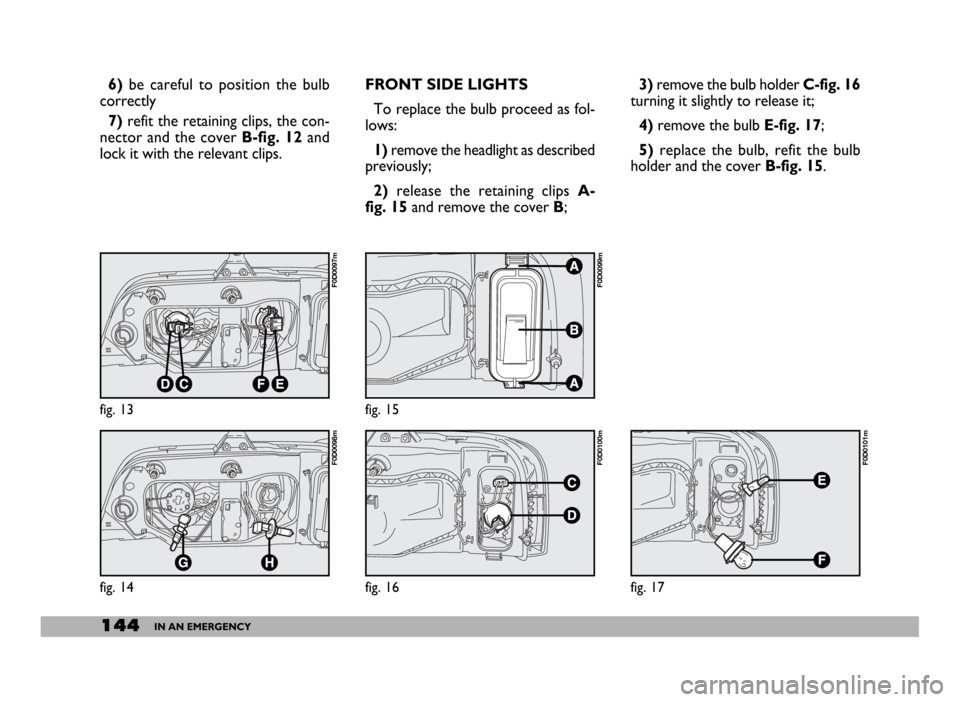
3)remove the bulb holder C-fig. 16
turning it slightly to release it;
4)remove the bulb E-fig. 17;
5) replace the bulb, refit the bulb
holder and the cover B-fig. 15. 6)be careful to position the bulb
correctly
7)refit the retaining clips, the con-
nector and the cover B-fig. 12and
lock it with the relevant clips.
fig. 15
F0D0099m
fig. 16
F0D0100m
fig. 17
F0D0101m
FRONT SIDE LIGHTS
To replace the bulb proceed as fol-
lows:
1)remove the headlight as described
previously;
2)release the retaining clips A-
fig. 15and remove the cover B;
fig. 13
F0D0097m
fig. 14
F0D0098m