Page 146 of 258

145IN AN EMERGENCY
REAR LIGHT CLUSTER
To replace a bulb proceed as follows:
1)loosen the two screws A-fig. 20
with a screwdriver
2)remove the light cluster Band dis-
connect connector C
3)loosen the two screws D-fig. 21
and remove the light cluster:
E- stop light bulb;
F- bulb for reversing light
G - bulb (amber) for direction indi-
cators
H- twin-light bulb for rear fog light
and taillight
fig. 20
F0D0073m
FRONT DIRECTION
INDICATORS
To replace the halogen bulb proceed
as follows:
1) remove the headlight as described
previously;
2)release the retaining clips A-
fig. 15 and remove the cover B;
3)remove the bulb holder D-fig. 16;
4)remove the bulb F-fig. 17push-
ing it slightly and turning it anticlock-
wise at the same time;
5)after replacing the bulb refit the
bulb holder and the cover B-fig. 15.SIDE DIRECTION
INDICATORS
To replace the bulb proceed as fol-
lows:
1)Press the lens in the direction
shown fig. 18
2)remove the bulb holder A-fig. 19
turning it slightly and replace the bulb
B.
FRONT FOG LIGHTS
To replace these bulbs contact a Fi-
at Dealership.
fig. 18
F0D0137m
fig. 19
F0D0138m
Page 147 of 258
146IN AN EMERGENCY
THIRD BRAKE LIGHT fig. 23
To replace the bulb, proceed as fol-
lows:
1)loosen the two nuts A-fig. 24set
inside the vehicle near the rear ceil-
ing light; 4)remove bulbs pushing them slight-
ly and turning them anti-clockwise.
5) replace the bulb, refit the bulb
holder in the light cluster, reconnect
connector Cand refit it all fastening
the screws without forcing them.For truck and chassis cab versions:
Unscrew the four screws H-fig. 22
and replace the following bulbs:
I- bulb for reversing light
- bulb for rear fog light
L- bulbs for taillight (2)
M- bulb for brake light
N- bulb for direction indicators.
fig. 21
F0D0072m
fig. 22
F0D0109m
fig. 23
F0D0156m
fig. 24
F0D0157m
Page 148 of 258
147IN AN EMERGENCY
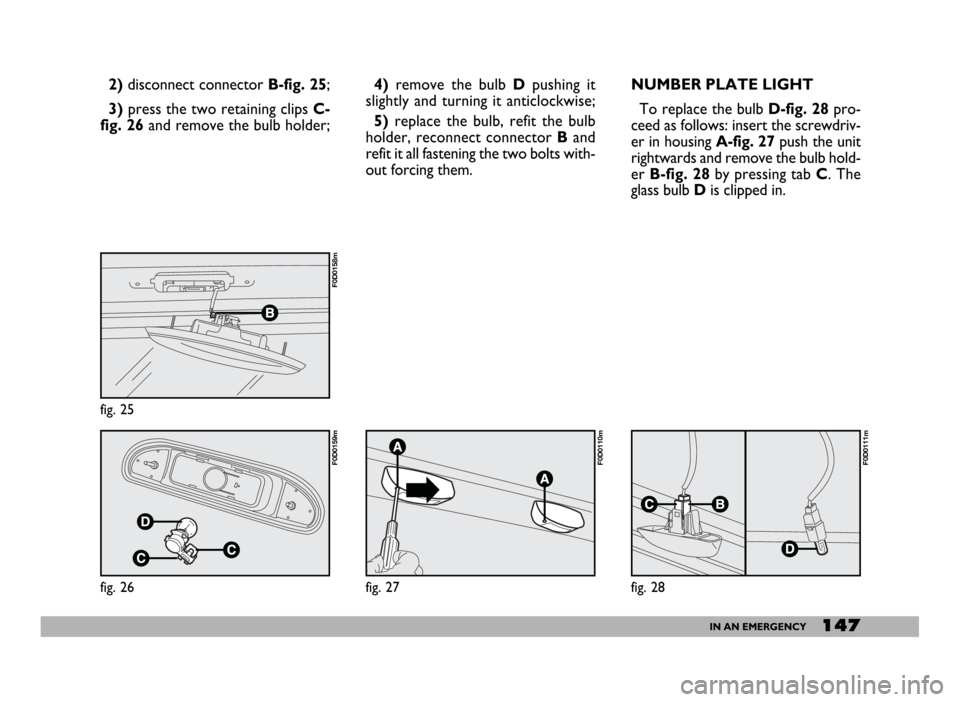
NUMBER PLATE LIGHT
To replace the bulb D-fig. 28pro-
ceed as follows: insert the screwdriv-
er in housing A-fig. 27push the unit
rightwards and remove the bulb hold-
er B-fig. 28by pressing tab C. The
glass bulb Dis clipped in. 2)disconnect connector B-fig. 25;
3)press the two retaining clips C-
fig. 26and remove the bulb holder;4)remove the bulb Dpushing it
slightly and turning it anticlockwise;
5)replace the bulb, refit the bulb
holder, reconnect connector Band
refit it all fastening the two bolts with-
out forcing them.
fig. 25
F0D0158m
fig. 26
F0D0159m
fig. 27
F0D0110m
fig. 28
F0D0111m
Page 158 of 258
157IN AN EMERGENCY
IF THE BATTERY
IS FLAT
IMPORTANTBattery recharging
procedure is given as information on-
ly since this operation shall be only
performed at a Fiat Dealership.
RECHARGING THE BATTERY
You are advised to recharge the bat-
tery slowly for a period of approxi-
mately 24 hours at a low amperage.
Charging for too long could damage
the battery.
Proceed as follows:
1) disconnect the electrical system
from the battery terminals;
IMPORTANTIf the vehicle is fit-
ted with the alarm system, deactivate
it by the remote control (see “Elec-
tronic alarm” in chapter “Getting to
know your vehicle”).JUMP STARTING
See “Jump starting” in this section. 2)connect the charger cables to the
battery terminals;
3)turn the charger on;
4)when you have finished, turn the
charger off before disconnecting the
battery;
5) reconnect the cables to the bat-
tery terminals. Make sure the polari-
ty is correct.
The liquid in the battery is
poisonous and corrosive.
Do not let it touch the skin or eyes.
Recharging the battery should be
done in a well-ventilated area away
from naked flames or possible
sources of sparks: explosion and fire
risk.
WARNING
Do not attempt to recharge
a frozen battery. Thaw it
first otherwise it could explode. If
the battery froze, make sure the in-
ternal elements are not broken
(short-circuit risk) and that the cas-
ing is not cracked (risk of spilling
the poisonous and corrosive fluid.
WARNING
Page 177 of 258

176VEHICLE MAINTENANCE
Furthermore, remember that high in-
take electric devices (such as baby bot-
tle warmers, vacuum cleaners, cellular
phones, mini-fridges, etc.) powered
when the engine is offcan deploy
the battery.
IMPORTANTWhen installing ad-
ditional systems on the vehicle, bear
in mind that improper branches on
connections of the vehicle wiring are
dangerous, particularly if safety devices
are involved.
Battery
60 Ah
88 Ah
100 Ah
The total intake of these systems
(factory and after-market) must be
less than 0.6 mA x Ah (of the bat-
tery) as shown in the following table:
Maximum
admitted stand-by
intake
36 mA
52.8 mA
60 mA
If the vehicle is inactive for a long pe-
riod of time, refer to the “Vehicle stor-
age” paragraph in section “Getting the
best out of you vehicle”.
Before performing any operation on
the electrical system, disconnect the
battery negative cable.
Battery terminals shall always be
perfectly separated.
If you want to add accessories after
buying the vehicle (antitheft system,
free-hand phone kit, radio navigator,
etc.) visit a Fiat Dealership. They
can suggest the most suitable acces-
sories to get and check whether the
electric system can support the
required load or whether a higher
capacity battery is required.
These devices will, in fact, run off
the battery even when the key is not
inserted (vehicle parked, engine off).
Page 178 of 258

177VEHICLE MAINTENANCE
ELECTRONIC
CONTROL UNIT
When the vehicle is being used nor-
mally, special measures are not nec-
essary.
The following instructions must be
followed very carefully however, if
you work on the electrical system or
in cases where emergency starting is
necessary:
– never disconnect the battery from
the electric system while the engine is
running;
– disconnect the battery from the
electric system if you are recharging it;
– never perform emergency starting
with a battery charger. Always use an
auxiliary battery;
– be particularly careful when con-
necting the battery to the electric sys-
tem. Make sure that the polarity is
correct and that the connection is ef-
ficient;
– do not connect or disconnect the
terminals of the electronic units while
the ignition key is at MAR;
– do not check polarity through
sparking;– disconnect the electronic control
units if you are electrically welding the
vehicle body. Remove the units if tem-
peratures exceed 80 °C (special op-
erations on the bodywork, etc.).
IMPORTANTIf the sound system
or vehicle alarm systems are not in-
stalled correctly, they can interfere
with the working of the electronic
control units.
Modifications or repairs to
the electrical system car-
ried out incorrectly and without
bearing the features of the system
in mind can cause malfunctions
with the risk of fire.
WARNING
SPEED LIMITER
On certain version, the injection con-
trol unit is set to limit the vehicle
speed at a max. preset limit.
Speed limits are the following:
– for Minibus versions (M2 homolo-
gation category): 100 km/h;
– for good Transport versions (ve-
hicle dead weight: > 3.5 t) (N2 ho-
mologation category): 90 km/h;
Label (fig.16) with admitted top
speed (90 or 100 km/h according to
versions) is applied on the wind-
screen.
This limit has been established by Eu-
ropean Directive 2002/85/EC, what-
ever violation is therefore punishable
by law.
IMPORTANTWhen the device
comes into action, the speed value
displayed on the instrument panel
could be approx. 10% higher than the
actual one.
fig. 16
F0D0299m
Page:
< prev 1-8 9-16 17-24