Page 216 of 293

WARNING!
Fluid level should be checked on a level surface and
with the engine off to prevent injury from moving
parts and to insure accurate fluid level reading. Do
not overfill. Use only manufacturer recommended
power steering fluid, refer to Recommended Fluids,
Lubricants and Genuine Parts for correct fluid type.
Fluid level should be maintained at the proper level
indicated on the side of the reservoir. If necessary, add
fluid to restore the proper indicated level. With a clean
cloth, wipe any spilled fluid from all surfaces. Refer to
Recommended Fluids, Lubricants, and Genuine Parts for
correct fluid type.
Suspension Ball Joints
There are two upper front and rear suspension ball joints.
Inspect these ball joints whenever under vehicle service is
done. If the seals are damaged, the ball joint should be
replaced.
Body Mechanism Lubrication
Locks and all body pivot points, including such items as
seat tracks, doors, liftgate and hood hinges, should be
lubricated periodically to assure quiet, easy operation
and to protect against rust and wear. Prior to the appli-
cation of any lubricant, the parts concerned should be
wiped clean to remove dust and grit; after lubricating
excess oil and grease should be removed. Particular
attention should also be given to hood latching compo-
nents to insure proper function. When performing other
Power Steering Fluid Reservoir
216 MAINTAINING YOUR VEHICLE
Page 218 of 293

Smooth White Body Lubricant - Such as Mopar
Spray White Lube:
•
Hood hinge springs and links
•Lock cylinders
•Parking brake mechanism
•Trunk latches
•Ash tray
Windshield Wiper Blades
Clean the rubber edges of the wiper blades and the
windshield periodically with a sponge or soft cloth and a
mild non abrasive cleaner. This will remove accumula-
tions of salt or road film.
Operation of the wipers on dry glass for long periods
may cause deterioration of the wiper blades. Always use
washer fluid when using the wipers to remove salt or dirt
from a dry windshield. Avoid using the wiper blades to
remove frost or ice from the windshield. Keep the blade
rubber out of contact with petroleum products such as
engine oil, gasoline, etc.
Windshield Wiper Blade Replacement
•
Lift the wiper arm away from the glass.
•Push the release tab and slide the wiper blade assem-
bly away from the wiper arm. Gently place the wiper
arm on the windshield.
•Install the new blade assembly onto the wiper arm tip
until it locks in place.
Windshield Washers
The fluid reservoir in the engine compartment should be
checked for fluid level at regular intervals. Fill the
reservoir with windshield antifreeze (not radiator anti-
freeze) rated not to freeze at -25°F (-31°C). Operate the
system for a few seconds to flush out the residual water.
218 MAINTAINING YOUR VEHICLE
Page 226 of 293
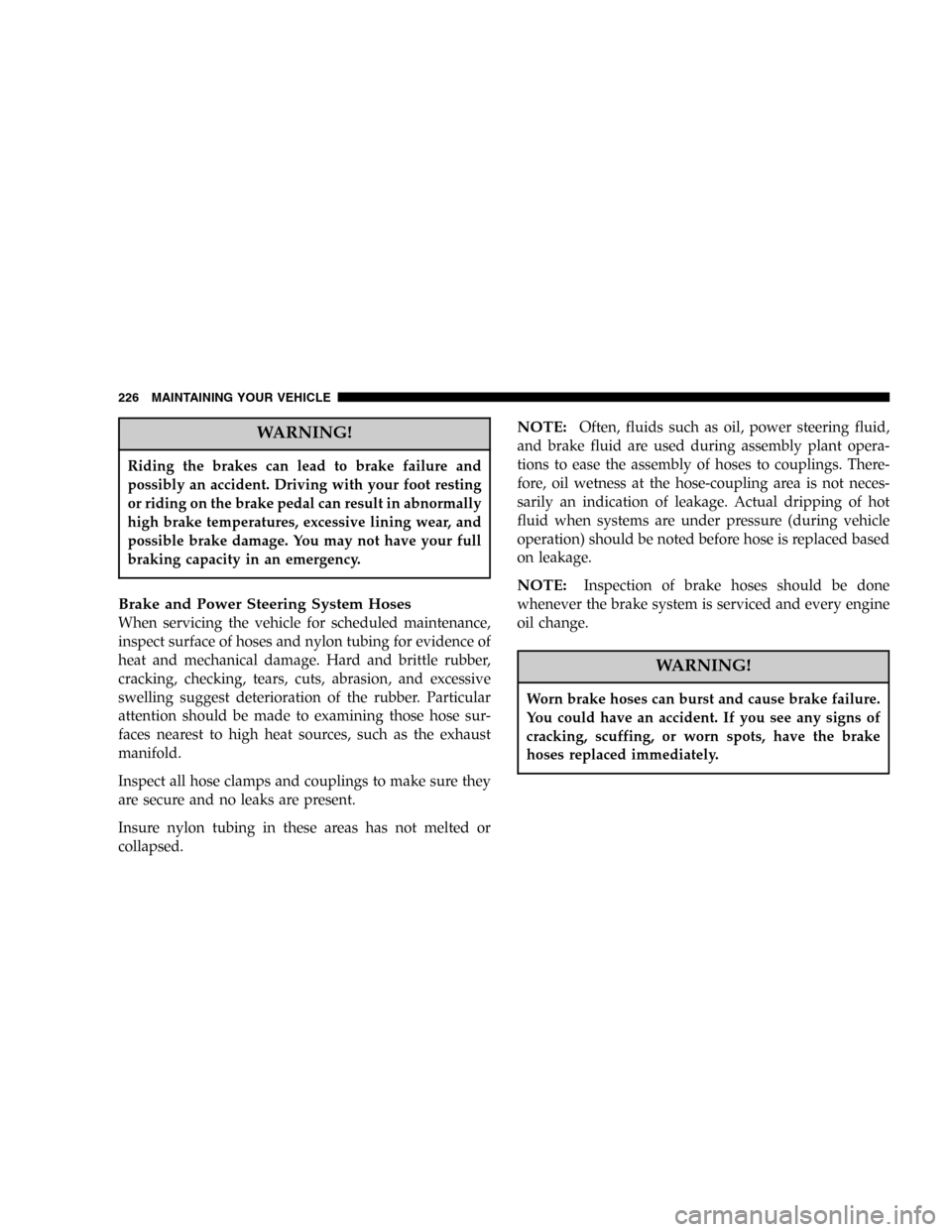
WARNING!
Riding the brakes can lead to brake failure and
possibly an accident. Driving with your foot resting
or riding on the brake pedal can result in abnormally
high brake temperatures, excessive lining wear, and
possible brake damage. You may not have your full
braking capacity in an emergency.
Brake and Power Steering System Hoses
When servicing the vehicle for scheduled maintenance,
inspect surface of hoses and nylon tubing for evidence of
heat and mechanical damage. Hard and brittle rubber,
cracking, checking, tears, cuts, abrasion, and excessive
swelling suggest deterioration of the rubber. Particular
attention should be made to examining those hose sur-
faces nearest to high heat sources, such as the exhaust
manifold.
Inspect all hose clamps and couplings to make sure they
are secure and no leaks are present.
Insure nylon tubing in these areas has not melted or
collapsed.
NOTE:Often, fluids such as oil, power steering fluid,
and brake fluid are used during assembly plant opera-
tions to ease the assembly of hoses to couplings. There-
fore, oil wetness at the hose-coupling area is not neces-
sarily an indication of leakage. Actual dripping of hot
fluid when systems are under pressure (during vehicle
operation) should be noted before hose is replaced based
on leakage.
NOTE:Inspection of brake hoses should be done
whenever the brake system is serviced and every engine
oil change.
WARNING!
Worn brake hoses can burst and cause brake failure.
You could have an accident. If you see any signs of
cracking, scuffing, or worn spots, have the brake
hoses replaced immediately.
226 MAINTAINING YOUR VEHICLE
Page 227 of 293

Master Cylinder
The fluid level in the master cylinder should be checked
when performing under hood services, or immediately if
the brake system warning lamp shows system failure.
Be sure to clean the top of the master cylinder area before
removing the cap. If necessary, fill brake fluid reservoir to
the top of the fill mark chevron. With disc brakes, fluid
level can be expected to fall as the brake pads wear.
However, low fluid level may be caused by a leak and a
checkup may be needed.Use only manufacturer’s recommended brake fluid, refer
to Recommended Fluids, Lubricants and Genuine Parts
for correct fluid type.
WARNING!
Use of a brake fluid that has a lower initial boiling
point than MOPAR DOT 3 Brake Fluid or that is
unidentified as to DOT FMVSS specification may
result in sudden brake failure during hard or pro-
longed braking. You could have an accident.
WARNING!
Overfilling the brake fluid reservoir can result in
spilling brake fluid on hot engine parts and the
brake fluid catching fire.
Use only brake fluid that has been in a tightly closed
container to avoid contamination from foreign matter.
Brake Fluid Reservoir
MAINTAINING YOUR VEHICLE 227
7
Page 250 of 293

Use the schedule that best describes your driving condi-
tions. Where time and mileage are listed, follow the
interval that occurs first.
NOTE:Under no circumstances should oil change
intervals exceed 6 months or 6,000 miles, whichever
comes first.
CAUTION!
Failure to perform the required maintenance items
may result in damage to the vehicle.
At Each Stop for Fuel
•
Check the engine oil level about 5 minutes after a fully
warmed engine is shut off. Checking the oil level while
the vehicle is on level ground will improve the accu-
racy of the oil level reading. Add oil only when the
level is at or below the ADD or MIN mark.
•Check the windshield washer solvent and add if
required.
Once a Month
•
Check tire pressure and look for unusual wear or
damage.
•Inspect the battery and clean and tighten the terminals
as required.
•Check the fluid levels of coolant reservoir, brake
master cylinder, and transaxle and add as needed.
•Check all lights and all other electrical items for correct
operation.
•Check rubber seals on each side of the radiator for
proper fit.
250 MAINTENANCE SCHEDULES
8
M
A
I
N
T
E
N
A
N
C
E
S
C
H
E
D
U
L
E
S
Page 251 of 293
At Each Oil Change
•
Change the engine oil filter.
•Inspect the exhaust system.
•Inspect the brake linings, hoses and calipers.
•Inspect the CV joints and front and rear suspension
components.
•Check the automatic transmission fluid level.
•Check the brake master cylinder fluid level.
•Check the coolant level, hoses, and clamps.
NOTE:In 2.7L Engines equipped with Flex Fuel Engine
(FFV), change engine oil every 5 months or 5,000 miles,
whichever comes first. This applies to both Maintenance
Schedule A and B.
MAINTENANCE SCHEDULES 251
8
M
A
I
N
T
E
N
A
N
C
E
S
C
H
E
D
U
L
E
S
Page 254 of 293
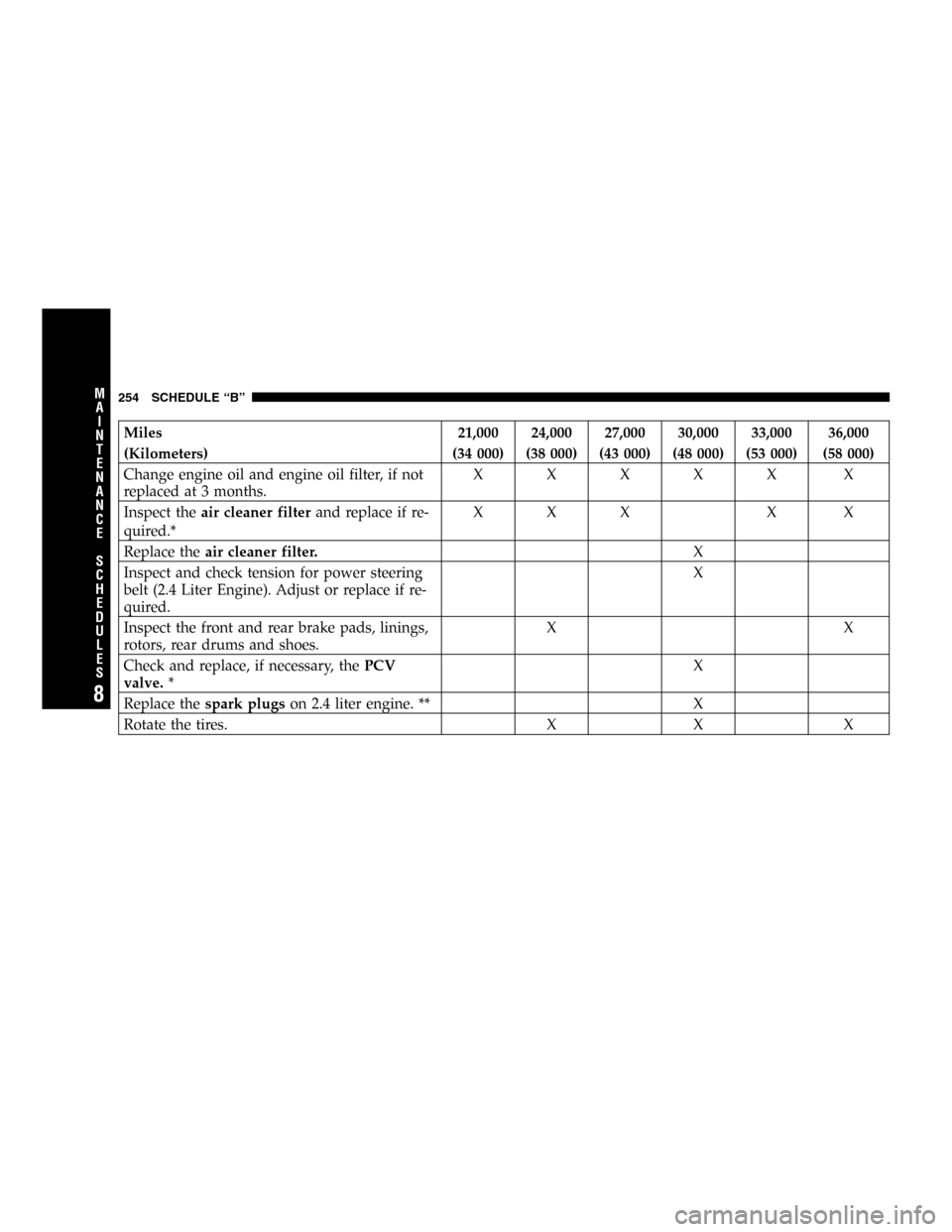
Miles 21,000 24,000 27,000 30,000 33,000 36,000
(Kilometers) (34 000) (38 000) (43 000) (48 000) (53 000) (58 000)
Change engine oil and engine oil filter, if not
replaced at 3 months.XXXXX X
Inspect theair cleaner filterand replace if re-
quired.*XXX X X
Replace theair cleaner filter.X
Inspect and check tension for power steering
belt (2.4 Liter Engine). Adjust or replace if re-
quired.X
Inspect the front and rear brake pads, linings,
rotors, rear drums and shoes.XX
Check and replace, if necessary, thePCV
valve.*X
Replace thespark plugson 2.4 liter engine. ** X
Rotate the tires. X X X
254 SCHEDULE“B”
8
M
A
I
N
T
E
N
A
N
C
E
S
C
H
E
D
U
L
E
S
Page 256 of 293
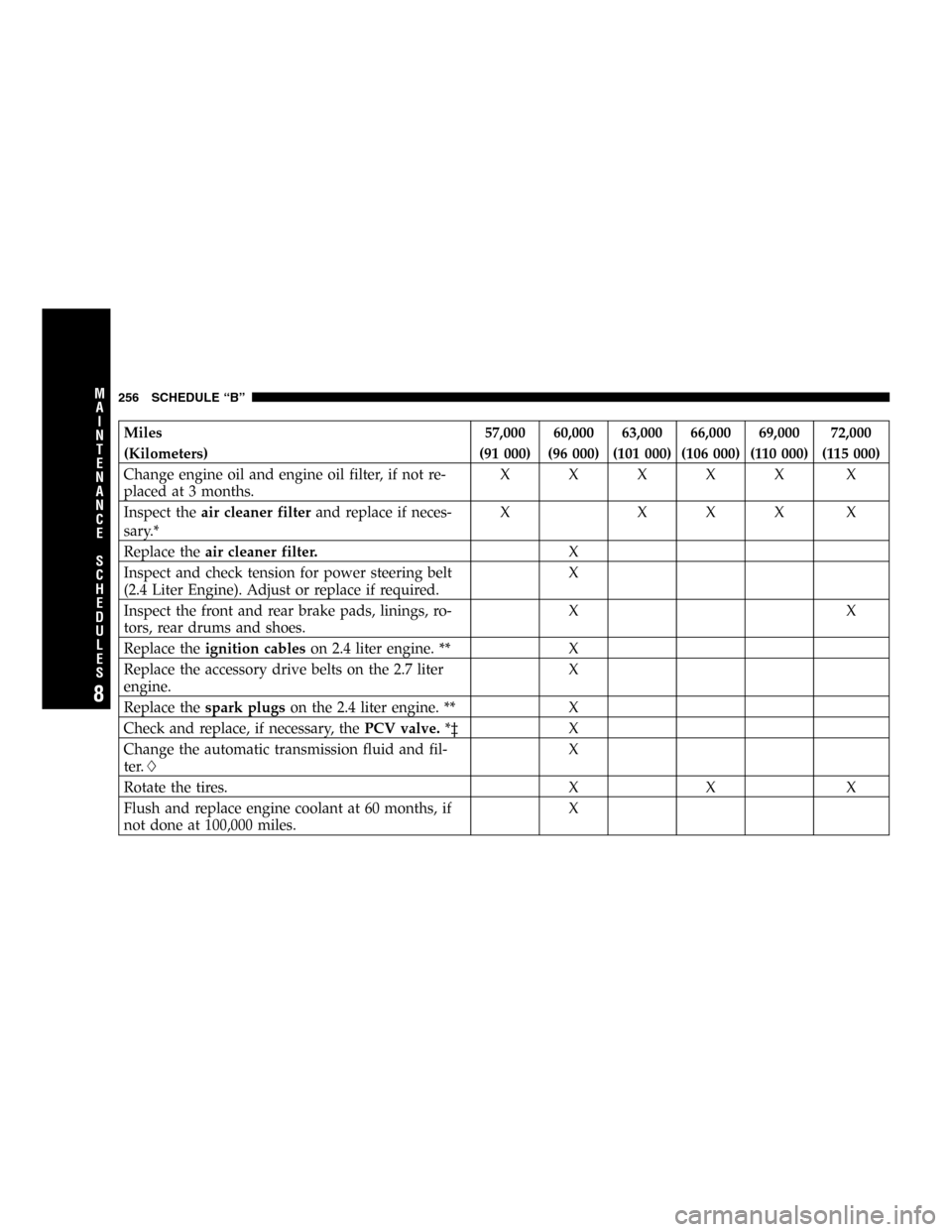
Miles 57,000 60,000 63,000 66,000 69,000 72,000
(Kilometers) (91 000) (96 000) (101 000) (106 000) (110 000) (115 000)
Change engine oil and engine oil filter, if not re-
placed at 3 months.XXXXX X
Inspect theair cleaner filterand replace if neces-
sary.*X XXX X
Replace theair cleaner filter.X
Inspect and check tension for power steering belt
(2.4 Liter Engine). Adjust or replace if required.X
Inspect the front and rear brake pads, linings, ro-
tors, rear drums and shoes.XX
Replace theignition cableson 2.4 liter engine. ** X
Replace the accessory drive belts on the 2.7 liter
engine.X
Replace thespark plugson the 2.4 liter engine. ** X
Check and replace, if necessary, thePCV valve.*‡X
Change the automatic transmission fluid and fil-
ter.�X
Rotate the tires. X X X
Flush and replace engine coolant at 60 months, if
not done at 100,000 miles.X
256 SCHEDULE“B”
8
M
A
I
N
T
E
N
A
N
C
E
S
C
H
E
D
U
L
E
S