Page 340 of 396
Vehicle Safety Standard No. 109. Grades B and A repre-
sent higher levels of performance on the laboratory test
wheel than the minimum required by law.
Tire inflation pressures
Proper tire inflation pressure is essential to the safe and
satisfactory operation of your vehicle. Three primary
areas are affected by improper tire pressure:
1. Safety
Under-inflation increases tire flexing and can result in tire
failure. Over-inflation results in a tire losing its ability to
cushion shock. Objects on the road and potholes could
cause tire damage that may result in tire failure.
2. Economy
Improper inflation pressures can cause uneven wear
patterns to develop across the tire tread. These abnormal
wear patterns will reduce tread life, resulting in a need
for earlier tire replacement.
Under-inflation also increases tire rolling resistance and
results in higher fuel consumption.
3. Ride comfort and vehicle stability
Proper tire inflation pressures contribute to the excellentride quality built into your vehicle. Over-inflation pro-
duces an uncomfortable and jarring ride.
Under-inflation can produce a feeling of sluggish response.
Unequal inflation pressures can produce erratic and
unpredictable vehicle response to steering maneuvers.
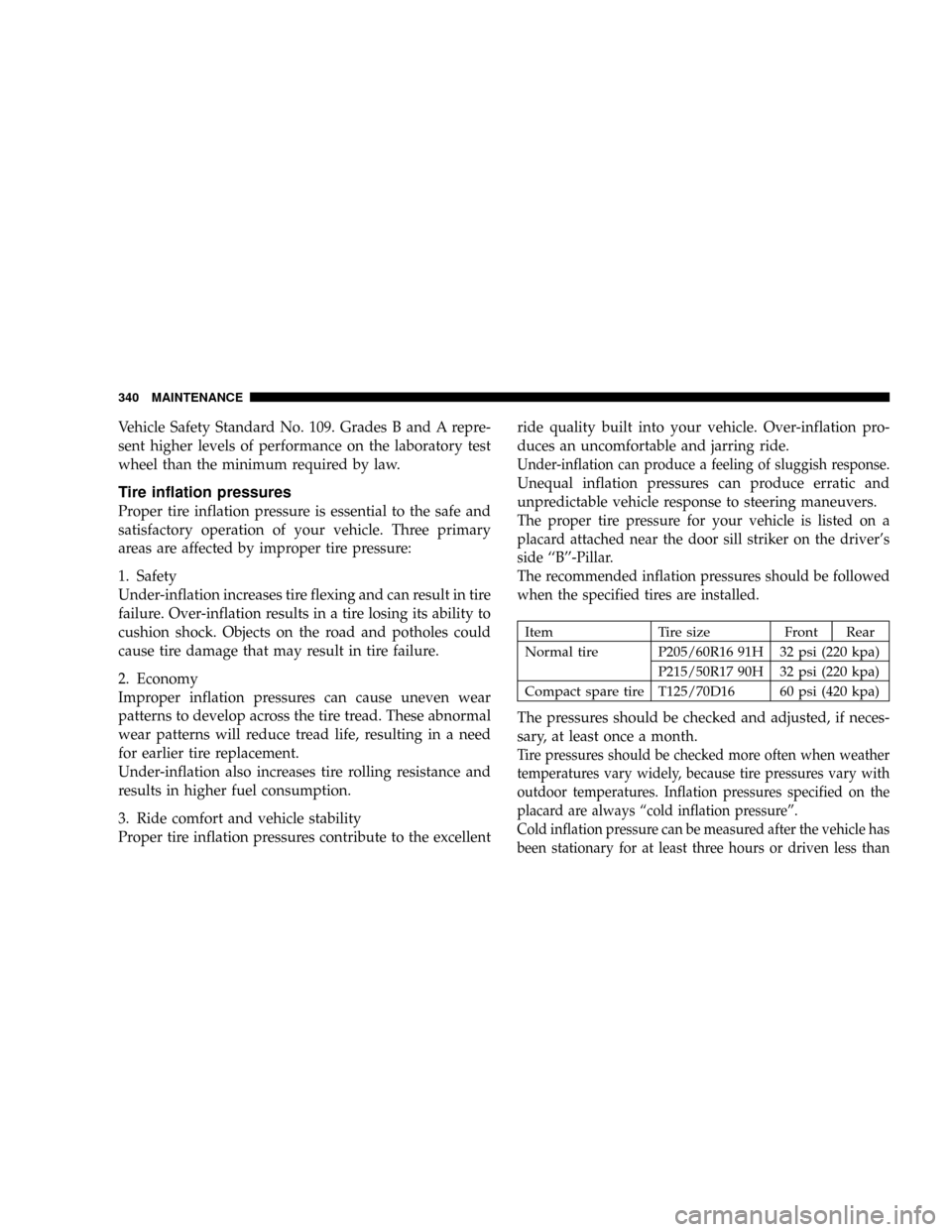
The proper tire pressure for your vehicle is listed on a
placard attached near the door sill striker on the driver's
side ``B''-Pillar.
The recommended inflation pressures should be followed
when the specified tires are installed.
Item Tire size Front Rear
Normal tire P205/60R16 91H 32 psi (220 kpa)
P215/50R17 90H 32 psi (220 kpa)
Compact spare tire T125/70D16 60 psi (420 kpa)
The pressures should be checked and adjusted, if neces-
sary, at least once a month.
Tire pressures should be checked more often when weather
temperatures vary widely, because tire pressures vary with
outdoor temperatures. Inflation pressures specified on the
placard are always ªcold inflation pressureº.
Cold inflation pressure can be measured after the vehicle has
been stationary for at least three hours or driven less than
340 MAINTENANCE
Page 342 of 396
Tire pressure for sustained high-speed driving
For sustained high-speed driving, increase inflation pres-
sure 4 psi (28 kPa) above the recommended pressure but
do not exceed the maximum cold inflation pressure
molded into the tire sidewall.
Replacing tire and wheels
CAUTION!
²Avoid using different size tires from the one listed
and the combined use of different types of tires,
as this can affect driving safety.
Refer to the(TIRES AND WHEELS(on page 377.
²Even if a wheel has the same rim size and offset as
the specified type of wheel, its shape may prevent
it from being fitted correctly. Consult an autho-
rized dealer before using wheels that you have.
Tire maintenance
The following maintenance steps are recommended:
1. Check pressure regularly.
2. Maintain wheel balance and front suspension align-
ment.3. Rotate tires regularly in accordance with the recom-
mendation in the section ªTire rotationº on page 347.
Loading information
WARNING!
Overloading of your tire is dangerous. Overloading can
cause tire failure, affect vehicle handling, and increase
your stopping distance. Use tires of the recommended
load capacity for your vehicle. Never overload them.
It is important to familiarize yourself with the following
terms before loading your vehicle:
²Vehicle maximum load on the tire : load on an indi-
vidual tire that is determined by distributing to each
axle its share of the maximum loaded vehicle weight
and dividing by two.
342 MAINTENANCE
Page 347 of 396

When the indicators appear in two or more adjacent
grooves, tire replacement is recommended.
NOTE: The mark and the location of the tire wear
indicator are different depending on tire manufacturers.
Tire rotation
To equalize wear and help extend tire life, DaimlerChrysler
recommends that you rotate your tires at the mileage speci-
fied on the scheduled maintenance chart.
However, the timing for tire rotation may vary according toyour vehicle condition, road surface conditions and each
individual driver's driving habits. Any time you notice
unusual wear, rotate your tires as soon as possible.
When rotating tires, check for uneven wear, damage and
wheel alignment. Abnormal wear is usually caused by incor-
rect tire pressure, improper wheel alignment, out-of-balance
wheel or severe braking. Consult an authorized dealer to
determine the cause of irregular tread wear.
The first rotation is the most important to achieve more
uniform wear for all tires on the vehicle.
M40A0270
Type 1
M40A0490
Type 2
MAINTENANCE 347
9
Page 348 of 396
CAUTION!
Do not use the compact spare tire for tire rotation.
Tire chains
CAUTION!
Tire chains are not recommended for your vehicle.
The clearance between the chains and the body is
small, and the body might be damaged.
Snow tires
Some areas of the country require the use of snow tires
during winter. Standard tires are of the all season type
and satisfy this requirement as indicated by the M+S
designation on the tire side wall.
If you need snow tires, select tires equivalent in size and
type to the original equipment tires. Failure to do so may
adversely affect the safety and handling of your vehicle.Snow tires should be inflated 4 psi (28 kPa) higher than
the inflation pressure shown on the vehicle's tire placard.
Never inflate over the maximum pressure shown on the
tire sidewall.
Snow tires should not be operated at sustained speeds
over 75 mph (120 km/h).
NOTE: As flange nuts are used on your vehicle, change
to tapered nuts when snow tires (steel wheels) are used.
348 MAINTENANCE
Page 350 of 396

!24,000 Miles (38 000 km) or at 24 months
NCheck automatic transaxle fluid level.
NInspect disc brake pads, rotors and calipers for
wear and leaks.
NCheck brake hoses for deterioration or leaks.
NInspect drive shaft boots for grease leaks and
damage.
NChange engine oil and engine oil filter.
NRotate tires.
MILEAGE/
MONTHSDEALERSHIP
NAME/CODE DATEREPAIR
ORDER #
!30,000 Miles (48 000 km) or at 30 months
NReplace air cleaner filter.
NReplace spark plugs, standard type.
NCheck drive belts condition (for the generator,
water pump, power steering pump).
NCheck manual transaxle oil level.
NCheck coolant hoses (radiator hose, heater hose).
NCheck fuel hoses condition.
NInspect rear drum brake linings and rear wheel
cylinders (except vehicles with disc brakes) for
wear and leaks of all wheels.
NInspect ball joint and steering linkage seals for
grease leaks and damage.
NInspect suspension system for looseness and dam-
age.
NCheck and service exhaust system as required
(connection portion of muffler, muffler pipes and
converter heat shields).
MILEAGE/
MONTHSDEALERSHIP
NAME/CODE DATEREPAIR
ORDER #
350 MAINTENANCE
Page 352 of 396
!54,000 Miles (86 000 km) or at 54 months
NChange engine oil and engine oil filter.
NRotate tires.
MILEAGE/
MONTHSDEALERSHIP
NAME/CODE DATEREPAIR
ORDER #
!60,000 Miles (96 000 km) or at 60 months
NReplace air cleaner filter.
NReplace spark plugs, standard type.
NReplace timing belt.*1
*1: For California, Massachusetts and Vermont
this maintenance is recommended but not re-
quired.
NChange automatic transaxle fluid.
NCheck drive belts condition (for the generator,
water pump, power steering pump).
NCheck manual transaxle oil level.
NCheck fuel hoses condition.
NFlush and replace engine coolant.
NInspect rear drum brake linings and rear wheel
cylinders (except vehicles with disc brakes) for
wear and leaks of all wheels.
NInspect disc brake pads, rotors and calipers for
wear and leaks.
MILEAGE/
MONTHSDEALERSHIP
NAME/CODE DATEREPAIR
ORDER #
352 MAINTENANCE
Page 354 of 396

!78,000 Miles (125 000 km) or at 78 months
NChange engine oil and engine oil filter.
NRotate tires.
MILEAGE/
MONTHSDEALERSHIP
NAME/CODE DATEREPAIR
ORDER #
!84,000 Miles (134 000 km) or at 84 months
NCheck automatic transaxle fluid level.
NInspect disc brake pads, rotors and calipers for
wear.
NCheck brake hoses for deterioration or leaks.
NInspect drive shaft boots for grease leaks and
damage.
NChange engine oil and engine oil filter.
NRotate tires.
MILEAGE/
MONTHSDEALERSHIP
NAME/CODE DATEREPAIR
ORDER #
!90,000 Miles (144 000 km) or at 90 months
NReplace air cleaner filter.
NReplace spark plugs, standard type.
NCheck drive belts condition (for the generator,
water pump, power steering pump).
NCheck manual transaxle oil level.
NCheck fuel hoses condition.
NCheck automatic transaxle fluid level.
NFlush and replace engine coolant.
NInspect rear drum brake linings and rear wheel
cylinders (except vehicles with disc brakes) for
wear and leaks of all wheels.
NInspect ball joint and steering linkage seals for
grease leaks and damage.
NInspect suspension system for looseness and damage.
NCheck and service exhaust system as required
(connection portion of muffler, muffler pipes and
converter heat shields).
MILEAGE/
MONTHSDEALERSHIP
NAME/CODE DATEREPAIR
ORDER #
354 MAINTENANCE
Page 356 of 396

!114,000 Miles (183 000 km) or at 114 months
NChange engine oil and engine oil filter.
NRotate tires.
MILEAGE/
MONTHSDEALERSHIP
NAME/CODE DATEREPAIR
ORDER #
!120,000 Miles (192 000 km) or at 120 months
NReplace air cleaner filter.
NReplace spark plugs, standard type.
NReplace timing belt.*1
*1:For California, Massachusetts and Vermont this
maintenance is recommended but not required.
NChange automatic transaxle fluid.
NCheck drive belts condition (for the generator,
water pump, power steering pump).
NCheck manual transaxle oil level.
NCheck fuel hoses condition.
MILEAGE/
MONTHSDEALERSHIP
NAME/CODE DATEREPAIR
ORDER #
!120,000 Miles (192 000 km) or at 120 months
NFlush and replace engine coolant.
NInspect rear drum brake linings and rear wheel
cylinders (except vehicles with disc brakes) for
wear and leaks of all wheels.
NInspect disc brake pads, rotors and calipers for
wear and leaks.
NInspect suspension system for looseness and dam-
age.
NInspect ball joint and steering linkage seals for
grease leaks and damage.
NCheck and service exhaust system as required
(connection portion of muffler, muffler pipes and
converter heat shields).
MILEAGE/
MONTHSDEALERSHIP
NAME/CODE DATEREPAIR
ORDER #
356 MAINTENANCE
