Page 247 of 396

To keep the windshield and door windows defogged,
and to keep leg area heated (when driving in rain or
snow).
1. Set the mode selection dial to the
position.
2. Adjust the blower to the desired speed.
3. Set the desired temperature.
For quick defrosting
1. Set the mode selection dial to the
position.
2. Adjust the blower to the maximum blower speed.
3. Adjust the temperature control to the maximum tem-
perature.
NOTE
1. When the mode selection dial is set to the ªº
or ª
º position, the air conditioning compressor will
operate automatically. The outside air position will also
be selected automatically. (In this case, the air condition-
ing indicator will not change.)
2. While in ª
ºorªº position, you cannot turn the
air conditioning off or select the recirculation position.
This ensures that the windows will not fog up.
3. To defog effectively, direct the air flow from the side
vents toward the door windows.
4. When defrosting, do not set the temperature control
dial around the max. cool position. Cool air will blow
against the window glass and fog it up.
H03D1500
FOR PLEASANT DRIVING 247
6
Page 248 of 396
Combination of unheated air and heated air
Set the mode selection dial to the position shown in the
illustration and set the air selection switch (A) to the
outside position.
The air will be directed to the leg area and the upper part
of the passenger compartment. Select the desired blower
speed.
Warm air flows to the leg area and unheated or slightly
warm air flows to the upper part of the passenger
compartment.
Cooling
Set the mode selection dial to the ªº position shown in
the illustration.
Set the air selection switch (A) to the outside position and
push the air conditioning switch (B).
1. Setting for ordinary cooling
2. Setting for cooling the leg area
H03C0680H04F0970
248 FOR PLEASANT DRIVING
Page 249 of 396

Adjust the temperature by turning the temperature con-
trol dial clockwise or counterclockwise.
Select the desired blower speed.
NOTE: If the outside air is dusty or otherwise contami-
nated, or if maximum cooling performance is desired, set
air selection switch (A) to the recirculation position and
the temperature control dial all the way to the left.
Introduce outside air from time to time for proper
ventilation.
Important operation tips for air conditioning
1. Park the vehicle in the shade whenever possible.
Parking under the hot sun makes the vehicle interior
extremely hot, which requires more time to cool the
interior. If it is necessary to park in the sun, open the
windows for the first few minutes of air conditioning
operation to expel hot air.
2. Close the windows when the air conditioning is in use.
The entry of outside air through open windows will
reduce cooling efficiency.
3. When operating the system, make sure the air intake,
which is located in front of the windshield, is free of
obstructions such as leaves. Leaves collected in the
air-intake plenum may reduce air flow and plug the
plenum water drains.
Air conditioning system refrigerant and lubricant
recommendations
If the air conditioning seems less effective than usual, the
cause might be a refrigerant leak.
Have the system inspected by your authorized dealer.
H04F0980
FOR PLEASANT DRIVING 249
6
Page 250 of 396

CAUTION!
The air conditioning system in your vehicle must be
charged with the refrigerant HFC-134a and the lubri-
cant SUN-PAG 56.
Use of any other refrigerant or lubricant will cause
severe damage which will result in the need to
replace your vehicle's entire air conditioning system.
The release of refrigerant into the atmosphere is not
recommended.
The new refrigerant (HFC-134a) in your vehicle is
designed not to harm the earth's ozone layer. How-
ever, it may slightly contribute to global warming.
It is recommended that the refrigerant be recovered
and recycled for future use.
During a long period of disuse
The air conditioning should be operated for at least five
minutes each a week, even in cold weather. This is to
maintain lubrication of the compressor internal parts and
maintain the air conditioning in the best operating con-
dition.
INSTALLATION OF ACCESSORIES
CAUTION!
Before any electrical or electronic accessories are
installed, consult an authorized dealer.
1. Improper installation of an electrical or electronic
accessory may cause a fire or electrical problem.
It also could result in failure of warranty coverage under
the new vehicle limited warranty.
2. When using a communication system such as a cellu-
lar phone or a radio set inside the vehicle, be sure to
install a separate external antenna. When a cellular phone
or a radio set is used by using an internal antenna alone,
it might cause failure to the vehicle's electrical system
and could interfere with safe operation of the vehicle.
WARNING!
If you use a cellular phone while driving, keep your
attention on your driving, in order to reduce risk of
accidents.
250 FOR PLEASANT DRIVING
Page 279 of 396

ENGINE OVERHEATING
If the engine coolant temperature gauge indicator enters
the ªHº (hot) position, the engine may be overheated.
In any of the following situations, you can reduce the
potential for overheating by taking the appropriate ac-
tion.
²On the highways Ð Slow down.
²In city traffic Ð While stopped, put transaxle in
neutral, but do not increase engine idle speed.
NOTE:There are steps that you can take to slow down
an impending overheat condition. If your air conditioner
is on, turn it off. The air conditioning system adds heat to
the engine cooling system and turning off the A/C
removes this heat. You can also turn the Temperature
control to maximum heat, the Mode control to floor, and
the fan control to High. This allows the heater core to act
as a supplement to the radiator and aids in removing heat
from the engine cooling system.
CAUTION!
Driving with a hot cooling system could damage
your vehicle. If temperature gauge reads ªHº, pull
over and stop the vehicle. Idle the vehicle with the
air conditioner turned off until the pointer drops
back into the normal range. If the pointer remains on
the ªHº, turn the engine off immediately, and call for
service.
WARNING!
A hot engine cooling system is dangerous. You or
others could be badly burned by steam or boiling
coolant. You may want to call a service center if your
vehicle overheats. If you decide to look under the
hood yourself, see Maintenance Section of this
manual. Follow the warnings under the Cooling
System Pressure Cap paragraph.
EMERGENCIES 279
8
Page 290 of 396
Engine compartment Fuse location tableNo. Symbol Electrical system Capacity
1
Fuse (+B) 60A
2
Radiator fan motor 50A
3
Anti-lock braking system 60A
4
Ignition switch 40A
5
Electric window controls 30A
6
Fog lights 15A
7Ð Ð Ð
8
Horn 15A
9
Engine control 20A
10
Air conditioning 10A
11
Stop lights 15A
12
ÐÐ
13
Alternator 7.5A
14
Hazard warning flasher 10A
15
Automatic transaxle 20A
16
Headlights high beam (right) 10A
17
Headlights high beam (left) 10A
18
Headlights low beam (right) 10A
19
Headlights low beam (left) 10A
20
Position lights (right) 7.5A
21
Position lights (left) 7.5AN29B2642
Engine compartment fuse location
290 EMERGENCIES
Page 343 of 396

²Vehicle normal load on the tire : load on an individual
tire that is determined by distributing to each axle its
share of the curb weight, accessory weight, and nor-
mal occupant weight and dividing by two.
²Maximum loaded vehicle weight : the sum of ±
(a) Curb weight;
(b) Accessory weight:
(c) Vehicle capacity weight; and
(d) Production options weight.
²Curb weight : the weight of a motor vehicle with
standard equipment including the maximum capacity
of fuel, oil, and coolant, and, if so equipped, air
conditioning and additional weight optional engine.
²Accessory weight : the combined weight (in excess of
those standard items which may be replaced) of auto-
matic transmission, power steering, power brakes,
power windows, power seats, radio, and heater, to the
extent that these items are available as factory-
installed equipment (whether installed or not).
²Vehicle capacity weight : the rated cargo and luggage
load plus 150 lbs (68kg) times the vehicle's designated
seating capacity.
²Production options weight : the combined weight of
those installed regular production options weighing
over 5 lbs (2.3kg) in excess of those standard items
which they replace, not previously considered in curb
weight or accessory weight, including heavy duty
brakes, ride levelers, roof rack, heavy duty battery, and
special trim.
²Normal occupant weight : 150 lbs (68kg) times the
number of specified occupants. (In your vehicle the
number is 3).
²Occupant distribution : distribution of occupants in a
vehicle as specified. (In your vehicle the distribution is
2 in front, 1 in second seat).
Steps for Determining Correct Load Limit
1. Locate the statement9The combined weight of occu-
pants and cargo should never exceed XXX pounds9on
your vehicle's placard.
MAINTENANCE 343
9
Page 378 of 396
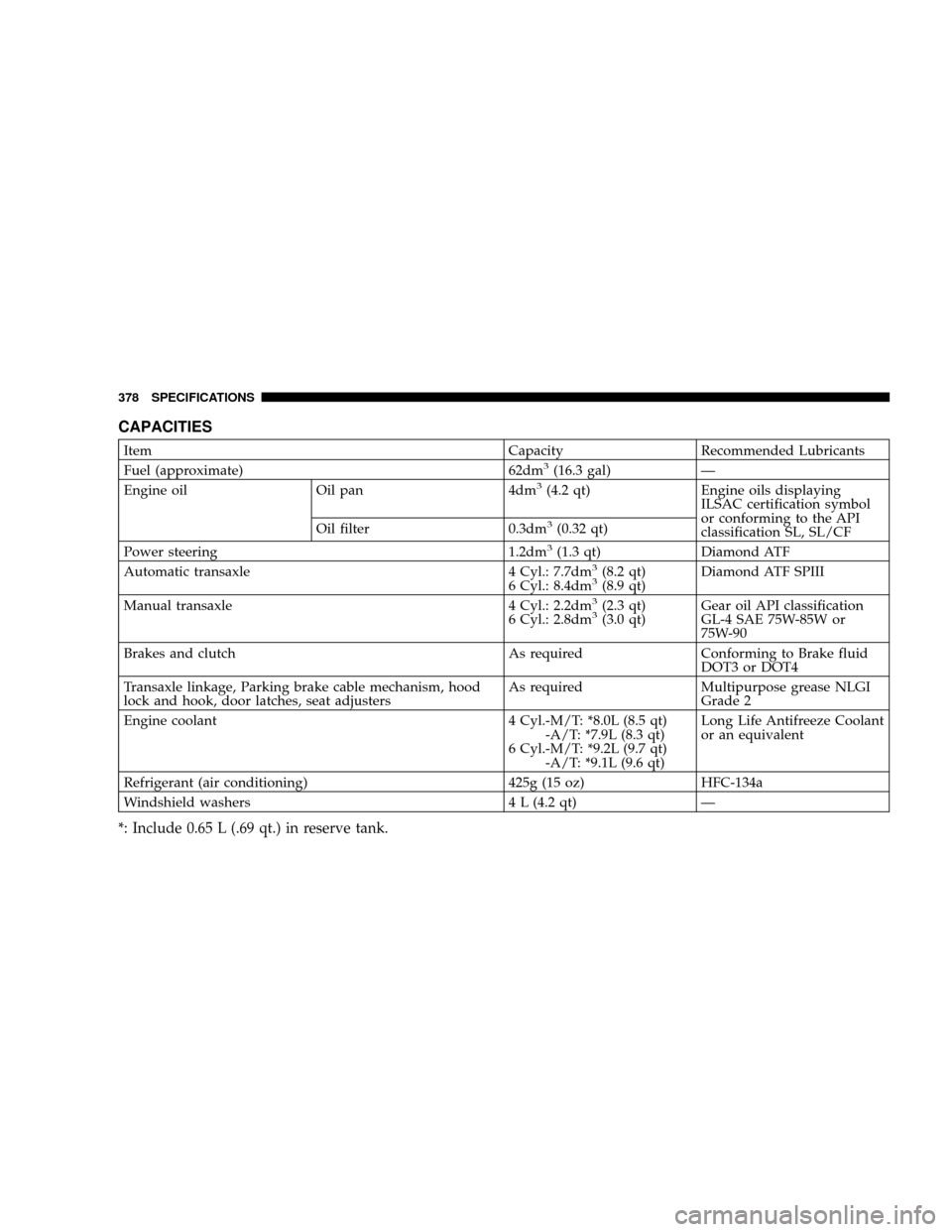
CAPACITIES
Item Capacity Recommended Lubricants
Fuel (approximate) 62dm3(16.3 gal) Ð
Engine oil Oil pan 4dm3(4.2 qt) Engine oils displaying
ILSAC certification symbol
or conforming to the API
classification SL, SL/CF Oil filter 0.3dm
3(0.32 qt)
Power steering 1.2dm
3(1.3 qt) Diamond ATF
Automatic transaxle 4 Cyl.: 7.7dm3(8.2 qt)
6 Cyl.: 8.4dm3(8.9 qt)Diamond ATF SPIII
Manual transaxle 4 Cyl.: 2.2dm3(2.3 qt)
6 Cyl.: 2.8dm3(3.0 qt)Gear oil API classification
GL-4 SAE 75W-85W or
75W-90
Brakes and clutch As required Conforming to Brake fluid
DOT3 or DOT4
Transaxle linkage, Parking brake cable mechanism, hood
lock and hook, door latches, seat adjustersAs required Multipurpose grease NLGI
Grade 2
Engine coolant 4 Cyl.-M/T: *8.0L (8.5 qt)
-A/T: *7.9L (8.3 qt)
6 Cyl.-M/T: *9.2L (9.7 qt)
-A/T: *9.1L (9.6 qt)Long Life Antifreeze Coolant
or an equivalent
Refrigerant (air conditioning) 425g (15 oz) HFC-134a
Windshield washers 4 L (4.2 qt) Ð
*: Include 0.65 L (.69 qt.) in reserve tank.
378 SPECIFICATIONS