Page 270 of 396

Before installing the wheel cover to the wheel, make sure
that the opening with the symbol mark is correctly
aligned with the air valve.
JACKING AND TIRE CHANGING
If a tire must be changed, do so only after making sure
the vehicle is stopped in a safe, flat location.
Jacking up the vehicle
1. Park the vehicle on level and stable ground.
2. Switch on the hazard warning flashers, set up a
warning triangle, flashing signal light, etc., at an ad-
equate distance from the vehicle, and have all passengers
leave the vehicle. Turn the ignition key to the ªLOCKº
position.
3. Set the parking brake firmly, and move the gearshift
lever (manual transaxle) to the ªNº (Neutral) position or
move the selector lever (automatic transaxle) to the ªPº
(PARK) position.4. Apply a chock or block (A) at the tire diagonally
opposite the tire (B) to be changed.
NOTE: The chock shown is not supplied with the ve-
hicle. It is recommended that you keep one in the vehicle
for use if required.
N24A0100
A
B
270 EMERGENCIES
Page 271 of 396
5. Place the jack under one of the jacking points shown in
the illustration. Use the jacking point closest to the tire
being changed.
C = Jacking point
WARNING!
²Do not set the jack at any other position on the
vehicle than those specified. If the jack is set at a
wrong position, the body of the vehicle could be
dented or the jack might fall over and cause
personal injury.
²Avoid using the jack on tilted or soft surfaces.
Otherwise, the jack might slip and cause personal
injury. Always use the jack on a flat, hard surface.
Before setting the jack, check to ensure that there
is no sand or pebbles on the underside of the jack
base.
N22A1280
EMERGENCIES 271
8
Page 274 of 396
WARNING!
²Before using the jack, chock or block the wheel
that is tire diagonally opposite the jacking point.
²Stop jacking up the vehicle when the tire is raised
off the ground. It is dangerous to raise the vehicle
any higher.
²Do not get under the vehicle while using the jack.
²Avoid jarring the raised vehicle or leaving it
supported on the jack for extended periods. Both
are very dangerous.
²Do not use a jack other than the one provided
with your vehicle.
²The jack should not be used for any purpose other
than changing a tire.
²No one should stay in the vehicle while the jack is
used.
²Do not start or run the engine while the vehicle is
on the jack.
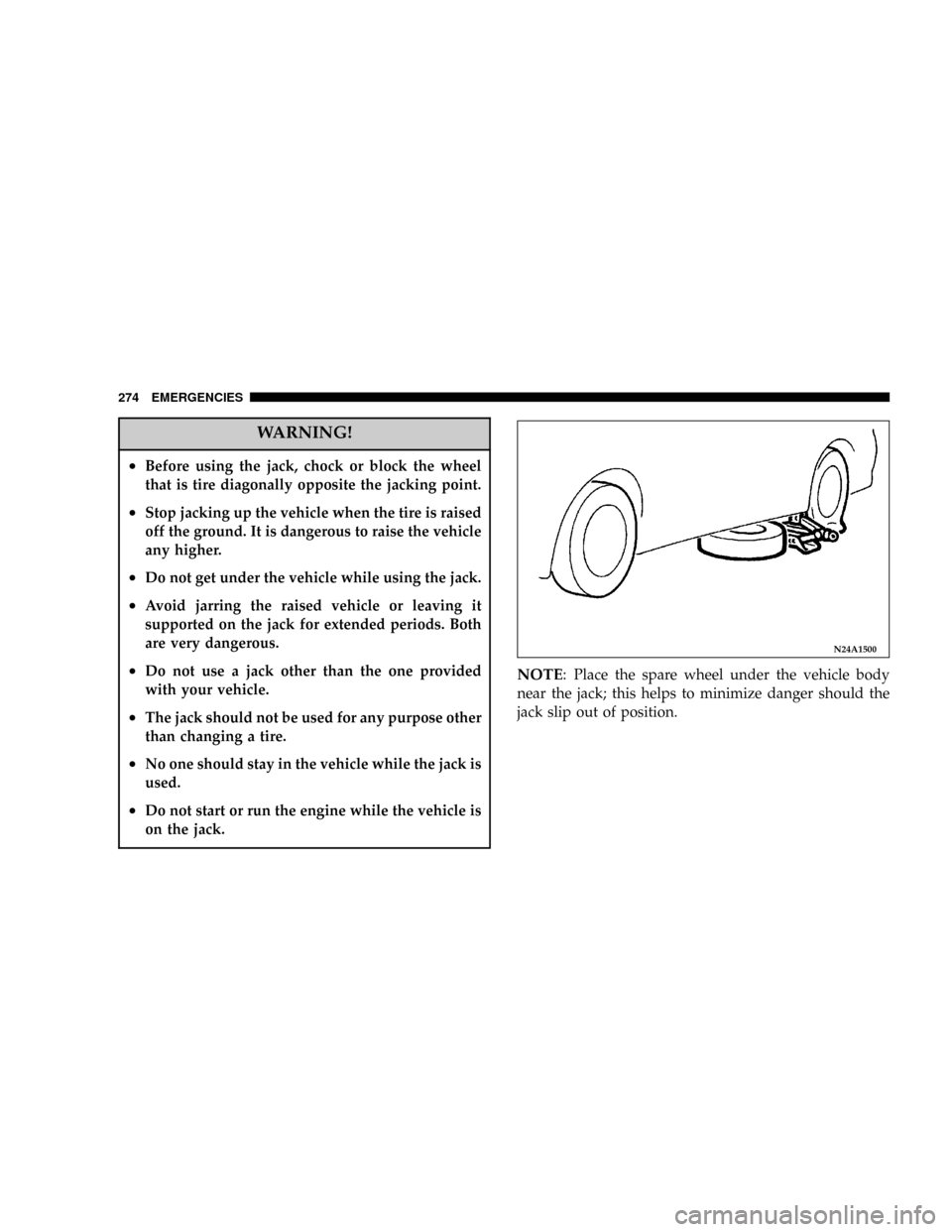
NOTE: Place the spare wheel under the vehicle body
near the jack; this helps to minimize danger should the
jack slip out of position.
N24A1500
274 EMERGENCIES
Page 275 of 396
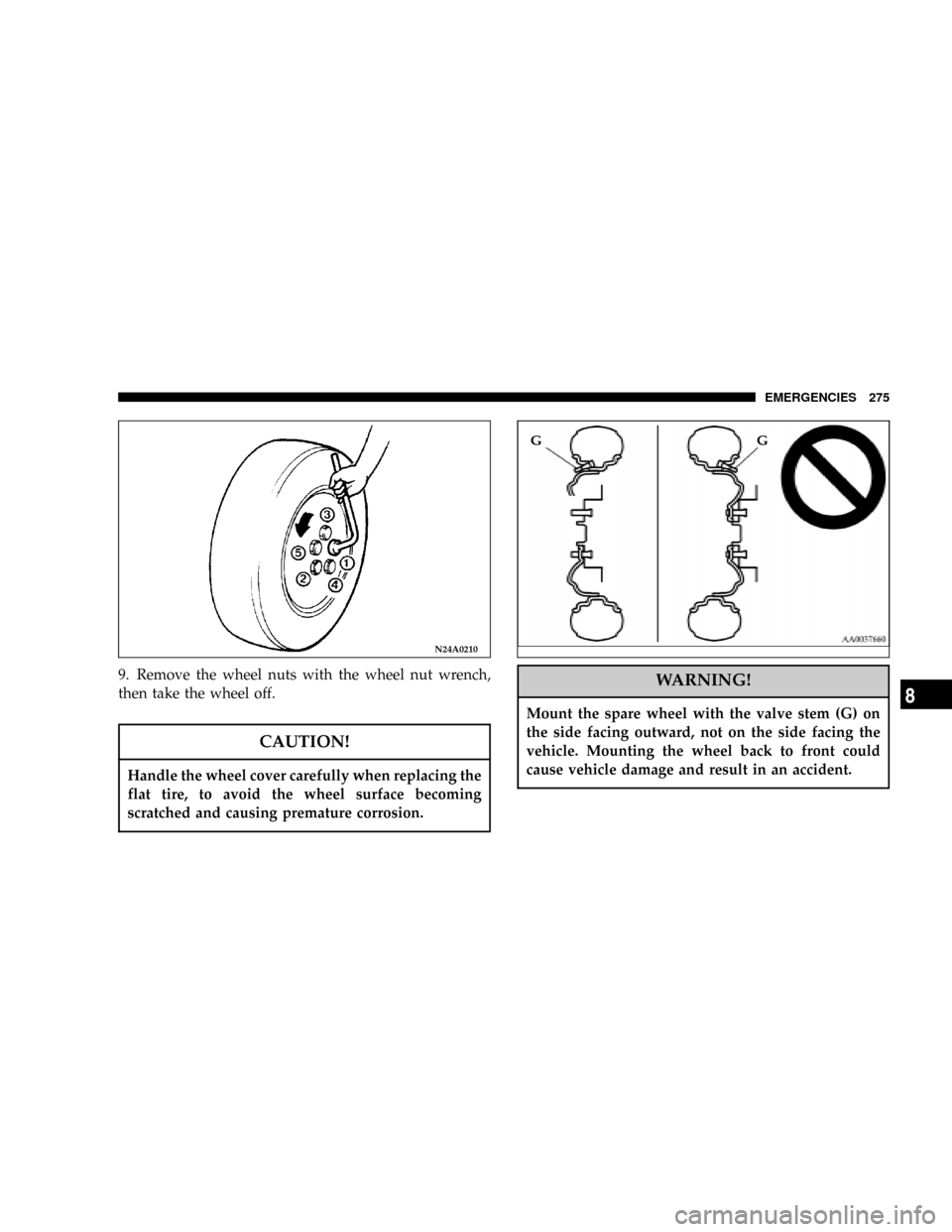
9. Remove the wheel nuts with the wheel nut wrench,
then take the wheel off.
CAUTION!
Handle the wheel cover carefully when replacing the
flat tire, to avoid the wheel surface becoming
scratched and causing premature corrosion.
WARNING!
Mount the spare wheel with the valve stem (G) on
the side facing outward, not on the side facing the
vehicle. Mounting the wheel back to front could
cause vehicle damage and result in an accident.
N24A0210
G
G
EMERGENCIES 275
8
Page 279 of 396
ENGINE OVERHEATING
If the engine coolant temperature gauge indicator enters
the ªHº (hot) position, the engine may be overheated.
In any of the following situations, you can reduce the
potential for overheating by taking the appropriate ac-
tion.
²On the highways Ð Slow down.
²In city traffic Ð While stopped, put transaxle in
neutral, but do not increase engine idle speed.
NOTE:There are steps that you can take to slow down
an impending overheat condition. If your air conditioner
is on, turn it off. The air conditioning system adds heat to
the engine cooling system and turning off the A/C
removes this heat. You can also turn the Temperature
control to maximum heat, the Mode control to floor, and
the fan control to High. This allows the heater core to act
as a supplement to the radiator and aids in removing heat
from the engine cooling system.
CAUTION!
Driving with a hot cooling system could damage
your vehicle. If temperature gauge reads ªHº, pull
over and stop the vehicle. Idle the vehicle with the
air conditioner turned off until the pointer drops
back into the normal range. If the pointer remains on
the ªHº, turn the engine off immediately, and call for
service.
WARNING!
A hot engine cooling system is dangerous. You or
others could be badly burned by steam or boiling
coolant. You may want to call a service center if your
vehicle overheats. If you decide to look under the
hood yourself, see Maintenance Section of this
manual. Follow the warnings under the Cooling
System Pressure Cap paragraph.
EMERGENCIES 279
8
Page 280 of 396
WARNING!
²When working near the radiator cooling fan, dis-
connect the fan motor lead or turn the ignition key
to the OFF position. The fan is temperature con-
trolled and can start at any time the ignition key is
in the ON position.
²You or others can be badly burned by hot coolant
or steam from your radiator. If you see or hear
steam coming from under the hood, don't open
the hood until the radiator has had time to cool.
Never try to open a cooling system pressure cap
when the radiator is hot.
JUMP-STARTING THE ENGINE
If the engine cannot be started because the battery is
weak or dead, the battery from another vehicle can be
used with booster cables to start the engine.
WARNING!
When using jumper cables to start a vehicle, follow
procedures exactly and exercise extreme caution.
CAUTION!
Do not try to start your vehicle by pushing or towing.
Vehicles equipped with an automatic transaxle can-
not be started this way. Pushing or towing a vehicle
equipped with a manual transaxle may overheat and
damage the catalytic converter. Also, there is a
greater risk of an accident when a vehicle is being
pushed or towed.
1. Remove any metal jewelry such as watch bands or
bracelets that might make an inadvertent electrical con-
tact.
2. Position the vehicles close enough together so the
booster cables can reach, but be sure the vehicles aren't
touching each other. If they are, it could cause a ground
280 EMERGENCIES
Page 281 of 396

connection. You wouldn't be able to start your vehicle,
and the bad ground could damage the electrical systems.
CAUTION!
Check the other vehicle. It must have a 12-volt
battery. If the other system isn't 12-volts, both sys-
tems can be damaged.
3. You could be injured if the vehicles move. Set the
parking brake firmly on each vehicle. Put an automatic
transaxle in ªPº (PARK) or a manual transaxle in ªNº
(Neutral). Turn the ignition key to the ªLOCKº position.
WARNING!
Turn the ignition key to the ªLOCKº position on
both vehicles.
Use care to make sure that the cables or your clothes
are never caught by the fan or drive belt. Personal
injury could result.
NOTE: Turn off all lights, heater and other electrical
loads. This will avoid sparks and help save both batter-
ies.
4. Make sure battery electrolyte is at the proper level.
(See ªBatteryº on page 325.)
WARNING!
If electrolyte fluid is not visible, or appears to be
frozen, do not attempt jump starting.
The battery might rupture or explode if the tempera-
ture is below the freezing point or if it is not filled to
the proper level.
EMERGENCIES 281
8
Page 283 of 396

6. Connect one end of the other jumper cable to the
negative (-) terminal of the booster battery (B), and the
other end to the engine block of the vehicle with the
discharged battery (A) at the point farthest from the
battery.WARNING!
²Be sure to observe the connecting sequence of¬
!!®!¯.
²Make sure that the connection¯is made to the
engine properly. If the connection is directly made
to the negative side of the battery, the flammable
gases generated from the battery might catch fire
and explode.
²When connecting the booster cable, do not con-
nect the positive (+) cable to the negative (-)
terminal. Otherwise sparks might cause explosion
of the battery.
²Use care not to have the booster cable caught in
the cooling fan or other rotating parts in the
engine compartment.
7. Start the engine in the vehicle which has the booster
battery, let the engine idle a few minutes, then start the
engine in the vehicle with the discharged battery.
8. After the engine is started, disconnect the cables in the
reverse order.
EMERGENCIES 283
8