Page 190 of 288

190 STARTING AND OPERATING
WARNING!
Take into consideration that when towing a trail-
er, the handling characteristics are different and
less stable from those when operating the vehicle
without a trailer.
It is important to avoid sudden maneuvers.
Sudden maneuvers may lead to loss of control
over the vehicle-trailer combination. This could
cause an accident resulting in property damage or
injury to you or others.
CAUTION!
If the transmission hunts between gears on
inclines, manually shift to a lower gear (select
"4",
"3", "2" or
"1"). A lower gear and reduction of
speed reduces the chance of engine overloading
and / or overheating.
When going down a long hill, shift into a lower
gear and use the engine’s braking effect. Avoid
riding the brakes, thus overheating the vehicle
and trailer brakes.
If the engine coolant rises to an extremely high
temperature (coolant temperature needle
approaching the red zone) when the air
conditioner is on, turn off the air conditioner.
Engine coolant heat can be additionally vented by
opening the windows, switching the climate
control fan speed to high and setting the
temperature control to the maximum hot position.
Page 191 of 288
STARTING AND OPERATING 191
5
Parking a Trailer
CAUTION!
Extreme care must be exercised since your vehicle
with a trailer will require additional passing
distance ahead than when driving without a
trailer. Because your vehicle and trailer is longer
than your vehicle alone, you will also need to go
much farther ahead of the passed vehicle before
you can return to your lane.
WARNING!
To reduce the risk of personal injury, or damage to
the vehicle powertrain, as a result of vehicle/trail-
er movement, always:
Keep right foot on brake pedal.
Shift gear selector lever to position
"N".
Have a second person place wheel chocks on
downhill side of left and right trailer wheels.
Slowly release brake pedal and let vehicle and
trailer roll into chocks until stopped.
Firmly depress parking brake pedal.
Move gear selector lever to position
"P".
On inclines turn front wheels towards the road
curb.
Page 195 of 288

WHAT TO DO IN EMERGENCIES
6
CONTENTS��
Hazard Warning Flasher Switch . . . . . . . . . . . . . 196
��
Fire Extinguisher (Optional) . . . . . . . . . . . . . . . . . 197
��
Vehicle Tool Kit . . . . . . . . . . . . . . . . . . . . . . . . . . . 197
��
Changing the Tire . . . . . . . . . . . . . . . . . . . . . . . . . . 198�Spare Wheel Location . . . . . . . . . . . . . . . . . . . . 200
��
Jack . . . . . . . . . . . . . . . . . . . . . . . . . . . . . . . . . . . . . . 203�Using the Jack . . . . . . . . . . . . . . . . . . . . . . . . . . . 203
��
Removing a Wheel . . . . . . . . . . . . . . . . . . . . . . . . . 206
��
Installing a Wheel . . . . . . . . . . . . . . . . . . . . . . . . . . 206
��
Jump Starting . . . . . . . . . . . . . . . . . . . . . . . . . . . . . . 209
��
Towing the Vehicle . . . . . . . . . . . . . . . . . . . . . . . . . 211�If the Engine is Damaged . . . . . . . . . . . . . . . . . 212�If the Transmission is Damaged . . . . . . . . . . . . 212�If the Front Axle is Damaged . . . . . . . . . . . . . . 212�If the Rear Axle is Damaged . . . . . . . . . . . . . . . 212
Page 208 of 288
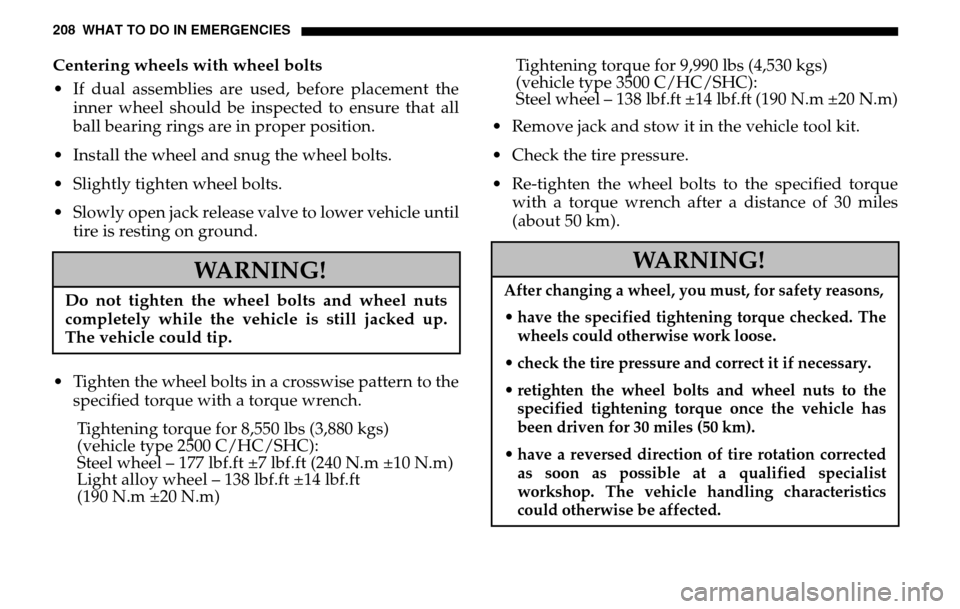
208 WHAT TO DO IN EMERGENCIESCentering wheels with wheel bolts
If dual assemblies are used, before placement the inner wheel should be inspected to ensure that all
ball bearing rings are in proper position.
Install the wheel and snug the wheel bolts.
Slightly tighten wheel bolts.
Slowly open jack release va lve to lower vehicle until
tire is resting on ground.
Tighten the wheel bolts in a crosswise pattern to the specified torque with a torque wrench.
Tightening torque for 8,550 lbs (3,880 kgs)
(vehicle type 2500 C/HC/SHC):
Steel wheel – 177 lbf.ft ±7 lbf.ft (240 N.m ±10 N.m)
Light alloy wheel – 138 lbf.ft ±14 lbf.ft
(190 N.m ±20 N.m) Tightening torque for 9,990 lbs (4,530 kgs)
(vehicle type 3500 C/HC/SHC):
Steel wheel – 138lbf.ft ±14lbf.ft (190N.m ±20N.m)
Remove jack and stow it in the vehicle tool kit.
Check the tire pressure.
Re-tighten the wheel bolts to the specified torque with a torque wrench after a distance of 30 miles
(about 50 km).
WARNING!
Do not tighten the wheel bolts and wheel nuts
completely while the vehicle is still jacked up.
The vehicle could tip.
WARNING!
After changing a wheel, you must, for safety reasons, have the specified tightening torque checked. The
wheels could otherwise work loose.
check the tire pressure and correct it if necessary.
retighten the wheel bolts and wheel nuts to the specified tightening torque once the vehicle has
been driven for 30 miles (50 km).
have a reversed direction of tire rotation corrected as soon as possible at a qualified specialist
workshop. The vehicle handling characteristics
could otherwise be affected.
Page 211 of 288
WHAT TO DO IN EMERGENCIES 211
6
TOWING THE VEHICLE
*Vehicle Type 2500 only
WARNING!
Do not tow the vehicle if the key cannot be turned
in the ignition lock.
If the key cannot be turned, the ignition lock re-
mains locked and the vehicle cannot be steered.
With the engine not running there is no power
assistance for the braking and steering systems.
In this case, it is important to keep in mind that a
considerably higher degree of effort is necessary
to brake and steer the vehicle.
The vehicle must not be towed with the front axle
raised and the key in position 2 in the ignition
lock as the drive wheels could then lock due to the
acceleration skid control (ASR) or the optional
Electronic Stability Program (ESP)
*.
Page 212 of 288
212 WHAT TO DO IN EMERGENCIESIf the Engine is DamagedFor towing distances up to 30 miles (about 50 km)
Shift gear selector lever to "N" position.
Do not exceed a towing speed of 30 mph (50 km / h).
For towing distances greater than 30 miles (about
50 km)
Remove the propeller shafts leading to the drive axles.
The vehicle can be towed without restriction.If the Transmission is Damaged Remove the propeller shafts leading to the drive
axles.
If the Front Axle is Damaged Raise the front axle.
Observe the same towing restrictions as for engine damage.IftheRearAxleisDamagedRaise the rear axle.
NOTE: Comply with local legal regulations regarding
towing vehicles.
Page 234 of 288

234 MAINTAINING YOUR VEHICLECorrosion protection, such as anticorrosion wax
should be applied to the engine compartment after
every engine cleaning. Before applying, all control
linkage bushings and joints should be lubricated. The
poly-V-belt and all pulleys should be protected from
any wax.Vehicle WashingDo not use hot water or wash your vehicle in direct
sunlight. Use only a mild car wash detergent.
Thoroughly spray the vehicle with a diffused jet of
water. Direct only a very weak spray towards the
ventilation intake. Use plenty of water and rinse the
sponge and chamois frequently.
Rinse with clear water and thoroughly wipe dry with a
chamois. Do not allow cleaning agents to dry on the
finish.
Due to the width of the vehicle, prior to running the
vehicle through an automatic car wash, fold back the
outside mirrors to prevent them from getting
damaged.
In the winter, thoroughly remove all traces of road salt
as soon as possible. When washing the underbody, do not forget to clean
the inner sides of the wheels.
Ornamental MoldingsFor regular cleaning and care of very dirty chrome-
plated parts, use a chrome cleaner.Headlamps, Taillamps, Identification Lamps, Turn
Signal LensesUse a mild car wash detergent with plenty of water.
To prevent scratches, never apply strong force and use
only a soft, non-scratchy cloth when cleaning the
lenses. Do not attempt to wipe dirty lenses with a dry
cloth or sponge.
WARNING!
Dirty or iced-up steps and entrances create a risk
of slipping or falling.
Keep steps, entrances and footwear free from dirt
(e.g. mud, clay, snow and ice).
Page 247 of 288
MAINTAINING YOUR VEHICLE 247
7
Low Beam Headlamps
1. Unplug the cable connector from the bulb.
2. Unclip in the retaining springs. Press the retaining springs towards the headlamps and down
(direction of arrow). 3. Remove the bulb.
4. Insert the new bulb so that the retaining lugs are
fed into the recesses in the reflector section of the
bulb holder.
5. Clip in the retaining springs.
6. Press on the cable connector.
7. Secure the housing cap.


