Page 109 of 216

Loading
The vehicle maximum load on the tire must not exceed
the load carrying capacity of the tire on your vehicle. You
will not exceed the tire’s load carrying capacity if you
adhere to the loading conditions, tire size and cold tire
inflation pressures specified on the Tire and Loading
Information placard and the Vehicle Loading section of
this manual.
NOTE:Under a maximum loaded vehicle condition,
gross axle weight ratings (GAWR’s) for the front and rear
axles must not be exceeded. For further information on
GAWR’s, vehicle loading and trailer towing, see the
Vehicle Loading section of this manual.
To determine the maximum loading conditions of your
vehicle, locate the statement“The combined weight of
occupants and cargo should never exceed XXX kg or XXX
lbs.”on the Tire and Loading Information placard. The
combined weight of occupants, cargo/luggage and
trailer tongue weight (if applicable) should never exceed
the weight referenced here.
Steps for Determining Correct Load Limit
1. Locate the statement“The combined weight of occu-
pants and cargo should never exceed XXX pounds”on
your vehicle’s placard.
2. Determine the combined weight of the driver and
passengers that will be riding in your vehicle.
3. Subtract the combined weight of the driver and pas-
sengers from XXX kilograms or XXX pounds.
4. The resulting figure equals the available amount of
cargo and luggage load capacity. For example, if“XXX”
amount equals 1400 lbs. and there will be five 150 lb.
passengers in your vehicle, the amount of available cargo
and luggage load capacity is 650 lb. (1400–750 (5 x 150) =
650 lb.)
5. Determine the combined weight of luggage and cargo
being loaded on the vehicle. That weight may not safely
exceed the available cargo and luggage load capacity
calculated in step 4.
STARTING AND OPERATING 109
5
Page 110 of 216
6. If your vehicle will be towing a trailer, load from your
trailer will be transferred to your vehicle. Consult this
manual to determine how this reduces the available
cargo and luggage load capacity of your vehicle.
NOTE:The following table shows examples on how to
calculate total load, cargo/luggage and towing capacities
of your vehicle with varying seating configurations andnumber and size of occupants. This table is for illustra-
tion purposes only and may not be accurate for the
seating and load carry capacity of your vehicle.
NOTE:For the following example the combined weight
of occupants and cargo should never exceed 865 lbs. (392
Kg).
110 STARTING AND OPERATING
Page 147 of 216

•Driving in dusty conditions
•Short trips of less than 10 miles (16.2 km)
•More than 50% of your driving is at sustained high
speeds during hot weather, above 90°F (32°C)
•Trailer towing
•Taxi, Police, or delivery service (commercial service)
•Off-road or desert operation
•If equipped for and operating with E-85 (ethanol) fuel
NOTE:IfANYof these apply to you then change your
engine oil every 3,000 miles (5 000 km) or 3 months,
whichever comes first and follow schedule“B”of the
�Maintenance Schedules�section of this manual.
If none of these apply to you, then change your engine oil
at every interval shown on schedule�A�of the�Mainte-
nance Schedules�section of this manual.
Engine Oil Selection
For best performance and maximum protection under all
types of operating conditions, the manufacturer only
recommends engine oils that are API certified and meet
the requirements of DaimlerChrysler Material Standard
MS-6395.
If you choose to operate this vehicle in a very spirited
driving style, the manufacturer recommends the use of
a full synthetic engine oil, such as Mobil 1�SAE 5W-30.
Oil Filler Cap Location
MAINTAINING YOUR VEHICLE 147
7
Page 180 of 216
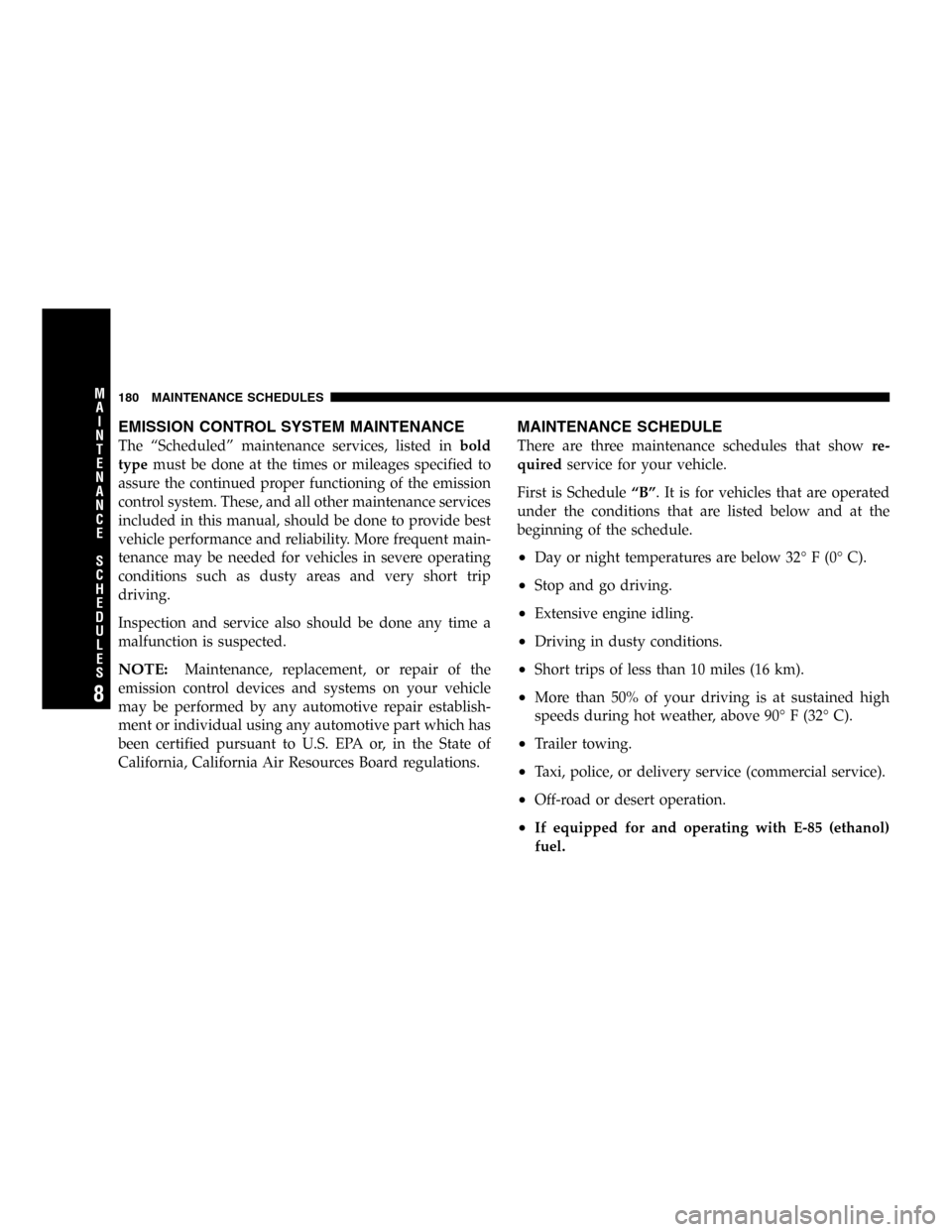
EMISSION CONTROL SYSTEM MAINTENANCE
The“Scheduled”maintenance services, listed inbold
typemust be done at the times or mileages specified to
assure the continued proper functioning of the emission
control system. These, and all other maintenance services
included in this manual, should be done to provide best
vehicle performance and reliability. More frequent main-
tenance may be needed for vehicles in severe operating
conditions such as dusty areas and very short trip
driving.
Inspection and service also should be done any time a
malfunction is suspected.
NOTE:Maintenance, replacement, or repair of the
emission control devices and systems on your vehicle
may be performed by any automotive repair establish-
ment or individual using any automotive part which has
been certified pursuant to U.S. EPA or, in the State of
California, California Air Resources Board regulations.
MAINTENANCE SCHEDULE
There are three maintenance schedules that showre-
quiredservice for your vehicle.
First is Schedule“B”. It is for vehicles that are operated
under the conditions that are listed below and at the
beginning of the schedule.
•Day or night temperatures are below 32°F(0°C).
•Stop and go driving.
•Extensive engine idling.
•Driving in dusty conditions.
•Short trips of less than 10 miles (16 km).
•More than 50% of your driving is at sustained high
speeds during hot weather, above 90°F (32°C).
•Trailer towing.
•Taxi, police, or delivery service (commercial service).
•Off-road or desert operation.
•If equipped for and operating with E-85 (ethanol)
fuel.
180 MAINTENANCE SCHEDULES
8
M
A
I
N
T
E
N
A
N
C
E
S
C
H
E
D
U
L
E
S
Page 183 of 216
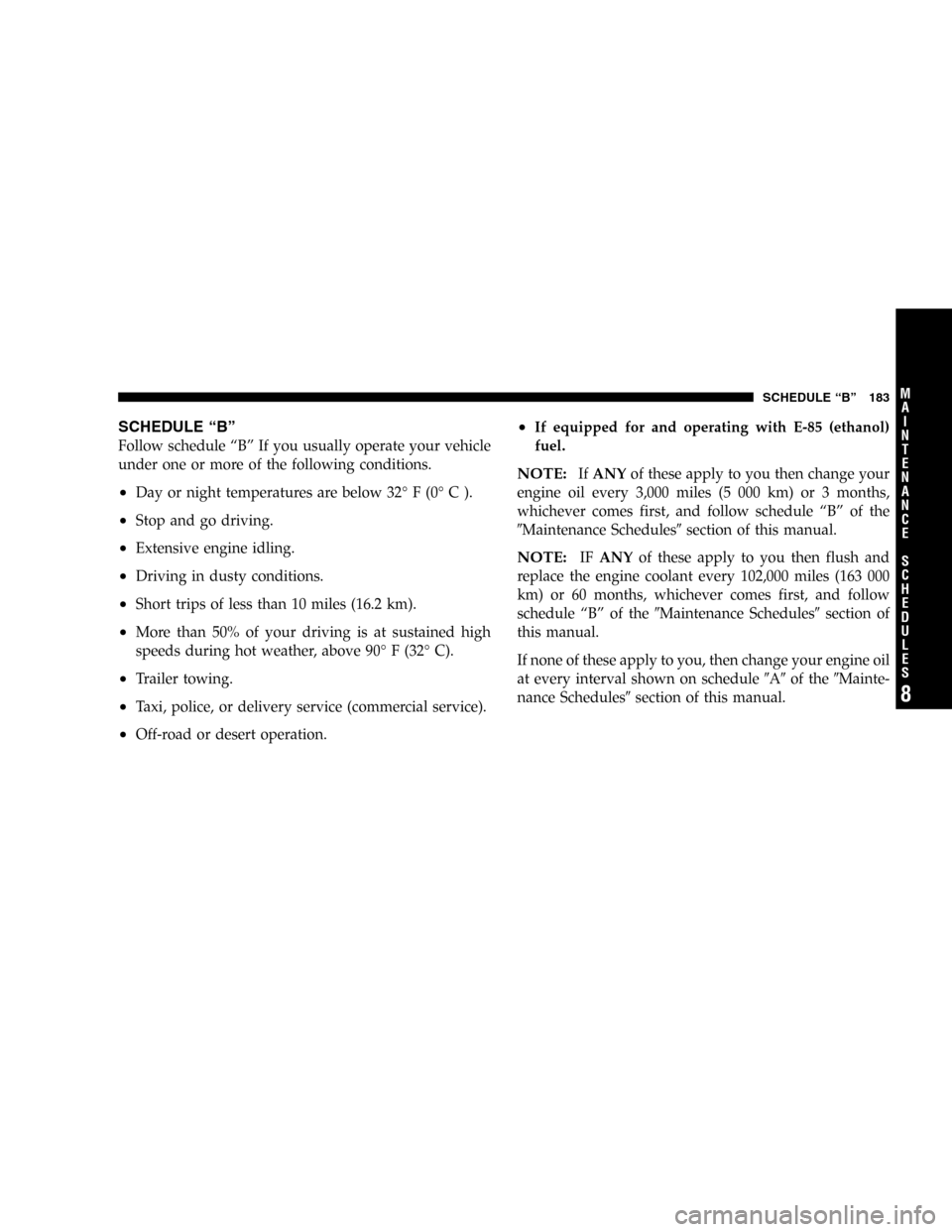
SCHEDULE“B”
Follow schedule“B”If you usually operate your vehicle
under one or more of the following conditions.
•Day or night temperatures are below 32°F(0°C).
•Stop and go driving.
•Extensive engine idling.
•Driving in dusty conditions.
•Short trips of less than 10 miles (16.2 km).
•More than 50% of your driving is at sustained high
speeds during hot weather, above 90°F (32°C).
•Trailer towing.
•Taxi, police, or delivery service (commercial service).
•Off-road or desert operation.
•If equipped for and operating with E-85 (ethanol)
fuel.
NOTE:IfANYof these apply to you then change your
engine oil every 3,000 miles (5 000 km) or 3 months,
whichever comes first, and follow schedule“B”of the
�Maintenance Schedules�section of this manual.
NOTE:IFANYof these apply to you then flush and
replace the engine coolant every 102,000 miles (163 000
km) or 60 months, whichever comes first, and follow
schedule“B”of the�Maintenance Schedules�section of
this manual.
If none of these apply to you, then change your engine oil
at every interval shown on schedule�A�of the�Mainte-
nance Schedules�section of this manual.
SCHEDULE“B”183
8
M
A
I
N
T
E
N
A
N
C
E
S
C
H
E
D
U
L
E
S
Page 186 of 216
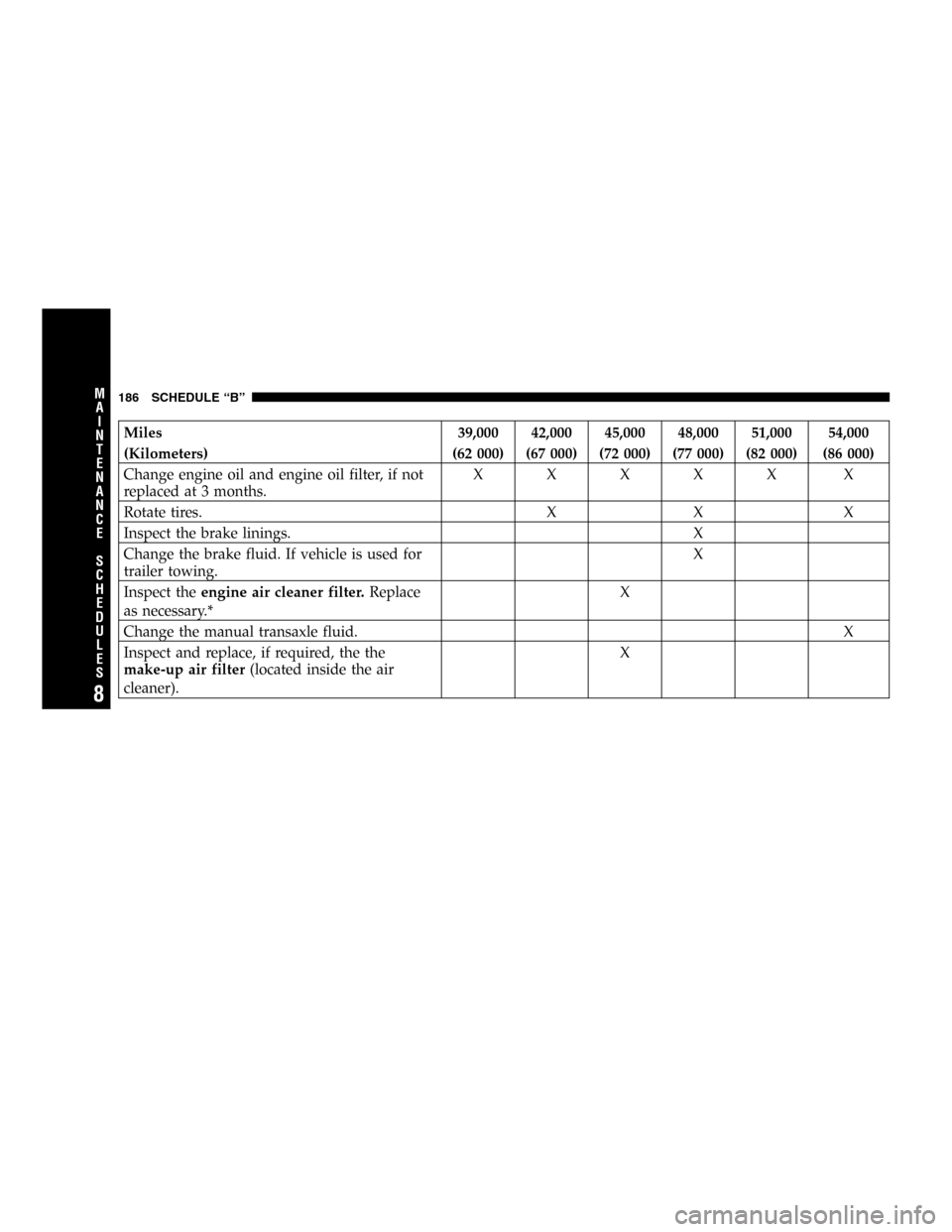
Miles 39,000 42,000 45,000 48,000 51,000 54,000
(Kilometers) (62 000) (67 000) (72 000) (77 000) (82 000) (86 000)
Change engine oil and engine oil filter, if not
replaced at 3 months.XXXXX X
Rotate tires. X X X
Inspect the brake linings. X
Change the brake fluid. If vehicle is used for
trailer towing.X
Inspect theengine air cleaner filter.Replace
as necessary.*X
Change the manual transaxle fluid.X
Inspect and replace, if required, the the
make-up air filter(located inside the air
cleaner).X
186 SCHEDULE“B”
8
M
A
I
N
T
E
N
A
N
C
E
S
C
H
E
D
U
L
E
S
Page 189 of 216
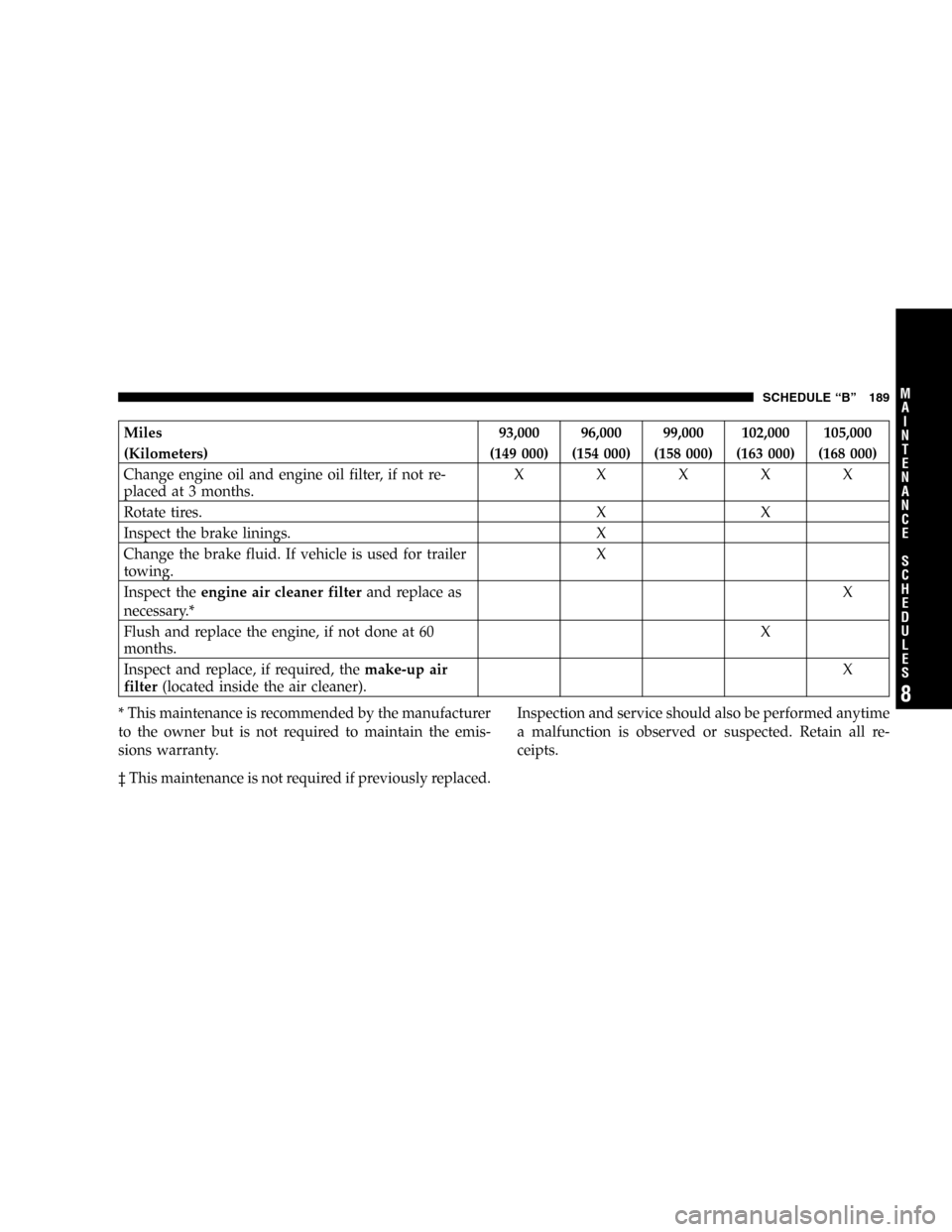
Miles 93,000 96,000 99,000 102,000 105,000
(Kilometers) (149 000) (154 000) (158 000) (163 000) (168 000)
Change engine oil and engine oil filter, if not re-
placed at 3 months.XXXXX
Rotate tires. X X
Inspect the brake linings. X
Change the brake fluid. If vehicle is used for trailer
towing.X
Inspect theengine air cleaner filterand replace as
necessary.*X
Flush and replace the engine, if not done at 60
months.X
Inspect and replace, if required, themake-up air
filter(located inside the air cleaner).X
* This maintenance is recommended by the manufacturer
to the owner but is not required to maintain the emis-
sions warranty.
‡This maintenance is not required if previously replaced.Inspection and service should also be performed anytime
a malfunction is observed or suspected. Retain all re-
ceipts.
SCHEDULE“B”189
8
M
A
I
N
T
E
N
A
N
C
E
S
C
H
E
D
U
L
E
S