Page 21 of 216

3. To reassemble the transmitter case, snap two halves
together. Make sure there is an even gap between the two
halves. Test transmitter operation.
VEHICLE THEFT ALARM
The system monitors the doors, trunk latch, and ignition
for unauthorized operation.
If something triggers the alarm, the system will signal for
about 18 minutes. For the first 3 minutes the horn will
sound and the headlights, park/turn signal lights, tail
lights and the indicator light in the cluster will flash.
Then the exterior lights will flash for another 15 minutes.
If the monitored system which triggered the alarm is
deactivated, the alarm will continue to sound until 3
minutes of alarm time is reached. If the monitored system
which triggered the alarm is deactivated after the alarm
has been on for 3 minutes, the alarm will shut off
immediately.
To set the alarm:
1. Remove the keys from the ignition switch and get out
of the vehicle.
2. Lock the door using either the door key, power door
lock switch, or the Keyless Entry Transmitter and close all
doors.
3. The indicator light in the instrument cluster will flash
rapidly for 16 seconds. This shows that the system is
arming. During this period, if a door is opened, the
ignition switch is turned on, or the power door locks are
unlocked in any manner, the system will automatically
disarm. If the light comes on but does not flash, the
system is arming but there is a problem in the trunk
circuit. After 16 seconds the indicator light will flash
slowly. This shows that the system is fully armed.
Vehicles equipped with the Sentry Key Immobilizer
System can be safely started with a valid key. A valid key
is one that is programmed to that particular vehicle. A
valid key will disarm the system from the driver’s side
door, an invalid key will trigger the alarm.
THINGS TO KNOW BEFORE STARTING YOUR VEHICLE 21
2
Page 57 of 216

Daytime Running Lights (Canada Only)
The front fog lights will come on as Daytime Running
Lights whenever the ignition is on, the headlights are off,
and the parking brake is off. The headlight switch must
be used for normal night time driving.
Lights-on Reminder
If the headlights or parking lights are on after the ignition
is turned OFF, a chime will sound when the driver’s door
is opened. Leaving the headlights on for an extended
period of time will discharge the battery resulting in
reduced battery life and possible inability to start the
vehicle.
Fog Lights
The front fog light switch is on the Multi-Function
Control Lever. To activate the front fog lights, turn
on the headlights and pull out the end of the
control lever.
NOTE:The fog lights will only operate with the head-
lights on low beam. Selecting high beam headlights or
park lights will turn off the fog lights.
Turn Signals
Move the Multi-Function Control Lever up or down to
detent and the arrows on each side of the instrument
cluster flash to show proper operation of the front and
rear turn signal lights. You can signal a lane change by
moving the lever partially up or down.
If either light remains on and does not flash, or there is a
very fast flash rate, check for a defective outside light
bulb. If an indicator fails to light when the lever is
moved, it would suggest that the fuse or indicator bulb is
defective.
Headlight Dimmer Switch
Pull the Multi-Function Control Lever towards you to
switch the headlights to HIGH beam. Pull the control
lever a second time to switch the headlights to LOW
beam.
Passing Light
You can signal another vehicle with your headlights by
lightly pulling the Multi-Function Control Lever toward
you. This will cause the headlights to turn on at high
beam and remain on until the lever is released.
UNDERSTANDING THE FEATURES OF YOUR VEHICLE 57
3
Page 65 of 216

UNDERSTANDING YOUR INSTRUMENT PANEL
CONTENTS
�Instrument Panel Features................67
�Instrument Cluster—Turbo................68
�Instrument Cluster Descriptions............69
�Electronic Digital Clock..................74
▫Clock Setting Procedure..................74
�Radio General Information................74
▫Radio Broadcast Signals..................74
▫Two Types Of Signals...................74
▫Electrical Disturbances...................75
▫AM Reception........................75
▫FM Reception.........................75
�Sales Code RBK—AM/ FM Stereo Radio With
CD Player And CD Changer Controls
........75
▫Radio Operation.......................75
▫CD Player Operation....................77
▫CD Changer Control Capability—
If Equipped..........................79
�Satellite Radio—If Equipped..............80
▫System Activation......................80
▫Electronic Serial Number/Sirius Identification
Number (ENS/SID).....................81
▫Selecting Satellite Mode In RBB, RAH And RBK
Radios..............................81
4
Page 68 of 216
INSTRUMENT CLUSTER—TURBO
68 UNDERSTANDING YOUR INSTRUMENT PANEL
Page 69 of 216

INSTRUMENT CLUSTER DESCRIPTIONS
1. Fog Light Indicator
This light shows when the fog lights are ON.
2. Brake System Warning Light
This light monitors various brake functions,
including brake fluid level and parking brake
application. If the brake light comes on, it may
indicate that the parking brake is applied, or there is a
low brake fluid level. It may also indicate an ABS
malfunction that could lead to reduced braking per-
formance.
WARNING!
Driving a vehicle with the brake light on is danger-
ous. A significant decrease in braking performance
or vehicle stability during braking may occur. It will
take you longer to stop the vehicle or will make your
vehicle harder to control. You could have an acci-
dent. Have the vehicle checked immediately.
The operation of the Brake Warning light can be checked
by turning the ignition key from the OFF to the ON
position. The light should illuminate for three seconds, or
until the engine is started, whichever comes first. The
light should then go out unless the parking brake is
applied or a brake fault is detected. If the light does not
illuminate, have the light inspected and serviced as soon
as possible.
The light will also come on when the parking brake is
applied with the ignition in the ON position.
NOTE:This light shows only that the parking brake is
on. It does not show the degree of brake application.
If the parking brake is off and the light remains on, have
the brake system inspected as soon as possible.
3. Anti-Lock Warning Light (ABS)
This light monitors the Anti-Lock Brake System
(ABS) described elsewhere in this manual. This
light will come on when the ignition key is turned to
the ON position and may stay on for as long as four
seconds.
UNDERSTANDING YOUR INSTRUMENT PANEL 69
4
Page 73 of 216

20. Trip Indicator
This light will illuminate when the Trip Odometer is in
use.
21. Temperature Gauge
The temperature gauge shows engine coolant
temperature.
Normal operating range should be
within one notch above or one notch
below the 200 degree mark. The
gauge pointer may show a higher
than normal temperature when driv-
ing in hot weather, up mountain
grades, or in heavy stop and go
traffic.
If the pointer rises to theH(red) mark, the instrument
cluster will sound a chime. Pull off to the side of the road
at a safe area. With the vehicle in Park (automatic
transmission), or with the vehicle in neutral and the
emergrncy brake applied (manual transmission), idle the
vehicle with the air conditioner turned off until thepointer drops back into the normal range. If the pointer
remains on the H (red) mark, turn the engine off imme-
diately and call for service.
There are steps that you can take to slow down an
impending overheat condition. If your air conditioning is
on, turn it off. The air conditioning system adds heat to
the engine cooling system and turning off the A/C
removes this heat. You can also turn the Temperature
control to maximum heat, the Mode control to Floor and
the Fan control to High. This allows the heater core to act
as a supplement to the radiator and aids in removing heat
from the engine cooling system.
UNDERSTANDING YOUR INSTRUMENT PANEL 73
4
Page 100 of 216
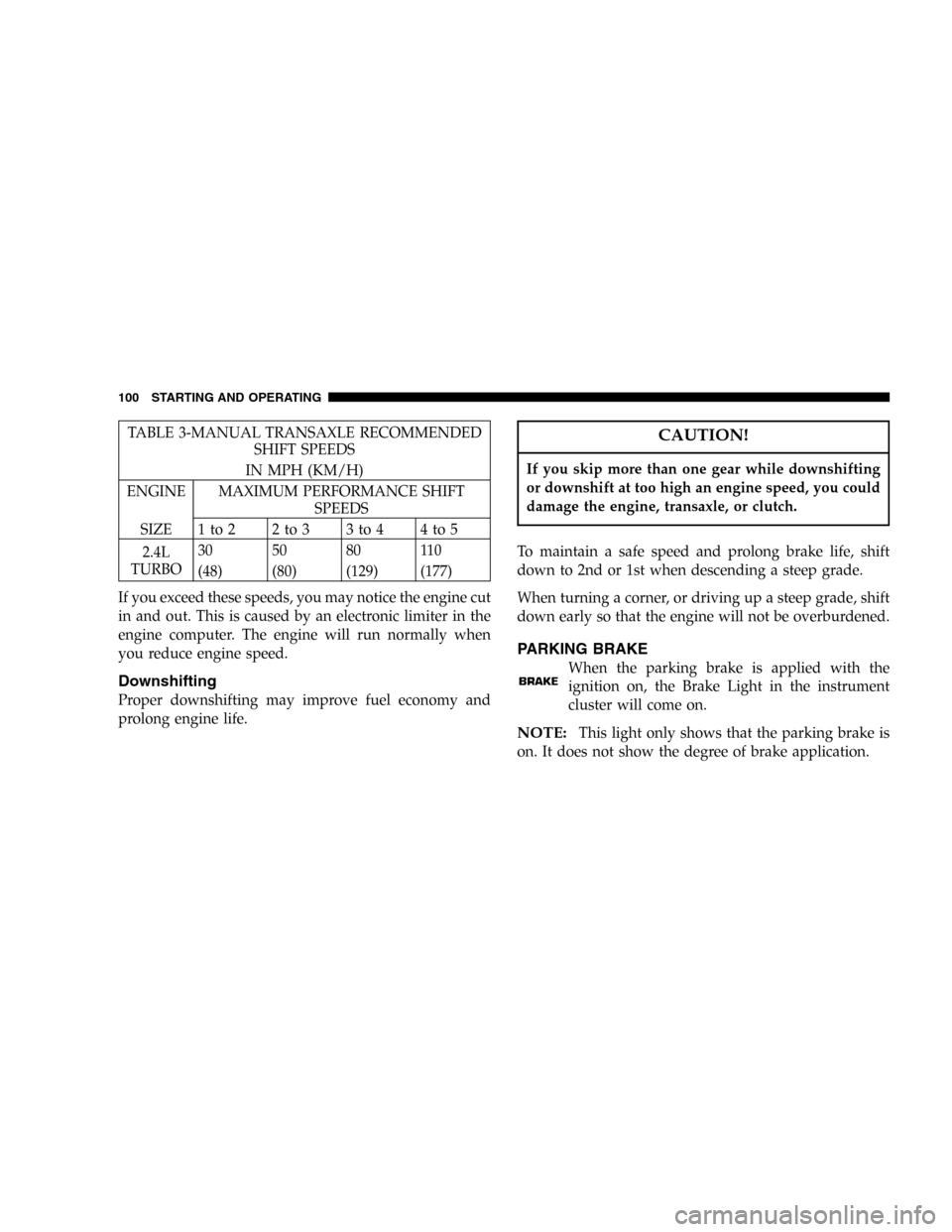
TABLE 3-MANUAL TRANSAXLE RECOMMENDED
SHIFT SPEEDS
IN MPH (KM/H)
ENGINE MAXIMUM PERFORMANCE SHIFT
SPEEDS
SIZE 1 to 2 2 to 3 3 to 4 4 to 5
2.4L
TURBO30 50 80 110
(48) (80) (129) (177)
If you exceed these speeds, you may notice the engine cut
in and out. This is caused by an electronic limiter in the
engine computer. The engine will run normally when
you reduce engine speed.
Downshifting
Proper downshifting may improve fuel economy and
prolong engine life.
CAUTION!
If you skip more than one gear while downshifting
or downshift at too high an engine speed, you could
damage the engine, transaxle, or clutch.
To maintain a safe speed and prolong brake life, shift
down to 2nd or 1st when descending a steep grade.
When turning a corner, or driving up a steep grade, shift
down early so that the engine will not be overburdened.
PARKING BRAKE
When the parking brake is applied with the
ignition on, the Brake Light in the instrument
cluster will come on.
NOTE:This light only shows that the parking brake is
on. It does not show the degree of brake application.
100 STARTING AND OPERATING
Page 169 of 216
Cleaning Plastic Instrument Cluster Lenses
The lenses in front of the instruments in the vehicle are
molded in clear plastic. When cleaning the lenses, care
must be taken to avoid scratching the plastic.
1. Clean with a wet soft rag. A mild soap solution may be
used, but do not use high alcohol content of abrasive
cleaners. If soap is used, wipe clean with a clean damp
rag.
2. Dry with a soft tissue.
Seat Belt Maintenance
Do not bleach, dye or clean the belts with chemical
solvents or abrasive cleaners. This will weaken the fabric.
Sun damage will also weaken the fabric.
If the belts need cleaning, use a mild soap solution or
lukewarm water. Do not remove the belts from the
vehicle to wash them.
Replace the belts if they appear frayed or worn or if the
buckles do not work properly.
MAINTAINING YOUR VEHICLE 169
7