2005 DODGE NEON SRT fuel
[x] Cancel search: fuelPage 100 of 216
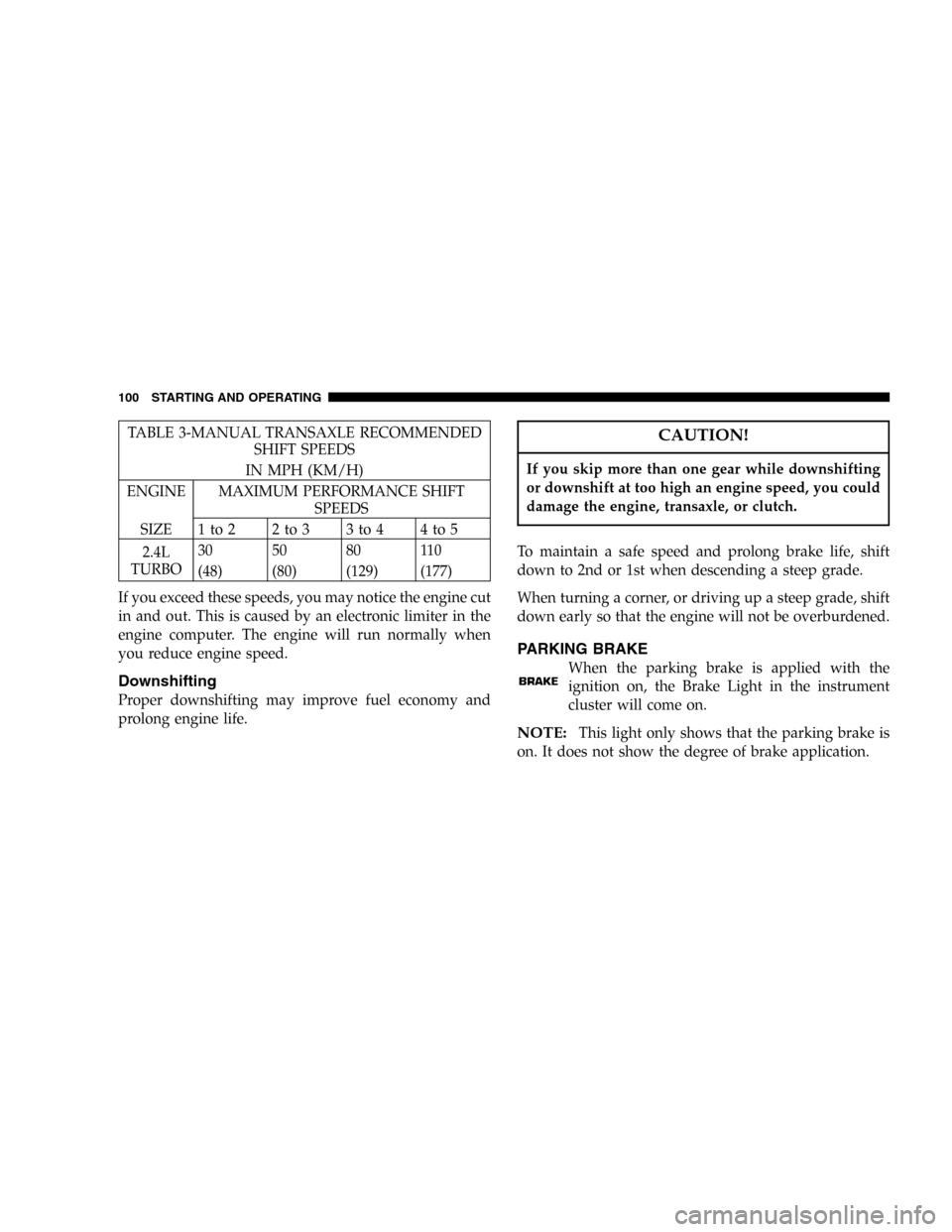
TABLE 3-MANUAL TRANSAXLE RECOMMENDED
SHIFT SPEEDS
IN MPH (KM/H)
ENGINE MAXIMUM PERFORMANCE SHIFT
SPEEDS
SIZE 1 to 2 2 to 3 3 to 4 4 to 5
2.4L
TURBO30 50 80 110
(48) (80) (129) (177)
If you exceed these speeds, you may notice the engine cut
in and out. This is caused by an electronic limiter in the
engine computer. The engine will run normally when
you reduce engine speed.
Downshifting
Proper downshifting may improve fuel economy and
prolong engine life.
CAUTION!
If you skip more than one gear while downshifting
or downshift at too high an engine speed, you could
damage the engine, transaxle, or clutch.
To maintain a safe speed and prolong brake life, shift
down to 2nd or 1st when descending a steep grade.
When turning a corner, or driving up a steep grade, shift
down early so that the engine will not be overburdened.
PARKING BRAKE
When the parking brake is applied with the
ignition on, the Brake Light in the instrument
cluster will come on.
NOTE:This light only shows that the parking brake is
on. It does not show the degree of brake application.
100 STARTING AND OPERATING
Page 113 of 216

2. Economy—
Improper inflation pressures can cause uneven wear
patterns to develop across the tire tread. These abnormal
wear patterns will reduce tread life resulting in a need for
earlier tire replacement. Underinflation also increases tire
rolling resistance and results in higher fuel consumption.
3. Ride Comfort and Vehicle Stability—
Proper tire inflation contributes to a comfortable ride.
Overinflation produces a jarring and uncomfortable ride.
Tire Inflation Pressures
The proper cold tire inflation pressure for passenger cars
is listed on either the face of the driver’s door or the
driver’s side“B”pillar. For vehicles other than passenger
cars, the cold tire inflation pressures are listed on either
the“B”pillar, the Certification Label or in the Tire
Inflation Pressures brochure in the glove compartment.The pressure should be checked and adjusted as well as
inspecting for signs of tire wear or visible damage at least
once a month. Use a good quality pocket-type gauge to
check tire pressure. Do not make a visual judgement
when determining proper inflation. Radial tires may look
properly inflated even when they are underinflated.
Tire Placard Location
STARTING AND OPERATING 113
5
Page 121 of 216

SELECTING FUEL
2.4L TURBO
Your engine is designed to meet all emis-
sion regulations and provide excellent fuel
economy and performance when using
high quality unleaded gasoline having an
octane rating of 91. The purchase of higher
octane is not recommended.
High quality unleaded gasoline having a minumum
octane rating of 87 may safely be used for your vehicle.
Use of these lower octane gasolines, however, may result
in reduced acceleration performance.
If low octane fuel (below the recommended 91 octane
(R+M)/2)) is used, boost will be reduced significantly.
Normal boost levels will return once the recommended
fuel is used and the engine controller adapts to the fuel
octane level.
Spark Knock
Light spark knock at low engine speeds is not harmful to
your engine. However, continued heavy spark knock at
high speeds can cause damage and immediate service is
required.
Poor quality gasoline can cause problems such as hard
starting, stalling and hesitations. If you experience these
symptoms, try another brand of“regular”gasoline be-
fore considering service for the vehicle.
Over 40 automobile manufacturers around the world
have issued and endorsed consistent gasoline specifica-
tions (the World Wide Fuel Charter, WWFC) to define
fuel properties necessary to deliver enhanced emissions,
engine performance, and durability for your vehicle. The
manufacturer recommends the use of gasolines that meet
the WWFC specifications if they are available.
Reformulated Gasoline
Many areas of the country require the use of cleaner
burning fuel referred to as Reformulated Gasoline. Re-
formulated gasolines contain oxygenates, and are specifi-
cally blended to reduce vehicle emissions and improve
air quality.
STARTING AND OPERATING 121
5
Page 122 of 216

The manufacturer supports the use of reformulated gaso-
lines. Properly blended reformulated gasolines will pro-
vide excellent performance and durability for the engine
and fuel system components.
Gasoline/Oxygenate Blends
Some fuel suppliers blend unleaded gasoline with mate-
rials called oxygenates such as 10% ethanol, MTBE and
ETBE. Oxygenates are required in some areas of the
country during the winter months to reduce carbon
monoxide emissions. Fuels blended with these oxygen-
ates may be used in your vehicle.
CAUTION!
DO NOT use gasolines containing Methanol. Gaso-
line containing methanol may damage critical fuel
system components.
Problems that result from using methanol/gasoline
blends are not the responsibility of the manufacturer.
While MTBE is an oxygenate made from Methanol, it
does not have the negative effects of Methanol.
MMT in Gasoline
MMT is a manganese containing metallic additive that is
blended into some gasoline to increase octane. Gasolines
blended with MMT provide no performance advantage
beyond gasolines of the same octane number without
MMT. Gasolines blended with MMT have shown to reduce
spark plug life and reduce emission system performance in
some vehicles. The manufacturer recommends that gaso-
lines free of MMT be used in your vehicle. The MMT
content of gasoline may not be indicated on the gasoline
pump, therefore you should ask your gasoline retailer
whether or not his/her gasoline contains MMT.
It is even more important to look for gasolines without
MMT in Canada because MMT can be used at higher
levels than allowed in the United States.
MMT is prohibited in both Federal and California refor-
mulated gasolines.
Materials Added to Fuel
All gasoline sold in the United States is required to
contain effective detergent additives. Use of additional
detergents or other additives is not needed under normal
122 STARTING AND OPERATING
Page 123 of 216

conditions and would result in unnecessary cost. There-
fore you should not have to add anything to the fuel.
Fuel System Cautions
CAUTION!
Follow these guidelines to maintain your vehicle’s
performance:
•The use of leaded gas is prohibited by Federal law.
Using leaded gasoline can impair engine performance,
damage the emission control system.
•An out-of-tune engine, or certain fuel or ignition
malfunctions, can cause the catalytic converter to
overheat. If you notice a pungent burning odor or
some light smoke, your engine may be out of tune or
malfunctioning and may require immediate service.
Contact your dealer for service assistance.
•The use of fuel additives which are now being sold as
octane enhancers is not recommended. Most of these
products contain high concentrations of methanol.Fuel system damage or vehicle performance problems
resulting from the use of such fuels or additives is not
the responsibility of the manufacturer.
NOTE:Intentional tampering with emissions control
systems can result in civil penalties being assessed
against you.
Carbon Monoxide Warnings
WARNING!
Carbon monoxide (CO) in exhaust gases is deadly.
Follow the precautions below to prevent carbon
monoxide poisoning:
•Do not inhale exhaust gases. They contain carbon
monoxide, a colorless and odorless gas which can kill.
Never run the engine in a closed area, such as a
garage, and never sit in a parked vehicle with the
engine running for an extended period. If the vehicle is
stopped in an open area with the engine running for
more than a short period, adjust the ventilation system
to force fresh, outside air into the vehicle.
STARTING AND OPERATING 123
5
Page 124 of 216

•Guard against carbon monoxide with proper mainte-
nance. Have the exhaust system inspected every time
the vehicle is raised. Have any abnormal conditions
repaired promptly. Until repaired, drive with all side
windows fully open.
•Keep the trunk closed when driving your vehicle to
prevent carbon monoxide and other poisonous ex-
haust gases from entering the vehicle.
ADDING FUEL
NOTE:
The fuel tank filler tube has a restricting door
about 2 inches (50 mm) down from the opening. If fuel is
poured from a portable container, the container should
have a flexible nozzle long enough to force open the
restricting door.
Fuel Tank Filler Cap
The gas cap is behind the fuel filler door, on the passen-
ger’s side of the vehicle. If the gas cap is lost or damaged,
be sure the replacement cap has been designed for use
with this vehicle.
CAUTION!
Damage to the fuel system or emission control
system could result from using an improper fuel
tank filler tube cap (gas cap). A poorly fitting cap
could let impurities into the fuel system.
CAUTION!
A poorly fitting gas cap may cause the Malfunction
Indicator Lamp to turn on.
NOTE:When the fuel nozzle“clicks”or shuts off, the
fuel tank is full.
CAUTION!
To avoid fuel spillage and overfilling, do not“top
off”the fuel tank after filling.
124 STARTING AND OPERATING
Page 125 of 216

NOTE:Tighten the gas cap about 1/4 turn until you
hear one click. This is an indication that the cap is
properly tightened.
If the gas cap is not tightened properly, the Malfunc-
tion Indicator light will come on. Be sure the gas cap is
tightened every time the vehicle is fueled.
WARNING!
•Never have any smoking materials lit in or near
the vehicle when the gas cap is removed or the
tank filled.
•Never add fuel when the engine is running.
•Turn off engine.
•Rotate the gas cap to the left to remove.
•To replace the cap, insert it into the filler neck and
tighten to the right until at least one click is heard.
WARNING!
A fire may result if gasoline is pumped into a
portable container that is inside of a vehicle. You
could be burned. Always place gas containers on the
ground while filling.
VEHICLE LOADING
Vehicle Loading Capacities
Front Seat Occupants....................... 2
Rear Seat Occupants........................ 3
Luggage....................... 115lbs. (52 kg)
Rated Vehicle Capacity............ 865lbs. (392 kg)
STARTING AND OPERATING 125
5
Page 133 of 216

7. Finish tightening the nuts. Push down on the wrench
while tightening the wheel nuts. Alternate nuts until each
nut has been tightened twice. Correct wheel nut torque is
100 ft. lbs. (135 N·m.). If you are not sure about the
tightness, have them checked with a torgue wrench by
your dealer or at a service station.
8. Remove the wheel blocks and lower the jack until it is
free. Stow the lug wrench, replaced tire, and jack. Secure
all parts using the means provided.
WARNING!
A loose tire or jack thrown forward in a collision or
hard stop could endanger the occupants of the ve-
hicle. Always stow the jack parts and the spare tire in
the places provided.
9. Adjust the tire pressure as soon as possible.
NOTE:The spare tire well is designed to hold the
compact spare tire or a deflated (flat) tire. A fully inflated
tire will not fit in the spare tire well.
JUMP-STARTING PROCEDURES DUE TO A LOW
BATTERY
WARNING!
Take care to avoid the radiator cooling fan whenever
the hood is raised. It can start anytime the ignition
switch is on. You can be hurt by the fan.
WARNING!
Do not attempt to push or tow your vehicle to get it
started. Unburned fuel could enter the catalytic
converter and once the engine has started, ignite and
damage the converter and vehicle. If the vehicle has
a discharged battery, booster cables may be used to
obtain a start from another vehicle. This type of start
can be dangerous if done improperly, so follow this
procedure carefully.
WHAT TO DO IN EMERGENCIES 133
6