Page 301 of 416
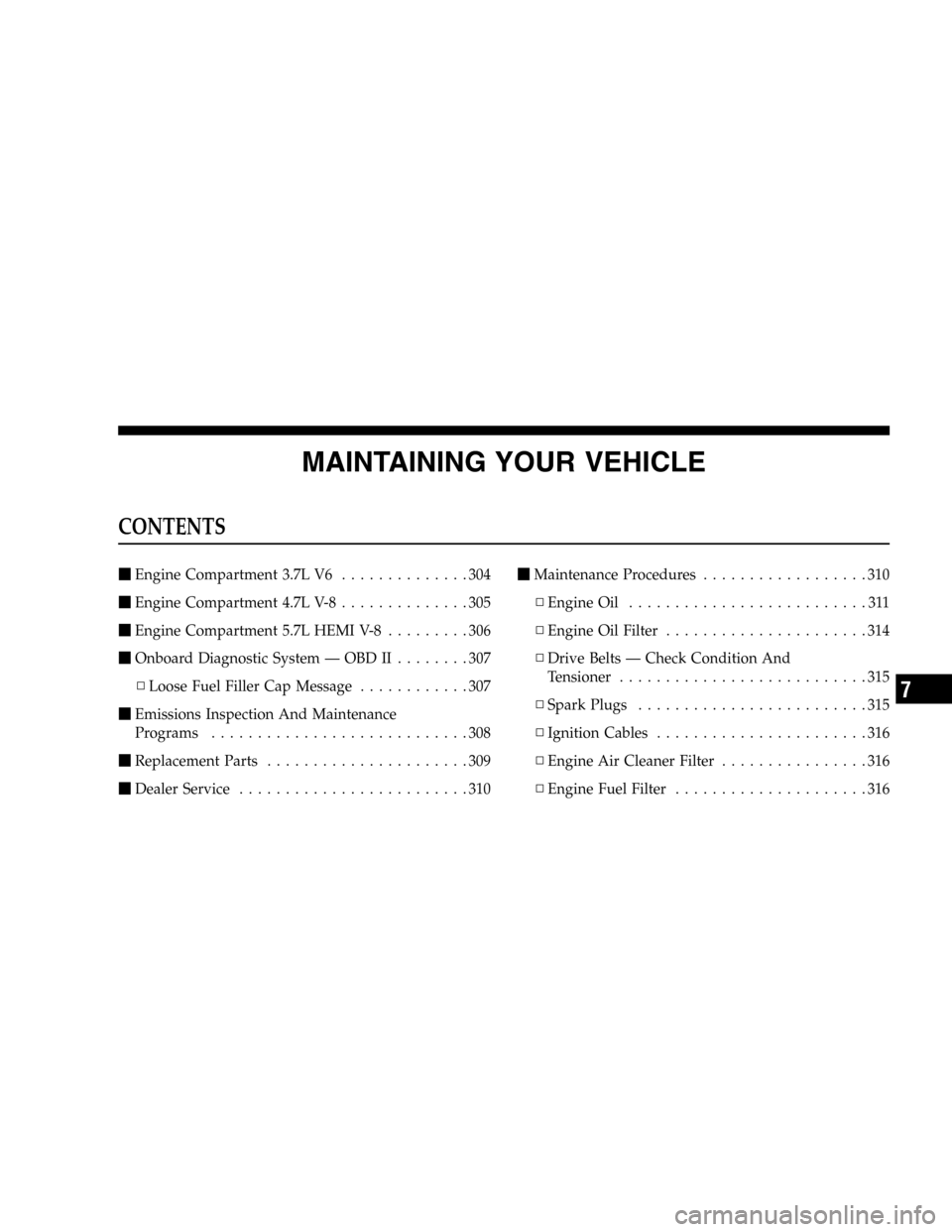
MAINTAINING YOUR VEHICLE
CONTENTS
�Engine Compartment 3.7L V6..............304
�Engine Compartment 4.7L V-8..............305
�Engine Compartment 5.7L HEMI V-8.........306
�Onboard Diagnostic System — OBD II........307
▫Loose Fuel Filler Cap Message............307
�Emissions Inspection And Maintenance
Programs............................308
�Replacement Parts......................309
�Dealer Service.........................310�Maintenance Procedures..................310
▫Engine Oil..........................311
▫Engine Oil Filter......................314
▫Drive Belts — Check Condition And
Tensioner...........................315
▫Spark Plugs.........................315
▫Ignition Cables.......................316
▫Engine Air Cleaner Filter................316
▫Engine Fuel Filter.....................316
7
Page 311 of 416

Engine Oil
Checking Engine Oil Level
To assure proper lubrication of your vehicle’s engine, the
engine oil must be maintained at the correct level. The
best time to check the engine oil level is about 5 minutes
after a fully warmed up engine is shut off or before
starting the engine after it has sat overnight.
1. Position the vehicle on a level surface.
2. Turn Off the engine and allow approximately 5 min-
utes for the oil to settle to the bottom of the crankcase.
3. Remove the engine oil level indicator (dipstick).
4. Wipe the engine oil level indicator (dipstick) clean.
5. Install the engine oil level indicator (dipstick) and
make sure it is seated in the tube.
6. Remove the engine oil level indicator (dipstick), keep-
ing the handle above the tip, and read the oil level on the
engine oil level indicator (dipstick).7. Add oil only if the level is below the “SAFE” range (at
or below the “ADD” mark) on the engine oil level
indicator (dipstick). Adding one quart of oil when the
reading is at the ADD mark will result in a reading at the
top of the SAFE range..
MAINTAINING YOUR VEHICLE 311
7
Page 312 of 416

CAUTION!
Overfilling or underfilling the crankcase will cause
oil aeration or loss of oil pressure. This could dam-
age your engine.
Frequency Of Oil Change
Road conditions and your style of driving affect the
interval at which your oil should be changed. Check the
following to determine ifANYapply to you:
•Day or night temperatures are below 32°F (0°C).
•Stop and Go driving.
•Extensive engine idling.
•Driving in dusty conditions.
•Short trips of less than 10 miles (16.2 km).
•More than 50% of your driving is at sustained high
speeds during hot weather, above 90°F (32°C).
•Trailer towing, Taxi, Police or delivery service (com-
mercial service).
•Off-Road or desert operation.
•If equipped for and operating with E-85 (ethanol)
fuel.
NOTE:IfANYof these apply to you then change your
engine oil every 3,000 miles (5 000 km) or 3 months,
whichever comes first and follow schedule “B” of the
�Maintenance Schedules�section of this manual.
If none of these apply to you, then change your engine oil
at every interval shown on schedule�A�of the�Mainte-
nance Schedules�section of this manual.
4x4 Models, If Used Primarily For Off-Road Operation
Every 50 hours of use.
312 MAINTAINING YOUR VEHICLE
Page 313 of 416

Dusty Conditions
Driving through dust-laden air increases the problems of
keeping abrasive materials out of the engine. Under these
conditions, special attention should be given to the
engine air cleaner and the crankcase inlet air cleaner. The
crankcase ventilation system should also be checked
periodically. Make sure that these units are always clean.
This will tend to reduce to a minimum the amount of
abrasive material that may enter the engine.
Engine Oil Selection
For best performance and maximum protection under all
types of operating conditions, the manufacture only
recommends engine oils that are API certified and meet
the requirements of DaimlerChrysler Material Standard
MS-6395. Use Mopar or an equivalent oil meeting the
specification MS-6395.
Engine Oil Identification (API) Symbol
There is a symbol to aid you in selecting the proper
engine oil.
This symbol means that the oil has
been certified by the American
Petroleum Institute (API). The
manufacture only recommends
API Certified engine oils that
meet the requirements of
DaimlerChrysler Material Stan-
dard MS-6395. Use Mopar or an
equivalent oil meeting the specifi-
cation MS-6395.
Engine Oil Viscosity (SAE Grade)
For 3.7L/4.7L engines SAE 5W-30 engine oil is recom-
mended for all operating temperatures. For 5.7L en-
gines SAE 5W-20 engine oil is recommended for all
operating temperatures.These engine oils improve low
MAINTAINING YOUR VEHICLE 313
7
Page 314 of 416

temperature starting and vehicle fuel economy. Refer to
your engine oil filler cap for the recommended engine
oil viscosity for your vehicle.
For information on engine oil filler cap location, see the
Engine Compartment illustration in this section.
Lubricants which do not have both, the engine oil certi-
fication mark and the correct SAE viscosity grade num-
ber should not be used.
Synthetic Engine Oils
There are a number of engine oils being promoted as
either synthetic or semi-synthetic. If you chose to use
such a product, useonlythose oils that meet the Ameri-
can Petroleum Institute (API) and SAE viscosity stan-
dard. Follow the service schedule that describes your
driving type.
Materials Added to Engine Oils
The manufacture strongly recommends against the addi-
tion of any additives (other than leak detection dyes) to
the engine oil. Engine oil is an engineered product and
it’s performance may be impaired by supplemental ad-
ditives.
Disposing of Used Engine Oil And Oil Filters
Care should be taken in disposing of used engine oil and
oil filters from your vehicle. Used oil and oil filters,
indiscriminately discarded, can present a problem to the
environment. Contact your dealer, service station, or
governmental agency for advice on how and where used
oil and oil filters can be safely discarded in your area.
Engine Oil Filter
The engine oil filter should be replaced at every engine
oil change.
314 MAINTAINING YOUR VEHICLE
Page 315 of 416

Engine Oil Filter Selection
The manufacturer’s engines have a full-flow type oil
filter. Use a filter of this type for replacement. The quality
of replacement filters varies considerably. Only high
quality filters should be used to assure most efficient
service. Mopar�Engine Oil Filters are a high quality oil
filter and are recommended.
Drive Belts — Check Condition and Tensioner
Belt tension is controlled by means of an automatic
tensioner. No belt tension adjustments are required.
However, belt and belt tensioner condition should be
inspected at the specified intervals, and replaced if re-
quired. See your authorized dealer for service. At the
mileage indicated in the maintenance schedule, all belts
and tensioner should be checked for condition. Improper
belt tension can cause belt slippage and failure. Belts
should be inspected for evidence of cuts, cracks, glazing,
or frayed cords and replaced if there is indication of
damage which could result in belt failure. Low generatorbelt tension can cause battery failure. Also check belt
routing to make sure there is no interference between the
belts and other engine components.
Spark Plugs
Spark plugs must fire properly to assure proper engine
performance and emission control. The plugs installed in
your vehicle should operate satisfactorily in normal
service for the mileage indicated in the Maintenance
Chart. New plugs should be installed at this mileage. The
entire set should be replaced if there is any malfunction
due to a faulty spark plug. Check the Vehicle Emissions
Control Information label for the proper type of spark
plug for your vehicle.
MAINTAINING YOUR VEHICLE 315
7
Page 321 of 416

WARNING!
Fluid level should be checked on a level surface and
with the engine off to prevent injury from moving
parts and to insure accurate fluid level reading. Do
not overfill. Use only manufacturers recommended
power steering fluid.
If necessary, add fluid to restore to the proper indicated
level. With a clean cloth, wipe any spilled fluid from all
surfaces. Refer to Recommended Fluids, Lubricants, and
Genuine Parts for correct fluid type.
Front Suspension Ball Joints
The ball joints and seals should be inspected whenever
the vehicle is serviced for other reasons. Damaged seals
should be replaced to prevent leakage or contamination
of the grease.
Drive Shaft Constant Velocity Joints
All four wheel drive models are equipped with four
constant velocity joints. Periodic lubrication of these
joints is not required. However, the joint boot should be
inspected for external leakage or damage periodically. If
external leakage or damage is evident, the joint boot and
grease should be replaced immediately. Continued op-
eration could result in failure of the joint due to water
and dirt contamination of the grease. This would require
complete replacement of the joint assembly. Refer to the
Service Manual for the detailed replacement procedure.
Body Lubrication
Locks and all body pivot points, including such items as
seat tracks, doors,liftgate and hood hinges, should be
lubricated periodically to assure quiet, easy operation
and to protect against rust and wear. Prior to the appli-
cation of any lubricant, the parts concerned should be
wiped clean to remove dust and grit; after lubricating
excess oil and grease should be removed. Particular
MAINTAINING YOUR VEHICLE 321
7
Page 322 of 416

attention should also be given to hood latching compo-
nents to insure proper function. When performing other
underhood services, the hood latch, release mechanism
and safety catch should be cleaned and lubricated.
The external lock cylinders should be lubricated twice a
year, preferably in the fall and spring. Apply a small
amount of a high quality lubricant such as Mopar�Lock
Cylinder Lubricant directly into the lock cylinder.
Windshield Wiper Blades
The rubber edges of the wiper blades and the windshield
should be cleaned periodically with a sponge or soft cloth
and a mild nonabrasive cleaner. This will remove accu-
mulations of salt or road film.
Operation of the wipers on dry glass for long periods
may cause deterioration of the wiper blades. Always use
washer fluid when using the wipers to remove salt or dirt
from a dry windshield.Avoid using the wiper blades to remove frost or ice from
the windshield. Keep the blade rubber out of contact with
petroleum products such as engine oil, gasoline, etc.
Windshield Washers
The fluid reservoir should be checked for fluid level at
regular intervals. When freezing weather is anticipated,
flush out the water in the reservoir by operating the
system. Fill the reservoir with windshield washer anti-
freeze (not radiator antifreeze), and operate the system
for a few seconds to flush out the residual water.
To prevent freeze-up of your windshield washer system
in cold weather, select a solution or mixture that meets or
exceeds the temperature range of your climate. This
rating information can be found on most washer fluid
containers.
322 MAINTAINING YOUR VEHICLE