Page 272 of 416

TRAILER SWAY CONTROLis a telescoping link that
can be installed between the hitch receiver and the trailer
tongue that typically provides adjustable friction associ-
ated with the telescoping motion to dampen any un-
wanted trailer swaying motions while traveling.
CAUTION!
•During the first 500 miles (805 km) your new
vehicle is driven, do not tow a trailer. Doing so
may damage your vehicle.
•When first towing a trailer, limit your speed to 50
mph (80 km/h) during the first 500 miles (805 km)
of towing.
Perform the maintenance listed in Section 8 of this
manual. When towing a trailer, never exceed the GAWR,
or GCWR, ratings.Consider the following items when computing the
weight on the rear axle:
•The tongue weight of the trailer.
•The weight of any other type of cargo or equipment
put in or on your vehicle.
NOTE:Remember that everything put into or on the
trailer adds to the load on your vehicle. Also, additional
factory-installed options, or dealer-installed options,
must be considered as part of the total load on your
vehicle. Refer to the Certification label located at the
driver’s door for the Gross Vehicle Weight Rating.
272 STARTING AND OPERATING
Page 278 of 416
Cooling System Tips—Trailer Towing
To reduce potential for engine and transmission over-
heating, take the following actions:
•City Driving
When stopped for short periods of time, put transmission
in neutral and increase engine idle speed.
•Highway Driving
Reduce speed.
•Air Conditioning
Turn off temporarily.
•See Cooling System Operating information in the
Maintenance section of this manual for more informa-
tion.
To reduce potential for automatic transmission overheat-
ing, turn the “TOW/HAUL” feature on when driving in
hilly areas or shift the transmission to Drive position 2 on
more severe grades. Move the shift lever to the next
lower position to eliminate excessive transmission shift-
ing. This action will also reduce the possibility of trans-
mission overheating and provide better engine braking.
7 - Pin Connector
278 STARTING AND OPERATING
Page 301 of 416
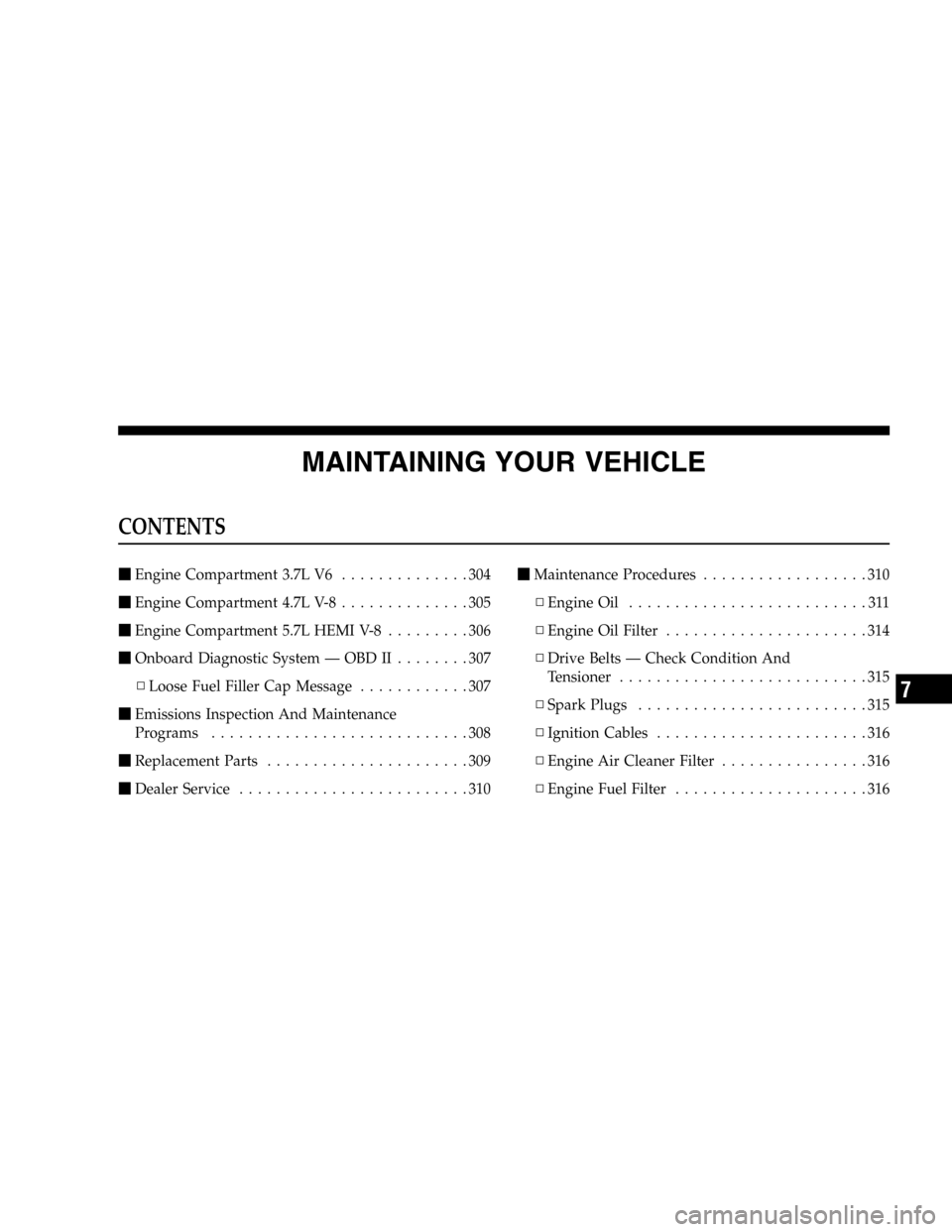
MAINTAINING YOUR VEHICLE
CONTENTS
�Engine Compartment 3.7L V6..............304
�Engine Compartment 4.7L V-8..............305
�Engine Compartment 5.7L HEMI V-8.........306
�Onboard Diagnostic System — OBD II........307
▫Loose Fuel Filler Cap Message............307
�Emissions Inspection And Maintenance
Programs............................308
�Replacement Parts......................309
�Dealer Service.........................310�Maintenance Procedures..................310
▫Engine Oil..........................311
▫Engine Oil Filter......................314
▫Drive Belts — Check Condition And
Tensioner...........................315
▫Spark Plugs.........................315
▫Ignition Cables.......................316
▫Engine Air Cleaner Filter................316
▫Engine Fuel Filter.....................316
7
Page 302 of 416

▫Catalytic Converter....................317
▫Maintenance-Free Battery................318
▫Air Conditioner Maintenance.............319
▫Power Steering — Fluid Check............320
▫Front Suspension Ball Joints..............321
▫Drive Shaft Constant Velocity Joints........321
▫Body Lubrication.....................321
▫Windshield Wiper Blades................322
▫Windshield Washers...................322
▫Exhaust System......................323
▫Cooling System.......................324
▫Emission Related Components............329
▫Brake System........................330▫Automatic Transmission................332
▫Transfer Case........................335
▫Axles..............................335
▫Selection Of Lubricating Grease...........336
▫Appearance Care And Protection From
Corrosion...........................337
�Power Distribution Center (Fuse/Relay).......341
�Fuse Block............................341
▫Interior Fuses........................342
▫Underhood Fuses (Power Distribution Center) . 345
▫Underhood Fuses (Integrated Power Module) . 347
�Replacement Light Bulbs.................348
�Bulb Replacement......................349
302 MAINTAINING YOUR VEHICLE
Page 308 of 416

cap until a�clicking�sound is heard. This is an indication
that the gas cap is properly tightened. Press the odometer
reset button to turn the message off. If the problem
persists, the message will appear the next time the
vehicle is started. This might indicate a damaged cap. If
the problem is detected twice in a row, the system will
turn on the Malfunction Indicator Light (MIL). Resolving
the problem will turn the MIL light off.
EMISSIONS INSPECTION AND MAINTENANCE
PROGRAMS
In some localities, it may be a legal requirement to pass
an inspection of your vehicle’s emissions control system.
Failure to pass could prevent vehicle registration.
For states which have an I/M (Inspection and
Maintenance) requirement, this check verifies the
following: the MIL (Malfunction Indicator Lamp)is functioning and is not on when the engine is running,
and that the OBD (On Board Diagnostic) system is ready
for testing.
Normally, the OBD system will be ready. The OBD
system maynotbe ready if your vehicle was recently
serviced, if you recently had a dead battery, or a battery
replacement. If the OBD system should be determined
not ready for the I/M test, your vehicle may fail the test.
Your vehicle has a simple ignition key actuated test
which you can use prior to going to the test station. To
check if your vehicle’s OBD system is ready, you must do
the following:
1. Insert your ignition key into the ignition switch.
2. Turn the ignition to the ON position, but do not crank
or start the engine.
3. If you crank or start the engine, you will have to start
this test over.
308 MAINTAINING YOUR VEHICLE
Page 309 of 416

4. As soon as you turn your key to the ON position, you
will see your MIL symbol come on as part of a normal
bulb check.
5. Approximately 15 seconds later, one of two things will
happen:
a. The MIL light will blink for approximately 5 sec-
onds and then remain on until the first engine crank or
the key is turned off. This means that your vehicle’s
OBD system isnot readyand you shouldnotproceed
to the I/M station.
b. The MIL light will remain fully illuminated until the
first engine crank or the key is turned off. This means
that your vehicle’s OBD system isreadyand you can
proceed to the I/M station.
If your OBD system isnot ready,you should see your
dealer or repair facility. If your vehicle was recently
serviced or had a battery failure or replacement, you mayneed to do nothing more than drive your vehicle as you
normally would in order for your OBD system to update.
A recheck with the above test routine may then indicate
that the system is now ready.
Regardless of whether your vehicle’s OBD system is
ready or not ready, if the MIL symbol is illuminated
during normal vehicle operation, you should have your
vehicle serviced before going to the I/M station. The I/M
station can fail your vehicle because the MIL symbol is on
with the engine running.
REPLACEMENT PARTS
Use of genuine Mopar�parts for normal/scheduled
maintenance and repairs is highly recommended to in-
sure the designed performance. Damage or failures
caused by the use of non-Mopar�parts for maintenance
and repairs will not be covered by the manufacturer’s
warranty.
MAINTAINING YOUR VEHICLE 309
7
Page 310 of 416

DEALER SERVICE
Your dealer has the qualified service personnel, special
tools and equipment to perform all service operations in
an expert manner. Service manuals are available which
include detailed service information for your vehicle.
Refer to these manuals before attempting any procedure
yourself.
NOTE:Intentional tampering with emissions control
systems can result in civil penalties being assessed
against you.WARNING!
You can be badly injured working on or around a
motor vehicle. Do only that service work for which
you have the knowledge and the proper equipment.
If you have any doubt about your ability to perform
a service job, take your vehicle to a competent
mechanic.
MAINTENANCE PROCEDURES
The pages that follow contain therequiredmaintenance
services determined by the engineers who designed your
vehicle.
Besides the maintenance items for which there are fixed
maintenance intervals, there are other items that should
operate satisfactorily without periodic maintenance.
However, if a malfunction of these items does occur, it
could adversely affect the engine or vehicle performance.
These items should be inspected if a malfunction is
observed or suspected.
310 MAINTAINING YOUR VEHICLE
Page 312 of 416

CAUTION!
Overfilling or underfilling the crankcase will cause
oil aeration or loss of oil pressure. This could dam-
age your engine.
Frequency Of Oil Change
Road conditions and your style of driving affect the
interval at which your oil should be changed. Check the
following to determine ifANYapply to you:
•Day or night temperatures are below 32°F (0°C).
•Stop and Go driving.
•Extensive engine idling.
•Driving in dusty conditions.
•Short trips of less than 10 miles (16.2 km).
•More than 50% of your driving is at sustained high
speeds during hot weather, above 90°F (32°C).
•Trailer towing, Taxi, Police or delivery service (com-
mercial service).
•Off-Road or desert operation.
•If equipped for and operating with E-85 (ethanol)
fuel.
NOTE:IfANYof these apply to you then change your
engine oil every 3,000 miles (5 000 km) or 3 months,
whichever comes first and follow schedule “B” of the
�Maintenance Schedules�section of this manual.
If none of these apply to you, then change your engine oil
at every interval shown on schedule�A�of the�Mainte-
nance Schedules�section of this manual.
4x4 Models, If Used Primarily For Off-Road Operation
Every 50 hours of use.
312 MAINTAINING YOUR VEHICLE