Page 327 of 480
General Information
This device complies with part 15 of the FCC rules and
RSS 210 of Industry Canada. Operation is subject to the
following conditions:
•This device may not cause harmful interference.
•This device must accept any interference received,
including interference that may cause undesired op-
eration.The tire pressure sensors are covered under one of the
following licenses:
United States.....................KR5S120123
Canada........................2671-S120123TIRE CHAINS
Use only compact chains, or other traction aids that meet
SAE type“Class S”specifications. Chains must be the
proper size for the vehicle, as recommended by the chain
manufacturer.
NOTE:Do not use tire chains on a compact spare tire.
STARTING AND OPERATING 327
5
Page 329 of 480

SNOW TIRES
Some areas of the country require the use of snow tires
during winter. Standard tires are of the all season type
and satisfy this requirement as indicated by the M+S
designation on the tire side wall.
If you need snow tires, select tires equivalent in size and
type to the original equipment tires. Use snow tires only
in sets of 4, failure to do so may adversely affect the
safety and handling of your vehicle.
Snow tires generally have lower speed ratings than what
was originally equipped with your vehicle and should
not be operated at sustained speeds over 75 mph (120
km/h).
TIRE ROTATION RECOMMENDATIONS
Tires on the front and rear axles of vehicles operate at
different loads and perform different steering, driving,
and braking functions. For these reasons, they wear at
unequal rates, and tend to develop irregular wear pat-
terns.
These effects can be reduced by timely rotation of tires.
The benefits of rotation are especially worthwhile with
aggressive tread designs such as those on all season type
tires. Rotation will increase tread life, help to maintain
mud, snow, and wet traction levels, and contribute to a
smooth, quiet ride.
Follow the recommended tire rotation frequency for your
type of driving found in the“Maintenance Schedules”
Section of this manual. More frequent rotation is permis-
sible if desired. The reasons for any rapid or unusual
wear should be corrected prior to rotation being per-
formed.
STARTING AND OPERATING 329
5
Page 339 of 480

•The tongue weight of the trailer.
•The weight of any other type of cargo or equipment
put in or on your vehicle.
•Remember that everything put in or on the trailer adds
to the load on your vehicle.
Tongue weight must be equal to at least 10% of Gross
Trailer Weight (GTW), but no more than 15% of GTW.
Towing Requirements
•
The maximum frontal area of the trailer cannot exceed
40 square feet (3.72 square meters).
•The trailer tongue load must be considered as part of
the combined weight of occupants and cargo, and
should never exceed the weight referenced on the Tire
and Loading Information placard. Refer to the Tire–
Safety Information Section in this manual.
•The“D”range can be selected when towing. However,
if frequent shifting occurs while in this range, the“3”
range must be selected.NOTE:Using the“3”range while operating the vehicle
under heavy operating conditions will improve perfor-
mance and extend transaxle life by reducing excessive
shifting and heat build up.
•Do not attempt to tow a trailer while using a compact
spare tire.
•Whenever you pull a trailer, regardless of the trailer
size, stop lights and turn signals on the trailer are
recommended for motoring safety.
•The automatic transaxle fluid and filter should be
changed if you REGULARLY tow a trailer for more
than 45 minutes of continuous operation. See Schedule
“B”in section 8 of this manual for transaxle fluid
change intervals.
NOTE:Check the automatic transaxle fluid level before
towing.
STARTING AND OPERATING 339
5
Page 359 of 480
CAUTION!
For vehicles equipped with fold-in-floor seating, the
Winch Mechanism is designed specifically to stow a
COMPACT Spare Tire ONLY. Do not attempt to use
the Winch to stow the Full Size’Flat’Tire, or any
other Full Size Tire. Vehicle damage may result.
Jacking Instructions—Non Fold-in-Floor Seating
Preparations For Jacking
Park the vehicle on a firm level surface, avoid ice or
slippery areas,set the parking brakeand place the gear
selector in PARK. Turn OFF the ignition.
WARNING!
Do not attempt to change a tire on the side of the
vehicle close to moving traffic. Pull far enough off
the road to avoid the danger of being hit when
operating the jack or changing the wheel.
•Turn on the Hazard Warning Flasher.
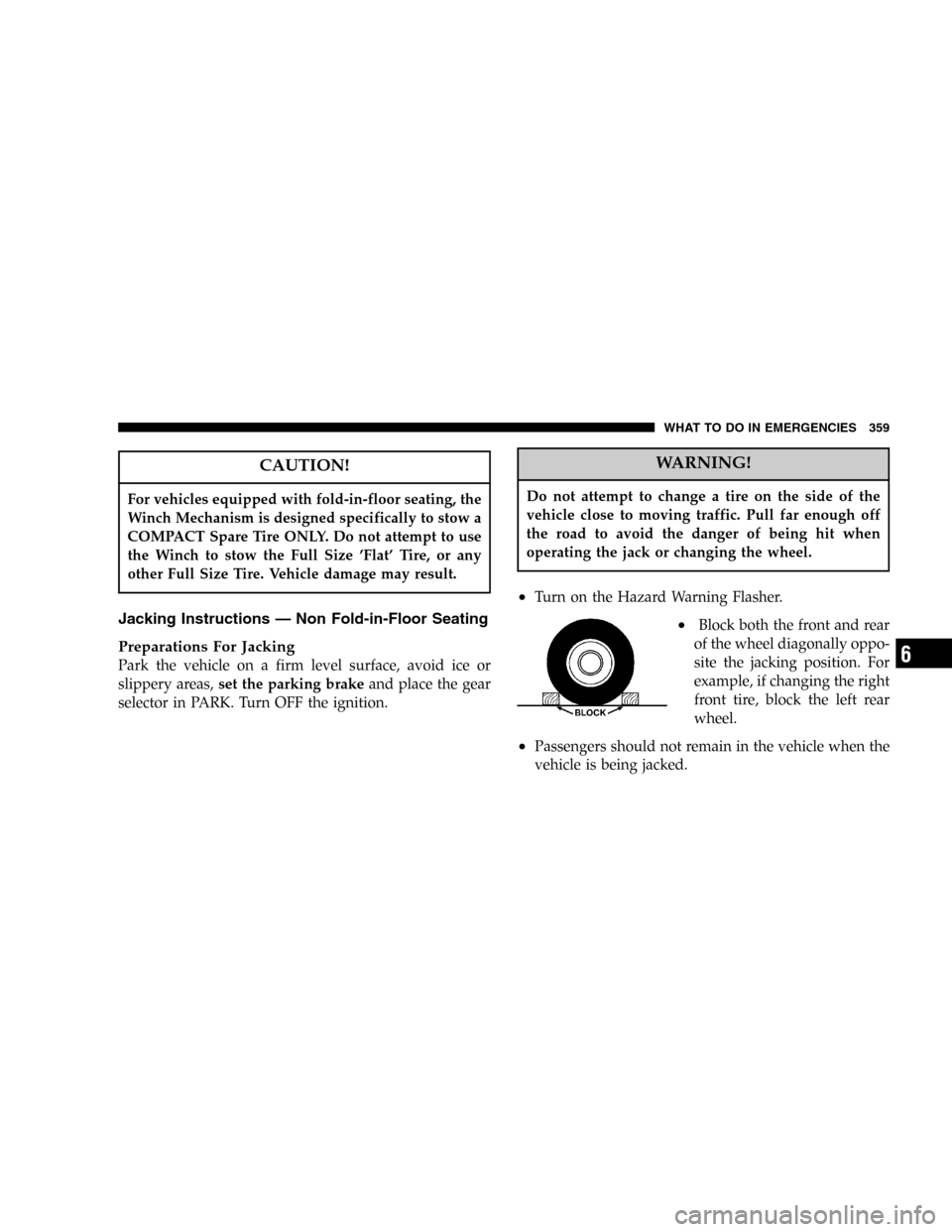
•Block both the front and rear
of the wheel diagonally oppo-
site the jacking position. For
example, if changing the right
front tire, block the left rear
wheel.
•Passengers should not remain in the vehicle when the
vehicle is being jacked.
WHAT TO DO IN EMERGENCIES 359
6
Page 473 of 480

Compact Spare........................ 320
Flat Changing........................ 355
General Information.................... 316
High Speed.......................... 319
Inflation Pressures..................... 317
Jacking........................346,347,359
Load Capacity.....................312,313
Pressure Monitor System................. 325
Quality Grading....................... 455
Radial.............................. 320
Replacement......................... 323
Rotation............................. 329
Safety...........................308,316
Sizes............................... 309
Snow Tires........................... 329
Spare Tire.........................349,360
Spinning............................ 322
Tread Wear Indicators................... 322Towing............................... 338
Disabled Vehicle....................... 369
Trailering............................ 338
Traction Control...................143,203,306
Traction Control Switch.................143,306
Trailer Towing.......................... 338
Minimum Requirements................. 339
Trailer and Tongue Weight................ 339
Transaxle............................. 297
Automatic........................... 297
Operation........................... 297
Overdrive........................... 300
Selection of Lubricant................403,423
Transmission........................... 402
Automatic........................... 402
Filter............................... 405
Fluid............................403,423
Transmitter Battery Service.................. 26
INDEX 473
10
