Page 372 of 480

▫Steering Shaft Seal....................391
▫Steering Linkage......................391
▫Drive Shaft Universal Joints..............391
▫Body Lubrication.....................391
▫Windshield Wiper Blades................392
▫Windshield And Rear Window Washers.....392
▫Exhaust System......................393
▫Cooling System.......................394
▫Hoses And Vacuum/Vapor Harnesses.......399
▫Brakes.............................399
▫Master Cylinder—ABS Brakes Brake
Fluid Level Check.....................401
▫Fuel System Hoses....................402▫Automatic Transmission................402
▫Front And Rear Wheel Bearings...........406
▫Appearance Care And Protection
From Corrosion......................406
▫Cleaning The Instrument Panel And Underseat
Cup Holders........................410
�Integrated Power Module (IPM)............412
�Vehicle Storage........................415
�Replacement Light Bulbs.................415
�Bulb Replacement......................416
▫Headlights..........................416
▫Front Park/Turn Signal And
Sidemarker Lights.....................418
▫Front Fog Light......................419
372 MAINTAINING YOUR VEHICLE
Page 390 of 480

frame with the direction of airflow (away from the
blower motor and towards the center of the car).
Refer to the“Maintenance Schedules”section of this
manual for the recommended air conditioning filter
replacement intervals.
Power Steering—Fluid Check
Checking the power steering fluid level at a defined
service interval is not required. The fluid should only be
checked if a leak is suspected, abnormal noises are
apparent, and/or the system is not functioning as antici-
pated. Coordinate inspection efforts through a certified
DaimlerChrysler Dealership.�
WARNING!
Fluid level should be checked on a level surface and
with the engine off to prevent injury from moving
parts and to insure accurate fluid level reading. Do
not overfill. Use only manufacturers recommended
power steering fluid.
If necessary, add fluid to restore to the proper indicated
level. With a clean cloth, wipe any spilled fluid from all
surfaces. Refer to Recommended Fluids, Lubricants, and
Genuine Parts for correct fluid type.
Front Suspension Ball Joints
The front suspension ball joints are permanently sealed.
No regular maintenance is required for these compo-
nents.
390 MAINTAINING YOUR VEHICLE
Page 400 of 480

WARNING!
Riding the brakes can lead to brake failure and
possibly an accident. Driving with your foot resting
or riding on the brake pedal can result in abnormally
high brake temperatures, excessive lining wear, and
possible brake damage. You wouldn’t have your full
braking capacity in an emergency.
Brake And Power Steering Hoses
When the vehicle is serviced for scheduled maintenance,
inspect surface of hoses and nylon tubing for evidence of
heat and mechanical damage. Hard and brittle rubber,
cracking, tears, cuts, abrasion, and excessive swelling
indicate deterioration of the rubber. Particular attention
should be made to examining those hose surfaces nearest
to high heat sources, such as the exhaust manifold.Insure nylon tubing in these areas has not melted or
collapsed.
Inspect all hose connections such as clamps and cou-
plings to make sure they are secure and no leaks are
present.
NOTE:Often, fluid such as oil, power steering fluid,
and brake fluid are used during assembly plant opera-
tions to facilitate the assembly of hoses to couplings.
Therefore, oil wetness at the hose-coupling area is not
necessarily an indication of leakage. Actual dripping of
hot fluid when systems are under pressure (during
vehicle operation), should be noted before hose is re-
placed based on leakage.
NOTE:Inspection of brake hoses should be performed
whenever the brake system is serviced and every engine
oil change. Inspect hydraulic brake hoses for surface
cracking, scuffing, or worn spots. If there is any evidence
of cracking, scuffing, or worn spots, the hose should be
400 MAINTAINING YOUR VEHICLE
Page 415 of 480

The Heated Mirrors, Lower Instrument Panel Power
Outlet and Removable Floor Console, when in the front
position are fused with self resetting fuses that are only
serviceable by an authorized dealer. The power seats are
fused by a 30 Amp circuit breaker located under the
driver’s seat. The Power Windows are fused by a 25 Amp
circuit breaker located under the instrument panel near
the steering column. If you experience temporary or
permanent loss of these systems see your authorized
dealer for service.
VEHICLE STORAGE
If you are leaving your vehicle dormant for more than 21
days you may want to take steps to protect your battery.
You may:
•Remove the 20 Amp mini fuse in the Integrated Power
Module labeled Ignition-Off Draw (IOD).
•Or, disconnect the negative cable from the battery.
•Anytime you store your vehicle, or keep it out of
service (i.e. vacation) for two weeks or more, run the
air conditioning system at idle for about five minutes
in the fresh air and high blower setting. This will
insure adequate system lubrication to minimize the
possibility of compressor damage when the system is
started again.
REPLACEMENT LIGHT BULBS
LIGHT BULBS—Interior Bulb Number
Center & Rear Dome Light.................. 578
Center & Rear Reading Lights............... 578
Front Door Courtesy Light.................. 578
Front Header Reading Lights—If Equipped..... 578
Instrument Cluster Lights.................PC74
Liftgate Light(s).......................... 578
Overhead Console Reading Lights..........PC579
Removable Console Light—If Equipped....... 194
Visor Vanity Lights....................6501966
MAINTAINING YOUR VEHICLE 415
7
Page 423 of 480
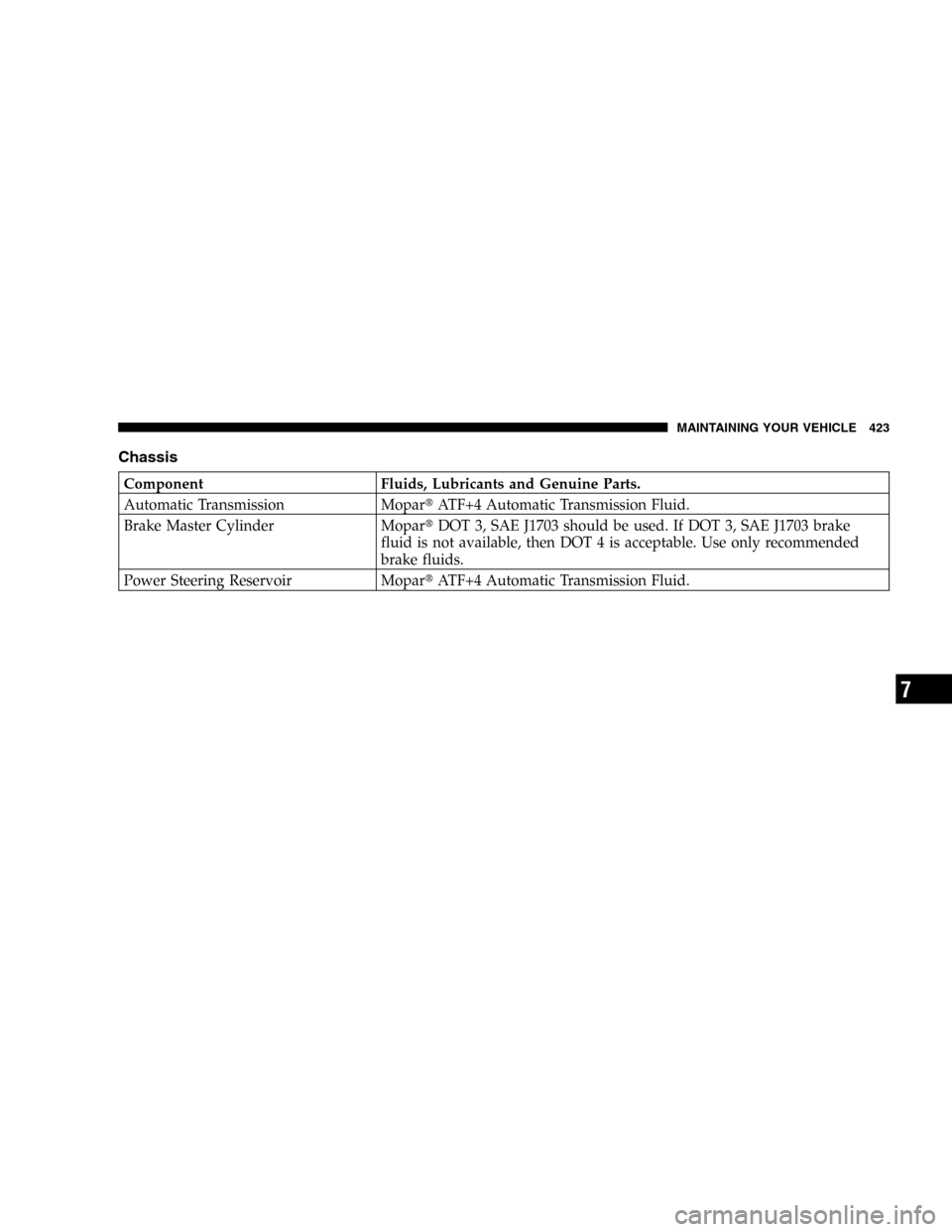
Chassis
Component Fluids, Lubricants and Genuine Parts.
Automatic Transmission Mopar�ATF+4 Automatic Transmission Fluid.
Brake Master Cylinder Mopar�DOT 3, SAE J1703 should be used. If DOT 3, SAE J1703 brake
fluid is not available, then DOT 4 is acceptable. Use only recommended
brake fluids.
Power Steering Reservoir Mopar�ATF+4 Automatic Transmission Fluid.
MAINTAINING YOUR VEHICLE 423
7
Page 430 of 480
Miles 3, 000 6, 000 9, 000 12, 000 15, 000 18, 000
(Kilometers) (5 000 ) (10 000 ) (14 000) (19 000) (24 000) (29 000)
Change engine oil and engine oil filter.XXXXX X
Rotate Tires X X X
Inspect the brake linings. X X
Inspect the engine air cleaner filter, replace if
necessary. *XXXX X
Replace theengine air cleaner filter.*X
Inspect and adjust the power steering pump
belt tension on 2.4 liter engines.X
Inspect the generator belt on 2.4 liter engines,
replace if necessary.X
Replace the air conditioning filter. X
430 SCHEDULE“B”
8
M
A
I
N
T
E
N
A
N
C
E
S
C
H
E
D
U
L
E
S
Page 431 of 480
Miles 21, 000 24, 000 27, 000 30, 000 33, 000 36, 000
(Kilometers) (34 000) (38 000) (43 000) (48 000) (53 000) (58 000)
Change engine oil and engine oil filter.XXXXX X
Rotate Tires X X X
Inspect the brake linings. X X
Inspect the engine air cleaner filter, replace if
necessary. *XXX X X
Replace theengine air cleaner filter.X
Replace thespark plugs2.4 liter engines. X
Inspect the tie rod ends and boot seals. X
Inspect and adjust the power steering pump
belt tension on 2.4 liter engines.X
Inspect the generator belt on 2.4 liter engines,
replace if necessary.X
Inspect thePCV valveand replace as neces-
sary.*X
Replace the air conditioning filter. X X
SCHEDULE“B”431
8
M
A
I
N
T
E
N
A
N
C
E
S
C
H
E
D
U
L
E
S
Page 432 of 480
Miles 39, 000 42, 000 45, 000 48, 000 51, 000 54, 000
(Kilometers) (62 000) (67 000) (72 000) (77 000) (82 000) (86 000)
Change engine oil and engine oil filter.XXXXX X
Rotate Tires X X X
Inspect the brake linings. X X
Inspect the engine air cleaner filter, replace if
necessary. *XX XX X
Replace theengine air cleaner filter.*X
Inspect and adjust the power steering pump
belt tension on 2.4 liter engines.X
Inspect the generator belt on 2.4 liter engines,
replace if necessary.X
Replace the air conditioning filter. X
432 SCHEDULE“B”
8
M
A
I
N
T
E
N
A
N
C
E
S
C
H
E
D
U
L
E
S