Page 90 of 291

INSTRUMENT CLUSTER DESCRIPTION
1. Fuel Gauge
When the ignition key is in the ON position, the
pointer will show the level of fuel remaining in
the fuel tank.
2. Traction Control — If Equipped
This display indicator illuminates momentarily
as a bulb check when the ignition switch is first
turned ON. The indicator will blink during an
active traction event, but will remain solid
when the system is deactivated or if a system malfunc-
tion occurs.
The Traction Control indicator will turn ON if:
•The Traction Control system is in use.
•The Traction Control switch has been used to turn
the system OFF.
•There is an Anti-Lock Brake system malfunction or
Traction Control system malfunction.
•The system has been deactivated to prevent damage
to the brake system due to overheated brake tem-
peratures.
NOTE:Extended heavy use of Traction Control may
cause the system to deactivate and turn on the Traction
Control indicator. This is to prevent overheating of the
brake system and is a normal condition. The system will
remain disabled for about 4 minutes until the brakes have
cooled. The system will automatically reactivate and turn
off the Traction Control indicator.
3. Cruise Light — If Equipped
This light shows that the Speed Control System is ON.
This light will also illuminate for a 5–second bulb check
when the ignition switch is first turned to the ON
position.
4. Airbag Light
The light comes on and remains on for 6 to 8
seconds as a bulb check when the ignition
switch is first turned ON. If the bulb does not
come on during starting, have the bulb replaced. If the
light stays on, or comes on while driving, have the
system checked by an authorized dealer.
90 UNDERSTANDING YOUR INSTRUMENT PANEL
Page 95 of 291

In an ABS equipped vehicle, the Brake System Warning
light will come on if the ABS light is not functioning or if
the ABS system is not communicating.
19. Seat Belt Reminder Light
When the ignition switch is first turned ON, this
light will turn on for 5 to 8 seconds as a bulb
check. During the bulb check, if the driver’s seat
belt is unbuckled, a chime will sound. After the bulb
check or when driving, if the driver seat belt remains
unbuckled, the Seat Belt Warning Light will flash or
remain on continuously. Refer to�Enhanced Driver
Seat Belt Reminder System (BeltAlert™)�in the Occu-
pant Restraints section for more information.
20. Theft Alarm Light—If Equipped
The light in the instrument cluster will flash rapidly for
15 seconds. This shows that the system is arming. If the
light comes on but does not flash, the system is still
armed, but there is a problem in the trunk circuit. After 15
seconds the light will continue to flash slowly. This
shows that the system is fully armed.
21. Low Fuel Light
When the fuel level drops to about 21⁄2gallons
(91⁄2liters), the fuel symbol will light and remain
lit until fuel is added.
COMPASS, TEMPERATURE, AND TRIP
COMPUTER DISPLAY—IF EQUIPPED
This feature allows you to choose between a compass /
temperature display and one of five trip conditions being
monitored.
Trip Computer Display
UNDERSTANDING YOUR INSTRUMENT PANEL 95
4
Page 151 of 291
NOTE:Using the“3”range while operating the vehicle
under heavy operating conditions will improve perfor-
mance, fuel economy, and extend transaxle life by reduc-
ing excessive shifting and heat build up.
Use the“3”range when descending steep grades to
prevent brake system distress.
“L”Low
This range should be used for maximum engine braking
when descending steep grades. In this range, up shifts
will occur only to prevent engine over speed while down
shifts occur as early as possible.
WARNING!
Never use Park position on an automatic transmis-
sion as a substitute for the parking brake. Always
apply parking brake fully when parked to guard
against vehicle movement and possible injury or
damage.
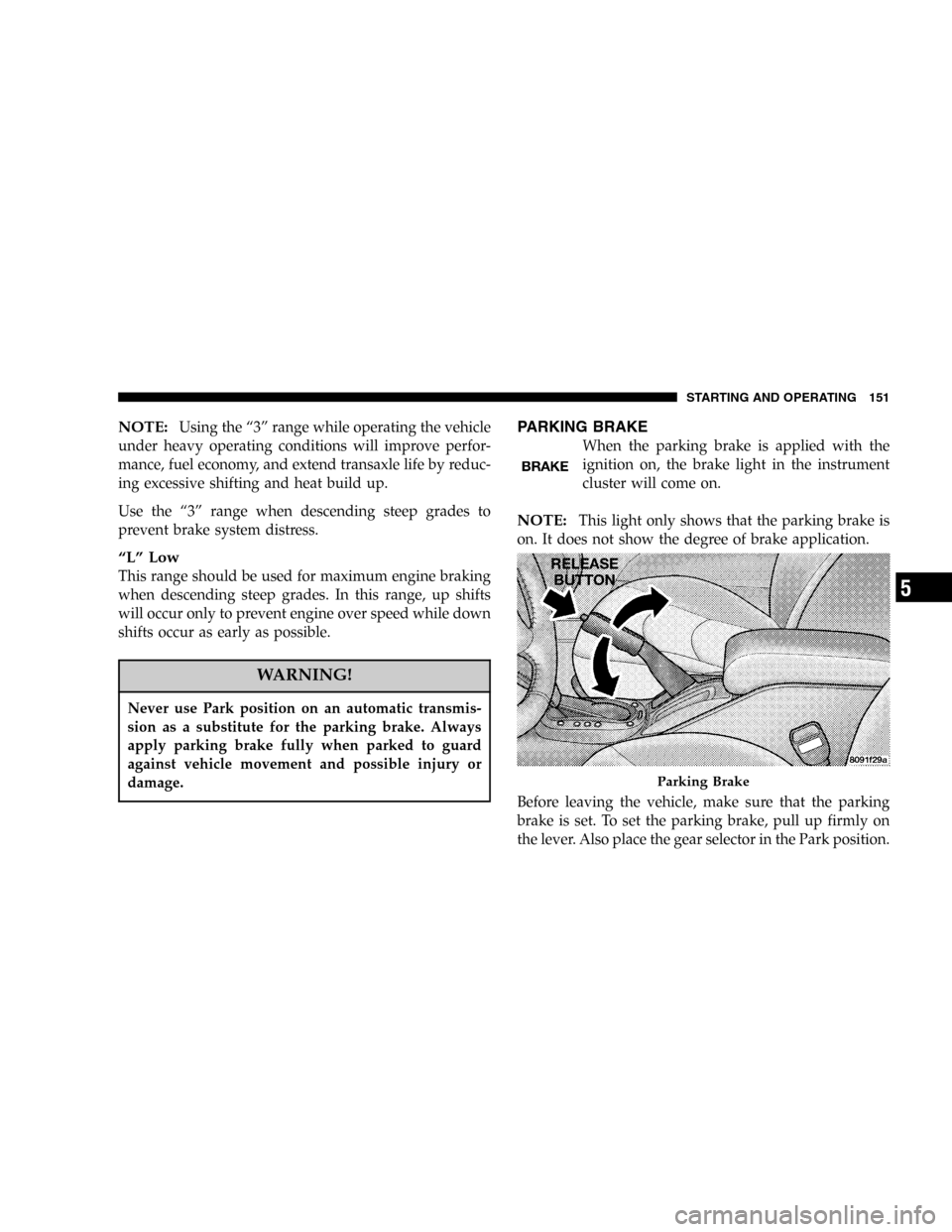
PARKING BRAKE
When the parking brake is applied with the
ignition on, the brake light in the instrument
cluster will come on.
NOTE:This light only shows that the parking brake is
on. It does not show the degree of brake application.
Before leaving the vehicle, make sure that the parking
brake is set. To set the parking brake, pull up firmly on
the lever. Also place the gear selector in the Park position.
Parking Brake
STARTING AND OPERATING 151
5
Page 155 of 291

POWER STEERING
The power assisted steering system of your vehicle
provides mechanical steering capability in the event
power assist is lost.
If for some reason the hydraulic pressure is interrupted,
it will still be possible to steer your vehicle. Under these
conditions you will observe a substantial increase in
steering effort.
TRACTION CONTROL—IF EQUIPPED
The Traction Control System will improve acceleration
and steering on slippery surfaces by reducing tire spin.
The system reduces wheel slip and maintains traction at
the driving (front) wheels by engaging the brake on the
wheel that is losing traction. When this occurs the
traction control indicator light located in the instrument
cluster will flash. The system operates at speeds below 35
mph (56 km/h).A push-button located on the top of the steering column
turns the Traction Control System ON or OFF.
The system is always in the“ON”mode unless:
•The traction control switch has been used to turn the
system off;
•There is a Anti-Lock Brake System malfunction;
•There is a Traction Control System malfunction;
Traction Control Switch
STARTING AND OPERATING 155
5
Page 156 of 291
•The system has been automatically deactivated to
prevent damage to the brake system due to overheated
brake temperatures.
NOTE:Extended heavy use of Traction Control may
cause the system to deactivate and turn on the traction
control light located in the instrument cluster.
This is to prevent overheating of the brake system and is
a normal condition. The system will remain disabled for
about 4 minutes until the brakes have cooled. The system
will automatically reactivate and turn off the traction
control light.
If your vehicle becomes stuck in mud, ice, or snow, turn
the Traction Control System Off before attempting to
“rock”the vehicle free.
TIRE SAFETY INFORMATION
Tire Markings
NOTE:
•
P(Passenger)-Metric tire sizing is based on U.S. design
standards. P-Metric tires have the letter“P”molded
into the sidewall preceding the size designation. Ex-
ample: P215/65R15 95H.
156 STARTING AND OPERATING
Page 233 of 291

Never use an abrasive type cleaner. Use caution when
cleaning inside rear windows equipped with electric
defrosters. Do not use scrapers or other sharp instru-
ments which may scratch the elements.
Instrument Panel Cover
The instrument panel cover has a low glare surface which
minimizes reflections in the windshield. Do not use
protectants or other products which may cause undesir-
able reflections. Use soap and warm water to restore the
low glare surface.
Cleaning Wood Trim
Your vehicle’s wood trim requires no specific mainte-
nance. Your wood trim can be cleaned as needed using
regularly available automotive interior cleaning and pro-
tecting products. Using a mild soap and water solution is
also acceptable. Excess cleaning materials should be
wiped dry with a soft terry cloth. Any harsh detergents,
abrasives, abrasive cleaners, cleansers, or chemicals
should be avoided, as these will damage the wood trim.
Cleaning Plastic Instrument Cluster Lenses
The lenses in front of the instruments in this vehicle are
molded in clear plastic. When cleaning the lenses, care
must be taken to avoid scratching the plastic.
•Clean with a wet soft rag. A mild soap solution may be
used, but do not use high alcohol content or abrasive
cleaners. If soap is used, wipe clean with a clean damp
rag.
•Dry with a soft tissue.
Seat Belt Maintenance
Do not bleach, dye or clean the belts with chemical
solvents or abrasive cleaners. This will weaken the fabric.
Sun damage will also weaken the fabric.
If the belts need cleaning, use a mild soap solution or
lukewarm water. Do not remove the belts from the
vehicle to wash them.
Replace the belts if they appear frayed or worn or if the
buckles do not work properly.
MAINTAINING YOUR VEHICLE 233
7
Page 235 of 291
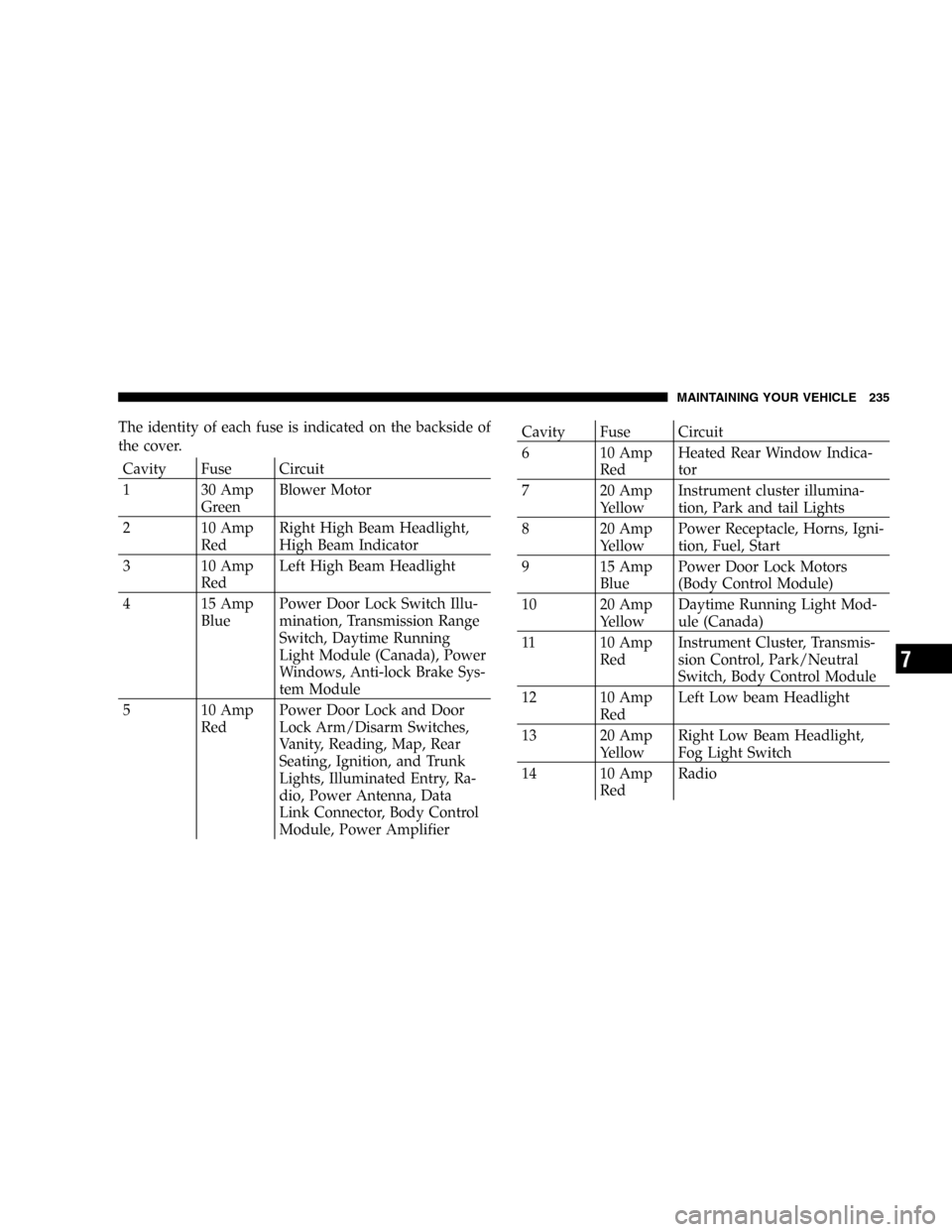
The identity of each fuse is indicated on the backside of
the cover.
Cavity Fuse Circuit
1 30 Amp
GreenBlower Motor
2 10 Amp
RedRight High Beam Headlight,
High Beam Indicator
3 10 Amp
RedLeft High Beam Headlight
4 15 Amp
BluePower Door Lock Switch Illu-
mination, Transmission Range
Switch, Daytime Running
Light Module (Canada), Power
Windows, Anti-lock Brake Sys-
tem Module
5 10 Amp
RedPower Door Lock and Door
Lock Arm/Disarm Switches,
Vanity, Reading, Map, Rear
Seating, Ignition, and Trunk
Lights, Illuminated Entry, Ra-
dio, Power Antenna, Data
Link Connector, Body Control
Module, Power Amplifier
Cavity Fuse Circuit
6 10 Amp
RedHeated Rear Window Indica-
tor
7 20 Amp
YellowInstrument cluster illumina-
tion, Park and tail Lights
8 20 Amp
YellowPower Receptacle, Horns, Igni-
tion, Fuel, Start
9 15 Amp
BluePower Door Lock Motors
(Body Control Module)
10 20 Amp
YellowDaytime Running Light Mod-
ule (Canada)
11 10 Amp
RedInstrument Cluster, Transmis-
sion Control, Park/Neutral
Switch, Body Control Module
12 10 Amp
RedLeft Low beam Headlight
13 20 Amp
YellowRight Low Beam Headlight,
Fog Light Switch
14 10 Amp
RedRadio
MAINTAINING YOUR VEHICLE 235
7
Page 237 of 291
REPLACEMENT LIGHT BULBS
LIGHT BULBS—Interior Bulb Number
Instrument Cluster..................... PC194
ABS Lamp........................... PC161
Fog Light Indicator..................... PC161
Dome Light............................ 578
Front Reading/Map Lights.................. 906
Trunk Light............................ 562
Climate Control Light...................... 37
Traction Control Light...................PC161
LIGHT BULBS—Exterior Bulb Number
Headlight.............................9007
Park/Turn Signal (Front).................3157A
Side / Marker (Front)..................... 168
Fog Light.............................880L
Tail/Stop/Turn Signal....................3157
Back Up Light........................... 921
Center Stop Light........................ 921
License Light...........................2825
BULB REPLACEMENT
Headlight Bulb Replacement
1. Open the hood and remove the two headlight mount-
ing screws.
MAINTAINING YOUR VEHICLE 237
7