Page 200 of 280

Catalytic Converter
The catalytic converter requires the use of unleaded fuel
only. Leaded gasoline will destroy the effectiveness of the
catalyst as an emission control device.
Under normal operating conditions, the catalytic con-
verter will not require maintenance. However, it is im-
portant to keep the engine properly serviced to assure
proper catalyst operation and prevent possible catalyst
damage.
If the CHECK ENGINE light is flashing, immediate
service is required.CAUTION!
Damage to the catalytic converter can result if your
vehicle is not kept in proper operating condition. In
the event of engine malfunction, particularly involv-
ing engine misfire or other apparent loss of perfor-
mance, have your vehicle serviced promptly. Contin-
ued operation of your vehicle with a severe
malfunction could cause the converter to overheat,
resulting in possible damage to the converter and the
vehicle.
WARNING!
A hot exhaust system can start a fire if you park over
materials that can burn. Such materials might be
grass or leaves coming into contact with your ex-
haust system. Do not park or operate your vehicle in
areas where your exhaust system can contact any-
thing that can burn.
200 MAINTAINING YOUR VEHICLE
Page 211 of 280

•If frequent coolant additions are required, or if the
level in the recovery bottle does not drop when the
engine cools, the cooling system should be pressure
tested for leaks.
•Maintain a coolant concentration of a minimum of 50%
ethylene glycol Extended Life Coolant and high qual-
ity water with recommended antifreeze for proper
corrosion protection of your engine cooling system
that contains aluminum components.
•Make sure that the radiator and coolant bottle hoses
are not kinked or obstructed.
•Keep the front of the radiator clean. If your vehicle has
air conditioning, keep the front of the condenser clean,
also.
•Do not change the thermostat for summer or winter
operation. If replacement is ever necessary, install
ONLY the correct type thermostat. Other designs may
result in unsatisfactory coolant performance, poor fuel
economy, and increased emissions.
Hoses And Vacuum/Vapor Harnesses
Inspect surfaces of hoses and nylon tubing for evidence
of heat and mechanical damage. Hard or soft spots,
brittle rubber, cracking, checking, tears, cuts, abrasions,
and excessive swelling indicate deterioration of the rub-
ber.
Pay particular attention to the hoses nearest to high heat
sources such as the exhaust manifold. Inspect hose rout-
ing to be sure hoses do not touch any heat source or
moving component that may cause heat damage or
mechanical wear.
Insure nylon tubing in these areas has not melted or
collapsed. Inspect all hose connections such as clamps
and couplings to make sure they are secure and no leaks
are present. Components should be replaced immedi-
ately if there is any evidence of degradation that could
cause failure.
Brakes
In order to assure brake system performance, all brake
system components should be inspected periodically.
Suggested service intervals can be found in the Mainte-
nance section.
MAINTAINING YOUR VEHICLE 211
7
Page 226 of 280
Relay Control Module Fuses
Cavity Fuse Circuits
1 15 Amp Blue Traction System
2 15 Amp Blue Engine Control 2
3 15 Amp Blue Engine Control 1
4 40 Amp
OrangeAir Pump
5 15 Amp Blue Fuel Pump
6 15 Amp Blue Horn
Interior Fuses
The fuse access door is located on the end of the
instrument panel on the driver’s side behind the trim
panel cover. Use a coin or flat blade screwdriver to open
and close this access door.
226 MAINTAINING YOUR VEHICLE
Page 231 of 280

NOTE:Always test the operation of all lights after
service operations have been performed to validate an
effective repair.
Headlight Aiming
The headlights on your new vehicle were aimed at the
factory. The factory setting was made at a no load setting.
A great increase in weight will change the aiming and it
may be necessary to readjust the headlights if carrying an
excessive amount of weight in the rear cargo area. To
readjust the headlights first mark the position of the
headlights on a wall prior to loading the vehicle. Loadthe vehicle and then readjust the headlights to the
original position. If any further adjustments are neces-
sary contact your manufacturer’s dealer. A detailed ser-
vice procedure is contained in the manufacturer’s Service
Manual. Information on purchasing a Service Manual can
be found at the back of this Owner’s Manual.
VEHICLE STORAGE
We recommend that you follow these guidelines before
storing your Crossfire for extended periods.
•Fill the gas tank. This will prevent water condensation
inside the tank. If you plan on storing your vehicle
more than two months, add an anti-oxidant fuel
stabilizer to the gas tank.
•Change the oil to remove any corrosive combustion-
related acids in the crankcase.
•Wash and wax the vehicle to protect the finish.
•Cover the vehicle whenever possible to prevent acci-
dental damage to the finish.
•Store the vehicle in a dry, well-ventilated location.
MAINTAINING YOUR VEHICLE 231
7
Page 235 of 280
FLUID CAPACITIES
Metric U.S.
Fuel (Approximate)60.0 Liters 15.8 Gallons
Fuel Tank Reserve8.0 Liters 2.1 Gallons
Engine Oil (with filter)
3.2 L Supercharged Engine 8.0 Liters 8.5 Qts.
Cooling System *
3.2 L Supercharged Engine 14.5 Liters 15.3 Qts.
Automatic Transmission8.0 Liters 8.5 Qts.
Rear Axle1.3 Liters 1.4 Qts.
Power Steering Reservoir1.0 Liters 1.1 Qts.
Brake Reservoir.5 Liters .5 Qts.
Windshield Washer Reservoir7.0 Liters 7.4 Qts.
* Includes heater and coolant recovery bottle filled to MAX level.
MAINTAINING YOUR VEHICLE 235
7
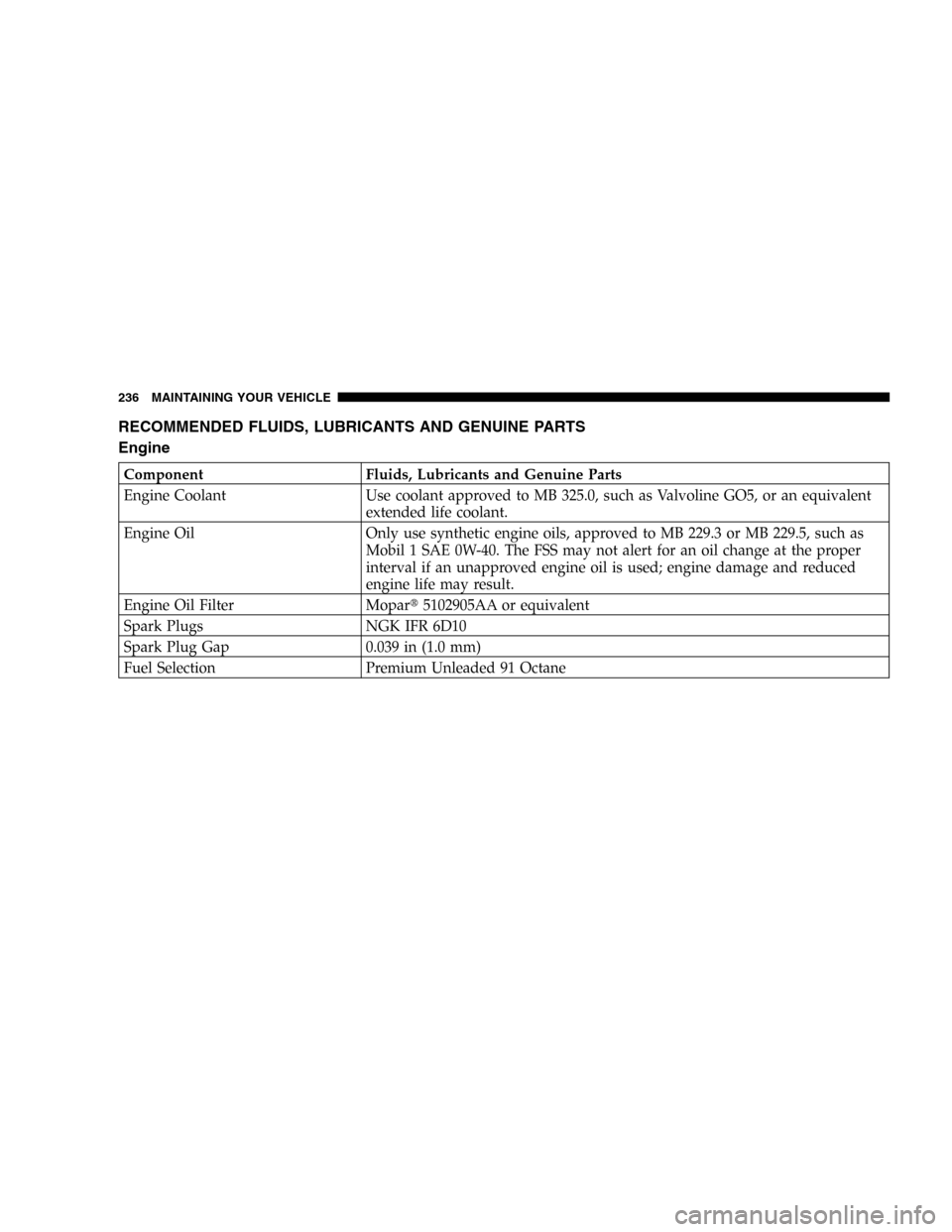
Page 236 of 280
RECOMMENDED FLUIDS, LUBRICANTS AND GENUINE PARTS
Engine
Component Fluids, Lubricants and Genuine Parts
Engine Coolant Use coolant approved to MB 325.0, such as Valvoline GO5, or an equivalent
extended life coolant.
Engine Oil Only use synthetic engine oils, approved to MB 229.3 or MB 229.5, such as
Mobil 1 SAE 0W-40. The FSS may not alert for an oil change at the proper
interval if an unapproved engine oil is used; engine damage and reduced
engine life may result.
Engine Oil Filter Mopar�5102905AA or equivalent
Spark Plugs NGK IFR 6D10
Spark Plug Gap 0.039 in (1.0 mm)
Fuel Selection Premium Unleaded 91 Octane
236 MAINTAINING YOUR VEHICLE
Page 246 of 280

REGULAR CHECK-UPS
To maintain the safe operation of your vehicle, it is
recommended that you perform the following tasks on a
regular basis (i.e., weekly or whenever the vehicle is
refueled).
CAUTION!
Failure to perform the required maintenance items
may result in damage to the vehicle.
At Each Stop for Fuel
•
Check the engine oil level about 5 minutes after a fully
warmed engine is shut off. Checking the oil level while
the vehicle is on level ground will improve the accu-
racy of the oil level reading. See the procedure de-
scribed in Checking Your Engine Oil in the Under-
standing Your Instrument Panel section or under
Engine Oil in the Maintaining Your Vehicle section.
Add oil only when the level is at or below the ADD or
MIN mark.
•Check the windshield washer solvent and add if
required.
•Inspect wiper blade condition.
•Check operation of lighting systems.
•Inspect tires for unusual wear, damage, and pressure
(at least every 14 days).
•Mechanical assemblies (e.g., engine, transmission, etc.)
- check for leaks.
Once a Month
•
Inspect the battery and clean and tighten the terminals
as required.
•Check the fluid levels of coolant reservoir, brake
master cylinder and power steering and add as
needed.
•Check all lights and all other electrical items for correct
operation.
246 MAINTENANCE SCHEDULES
8
M
A
I
N
T
E
N
A
N
C
E
S
C
H
E
D
U
L
E
S
Page 247 of 280

Additional Periodic Maintenance
The following maintenance items should be performed
during the scheduled maintenance nearest the time
elapsed and/or distance shown. Follow the interval that
occurs first.
Every 2 years:
•Inspect body for paint damage.
•Check chassis and supporting body parts for damage
and corrosion.
At approximately every 50,000 miles (80,000 km) or 4
years:
•Check condition of driveshaft flex discs.
•Retighten locking bolts for steering (observe torque).
At approximately every 60,000 miles (96,000 km) or 4
years:
•Replace fuel filter.
•Replace air cleaner filter element.At approximately 80,000 miles (129,000 km):
•Change the automatic transmission fluid and filter.
Use the recommended automatic transmission fluid.
After this change it is filled for life.
At approximately every 100,000 miles (161,000 km) or 5
years:
•Replace spark plugs.
Every 100,000 miles (161,000 km) or 5 years:
•Replace engine coolant using coolant approved to MB
325.0, such as Valvoline GO5, or an equivalent ex-
tended life coolant.
WARNING!
You can be badly injured working on or around a
motor vehicle. Do only that service work for which
you have the knowledge and the right equipment. If
you have any doubt about your ability to perform a
maintenance service, take your vehicle to a compe-
tent technician.
MAINTENANCE SCHEDULES 247
8
M
A
I
N
T
E
N
A
N
C
E
S
C
H
E
D
U
L
E
S