2005 CHRYSLER CROSSFIRE child restraint
[x] Cancel search: child restraintPage 42 of 288

•Check belt fit periodically. A child’s squirming or
slouching can move the belt out of position.
•If the shoulder belt contacts the face or neck, move the
child closer to the center of the vehicle. Never allow a
child to put the shoulder belt under an arm or behind
their back.
LATCH - Child Seat Anchorage System (Lower
Anchors and Tether for Children)
Your vehicle’s passenger seat is equipped with the child
restraint anchorage system called LATCH. The LATCH
system provides for the installation of the child restraint
without using the vehicle’s belts, instead securing the
child restraint using lower anchorages and upper tether
straps from the child restraint to the vehicle structure.
LATCH-compatible child restraints are now available.
Installing the LATCH-Compatible Child Restraint
System
We urge that you carefully follow the directions of the
manufacturer when installing your child restraint. Theseare general instructions, and not all child restraint sys-
tems will be installed exactly as described here. Again,
carefully follow the installation instructions that were
provided with the child restraint system.
The passenger seat lower anchorages are round bars,
located at the rear of the seat cushion where it meets the
seat back, and are just visible when you lean in to install
the child restraint. You will easily feel them if you run
your finger along the intersection of the seat back and
seat cushion surfaces.
42 THINGS TO KNOW BEFORE STARTING YOUR VEHICLE
Page 43 of 288

The passenger seat tether anchorage is located on the
back of the seat cushion frame. It is visible by moving the
passenger seat forward in the vehicle.
Many, but not all LATCH-Compatible child restraint
systems will be equipped with separate straps on each
side, with each having a hook or connector for attach-
ment to the lower anchorage and a means of adjusting
the tension in the strap. Forward-facing toddler restraints
and some rear-facing infant restraints will also beequipped with a tether strap, a hook for attachment to the
tether strap anchorage and a means of adjusting the
tension of the strap.
You will first loosen the adjusters on the lower straps and
on the tether strap so that you can more easily attach the
hooks or connectors to the vehicle anchorages. Next, you
can attach the tether strap to the anchor by moving the
passenger seat forward. Route the child restraint tether
directly over the top of the seat, through the strap near
the top of the seat back, and attach the hook to the anchor
bar. Recline the seat back and move the passenger seat as
far rearward as possible. Next, attach the lower hooks to
the passenger seat lower anchor bars by pushing aside
the seat cover material. Finally, tighten all three straps as
you push the child restraint rearward and downward
into the seat, removing slack in the straps according to
the child restraint manufacturer’s instructions.
THINGS TO KNOW BEFORE STARTING YOUR VEHICLE 43
2
Page 44 of 288

WARNING!
Improper installation of a child restraint to the
LATCH anchorages can lead to failure of an infant or
child restraint. The child could be badly injured or
killed. Follow the manufacturer’s directions exactly
when installing an infant or child restraint.
Installing Child Restraints Using the Vehicle Seat
Belt
Child restraints can be securely fastened in the passenger
seat using the seat belts. For this purpose, the passenger
seat belt retractor provides two modes of operation -
normal emergency locking and automatic locking. For
child restraint installation, the retractor switches to auto-
matic locking when the belt is pulled out to the full extent
of its travel. As the belt retracts, the retractor locks to
prevent the belt from being pulled out again. Pulling the
belt snugly over the child restraint toward the retractor
secures the restraint in place. When the belt retracts fully
after child restraint removal, normal (emergency locking)retractor action is restored. Any seat belt system will
loosen with time, so check the belt occasionally and pull
it tight if necessary.
If your child restraint is equipped with a tether strap,
attach it to the vehicle by first moving the seat back fully
forward. Next, route the child restraint tether directly
over the top of the seat, through the strap near the top of
the seat back, and attach the hook to the anchor bar.
Recline the seat back and move the passenger seat as far
rearward as possible. Remove slack in the tether strap as
you push the child restraint downward and rearward,
following the child restraint manufacturer’s instructions.
Child Restraint Tether Anchor - General
Information
Child restraints having tether straps and hooks for con-
nection to tether anchors have been available for some
time. In fact, many child restraint manufacturers will
provide add-on tether strap kits for certain of their older
products. There is a tether strap anchor behind the
passenger seat.
44 THINGS TO KNOW BEFORE STARTING YOUR VEHICLE
Page 45 of 288
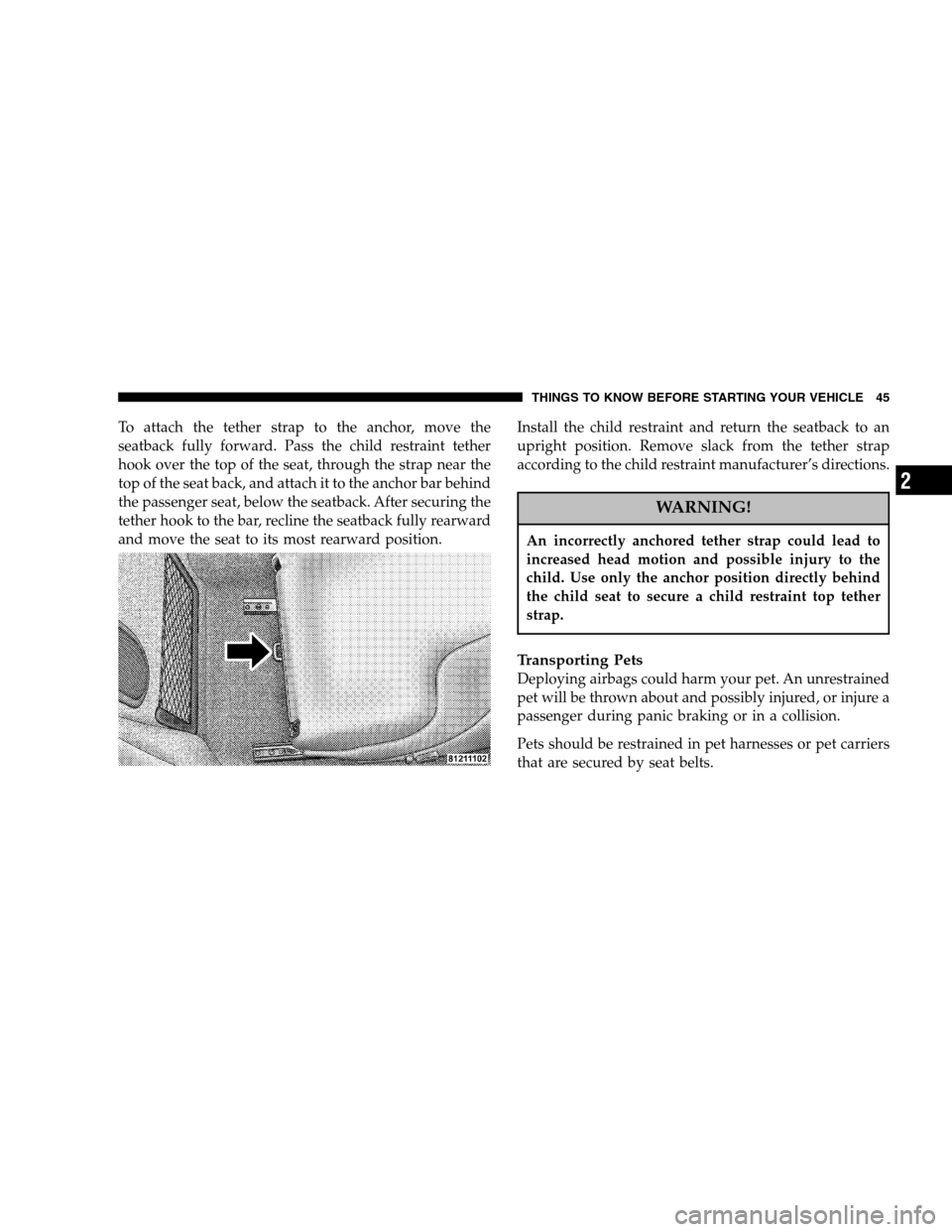
To attach the tether strap to the anchor, move the
seatback fully forward. Pass the child restraint tether
hook over the top of the seat, through the strap near the
top of the seat back, and attach it to the anchor bar behind
the passenger seat, below the seatback. After securing the
tether hook to the bar, recline the seatback fully rearward
and move the seat to its most rearward position.Install the child restraint and return the seatback to an
upright position. Remove slack from the tether strap
according to the child restraint manufacturer’s directions.
WARNING!
An incorrectly anchored tether strap could lead to
increased head motion and possible injury to the
child. Use only the anchor position directly behind
the child seat to secure a child restraint top tether
strap.
Transporting Pets
Deploying airbags could harm your pet. An unrestrained
pet will be thrown about and possibly injured, or injure a
passenger during panic braking or in a collision.
Pets should be restrained in pet harnesses or pet carriers
that are secured by seat belts.
THINGS TO KNOW BEFORE STARTING YOUR VEHICLE 45
2
Page 275 of 288

Carbon Monoxide Warning................ 46
Cargo Compartment
Capacity............................ 168
Catalytic Converter..................... 206
CD Player......................... 112,116
Chains, Tire........................... 158
Changing A Flat Tire.................... 174
Charging System Light................... 104
Checks, Safety.......................... 46
Child Restraint......................... 39
Child Restraint Tether Anchors............. 44
Cigar Lighter........................... 64
Circuit Breakers........................ 228
Clean Air Gasoline...................... 164
Cleaning
Glass.............................. 225
Headlights.......................... 225
Climate Control........................ 121
Coin Holder........................... 64
Compact Disc Maintenance............... 120
Console............................... 61
Contract, Service....................... 260
Converter, Catalytic..................... 177Convertible............................ 52
Convertible Top......................... 52
Convertible Top Maintenance.............. 226
Convertible Top Manual Override.......... 189
Coolant...........................215,256
Cooling System........................ 214
Adding Coolant (Antifreeze)............. 215
Coolant Level........................ 214
Disposal of Used Coolant............... 215
Drain, Flush, and Refill................. 215
Points to Remember................... 216
Pressure Cap........................ 216
Rubber and Plastic Components.......... 217
Selection of Coolant................... 215
Corrosion Protection.................... 222
Crankcase Emission Control System......... 207
Cup Holder............................ 65
Customer Assistance.................... 258
Cylinders, Lock........................ 211
Dealer Service......................... 200
Deck Lid.............................. 19
Defroster, Windshield..................... 47
INDEX 275
10
Page 279 of 288

Oil, Engine........................... 201
Change Interval...................... 202
Checking........................... 201
Disposal............................ 204
Filter.............................. 204
Materials Added to.................... 204
Recommendation..................... 204
Oil Filter, Selection...................... 204
Onboard Diagnostic System............198,199
Overheating, Engine..................... 172
Owner’s Manual....................... 263
Paint Care............................ 222
Parking Brake......................... 142
Passing Light........................... 76
Pets.................................. 45
Pets, Transporting....................... 45
Power
Outlet.............................. 64
Steering.........................152,209
Steering, Checking.................... 209
Windows............................ 20
Pregnant Women and Seat Belts............. 27Program Mode Selector Switch............. 140
Programming Transmitters...............95,96
Radial Ply Tires........................ 156
Radio................................ 112
Radio Antenna......................... 120
Radio Operation....................... 120
Rear Liftgate........................... 21
Rear Spoiler............................ 82
Recommended Fluids, Lubricants and Genuine
Parts............................... 244
Reformulated Gasoline................... 164
Refrigerant............................ 209
Remote Keyless Entry.................... 14
Replacement Tires...................... 160
Reporting Safety Defects................. 262
Residual Engine Heat Utilization (REST) . . . 125,126
Restraints, Child........................ 39
Restraints, Infant........................ 39
Restraints, Occupant..................... 21
Rotation, Tires......................... 162
Safety Checks Inside Vehicle............... 47
INDEX 279
10