2005 CHEVROLET UPLANDER fold seats
[x] Cancel search: fold seatsPage 7 of 460
Front Seats......................................................1-3
Manual Seats................................................1-3
Six-Way Power Seats.....................................1-4
Heated Seats.................................................1-4
Reclining Seatbacks........................................1-5
Head Restraints.............................................1-7
Rear Seats.......................................................1-7
Rear Seat Operation.......................................1-7
Flip and Fold Feature (Bucket Seats)................1-8
Bucket Seats.................................................1-9
Captain Chairs.............................................1-14
Third Row Seat............................................1-19
Safety Belts...................................................1-22
Safety Belts: They Are for Everyone................1-22
Questions and Answers About Safety Belts......1-26
How to Wear Safety Belts Properly.................1-27
Driver Position..............................................1-27
Shoulder Belt Height Adjustment.....................1-35
Safety Belt Use During Pregnancy..................1-36
Right Front Passenger Position.......................1-36
Rear Seat Passengers..................................1-36Rear Safety Belt Comfort Guides for
Children and Small Adults..........................1-39
Safety Belt Pretensioners...............................1-41
Safety Belt Extender.....................................1-42
Child Restraints.............................................1-42
Older Children..............................................1-42
Infants and Young Children............................1-45
Child Restraint Systems.................................1-48
Where to Put the Restraint.............................1-51
Top Strap....................................................1-52
Top Strap Anchor Location.............................1-53
Lower Anchorages and Top Tethers for
Children (LATCH System)...........................1-54
Securing a Child Restraint Designed for
the LATCH System....................................1-56
Securing a Child Restraint in a Rear
Seat Position............................................1-56
Securing a Child Restraint in the Right
Front Seat Position....................................1-58
Built-In Child Restraint...................................1-62
Section 1 Seats and Restraint Systems
1-1
Page 14 of 460
Flip and Fold Feature (Bucket Seats)
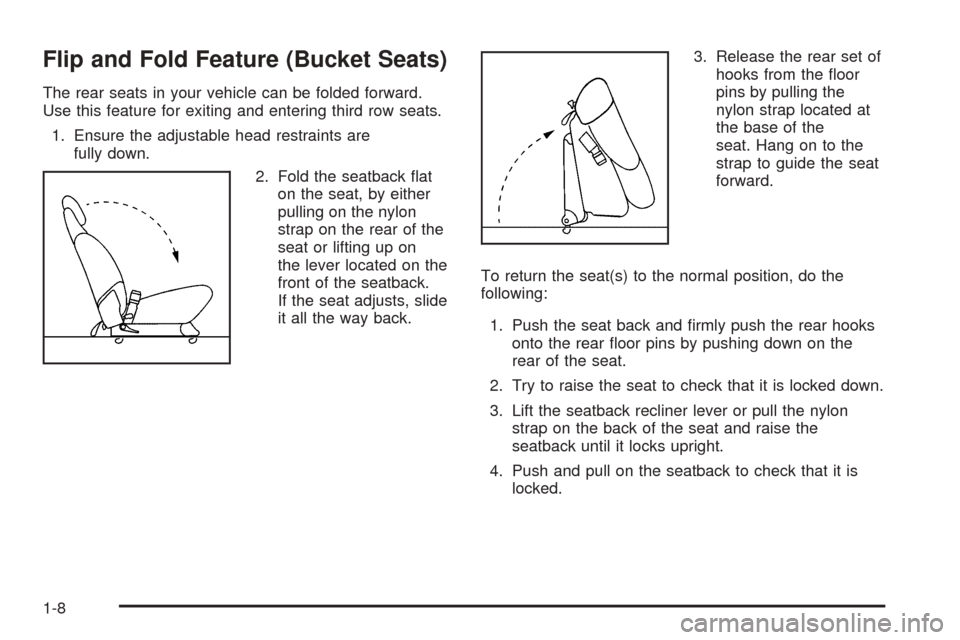
The rear seats in your vehicle can be folded forward.
Use this feature for exiting and entering third row seats.
1. Ensure the adjustable head restraints are
fully down.
2. Fold the seatback at
on the seat, by either
pulling on the nylon
strap on the rear of the
seat or lifting up on
the lever located on the
front of the seatback.
If the seat adjusts, slide
it all the way back.3. Release the rear set of
hooks from the oor
pins by pulling the
nylon strap located at
the base of the
seat. Hang on to the
strap to guide the seat
forward.
To return the seat(s) to the normal position, do the
following:
1. Push the seat back and rmly push the rear hooks
onto the rear oor pins by pushing down on the
rear of the seat.
2. Try to raise the seat to check that it is locked down.
3. Lift the seatback recliner lever or pull the nylon
strap on the back of the seat and raise the
seatback until it locks upright.
4. Push and pull on the seatback to check that it is
locked.
1-8
Page 15 of 460
Bucket Seats
If your vehicle has the bucket seats, the seatbacks can
be folded down or reclined. The seats can also be
adjusted forward or rearward, or removed.
One of the bucket seats may be equipped with a built-in
child restraint. SeeBuilt-In Child Restraint on page 1-62.
Adjusting the Bucket Seats
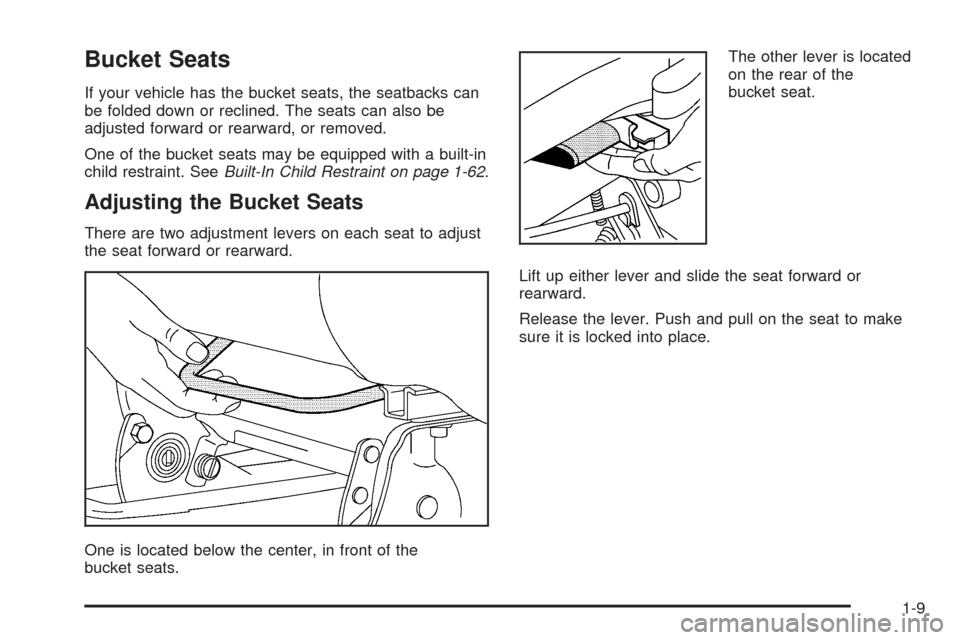
There are two adjustment levers on each seat to adjust
the seat forward or rearward.
One is located below the center, in front of the
bucket seats.The other lever is located
on the rear of the
bucket seat.
Lift up either lever and slide the seat forward or
rearward.
Release the lever. Push and pull on the seat to make
sure it is locked into place.
1-9
Page 17 of 460
To recline the seatback, pull the nylon strap or lift the
recliner lever. Press back on the seatback until you
reach the desired position, then let go of the strap or
lever.
To return the seatback to an upright position, pull on the
nylon strap or lift the recliner lever without putting any
pressure on the seatback. Push and pull on the
seatback to be sure it is locked into place.
Removing the Bucket Seats
Make sure the seatback is in the upright position. The
head restraints should be fully down.
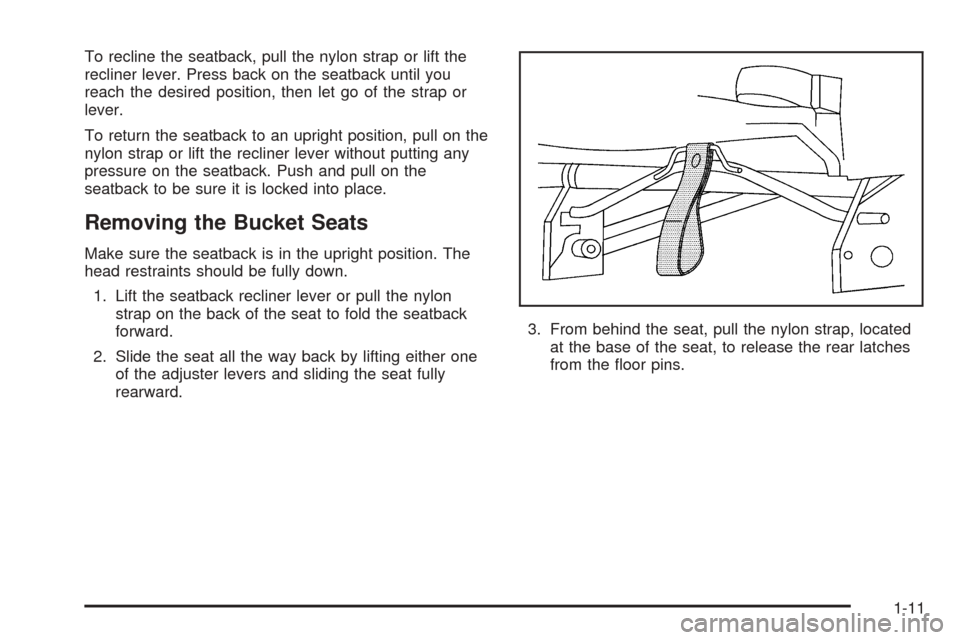
1. Lift the seatback recliner lever or pull the nylon
strap on the back of the seat to fold the seatback
forward.
2. Slide the seat all the way back by lifting either one
of the adjuster levers and sliding the seat fully
rearward.3. From behind the seat, pull the nylon strap, located
at the base of the seat, to release the rear latches
from the oor pins.
1-11
Page 19 of 460
Replacing the Bucket Seats
{CAUTION:
If the seatback is not locked, it could move
forward in a sudden stop or crash. That could
cause injury to the person sitting there. Always
press rearward on the seatback to be sure it is
locked.
{CAUTION:
A seat that is not locked into place properly
can move around in a collision or sudden stop.
People in the vehicle could be injured. Be sure
to lock the seat into place properly when
installing it.
{CAUTION:
A safety belt that is improperly routed, not
properly attached, or twisted will not provide
the protection needed in a crash. The person
wearing the belt could be seriously injured.
After installing the seat, always check to be
sure that the safety belts are properly routed
and attached, and are not twisted.
Do not put the seats in so they face rearward because
they will not latch that way. If you want more storage
room behind the seat, adjust the seat by sliding it
forward.
Make sure the seats are in the full rear position before
beginning this procedure.
1. With the seat folded, squeeze the angled bar
toward the straight crossbar while placing the
front hooks of the bucket seat onto the front two
oor pins.
1-13
Page 147 of 460
Overhead Console (Without Rail)
If your vehicle has an overhead console without the rail
system, it has two reading lights, a courtesy light,
and a switchbank. SeeOverhead Console Switchbank
on page 3-20for more information.
Floor Console Storage Area
If your vehicle has a storage compartment located on the
front console below the front cupholders. Pull up and then
forward on the handle to open the storage compartment.
Folding Tray
Your vehicle may be
equipped with folding
convenience trays located
between seats. To use
each tray lift up on
the handle located on its
front end, while pulling
up on the tray to lock it into
place. There are four
cupholders on each tray.
Second Row Center Console
If your vehicle has the second row center console, use
the following procedure to remove or install the
console.
Removing the Center Console
1. Locate the attachment lever in an opening on the
rear of the console
2. Pull the attachment lever upward to release the
attachment hook.
3. Lift the console up to remove it from the vehicle.
2-53
Page 304 of 460
Never exceed the GVWR for your vehicle or the GAWR
for either the front or rear axle.
{CAUTION:
Do not load your vehicle any heavier than the
Gross Vehicle Weight Rating (GVWR), or either
the maximum front or rear Gross Axle Weight
Rating (GAWR). If you do, parts on your
vehicle can break, and it can change the way
your vehicle handles. These could cause you
to lose control and crash. Also, overloading
can shorten the life of your vehicle.
Notice:Overloading your vehicle may cause
damage. Repairs would not be covered by your
warranty. Do not overload your vehicle.
If you put things inside your vehicle — like suitcases,
tools, packages, or anything else, they will go as fast as
the vehicle goes. If you have to stop or turn quickly,
or if there is a crash, they will keep going.
{CAUTION:
Things you put inside your vehicle can strike
and injure people in a sudden stop or turn, or
in a crash.
Put things in the cargo area of your
vehicle. Try to spread the weight evenly.
Never stack heavier things, like suitcases,
inside the vehicle so that some of them
are above the tops of the seats.
Do not leave an unsecured child restraint
in your vehicle.
When you carry something inside the
vehicle, secure it whenever you can.
Do not leave a seat folded down unless
you need to.
4-38
Page 425 of 460

Maintenance Footnotes
#Lubricate the suspension, steering linkage, transaxle
shift linkage, and the underbody contact points and
linkage.
(a)Visually inspect brake lines and hoses for proper
hook-up, binding, leaks, cracks, chang, etc. Inspect
disc brake pads for wear and rotors for surface
condition. Inspect other brake parts, including calipers,
parking brake, etc. Check parking brake adjustment.
(b)Visually inspect front and rear suspension and
steering system for damaged, loose, or missing parts,
signs of wear, or lack of lubrication. Inspect power
steering lines and hoses for proper hook-up, binding,
leaks, cracks, chang, etc.
(c)Visually inspect hoses and have them replaced if they
are cracked, swollen, or deteriorated. Inspect all pipes,
ttings and clamps; replace with genuine GM parts as
needed. To help ensure proper operation, a pressure test
of the cooling system and pressure cap and cleaning the
outside of the radiator and air conditioning condenser is
recommended at least once a year.
(d)Visually inspect wiper blades for wear or cracking.
Replace wiper blades that appear worn or damaged
or that streak or miss areas of the windshield.(e)Make sure the safety belt reminder light and all your
belts, buckles, latch plates, retractors, and anchorages
are working properly. If your vehicle has a built-in
child restraint, make sure the harness straps, latch
plates, buckle, clip, child head restraint, and anchorages
are working properly. Look for any other loose or
damaged safety belt system parts. If you see anything
that might keep a safety belt system from doing its
job, have it repaired. Have any torn or frayed safety belts
replaced. Also look for any opened or broken airbag
coverings, and have them repaired or replaced.
The airbag system does not need regular maintenance.
(f)Lubricate all key lock cylinders, hood latch
assemblies, secondary latches, pivots, spring anchor
and release pawl, hood and door hinges, rear folding
seats, liftgate hinges, fuel door hinge, power sliding door
cable, and sliding door track(s). More frequent
lubrication may be required when exposed to a corrosive
environment. Applying silicone grease on weatherstrips
with a clean cloth will make them last longer, seal
better, and not stick or squeak.
(g)If you drive regularly under dusty conditions, inspect
the lter at each engine oil change.
6-7