2005 CHEVROLET SILVERADO ESP
[x] Cancel search: ESPPage 20 of 580
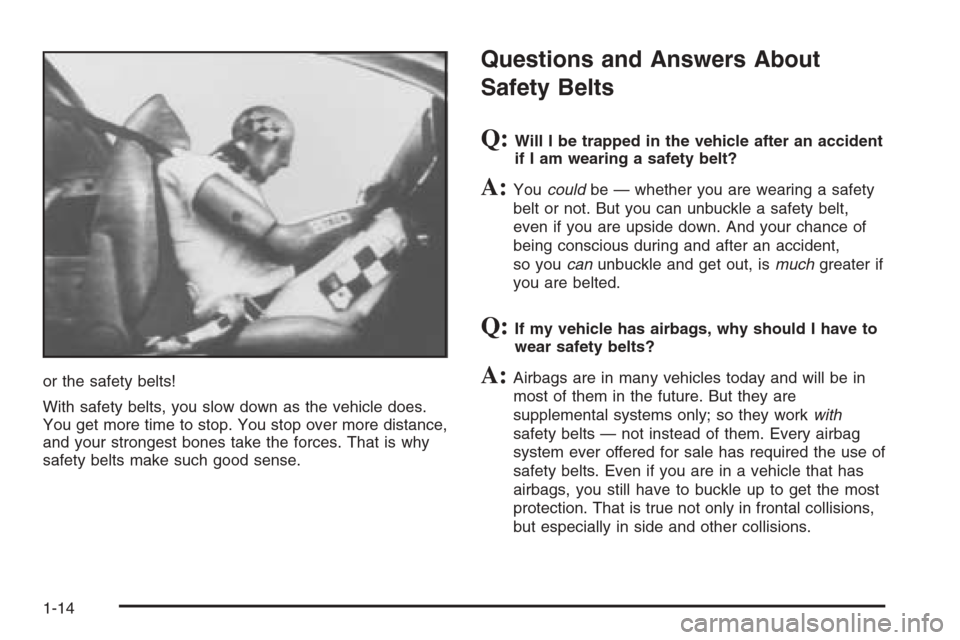
or the safety belts!
With safety belts, you slow down as the vehicle does.
You get more time to stop. You stop over more distance,
and your strongest bones take the forces. That is why
safety belts make such good sense.
Questions and Answers About
Safety Belts
Q:Will I be trapped in the vehicle after an accident
if I am wearing a safety belt?
A:Youcouldbe — whether you are wearing a safety
belt or not. But you can unbuckle a safety belt,
even if you are upside down. And your chance of
being conscious during and after an accident,
so youcanunbuckle and get out, ismuchgreater if
you are belted.
Q:If my vehicle has airbags, why should I have to
wear safety belts?
A:Airbags are in many vehicles today and will be in
most of them in the future. But they are
supplemental systems only; so they workwith
safety belts — not instead of them. Every airbag
system ever offered for sale has required the use of
safety belts. Even if you are in a vehicle that has
airbags, you still have to buckle up to get the most
protection. That is true not only in frontal collisions,
but especially in side and other collisions.
1-14
Page 45 of 580
CAUTION: (Continued)
Even though the passenger sensing system or
airbag off switch are designed to turn off the
passenger’s frontal airbag under certain
conditions, no system is fail-safe, and no one
can guarantee that an airbag will not deploy
under some unusual circumstance, even
though it is turned off. General Motors
recommends that rear-facing child restraints
be transported in vehicles with a rear seat that
will accommodate a rear-facing child restraint,
whenever possible.
If you need to secure a forward-facing child
restraint in the right front seat, always move
the front passenger seat as far back as it will
go. It is better to secure the child restraint in a
rear seat.
{CAUTION:
A child in a child restraint in the center front
seat can be badly injured or killed by the right
front passenger’s airbag if it inates. Never
secure a child restraint in the center front seat.
It is always better to secure a child restraint in
the rear seat.
If you need to secure a forward-facing child
restraint in the right front passenger seat,
always move the front passenger seat as far
back as it will go. It is better to secure the
child restraint in a rear seat.
Do not use child restraints in the center front seat
position. The restraints will not work properly.
There is limited space in the rear seating area of an
extended cab model. If you want to secure a child
restraint in a rear seating position of an extended cab
model, especially in the rear center position, be sure
to study the instructions that came with your child
restraint to see if there is enough room to secure your
seat properly.
1-39
Page 56 of 580
Extended Cab
There is limited space in the rear seating area of an
extended cab model. If you want to secure a child
restraint in a rear seat position of an extended cab
model, especially in the rear center seat position,
be sure to study the instructions that came with your
child restraint to see if there is enough room to secure
your child restraint properly.
If your child restraint is equipped with the LATCH
system, seeLower Anchors and Tethers for Children
(LATCH) on page 1-45. SeeTop Strap on page 1-40
if the child restraint has one.
If your child restraint does not have the LATCH system,
you will be using the lap belt to secure a child restraint
in the center rear seat position of an extended cab.
Be sure to follow the instructions that came with the child
restraint. Secure the child in the child restraint when
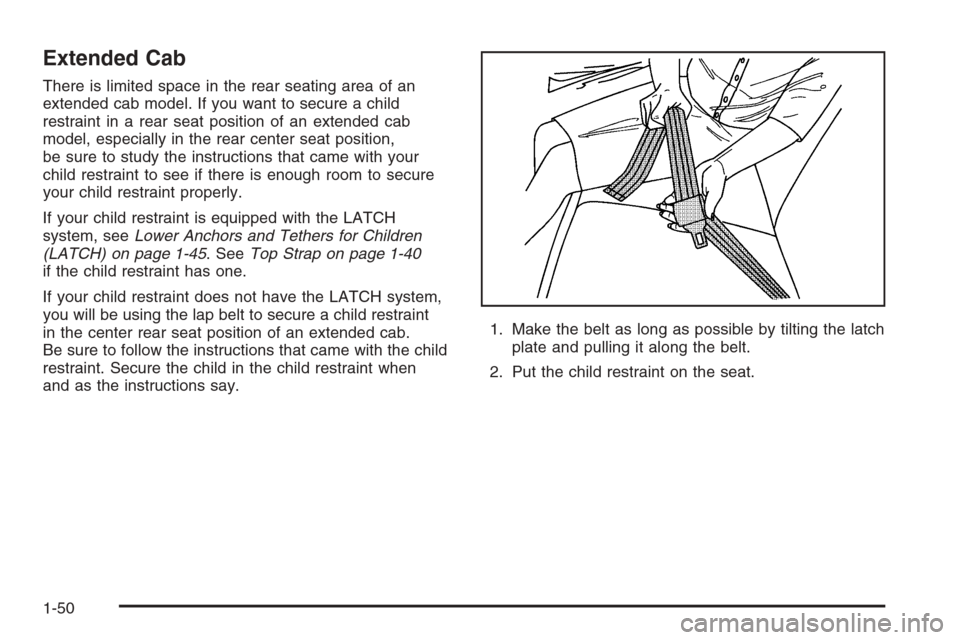
and as the instructions say.1. Make the belt as long as possible by tilting the latch
plate and pulling it along the belt.
2. Put the child restraint on the seat.
1-50
Page 72 of 580
When Should an Airbag Inate?
The driver’s and right front passenger’s frontal airbags
are designed to inate in moderate to severe frontal
or near-frontal crashes. But they are designed to inate
only if the impact exceeds a predetermined deployment
threshold. Deployment thresholds take into account
a variety of desired deployment and non-deployment
events and are used to predict how severe a crash
is likely to be in time for the airbags to inate and help
restrain the occupants. Whether your frontal airbags
will or should deploy is not based on how fast your
vehicle is traveling. It depends largely on what you hit,
the direction of the impact and how quickly your
vehicle slows down.
Frontal airbags may inate at different crash speeds.
For example:
If the vehicle hits a stationary object, the airbags
could inate at a different crash speed than if the
object were moving.
If the vehicle hits an object that deforms, the
airbags could inate at a different crash speed than
if the vehicle hits an object does not deform.
If the vehicle hits a narrow object (like a pole) the
airbags could inate at a different crash speed
than if the vehicle hits a wide object (like a wall).
If the vehicle goes into an object at an angle the
airbags could inate at a different crash speed
than if the vehicle goes straight into the object.
The frontal airbags (driver and right front passenger)
are not intended to inate during vehicle rollovers,
rear impacts, or in many side impacts.
In any particular crash, no one can say whether an
airbag should have inated simply because of the
damage to a vehicle or because of what the repair costs
were. Ination is determined by what the vehicle hits,
the angle of the impact, and how quickly the vehicle
slows down.
The airbag system is designed to work properly under
a wide range of conditions, including off-road usage.
Observe safe driving speeds, especially on rough
terrain. As always, wear your safety belt. SeeOff-Road
Driving on page 4-20for more tips on off-road driving.
1-66
Page 94 of 580
Resynchronization
Resynchronization may be necessary due to the
security method used by this system. The transmitter
does not send the same signal twice to the receiver.
The receiver will not respond to a signal that has been
sent previously. This prevents anyone from recording
and playing back the signal from the transmitter.
To resynchronize your transmitter, stand close to your
vehicle and press and hold the lock and unlock
buttons on the transmitter at the same time for
15 seconds. The door locks should cycle to conrm
synchronization. If the locks do not cycle, see your
dealer for service.
Doors and Locks
Door Locks
{CAUTION:
Unlocked doors can be dangerous.
Passengers — especially children — can
easily open the doors and fall out of a
moving vehicle. When a door is locked,
the handle will not open it. You increase
the chance of being thrown out of the
vehicle in a crash if the doors are not
locked. So, wear safety belts properly and
lock the doors whenever you drive.
Young children who get into unlocked
vehicles may be unable to get out. A child
can be overcome by extreme heat and can
suffer permanent injuries or even death
from heat stroke. Always lock your vehicle
whenever you leave it.
Outsiders can easily enter through an
unlocked door when you slow down or
stop your vehicle. Locking your doors can
help prevent this from happening.
2-8
Page 102 of 580
Windows
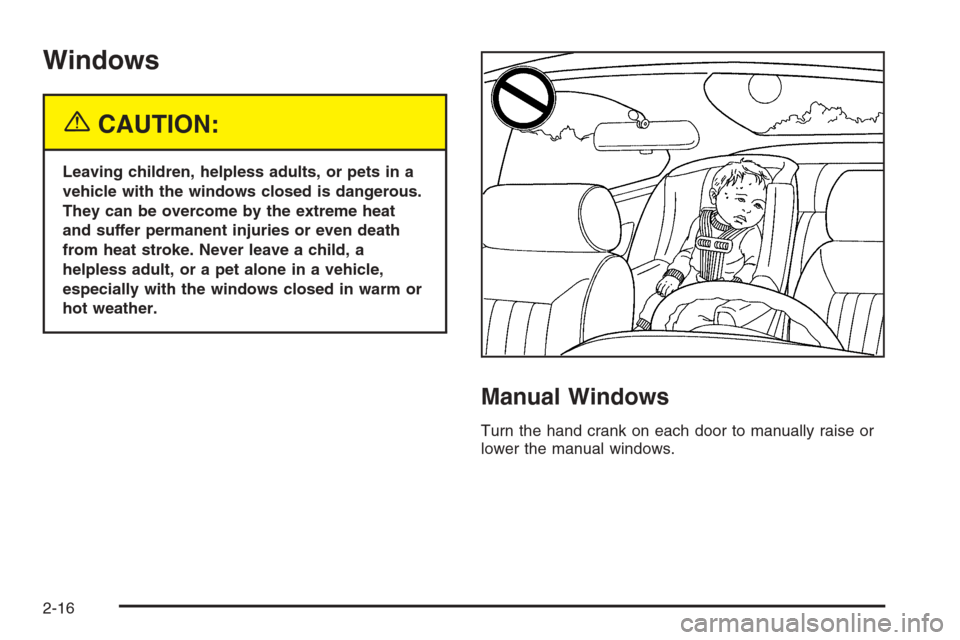
{CAUTION:
Leaving children, helpless adults, or pets in a
vehicle with the windows closed is dangerous.
They can be overcome by the extreme heat
and suffer permanent injuries or even death
from heat stroke. Never leave a child, a
helpless adult, or a pet alone in a vehicle,
especially with the windows closed in warm or
hot weather.
Manual Windows
Turn the hand crank on each door to manually raise or
lower the manual windows.
2-16
Page 105 of 580

Theft-Deterrent Systems
Vehicle theft is big business, especially in some cities.
Although your vehicle has a number of theft-deterrent
features, we know that nothing we put on it can make it
impossible to steal.
Content Theft-Deterrent
Your vehicle may be equipped with a content
theft-deterrent alarm system.
The security light, located
on the instrument panel
cluster, will ash as
you open the door, while
the ignition is off, to
indicate the system is
being activated.This message reminds you to activate the theft-deterrent
system. Here is how to do it:
1. Open the door.
2. Lock the door with the power door lock switch or
the remote keyless entry transmitter. The security
light should come on and ash. If using the
remote keyless entry transmitter, the door does not
need to be open.
If the delayed locking feature is active, the alarm
will not be activated until all doors are closed
and the security light goes off.
3. Close all doors. The security light will stop ashing
and go off after approximately 30 seconds.
The content theft deterrent alarm is not armed until
the security light goes off.
If a door is opened without using the remote keyless
entry transmitter, the alarm will go off. Your vehicle’s
headlamps will ash and the horn will sound for
about two minutes, then will turn off to save the
battery power.
2-19
Page 131 of 580
Shifting Into NEUTRAL
To shift the transfer case to NEUTRAL do the following:
1. Make sure the vehicle is parked so that it will not roll.
2. Set the parking brake.
3. Start the vehicle or turn the ignition to RUN.
4. Put the transmission in NEUTRAL (N).
5. Shift the transfer case to Two-Wheel High.
6. Simultaneously press and hold the Two-Wheel High
and Four-Wheel Low buttons for 10 seconds.
The red NEUTRAL light will come on when the
transfer case shift to NEUTRAL is complete.
7. If the engine is running, shift the transmission to
REVERSE (R) for one second, then shift the
transmission to DRIVE (D) for one second,
or FIRST (1) for vehicles equipped with a manual
transmission.
8. Turn the engine off, by turning the key to
ACCESSORY.
9. Place the transmission shift lever in PARK (P).
10. Turn the ignition to LOCK.
Shifting Out of NEUTRAL
To shift out of NEUTRAL:
1. Set the parking brake and apply the regular brake
pedal.
2. Turn the ignition to RUN with the engine off.
3. Shift the transmission to NEUTRAL (N).
4. Press the button for the desired transfer case
shift position (Two-Wheel High, Four-Wheel
High, AUTO 4WD, or Four-Wheel Low).
5. After the transfer case has shifted out of NEUTRAL
the red light will go out.
6. Release the parking brake.
7. You may start the engine and shift the transmission
to the desired position.
Excessively shifting the transfer case into or out of the
different modes may cause the transfer case to enter the
shift protection mode. This will protect the transfer case
from possible damage and will only allow the transfer
case to respond to one shift per 10 seconds. The transfer
case may stay in this mode for up to three minutes.
2-45