2005 CHEVROLET MALIBU check engine light
[x] Cancel search: check engine lightPage 186 of 434
DIC Warnings and Messages
These messages will appear if there is a problem
detected in one of your vehicle’s systems.
Any message will clear when the vehicle’s condition is
no longer present. The warning message will come back
on the next time the vehicle is turned off and back on
if the condition is still present. With most messages,
a warning chime will sound when the message is
displayed. Your vehicle may have other warning
messages.
AUTO LIGHTS OFF:This message is displayed if the
automatic headlamp system is disabled with the
headlamp switch.
AUTO LIGHTS ON:This message is displayed if the
automatic headlamp system is enabled with the
headlamp switch.
BRAKE FLUID:This message will display if the ignition
is in ON to inform the driver that the brake uid level
is low. Have the brake system serviced by your
GM dealer as soon as possible.CHANGE OIL SOON:This message is displayed when
the life of the engine oil has expired and it should be
changed.
When you acknowledge the Change Engine Oil
message by clearing it from the display, you still must
reset the engine oil life system separately. See
Engine Oil Life System on page 5-18,Engine Oil on
page 5-15, andScheduled Maintenance on page 6-4for
more information.
CHECK GAS CAP:This message will appear if the gas
cap has not been fully tightened. You should recheck
your gas cap to make sure that it is on properly. A few
driving trips with the cap properly installed should
turn the display off.
DOOR AJAR:This message is displayed if one or
more of the vehicle’s doors are not closed properly.
When this message appears, you should make sure that
the door is closed completely.
ENGINE DISABLED:This message is displayed if the
starting of the engine is disabled. Have your vehicle
serviced by your GM dealer immediately.
3-56
Page 283 of 434
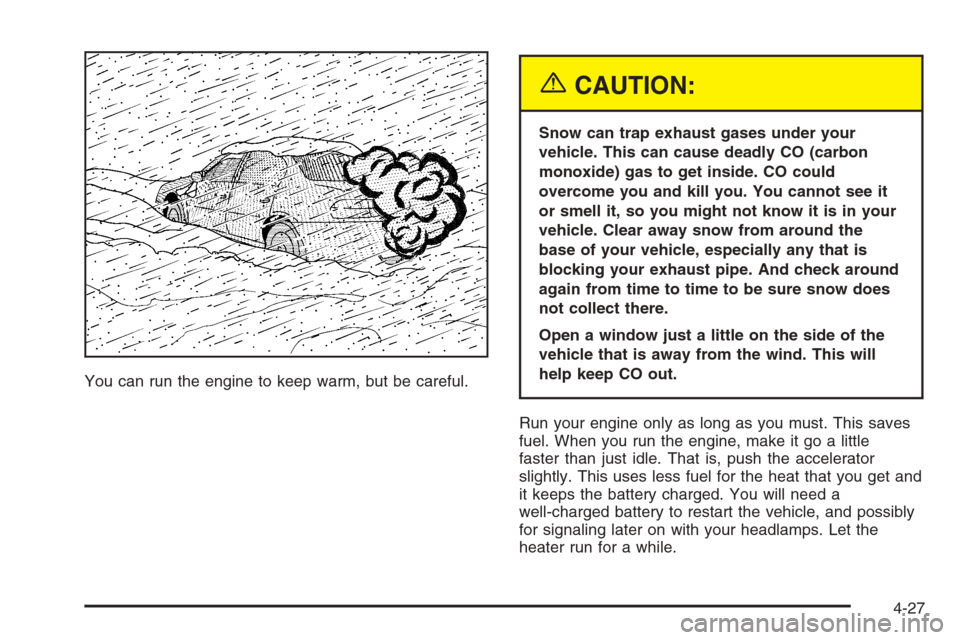
You can run the engine to keep warm, but be careful.
{CAUTION:
Snow can trap exhaust gases under your
vehicle. This can cause deadly CO (carbon
monoxide) gas to get inside. CO could
overcome you and kill you. You cannot see it
or smell it, so you might not know it is in your
vehicle. Clear away snow from around the
base of your vehicle, especially any that is
blocking your exhaust pipe. And check around
again from time to time to be sure snow does
not collect there.
Open a window just a little on the side of the
vehicle that is away from the wind. This will
help keep CO out.
Run your engine only as long as you must. This saves
fuel. When you run the engine, make it go a little
faster than just idle. That is, push the accelerator
slightly. This uses less fuel for the heat that you get and
it keeps the battery charged. You will need a
well-charged battery to restart the vehicle, and possibly
for signaling later on with your headlamps. Let the
heater run for a while.
4-27
Page 323 of 434
Notice:If you use an improper coolant mixture,
your engine could overheat and be badly damaged.
The repair cost would not be covered by your
warranty. Too much water in the mixture can freeze
and crack the engine, radiator, heater core and
other parts.
If you have to add coolant more than four times a year,
have your dealer check your cooling system.
Notice:If you use the proper coolant, you do not
have to add extra inhibitors or additives which claim
to improve the system. These can be harmful.
Checking Coolant
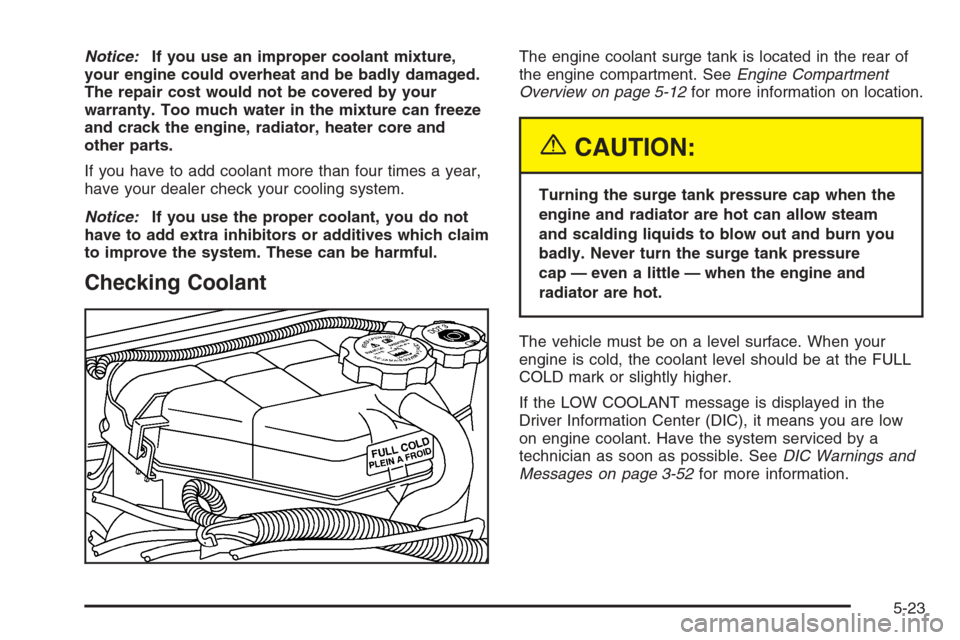
The engine coolant surge tank is located in the rear of
the engine compartment. SeeEngine Compartment
Overview on page 5-12for more information on location.
{CAUTION:
Turning the surge tank pressure cap when the
engine and radiator are hot can allow steam
and scalding liquids to blow out and burn you
badly. Never turn the surge tank pressure
cap — even a little — when the engine and
radiator are hot.
The vehicle must be on a level surface. When your
engine is cold, the coolant level should be at the FULL
COLD mark or slightly higher.
If the LOW COOLANT message is displayed in the
Driver Information Center (DIC), it means you are low
on engine coolant. Have the system serviced by a
technician as soon as possible. SeeDIC Warnings and
Messages on page 3-52for more information.
5-23
Page 337 of 434
Notice:Ignoring these steps could result in costly
damage to your vehicle that would not be covered
by your warranty.
Trying to start your vehicle by pushing or pulling it
will not work, and it could damage your vehicle.
1. Check the other vehicle. It must have a 12-volt
battery with a negative ground system.
Notice:If the other vehicle’s system is not a 12-volt
system with a negative ground, both vehicles can
be damaged. Only use vehicles with 12-volt systems
with negative grounds to jump start your vehicle.
2. Get the vehicles close enough so the jumper cables
can reach, but be sure the vehicles are not touching
each other. If they are, it could cause a ground
connection you do not want. You would not be able
to start your vehicle, and the bad grounding
could damage the electrical systems.
To avoid the possibility of the vehicles rolling, set
the parking brake rmly on both vehicles involved in
the jump start procedure. Put an automatic
transaxle in PARK (P) or a manual transaxle in
NEUTRAL before setting the parking brake.Notice:If you leave your radio or other accessories
on during the jump starting procedure, they could
be damaged. The repairs would not be covered
by your warranty. Always turn off your radio and
other accessories when jump starting your vehicle.
3. Turn off the ignition on both vehicles. Unplug
unnecessary accessories plugged into the cigarette
lighter or the accessory power outlet. Turn off
the radio and all lamps that are not needed. This
will avoid sparks and help save both batteries. And
it could save the radio!
4. Open the hoods and locate the batteries. Find the
positive (+) and negative (−) terminal locations on
each vehicle. SeeEngine Compartment Overview
on page 5-12for more information on location.
{CAUTION:
An electric fan can start up even when the
engine is not running and can injure you. Keep
hands, clothing and tools away from any
underhood electric fan.
5-37
Page 338 of 434
{CAUTION:
Using a match near a battery can cause battery
gas to explode. People have been hurt doing
this, and some have been blinded. Use a
ashlight if you need more light.
Be sure the battery has enough water. You do
not need to add water to the battery installed
in your new vehicle. But if a battery has ller
caps, be sure the right amount of uid is there.
If it is low, add water to take care of that rst.
If you do not, explosive gas could be present.
Battery uid contains acid that can burn you.
Do not get it on you. If you accidentally get it
in your eyes or on your skin, ush the place
with water and get medical help immediately.5. Check that the jumper cables do not have loose or
missing insulation. If they do, you could get a
shock. The vehicles could be damaged too.
Before you connect the cables, here are some
things you should know. Positive (+) will go
to positive (+) or to a remote positive (+) terminal if
the vehicle has one. Negative (−) will go to a
heavy, unpainted metal engine part or to a remote
negative (−) terminal if the vehicle has one.
Do not connect positive (+) to negative (−)oryou
will get a short that would damage the battery
and maybe other parts too. And do not connect the
negative (−) cable to the negative (−) terminal on
the dead battery because this can cause sparks.
{CAUTION:
Fans or other moving engine parts can injure
you badly. Keep your hands away from moving
parts once the engine is running.
5-38
Page 383 of 434
Electrical System
Add-On Electrical Equipment
Notice:Don’t add anything electrical to your vehicle
unless you check with your dealer rst. Some
electrical equipment can damage your vehicle and
the damage wouldn’t be covered by your warranty.
Some add-on electrical equipment can keep other
components from working as they should.
Your vehicle has an airbag system. Before attempting to
add anything electrical to your vehicle, seeServicing
Your Airbag-Equipped Vehicle on page 1-74.
Headlamp Wiring
The headlamp wiring is protected by fuses, one for each
headlamp, in the fuse block. An electrical overload
will cause the lamps to turn off. If this happens, have
your headlamp wiring checked right away.
Windshield Wiper Fuses
The windshield wiper motor is protected by an internal
circuit breaker and a fuse. If the motor overheats due to
heavy snow, etc., the wiper will stop until the motor
cools. If the overload is caused by some electrical
problem and not snow, etc., be sure to get it xed.
Power Windows and Other Power
Options
Fuses in the fuse block protect the power windows and
other power accessories. When the current load is
too heavy, the fuse opens protecting the circuit until the
problem is xed or goes away.
Fuses
The wiring circuits in your vehicle are protected from
short circuits by fuses and fusible thermal links in
the wiring itself.
Look at the silver-colored band inside the fuse. If the
band is broken or melted, replace the fuse. Be sure you
replace a bad fuse with a new one of the identical
size and rating.
If you ever have a problem on the road and don’t have
a spare fuse, you can borrow one that has the same
amperage. Just pick a feature of your vehicle that
you can get along without — like the radio or cigarette
lighter — and use its fuse, if it is the correct amperage.
Replace it as soon as you can.
There are three fuse blocks in your vehicle: one in the
center of the instrument panel, one in the engine
compartment and one in the trunk.
There is a fuse puller located on the instrument panel
fuse block. It can be used to easily remove fuses
from the fuse block.
5-83
Page 423 of 434
C
California Fuel.................................................. 5-6
Canadian Owners................................................ ii
Capacities and Specications............................5-91
Carbon Monoxide...........2-14, 2-15, 2-32, 4-24, 4-38
Care of
Safety Belts................................................5-77
Your Cassette Tape Player..........................3-120
Your CD and DVD Player...........................3-121
Your CDs and DVDs ..................................3-121
Cargo Lamp...................................................3-19
Center Console Storage Area...........................2-44
Chains, Tire...................................................5-60
Charging System Light....................................3-37
Check
Engine Light...............................................3-41
Checking Things Under the Hood......................5-10
Chemical Paint Spotting...................................5-80
Child Restraints
Child Restraint Systems...............................1-39
Infants and Young Children...........................1-35
Lower Anchorages and Top Tethers for
Children (LATCH System)..........................1-45
Older Children.............................................1-33
Securing a Child Restraint in a Rear Seat
Position..................................................1-53Child Restraints (cont.)
Securing a Child Restraint in the Right Front
Seat Position...........................................1-56
Where to Put the Restraint...........................1-42
Cleaning
Aluminum Wheels........................................5-79
Exterior Lamps/Lenses.................................5-78
Fabric/Carpet..............................................5-74
Finish Care.................................................5-78
Glass Surfaces............................................5-77
Instrument Panel.........................................5-76
Interior Plastic Components...........................5-76
Leather......................................................5-76
Tires..........................................................5-79
Ultra Lux Suede..........................................5-76
Underbody Maintenance...............................5-80
Vinyl..........................................................5-75
Washing Your Vehicle...................................5-77
Weatherstrips..............................................5-77
Windshield and Wiper Blades........................5-78
Climate Control System...................................3-21
Automatic...................................................3-25
Outlet Adjustment........................................3-29
Comfort Guides, Rear Safety Belt.....................1-28
Compact Spare Tire........................................5-73
Content Theft-Deterrent....................................2-18
Control of a Vehicle.......................................... 4-5
3
Page 425 of 434
E
Electrical System
Add-On Equipment......................................5-83
Engine Compartment Fuse Block...................5-86
Fuses........................................................5-83
Headlamp Wiring.........................................5-83
Instrument Panel Fuse Block.........................5-84
Power Windows and Other Power Options......5-83
Rear Compartment Fuse Block......................5-88
Windshield Wiper Fuses...............................5-83
Engine
Air Cleaner/Filter.........................................5-20
Battery.......................................................5-35
Check and Service Engine Soon Light............3-41
Coolant......................................................5-22
Coolant Heater............................................2-24
Coolant Temperature Gage...........................3-40
Coolant Temperature Warning Light................3-40
Engine Compartment Overview......................5-12
Exhaust.....................................................2-32
Oil .............................................................5-15
Oil Life System...........................................5-18
Overheating................................................5-24
Starting......................................................2-23Enhanced Traction System (ETS)........................ 4-8
Active Light................................................3-39
Warning Light.............................................3-39
Entry/Exit Lighting...........................................3-19
Event Data Recorders (EDR)............................. 7-9
Extender, Safety Belt.......................................1-32
Exterior Lamps...............................................3-13
F
Filter
Engine Air Cleaner......................................5-20
Finish Damage...............................................5-80
Fixed Mast Antenna.......................................3-122
Flash-to-Pass................................................... 3-8
Flat Tire........................................................5-61
Flat Tire, Changing.........................................5-62
Flat Tire, Storing.............................................5-70
Fluid
Automatic Transaxle.....................................5-21
Windshield Washer......................................5-30
Fog Lamps ....................................................3-18
Folding Seatback, Passenger............................. 1-6
Front Reading Lamps......................................3-19
5