Page 266 of 374
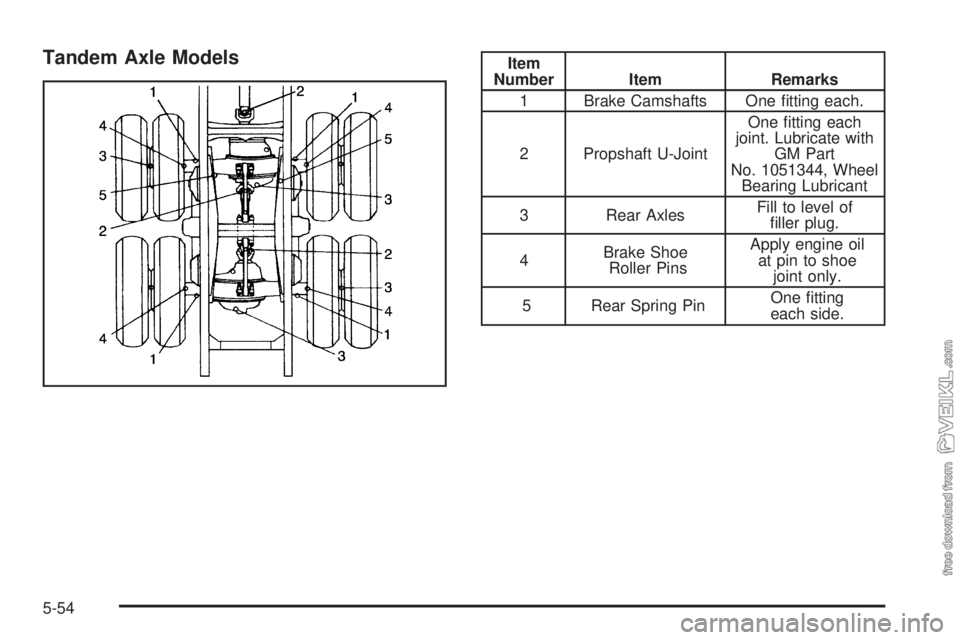
Tandem Axle ModelsItem
Number Item Remarks
1 Brake Camshafts One fitting each.
2 Propshaft U-JointOne fitting each
joint. Lubricate with
GM Part
No. 1051344, Wheel
Bearing Lubricant
3 Rear AxlesFill to level of
filler plug.
4Brake Shoe
Roller PinsApply engine oil
at pin to shoe
joint only.
5 Rear Spring PinOne fitting
each side.
5-54
Page 269 of 374

2. Get the vehicles close enough so the jumper cables
can reach, but be sure the vehicles are not touching
each other. If they are, it could cause a ground
connection you do not want. You would not be able
to start your vehicle, and the bad grounding
could damage the electrical systems.
To avoid the possibility of the vehicles rolling, set the
parking brake firmly on both vehicles involved in the
jump start procedure. Put an automatic transmission
in PARK (P) or a manual transmission in NEUTRAL
before setting the parking brake. If you have a
four-wheel-drive vehicle, be sure the transfer case is
in a drive gear, not in NEUTRAL.
Notice:If you leave your radio or other accessories
on during the jump starting procedure, they could
be damaged. The repairs would not be covered
by your warranty. Always turn off your radio and
other accessories when jump starting your vehicle.
3. Turn off the ignition on both vehicles. Unplug
unnecessary accessories plugged into the cigarette
lighter or accessory power outlets. Turn off the
radio and all lamps that are not needed. This will
avoid sparks and help save both batteries, and
it could save the radio!4. Open the hood on the other vehicle and locate the
positive (+) and the negative (−) terminal locations
on that vehicle.
Open the hood on your
vehicle and find the remote
positive (+) terminal,
located under a red plastic
cover on the passenger’s
side of the vehicle.
Squeeze the tab to open
the cover and access
the remote positive (+)
terminal.
You will not see the battery (or batteries) of your
vehicle under the hood. They are located in a frame
mounted battery box, which is located on either
the driver’s or the passenger’s side of the vehicle.
You will not need to access your battery (or
batteries) for jump starting. The remote positive (+)
terminal is for that purpose.
5-57
Page 274 of 374
Rear Axle Shift Motor
When to Check and Change Fluid
If you have an optional air-shift two-speed, controlled
traction, or locking differential type rear axle, a good time
to check the fluid level in the axle shift motor is when
the rear axle lubricant is checked. Use refrigerant
oil (shift motor only).
How to Check Fluid
Remove the plug on the front plate of the axle shift
motor, add enough fluid to raise the level to the bottom
of the filler plug hole, then replace the plug.
What to Use
Refer to your Maintenance Schedule to determine what
kind of lubricant to use. SeePart C: Recommended
Fluids and Lubricants on page 6-32.
Four-Wheel Drive
Transfer Case
When to Check Lubricant
It is not necessary to regularly check transfer case fluid
unless you suspect there is a leak or you hear an
unusual noise. A fluid loss could indicate a problem.
Have it inspected and repaired.
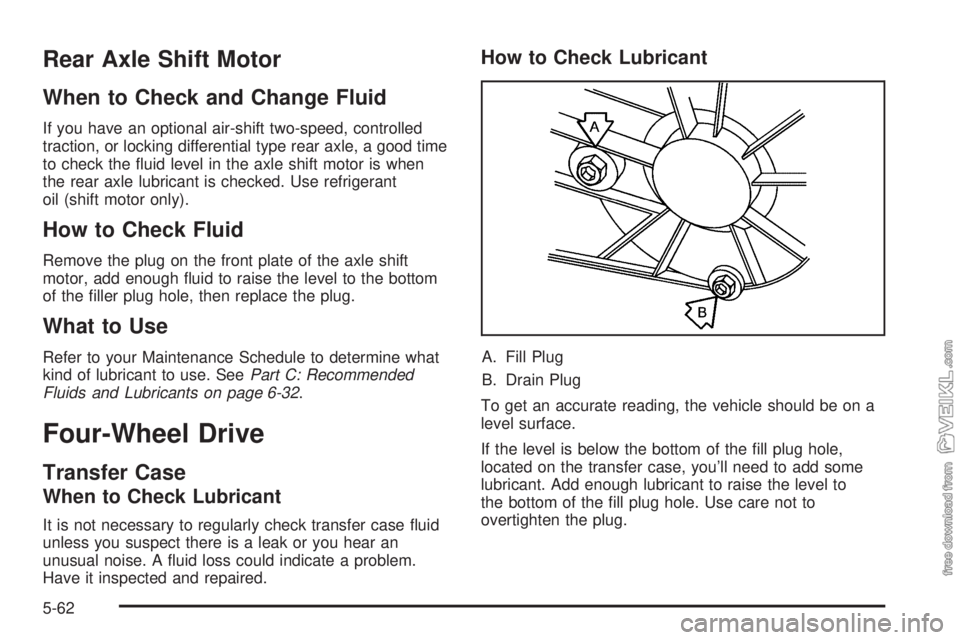
How to Check Lubricant
A. Fill Plug
B. Drain Plug
To get an accurate reading, the vehicle should be on a
level surface.
If the level is below the bottom of the fill plug hole,
located on the transfer case, you’ll need to add some
lubricant. Add enough lubricant to raise the level to
the bottom of the fill plug hole. Use care not to
overtighten the plug.
5-62
Page 281 of 374
6. Install a new gasket whenever you take out the
cylinder. Use only one gasket and spread a light
film of clean oil on it before installation.
7. Put in the new cylinder. Turn it clockwise until it just
starts to contact the gasket.
8. Tighten the cylinder another half turn (180 degrees).
Don’t over-tighten.
9. Retighten the cylinder clamp.
Front Wheel Bearings with
Oil-Filled Hubs
Notice:If you drive your vehicle through deep
water that is higher than the front or rear axle, water
may enter the axle housing and cause the axle
lubricant to break down. This could damage
the gears inside. Avoid driving your vehicle through
deep water.
You should avoid driving your vehicle through deep
puddles or standing water. If you must drive through
water that is higher than the front or rear axle, see your
dealer immediately afterward to have the condition of
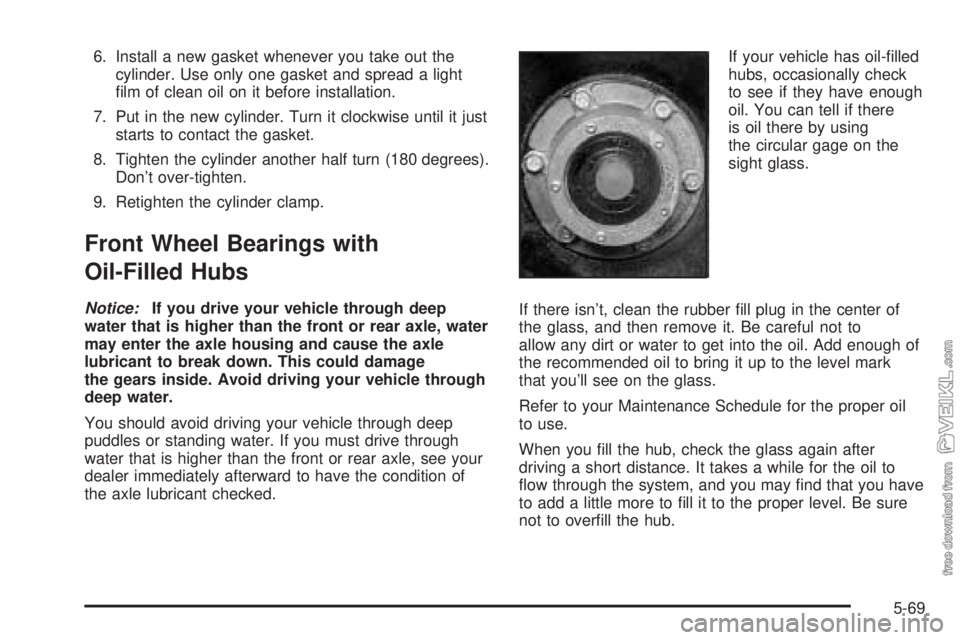
the axle lubricant checked.If your vehicle has oil-filled
hubs, occasionally check
to see if they have enough
oil. You can tell if there
is oil there by using
the circular gage on the
sight glass.
If there isn’t, clean the rubber fill plug in the center of
the glass, and then remove it. Be careful not to
allow any dirt or water to get into the oil. Add enough of
the recommended oil to bring it up to the level mark
that you’ll see on the glass.
Refer to your Maintenance Schedule for the proper oil
to use.
When you fill the hub, check the glass again after
driving a short distance. It takes a while for the oil to
flow through the system, and you may find that you have
to add a little more to fill it to the proper level. Be sure
not to overfill the hub.
5-69
Page 283 of 374
Ination - Tire Pressure
The GVW Rating label, which is on the driver’s door
frame, shows the correct inflation pressures for
your tires when they’re cold. “Cold” means your vehicle
has been sitting for at least three hours or driven no
more than 1 mile (1.6 km).
Notice:Do not let anyone tell you that
under-ination or over-ination is all right. It is not.
If your tires do not have enough air (under-ination),
you can get the following:
Too much exing
Too much heat
Tire overloading
Premature or irregular wear
Poor handling
Reduced fuel economy
If your tires have too much air (over-ination), you
can get the following:
Unusual wear
Poor handling
Rough ride
Needless damage from road hazards
When to Check
Check your tires once a month or more.
Also, check the tire pressure of the spare tire
(if equipped).
How to Check
Use a good quality pocket-type gage to check tire
pressure. You can’t tell if your tires are properly inflated
simply by looking at them. Radial tires may look
properly inflated even when they’re underinflated.
Be sure to put the valve caps back on the valve
stems. They help prevent leaks by keeping out dirt
and moisture.
Wheel Loading
Wheels are stamped with a maximum load and cold
inflation rating. Be sure you don’t exceed these. If you
ever think you need to, first contact the rim and
wheel maker to get their advice.
5-71
Page 284 of 374

Dual Tire Operation
When the vehicle is new, check the wheel nut tightness
on all wheels with a torque wrench after your first
100 miles (160 km) and then 1,000 miles (1 600 km) after
that. Whenever a wheel, wheel bolt or wheel nut is
removed or serviced, repeat the 100 miles (160 km), and
then 1,000 mile (1 600 km) wheel nut tightness check.
SeeTightening the Wheel Nuts on page 5-73for wheel
nut tightening information and proper torque values.
{CAUTION:
If you operate your vehicle with a tire that is
badly underinated, the tire can overheat. An
overheated tire can lose air suddenly or catch
re. You or others could be injured. Be sure all
tires (including the spare, if any) are properly
inated.
SeeTires on page 5-70andInation - Tire Pressure on
page 5-71for more information on proper tire inflation.
When It Is Time for New Tires
Replace your tires when the tread depth is down to
1/8 of an inch (3.2 mm) for the front tires, or 1/16 of an
inch (1.6 mm) for a rear tire. Also, you need a new
tire if:
•You can see cord or fabric showing through the
tire’s rubber.
•The tread or sidewall is cracked, cut or snagged
deep enough to show cord or fabric.
•The tire has a bump, bulge or split.
•The tire has a puncture, cut or other damage that
can’t be repaired well because of the size or
location of the damage.
{CAUTION:
Mixing tires could cause you to lose control
while driving. If you mix tires of different
types — like radial and bias-belted tires — the
vehicle may not handle properly, and you
could have a crash. Be sure to use the same
type of tires all around.
5-72
Page 285 of 374

When you replace tires, make sure they are the same
size, load range, speed rating and construction type
(bias, bias-belted or radial) as your original tires.
If your vehicle has four-wheel drive, the axle differentials,
propshafts and transfer case may be damaged if tires
of different sizes, brands or tread types are installed on
the front and rear axles. That damage would not be
covered under your warranty.
Wheel Alignment and Tire Balance
The wheels on your vehicle were aligned at the
factory to give you the longest tire life and best overall
performance.
Proper front wheel alignment must be maintained in
order to ensure efficient steering, good directional
stability, and prevent abnormal tire wear. If you notice
unusual tire wear or your vehicle is pulling one way
or the other, the alignment may need to be reset. If you
notice your vehicle vibrating when driving on a smooth
road, your wheels may need to be balanced.
Tightening the Wheel Nuts
{CAUTION:
Wheel nuts that are not tight can work loose. If
all the nuts on a wheel come off, the wheel can
come off the vehicle, causing a crash. All
wheel nuts must be properly tightened. Follow
the rules in this section to be sure they are.
This section lets you know how often to check the
tightness of the wheel nuts on your vehicle and how tight
they must be.
5-73
Page 286 of 374
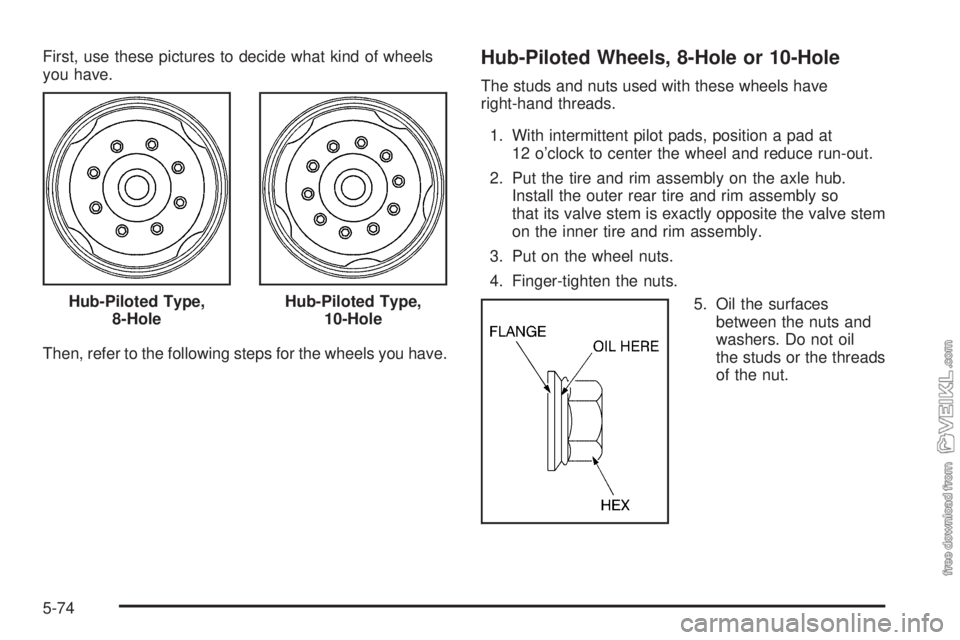
First, use these pictures to decide what kind of wheels
you have.
Then, refer to the following steps for the wheels you have.Hub-Piloted Wheels, 8-Hole or 10-Hole
The studs and nuts used with these wheels have
right-hand threads.
1. With intermittent pilot pads, position a pad at
12 o’clock to center the wheel and reduce run-out.
2. Put the tire and rim assembly on the axle hub.
Install the outer rear tire and rim assembly so
that its valve stem is exactly opposite the valve stem
on the inner tire and rim assembly.
3. Put on the wheel nuts.
4. Finger-tighten the nuts.
5. Oil the surfaces
between the nuts and
washers. Do not oil
the studs or the threads
of the nut. Hub-Piloted Type,
8-Hole
Hub-Piloted Type,
10-Hole
5-74