2005 CHEVROLET KODIAK automatic transmission
[x] Cancel search: automatic transmissionPage 91 of 374

Diesel Engine Exhaust Brake
If your vehicle is equipped with a diesel engine,
it may have an exhaust brake, which is located in the
exhaust system.
The exhaust brake is used to help slow the vehicle and
may assist the vehicle’s foundation brakes. The use of
the exhaust brake will assist the braking of the vehicle
and prolong the life of the foundation brake lining
material.
The exhaust brake switch
is located in the instrument
panel switchbank.
Push the bottom of the switch to turn the exhaust brake
on. When you push the top of the switch, the exhaust
brake will turn off.
There is an indicator light on the instrument panel similar
to the symbol on the switch, that will come on when the
exhaust brake is active. SeeExhaust Brake Indicator
Light on page 3-40for more information.When using the exhaust brake, the proper gear range
selection is important. The exhaust brake will be
most effective if the gear range selected is the lowest
possible range that does not allow the engine rpm to go
more than 200 rpm above rated (full load) rpm. If you
have a Caterpillar
®diesel engine, do not exceed
2900 rpm. If you have a DURAMAX®7800 diesel
engine, do not exceed 2550 rpm. If you have a
DURAMAX
®6600 diesel engine, do not exceed
3600 rpm.
If you have an Allison
®1000/2000/2200/2400/2500
series automatic transmission and press this button,
the transmission will downshift to a factory default
setting of fourth gear. To change the default setting,
or for more information on factory default settings,
contact your dealer for assistance.
The accelerator and clutch pedals must be released in
order for the exhaust brake to engage. The exhaust
brake will not function when the cruise control feature
is active with a DURAMAX
®6600 engine, and will
automatically shut off when the anti-lock brake system
is active.
When equipped with a Caterpillar
®diesel engine,
the exhaust brake will become active in cruise control
when you exceed the set speed by 3 mph.
2-25
Page 93 of 374
Air Shift Control
(Automatic Transmission)
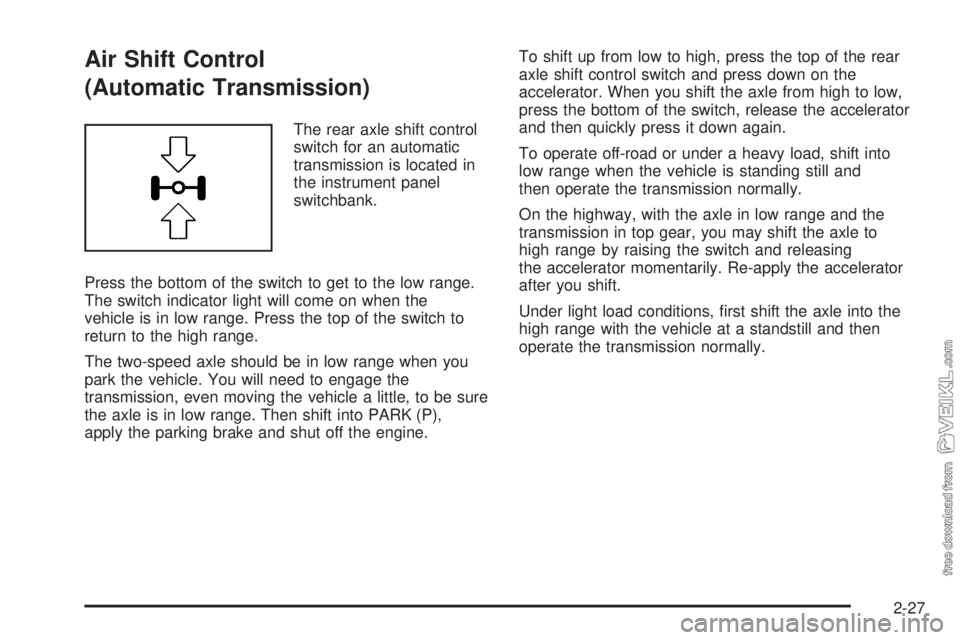
The rear axle shift control
switch for an automatic
transmission is located in
the instrument panel
switchbank.
Press the bottom of the switch to get to the low range.
The switch indicator light will come on when the
vehicle is in low range. Press the top of the switch to
return to the high range.
The two-speed axle should be in low range when you
park the vehicle. You will need to engage the
transmission, even moving the vehicle a little, to be sure
the axle is in low range. Then shift into PARK (P),
apply the parking brake and shut off the engine.To shift up from low to high, press the top of the rear
axle shift control switch and press down on the
accelerator. When you shift the axle from high to low,
press the bottom of the switch, release the accelerator
and then quickly press it down again.
To operate off-road or under a heavy load, shift into
low range when the vehicle is standing still and
then operate the transmission normally.
On the highway, with the axle in low range and the
transmission in top gear, you may shift the axle to
high range by raising the switch and releasing
the accelerator momentarily. Re-apply the accelerator
after you shift.
Under light load conditions, first shift the axle into the
high range with the vehicle at a standstill and then
operate the transmission normally.
2-27
Page 94 of 374
Automatic Transmission Operation
We build vehicles with Allison®five and six-speed
automatic transmissions. This part of the manual covers
the basics of these. With these transmissions, you
will find another Allison
®manual in your vehicle that
goes into more detail. On the headliner, in front of and
above the driver, or in some other place near the
driver, you will see a label that describes important
operating facts about the automatic transmission in
your vehicle. Make sure you follow the instructions on
this label.
Be sure to keep your parking brake set until you are
ready to shift into DRIVE (D), and press the brake pedal
while shifting from NEUTRAL (N) or PARK (P) to a
drive gear.
All vehicles equipped with automatic transmissions can
be started in PARK (P), if equipped, or in NEUTRAL (N).
See the Allison
®Transmission Operator’s Manual in
your vehicle for more information about this.
{CAUTION:
It can be dangerous to get out of your vehicle
without the parking brake rmly set. Your
vehicle can roll. If you have left the engine
running, the vehicle can move suddenly. You or
others could be injured. To be sure your vehicle
will not move, even when you are on fairly level
ground, always set the parking brake.
{CAUTION:
Shifting into a drive gear while your engine is
running at high speed is dangerous. Unless
your foot is rmly on the brake pedal, your
vehicle could move very rapidly. You could
lose control and hit people or objects. Do not
shift into a drive gear while your engine is
running at high speed.
2-28
Page 96 of 374

Eaton®Fuller®Five and Six-Speed
Transmissions and TTC Spicer
Seven-Speed Transmissions
These transmissions have gears that automatically
synchronize when you shift up or down (except
FIRST (1) gear on the five-speed and seven-speed
transmission which is unsynchronized). Choose the
gear that will maintain the road speed you want while
keeping the engine above two-thirds of the governed
speed. When the engine speed drops below two-thirds
of the governed speed, shift into the next lower gear
before your engine begins to lug. When you shift down,
be sure to double-clutch if required.
ZF Six-Speed Transmission
Here is how to operate your transmission.
This six-speed pattern is
unique to GM manual
transmissions.
The transmission always repositions the shift lever to
NEUTRAL, which is located between FOURTH (4)
and FIFTH (5) gear.
To prevent unintentional gear selections, additional force
is required to move the shift lever into REVERSE (R) or
FIRST (1). Use FIRST (1) when trailer towing, driving
with a heavier payload or launching on a grade.
Otherwise, start in SECOND (2) gear. Only shift into
FIRST (1) when the vehicle has stopped moving.
2-30
Page 104 of 374
Parking
{CAUTION:
If you do not park your vehicle properly, it can
roll. If you have left the engine running, it can
move very quickly. You or others could be
injured. To be sure your vehicle will not move,
even when you are on level ground, follow the
steps below.
Two-Speed Rear Axle
1. With the engine running, shift the two-speed rear
axle into low. To be sure it is in low, you will need
to move the vehicle in gear just a little.
2. Hold the regular brake pedal down with your
right foot.
3. Apply the parking brake.
4. Shift the transmission to NEUTRAL for manual
transmission or PARK (P) for automatic
transmission.
Hydraulic Brakes
(Parking Brake Operation)
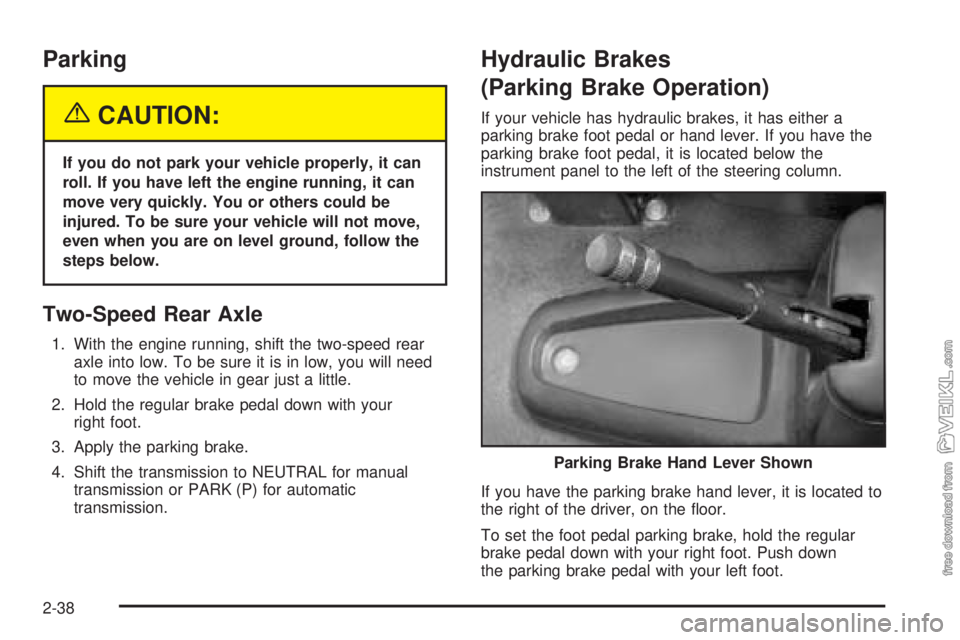
If your vehicle has hydraulic brakes, it has either a
parking brake foot pedal or hand lever. If you have the
parking brake foot pedal, it is located below the
instrument panel to the left of the steering column.
If you have the parking brake hand lever, it is located to
the right of the driver, on the floor.
To set the foot pedal parking brake, hold the regular
brake pedal down with your right foot. Push down
the parking brake pedal with your left foot.Parking Brake Hand Lever Shown
2-38
Page 110 of 374

Running the Engine While Parked
It is better not to park with the engine running. But if you
ever have to, here are some things to know.
{CAUTION:
Idling the engine with the climate control
system off could allow dangerous exhaust into
your vehicle. See the earlier caution under
Engine Exhaust on page 2-43.
Also, idling in a closed-in place can let deadly
carbon monoxide (CO) into your vehicle even if
the climate control fan is at the highest setting.
One place this can happen is a garage.
Exhaust — with CO — can come in easily.
NEVER park in a garage with the engine
running.
Another closed-in place can be a blizzard.
SeeWinter Driving on page 4-26.
{CAUTION:
It can be dangerous to get out of your vehicle
if the automatic transmission shift lever is not
fully in PARK (P) with the parking brake rmly
set. Your vehicle can roll. Do not leave your
vehicle when the engine is running unless you
have to. If you have left the engine running,
the vehicle can move suddenly. You or others
could be injured. To be sure your vehicle will
not move, even when it is on fairly level
ground, always set the parking brake and
move the automatic transmission shift lever
to PARK (P), or the manual transmission
shift lever to NEUTRAL.
Follow the proper steps to be sure your vehicle
will not move.
2-44
Page 125 of 374

With cruise control, you can maintain a speed of about
30 mph (48 km/h) or more without keeping your foot
on the accelerator. Cruise control does not work
at speeds below about 30 mph (48 km/h).
If you have an automatic transmission and you apply
your brakes, the cruise control will shut off.
If you have a manual transmission and you apply your
brakes or push the clutch pedal, the cruise control
will shut off.
{CAUTION:
Cruise control can be dangerous where you
cannot drive safely at a steady speed. So, do
not use your cruise control on winding roads
or in heavy traffic.
Cruise control can be dangerous on slippery
roads. On such roads, fast changes in tire
traction can cause needless wheel spinning,
and you could lose control. Do not use cruise
control on slippery roads.
Setting Cruise Control
{CAUTION:
If you leave your cruise control on when you
are not using cruise, you might hit a button
and go into cruise when you do not want to.
You could be startled and even lose control.
Keep the cruise control switch off until you
want to use cruise control.
1. Move the cruise control switch to on.
2. Get up to the speed you want.
3. Press in the set button at the end of the lever and
release it.
4. Take your foot off the accelerator pedal. The
accelerator pedal will not go down.
3-11
Page 127 of 374

Reducing Speed While Using Cruise
Control
Press in the button at the end of the lever until you
reach the lower speed you want, then release it.
To slow down in very small amounts, tap the button
briefly. Each time you do this, you’ll go 1 mph (1.6 km/h)
slower.
Passing Another Vehicle While Using
Cruise Control
Use the accelerator pedal to increase your speed.
When you take your foot off the pedal, your vehicle will
slow down to the cruise control speed you set earlier.
Using Cruise Control on Hills
How well your cruise control will work on hills depends
upon your speed, load and the steepness of the
hills. When going up steep hills, you may want to step
on the accelerator pedal to maintain your speed.
When going downhill, you may have to brake or shift to
a lower gear to keep your speed down. Of course,
applying the brake or clutch takes you out of cruise
control. Many drivers find this to be too much trouble
and don’t use cruise control on steep hills.
Ending Cruise Control
There are four different ways to turn off the cruise
control:
•Step lightly on the brake pedal (manual and
automatic transmissions).
•Press the clutch pedal to the floor (manual
transmissions).
•Move the cruise switch to off, or
•Shift the transmission to NEUTRAL (N).
Erasing Speed Memory
When you turn off the ignition, your cruise control set
speed memory is erased.
3-13