2005 CHEVROLET IMPALA towing
[x] Cancel search: towingPage 246 of 398

Making Turns
Notice:Making very sharp turns while trailering
could cause the trailer to come in contact with the
vehicle. Your vehicle could be damaged. Avoid
making very sharp turns while trailering.
When you’re turning with a trailer, make wider turns than
normal. Do this so your trailer won’t strike soft shoulders,
curbs, road signs, trees or other objects. Avoid jerky or
sudden maneuvers. Signal well in advance.
Turn Signals When Towing a Trailer
When you tow a trailer, your vehicle may need additional
wiring. Check with your dealer. The arrows on your
instrument panel will ash whenever you signal a turn
or lane change. Properly hooked up, the trailer lamps
will also ash, telling other drivers you’re about to turn,
change lanes or stop.
When towing a trailer, the arrows on your instrument
panel will ash for turns even if the bulbs on the trailer
are burned out. Thus, you may think drivers behind
you are seeing your signal when they are not. It’s
important to check occasionally to be sure the trailer
bulbs are still working.
Driving On Grades
Reduce speed and shift to a lower gearbeforeyou start
down a long or steep downgrade. If you don’t shift
down, you might have to use your brakes so much that
they would get hot and no longer work well.
On a long uphill grade, shift down and reduce your
speed to around 45 mph (70 km/h) to reduce the
possibility of engine and transaxle overheating.
If you have overdrive, you may want to drive in
THIRD (3) instead of AUTOMATIC OVERDRIVE (D).
Parking on Hills
{CAUTION:
You really should not park your vehicle, with a
trailer attached, on a hill. If something goes
wrong, your rig could start to move. People
can be injured, and both your vehicle and the
trailer can be damaged.
4-42
Page 247 of 398

But if you ever have to park your rig on a hill,
here’s how to do it:
1. Apply your regular brakes, but don’t shift into
PARK (P) yet.
2. Have someone place chocks under the trailer
wheels.
3. When the wheel chocks are in place, release the
regular brakes until the chocks absorb the load.
4. Reapply the regular brakes. Then apply your
parking brake, and then shift to PARK (P).
5. Release the regular brakes.
When You Are Ready to Leave After
Parking on a Hill
1. Apply your regular brakes and hold the pedal down
while you:
start your engine,
shift into a gear, and
release the parking brake.
2. Let up on the brake pedal.
3. Drive slowly until the trailer is clear of the chocks.
4. Stop and have someone pick up and store the
chocks.
Maintenance When Trailer Towing
Your vehicle will need service more often when you’re
pulling a trailer. See the Maintenance Schedule for more
on this. Things that are especially important in trailer
operation are automatic transaxle uid (don’t overll),
engine oil, drive belts, cooling system and brake system.
Each of these is covered in this manual, and the
Index will help you nd them quickly. If you’re trailering,
it’s a good idea to review this information before you
start your trip.
Check periodically to see that all hitch nuts and bolts
are tight.
Engine Cooling When Trailer Towing
Your cooling system may temporarily overheat during
severe operating conditions. SeeEngine Overheating on
page 5-32.
4-43
Page 282 of 398
Overheated Engine Protection
Operating Mode
This emergency operating mode allows your vehicle to
be driven to a safe place in an emergency situation.
If an overheated engine condition exists, an overheat
protection mode which alternates ring groups of
cylinders helps prevent engine damage. In this mode,
you will notice a signicant loss in power and engine
performance. The low coolant light may come on
and the temperature gage will indicate an overheat
condition exists. Driving extended miles (km) and/or
towing a trailer in the overheat protection mode should
be avoided.
Notice:After driving in the overheated engine
protection operating mode, to avoid engine damage,
allow the engine to cool before attempting any
repair. The engine oil will be severely degraded.
Repair the cause of coolant loss, change the oil
and reset the oil life system. SeeEngine Oil
on page 5-18.
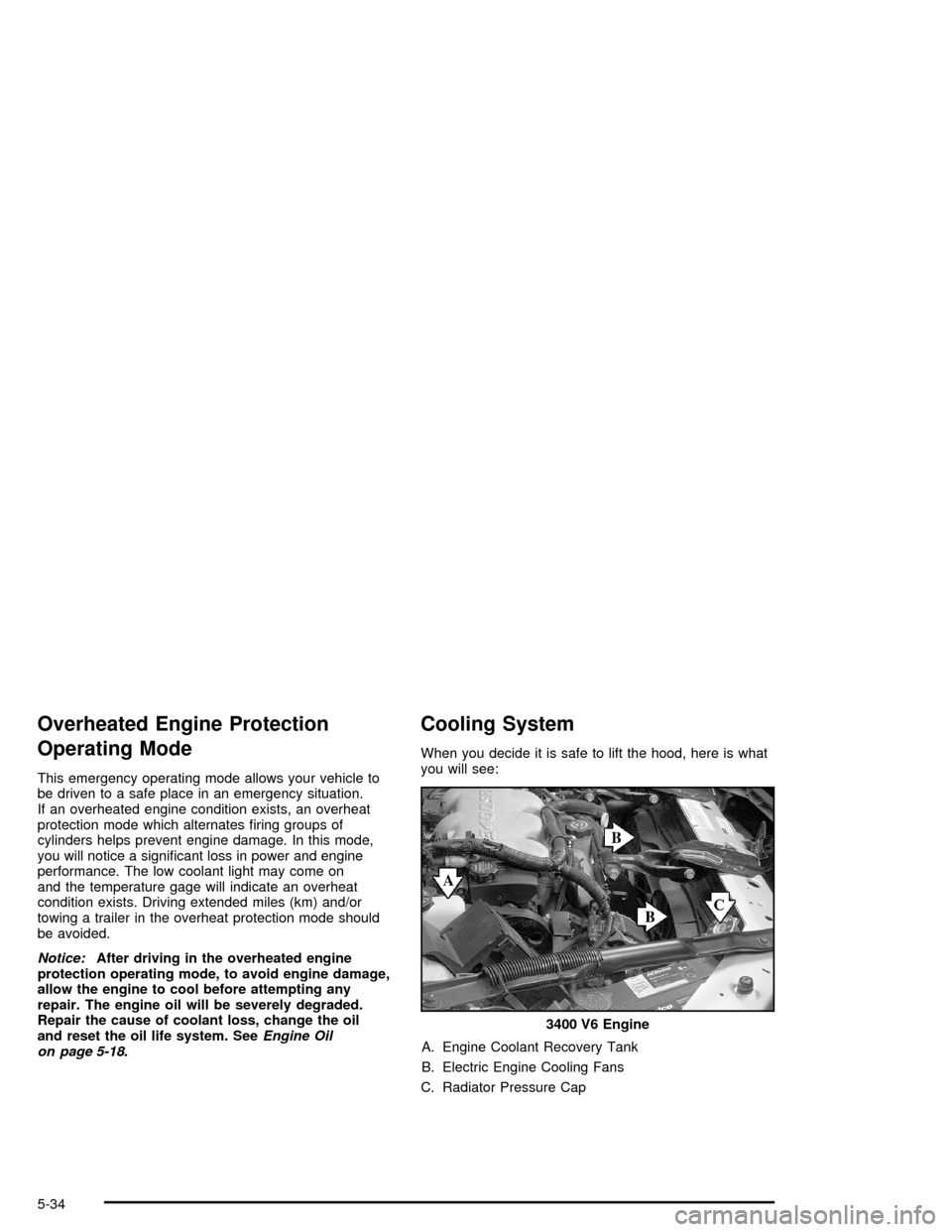
Cooling System
When you decide it is safe to lift the hood, here is what
you will see:
A. Engine Coolant Recovery Tank
B. Electric Engine Cooling Fans
C. Radiator Pressure Cap3400 V6 Engine
5-34
Page 364 of 398

(e)Make sure the safety belt reminder light and all
belts, buckles, latch plates, retractors, and anchorages
are working properly. Look for any other loose or
damaged safety belt system parts. If you see anything
that might keep a safety belt system from doing its
job, have it repaired. Have any torn or frayed safety belts
replaced. Also look for any opened or broken airbag
coverings, and have them repaired or replaced.
The airbag system does not need regular maintenance.
(f)Lubricate all key lock cylinders. Lubricate all
hinges and latches, including those for the body doors,
hood, secondary latch, pivots, spring anchor, release
pawl, rear compartment, glove box door, console door,
and any folding seat hardware. More frequent
lubrication may be required when exposed to a corrosive
environment. Applying silicone grease on weatherstrips
with a clean cloth will make them last longer, seal
better, and not stick or squeak.
(g)If you drive regularly under dusty conditions, the
lter may require replacement more often.
(h)Change automatic transaxle uid and lter if the
vehicle is mainly driven under one or more of these
conditions:
In heavy city traffic where the outside temperature
regularly reaches 90°F (32°C) or higher.
In hilly or mountainous terrain.
When doing frequent trailer towing.
Uses such as found in taxi, police, or delivery
service.(i)Drain, ush, and rell cooling system. This service
can be complex; you should have your dealer perform
this service. See Engine Coolant on page 5-29 for
what to use. Inspect hoses. Clean radiator, condenser,
pressure cap, and ller neck. Pressure test the
cooling system and pressure cap.
(j)Check throttle system for interference or binding and
for damaged or missing parts. Replace parts as
needed. Replace any components that have high effort
or excessive wear. Do not lubricate accelerator or
cruise control cables.
(k)A uid loss in any vehicle system could indicate a
problem. Have the system inspected and repaired
and the uid level checked. Add uid if needed.
(l)For supercharged engines only: Check the
supercharger oil level and add the proper supercharger
oil as needed (or every 36 months, whichever occurs
rst). See Recommended Fluids and Lubricants on
page 6-12.
(m)If you drive regularly under dusty conditions, inspect
the lter at each engine oil change.
(n)Visually inspect belt for fraying, excessive cracks, or
obvious damage. Replace belt if necessary.
6-8
Page 394 of 398

Power (cont.)
Retained Accessory (RAP)............................2-17
Six-Way Seats.............................................. 1-3
Steering Fluid.............................................5-43
Windows....................................................2-13
Programmable Automatic Door Locks.................. 2-9
Q
Questions and Answers About Safety Belts.........1-12
R
Radiator Pressure Cap....................................5-31
Radios..........................................................3-52
Care of Your Cassette Tape Player................3-88
Care of Your CD Player...............................3-90
Care of Your CDs........................................3-90
Radio with Cassette.....................................3-53
Radio with Cassette and CD.........................3-74
Radio with CD............................................3-64
Setting the Time..........................................3-52
Theft-Deterrent............................................3-87
Understanding Reception..............................3-88
Reading Lamps..............................................3-18
Rear Safety Belt Comfort Guides......................1-26Rear Seat Passengers, Safety Belts..................1-23
Rear Storage Area..........................................2-36
Rearview Mirror, Automatic Dimming..................2-28
Rearview Mirror, Automatic Dimming with
OnStar
®.....................................................2-29
Rearview Mirror with OnStar®...........................2-28
Rearview Mirrors.............................................2-28
Reclining Seatbacks.......................................... 1-4
Recommended Fluids and Lubricants.................6-12
Recreational Vehicle Towing.............................4-35
Remote Keyless Entry System............................ 2-3
Remote Keyless Entry System, Operation............ 2-4
Removing the Flat Tire and Installing the
Spare Tire..................................................5-80
Removing the Spare Tire and Tools...................5-79
Replacement Bulbs.........................................5-58
Reporting Safety Defects
Canadian Government..................................7-11
General Motors...........................................7-11
United States Government............................7-10
Restraint System Check
Checking the Restraint Systems....................1-58
Replacing Restraint System Parts
After a Crash..........................................1-59
Retained Accessory Power (RAP)......................2-17
Right Front Passenger Position,
Safety Belts................................................1-21
10
Page 397 of 398

Tires (cont.)
Pressure Monitor System..............................5-68
Removing the Flat Tire.................................5-80
Removing the Spare Tire and Tools...............5-79
Storing a Flat or Spare Tire and Tools............5-86
Tire Sidewall Labelling..................................5-61
Tire Terminology and Denitions....................5-64
Uniform Tire Quality Grading.........................5-73
Wheel Alignment and Tire Balance.................5-74
Wheel Replacement.....................................5-74
When It Is Time for New Tires......................5-71
Top Strap......................................................1-40
Top Strap Anchor Location...............................1-41
Towing
Recreational Vehicle.....................................4-35
Towing a Trailer..........................................4-37
Your Vehicle...............................................4-35
Traction
Active Message...........................................3-41
Control System (TCS).................................... 4-9
Control System Warning Light.......................3-33
Service Traction System Warning Message.......3-40
Transaxle
Fluid, Automatic...........................................5-26
Transaxle Operation, Automatic.........................2-20
Trip Computer................................................3-51
Trip Odometer................................................3-30Trunk............................................................2-10
Trunk Ajar Warning Message............................3-45
Turn and Lane-Change Signals.......................... 3-8
Turn Signal/Multifunction Lever........................... 3-7
U
Understanding Radio Reception........................3-88
Uniform Tire Quality Grading............................5-73
V
Vehicle
Control........................................................ 4-6
Customization Settings.................................3-91
Damage Warnings........................................... iv
Loading......................................................4-30
Service Soon Message.................................3-48
Symbols......................................................... iv
Vehicle Data Collection and Event
Data Recorders............................................. 7-9
Vehicle Identication
Number (VIN).............................................5-98
Service Parts Identication Label...................5-98
Vehicle Personalization....................................2-38
Ventilation Adjustment......................................3-24
Visors...........................................................2-13
13