Page 285 of 398
How to Add Coolant to the Coolant
Recovery Tank
If you have not found a problem yet, but the coolant
level is not at the COLD mark, add a 50/50 mixture of
clean, drinkable water and DEX-COOL
®engine
coolant at the coolant recovery tank. SeeEngine
Coolant on page 5-29.
{CAUTION:
Adding only plain water to your cooling
system can be dangerous. Plain water, or
some other liquid such as alcohol, can boil
before the proper coolant mixture will.
Your vehicle’s coolant warning system is set
for the proper coolant mixture. With plain
water or the wrong mixture, your engine could
get too hot but you would not get the overheat
warning. Your engine could catch re and you
or others could be burned. Use a 50/50 mixture
of clean, drinkable water and DEX-COOL
®
coolant.Notice:In cold weather, water can freeze and crack
the engine, radiator, heater core and other parts.
Use the recommended coolant and the proper
coolant mixture.
{CAUTION:
You can be burned if you spill coolant on hot
engine parts. Coolant contains ethylene glycol
and it will burn if the engine parts are hot
enough. Do not spill coolant on a hot engine.
When the coolant in the coolant recovery tank is at the
COLD mark, start your vehicle.
5-37
Page 286 of 398
If the overheat warning continues, there is one more
thing you can try. You can add the proper coolant
mixture directly to the radiator, but be sure the cooling
system is cool before you do it.
{CAUTION:
Steam and scalding liquids from a hot cooling
system can blow out and burn you badly.
They are under pressure, and if you turn the
radiator pressure cap — even a little — they
can come out at high speed. Never turn the
cap when the cooling system, including the
radiator pressure cap, is hot. Wait for the
cooling system and radiator pressure cap to
cool if you ever have to turn the pressure cap.
How to Add Coolant to the Radiator
Notice:Your engine has a specic radiator ll
procedure. Failure to follow this procedure could
cause your engine to overheat and be severely
damaged.
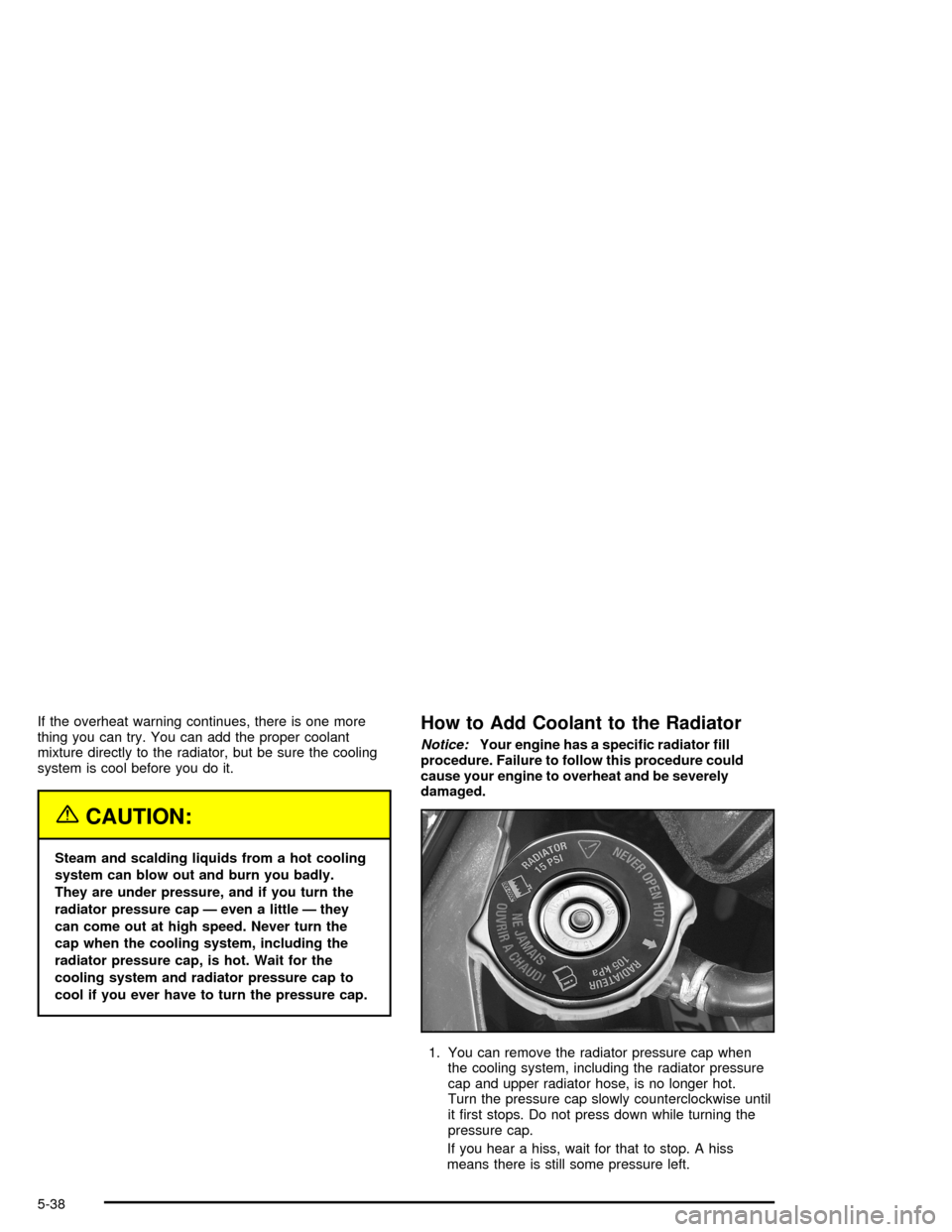
1. You can remove the radiator pressure cap when
the cooling system, including the radiator pressure
cap and upper radiator hose, is no longer hot.
Turn the pressure cap slowly counterclockwise until
it rst stops. Do not press down while turning the
pressure cap.
If you hear a hiss, wait for that to stop. A hiss
means there is still some pressure left.
5-38
Page 290 of 398
10. Start the engine and let it run until you can feel the
upper radiator hose getting hot. Watch out for the
engine cooling fans.11. By this time, the coolant level inside the radiator
ller neck may be lower. If the level is lower, add
more of the proper DEX-COOL
®coolant mixture
through the ller neck until the level reaches
the base of the ller neck.
12. Then replace the pressure cap. At any time during
this procedure if coolant begins to ow out of the
ller neck, reinstall the pressure cap. Be sure
the arrow on the pressure cap lines up properly.
13. Check the coolant in the recovery tank. The level in
the coolant recovery tank should be at the HOT
mark when the engine is hot or at the COLD mark
when the engine is cold.
5-42
Page 323 of 398
Each new wheel should have the same load-carrying
capacity, diameter, width, offset and be mounted
the same way as the one it replaces.
If you need to replace any of your wheels, wheel bolts
or wheel nuts, replace them only with new GM
original equipment parts. This way, you will be sure to
have the right wheel, wheel bolts and wheel nuts
for your vehicle.
{CAUTION:
Using the wrong replacement wheels, wheel
bolts or wheel nuts on your vehicle can be
dangerous. It could affect the braking and
handling of your vehicle, make your tires lose
air and make you lose control. You could have
a collision in which you or others could be
injured. Always use the correct wheel, wheel
bolts and wheel nuts for replacement.Notice:The wrong wheel can also cause problems
with bearing life, brake cooling, speedometer or
odometer calibration, headlamp aim, bumper height,
vehicle ground clearance and tire or tire chain
clearance to the body and chassis.
SeeChanging a Flat Tire on page 5-78for more
information.
Used Replacement Wheels
{CAUTION:
Putting a used wheel on your vehicle is
dangerous. You cannot know how it has been
used or how far it has been driven. It could fail
suddenly and cause a crash. If you have to
replace a wheel, use a new GM original
equipment wheel.
5-75
Page 353 of 398
Lower Fuse Block
Some fuses are in a fuse block in the engine
compartment on the passenger’s side of the vehicle.
SeeEngine Compartment Overview on page 5-12
for more information on location.
Fuses Usage
IGN SW Ignition Switch
RT I/P #3 Rear Defogger, Audio System
U/HOOD #2 Ignition Relay, AIR Pump
Fuses Usage
COOLING
FANSCooling Fans (Battery)
FAN CONT
#2�Cooling Fan Control Relays #2 & #3
FAN CONT #1 Cooling Fan Control Relays #1
FUEL INJ Fuel Injectors
TRANS SOL Transmission Solenoids
A/C RLY (COIL) HVAC Control Relay
ENG DEVICESCanister Purge Solenoid, Mass Air
Flow Sensor (MAF), AIR Pump
Relay & Valve Control
DFI MDL Direct Fire Ignition Module
OXY SENOxygen Sensor (Pre and Post
Converter)
Relays Usage
FAN CONT #3Secondary Cooling Fan
(Passenger’s Side)
FAN CONT #2 Cooling Fan Control Relay
FAN CONT #1 Primary Cooling fan (Driver’s Side)
IGN RLY Ignition Relay
A/C CMPR HVAC Compressor
5-105
Page 354 of 398
Capacities and Specications
The following approximate capacities are given in English and metric conversions. SeeRecommended Fluids and
Lubricants on page 6-12for more information.
ApplicationCapacities
English Metric
Air Conditioning Refrigerant R134a 2.3 lbs 1.0 kg
Automatic Transaxle
Pan Removal and Replacement 7.4 qt 7.0 L
After Complete Overhaul 10.0 qt 9.5 L
When draining/replacing converter, more uid may be needed.
Cooling System Including Reservoir
3400 V6 Engine 11.3 qt 10.7 L
3800 V6 Engine 11.7 qt 11.0 L
3800 Supercharged V6 Engine 11.7 qt 11.0 L
Engine Oil with Filter
3400 V6 Engine 4.0 qt 3.8 L
3800 V6 Engine 4.5 qt 4.2 L
3800 Supercharged V6 Engine 4.5 qt 4.2 L
Fuel Tank 17.0 gal 64.3 L
All capacities are approximate. When adding, be sure to ll to the approximate level, as recommended in this
manual. Recheck uid level after lling.
5-106
Page 361 of 398

Scheduled Maintenance
Service MaintenanceIMaintenanceII
Change engine oil and lter. SeeEngine Oil on page 5-18. Reset oil life system.
SeeEngine Oil Life System on page 5-21.An Emission Control Service.••
Visually check for any leaks or damage.See footnote (k).••
Inspect engine air cleaner lter. If necessary, replace lter. SeeEngine Air
Cleaner/Filter on page 5-25.See footnote (m).•
Rotate tires and check ination pressures and wear. SeeTire Inspection and
Rotation on page 5-70and “Tire Wear Inspection” inAt Least Once a Month on
page 6-9.••
Inspect brake system.See footnote (a).••
Check engine coolant and windshield washer uid levels and add uid as needed.••
Perform any needed additional services. See “Additional Required Services” in
this section.••
Inspect suspension and steering components.See footnote (b).•
Inspect engine cooling system.See footnote (c).•
Inspect wiper blades.See footnote (d).•
Inspect restraint system components.See footnote (e).•
Lubricate body components.See footnote (f).•
Check transaxle uid level and add uid as needed.•
Replace passenger compartment air lter (if equipped).See footnote (g).•
Inspect throttle system.See footnote (j).•
6-5
Page 363 of 398

Additional Required Services (cont’d)
Service and Miles (Kilometers)25,000
(41 500)50,000
(83 000)75,000
(125 000)100,000
(166 000)125,000
(207 500)150,000
(240 000)
Engine cooling system service (or every
ve years, whichever occurs rst).
An Emission Control Service.
See footnote (i).•
Inspect engine accessory drive belt.
An Emission Control Service.
See footnote (n).•
Maintenance Footnotes
†The U.S. Environmental Protection Agency or the
California Air Resources Board has determined that the
failure to perform this maintenance item will not nullify
the emission warranty or limit recall liability prior to
the completion of the vehicle’s useful life. We, however,
urge that all recommended maintenance services be
performed at the indicated intervals and the
maintenance be recorded.
(a)Visually inspect brake lines and hoses for proper
hook-up, binding, leaks, cracks, chang, etc. Inspect
disc brake pads for wear and rotors for surface
condition. Inspect other brake parts, including calipers,
parking brake, etc.(b)Visually inspect front and rear suspension and
steering system for damaged, loose, or missing parts or
signs of wear. Inspect power steering lines and hoses
for proper hook-up, binding, leaks, cracks, chang, etc.
(c)Visually inspect hoses and have them replaced if
they are cracked, swollen, or deteriorated. Inspect
all pipes, ttings, and clamps; replace with genuine
GM parts as needed. To help ensure proper operation,
a pressure test of the cooling system and pressure
cap and cleaning the outside of the radiator and
air conditioning condenser is recommended at least
once a year.
(d)Visually inspect wiper blades for wear or cracking.
Replace wiper blades that appear worn or damaged
or that streak or miss areas of the windshield.
6-7


