2005 CHEVROLET EQUINOX start stop button
[x] Cancel search: start stop buttonPage 32 of 364
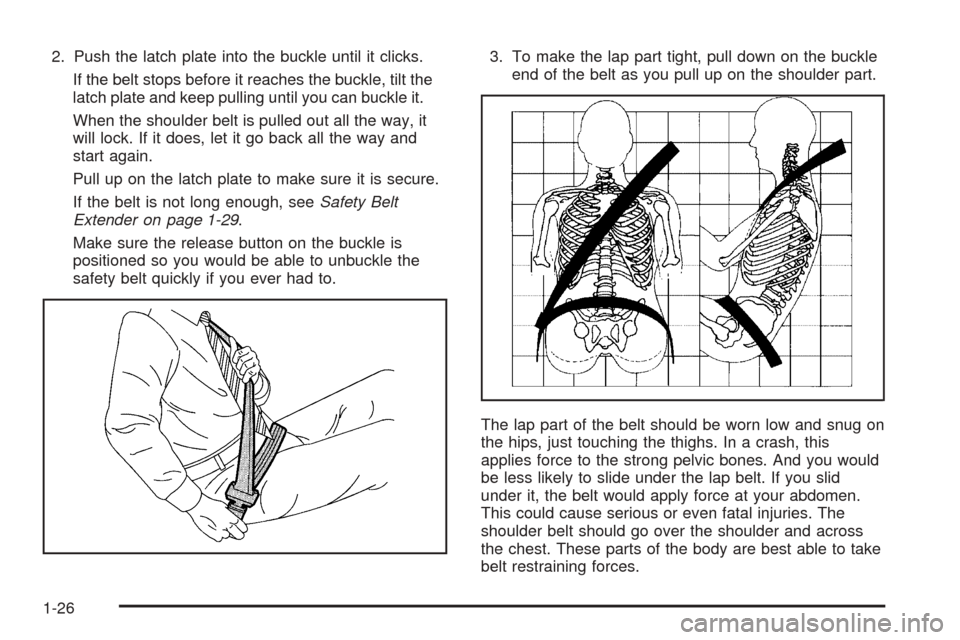
2. Push the latch plate into the buckle until it clicks.
If the belt stops before it reaches the buckle, tilt the
latch plate and keep pulling until you can buckle it.
When the shoulder belt is pulled out all the way, it
will lock. If it does, let it go back all the way and
start again.
Pull up on the latch plate to make sure it is secure.
If the belt is not long enough, seeSafety Belt
Extender on page 1-29.
Make sure the release button on the buckle is
positioned so you would be able to unbuckle the
safety belt quickly if you ever had to.3. To make the lap part tight, pull down on the buckle
end of the belt as you pull up on the shoulder part.
The lap part of the belt should be worn low and snug on
the hips, just touching the thighs. In a crash, this
applies force to the strong pelvic bones. And you would
be less likely to slide under the lap belt. If you slid
under it, the belt would apply force at your abdomen.
This could cause serious or even fatal injuries. The
shoulder belt should go over the shoulder and across
the chest. These parts of the body are best able to take
belt restraining forces.
1-26
Page 74 of 364
Resynchronization
This is used to keep the transmitter of the vehicle
communicating with the receiver of the vehicle.
Resynchronization may be required due to the security
method used by this system.
Your vehicle has an automatic resynchronization
function built into the system. If your transmitter is not
working properly and you have to manually
resynchronize, press the lock and unlock buttons at the
same time for seven seconds while you are near
your vehicle. The doors will lock or unlock, depending
on their starting position. If they do not, contact
your dealer for service.
Doors and Locks
Door Locks
{CAUTION:
Unlocked doors can be dangerous.
Passengers — especially children — can
easily open the doors and fall out of a
moving vehicle. When a door is locked, the
handle will not open it. You increase the
chance of being thrown out of the vehicle
in a crash if the doors are not locked. So,
wear safety belts properly and lock the
doors whenever you drive.
Young children who get into unlocked
vehicles may be unable to get out. A child
can be overcome by extreme heat and can
suffer permanent injuries or even death
from heat stroke. Always lock your vehicle
whenever you leave it.
Outsiders can easily enter through an
unlocked door when you slow down or
stop your vehicle. Locking your doors can
help prevent this from happening.
2-6
Page 140 of 364
Traction Control System (TCS)
Warning Light
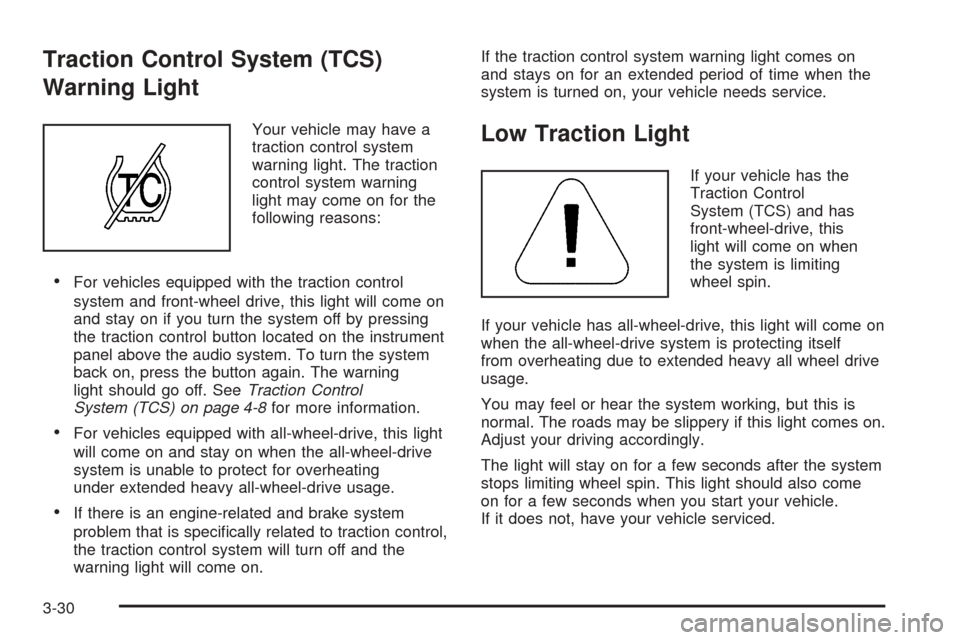
Your vehicle may have a
traction control system
warning light. The traction
control system warning
light may come on for the
following reasons:
For vehicles equipped with the traction control
system and front-wheel drive, this light will come on
and stay on if you turn the system off by pressing
the traction control button located on the instrument
panel above the audio system. To turn the system
back on, press the button again. The warning
light should go off. SeeTraction Control
System (TCS) on page 4-8for more information.
For vehicles equipped with all-wheel-drive, this light
will come on and stay on when the all-wheel-drive
system is unable to protect for overheating
under extended heavy all-wheel-drive usage.
If there is an engine-related and brake system
problem that is specically related to traction control,
the traction control system will turn off and the
warning light will come on.If the traction control system warning light comes on
and stays on for an extended period of time when the
system is turned on, your vehicle needs service.
Low Traction Light
If your vehicle has the
Traction Control
System (TCS) and has
front-wheel-drive, this
light will come on when
the system is limiting
wheel spin.
If your vehicle has all-wheel-drive, this light will come on
when the all-wheel-drive system is protecting itself
from overheating due to extended heavy all wheel drive
usage.
You may feel or hear the system working, but this is
normal. The roads may be slippery if this light comes on.
Adjust your driving accordingly.
The light will stay on for a few seconds after the system
stops limiting wheel spin. This light should also come
on for a few seconds when you start your vehicle.
If it does not, have your vehicle serviced.
3-30
Page 158 of 364
Playing a CD
Insert a CD partway into the slot, label side up. The
player will pull it in and the CD should begin playing. If
you want to insert a CD with the ignition off, rst
press the eject or DISP knob.
If the ignition or radio is turned off with the CD in the
player, it will stay in the player. When the ignition or the
radio is turned on, the CD will start playing, where it
stopped, if it was the last selected audio source.
When the CD is inserted, CD will appear on the display.
As each new track starts to play, TRACK and the
track number will appear on the display.
If playing a CD-R the sound quality may be reduced
due to CD-R quality, the method of recording, the quality
of the music that has been recorded, and the way the
CD-R has been handled. There may be an increase
in skipping, difficulty in nding tracks, and/or difficulty in
loading and ejecting. If these problems occur try a
known good CD.
Do not add paper labels to CDs, they could get caught
in the CD player.Notice:If you add any label to a CD, insert more
than one CD into the slot at a time, or attempt
to play scratched or damaged CDs, you could
damage the CD player. When using the CD player,
use only CDs in good condition without any
label, load one CD at a time, and keep the CD player
and the loading slot free of foreign materials,
liquids, and debris.
Do not play 3-inch (8 cm) CDs without a standard
adapter CD.
If an error appears on the display, see “CD Messages”
later in this section.
©(Previous Track):Press this button to go to the
start of the current track if more than eight seconds have
played. If this button is pressed more than once, the
player will continue moving backward through the CD.
¨(Next Track):Press this button to go to the start of
the next track. If you press this button more than
once, the player will continue moving forward through
the CD.
s(Reverse):Press and hold this pushbutton to
reverse quickly within a track. You will hear sound at a
reduced volume. Release the button to play the
passage. The elapsed time of the track will appear on
the display.
3-48
Page 159 of 364
\(Fast Forward):Press and hold this button to
advance quickly within a track. You will hear sound at a
reduced volume. Release the button to play the
passage. The elapsed time of the track will appear on
the display.
RPT (Repeat):Press this button once to hear a track
over again. RPT ON will appear on the display. The
current track will continue to repeat. Press RPT again to
turn off repeat play. RPT OFF will appear on the
display and RPT will disappear from the display.
RDM (Random):Press this button to hear the tracks in
random, rather than sequential, order. TRACK, TRK#,
and RDM will appear on the display. TRACK and
the track number will appear on the display when each
track starts to play. Press RDM again to turn off
random play. RDM OFF will appear on the display and
RDM will disappear from the display.
xSEEKw:Press the down arrow to go to the start
of the current track or to the previous track. If this
button is pressed more than once, the player will
continue moving backward through the CD.
Press the up arrow to go to the start of the next track. If
this button is pressed more than once, the player will
continue moving forward through the CD.
If either arrow is held for more than two seconds, the
CD will enter CD scan mode and the CD will playthe rst ten seconds of each track. Press either arrow
again to stop scanning.
DISP (Display):Press this knob to see how long the
current track has been playing. The track number,
and the elapsed time of the track will appear on the
display. To change the default on the display, track or
elapsed time, press the knob until you see the
display you want, then hold the knob for two seconds.
The radio will produce one beep and the selected
display will now be the default. Pressing this knob
will also display text on commercially recorded CDs
(if available).
AUTO EQ (Automatic Equalization):Press this button
to select the desired equalization setting while playing
a CD. The equalization will be automatically recalled
whenever a CD is played. For more information,
see AUTO EQ listed previously in this section.
BAND:Press this button to listen to the radio when a
CD is playing. The inactive CD will remain safely
inside the radio for future listening.
SRCE (Source):Press this button to play a CD when
listening to the radio. CD will appear on the display.
Z(Eject):Press this button to eject a CD. Eject may
be activated with either the ignition or radio off. CDs
may be loaded with the ignition and radio off if this
button is pressed rst.
3-49
Page 168 of 364
Playing a CD
Insert a CD partway into the slot, label side up. The
player will pull it in and the CD should begin playing. If
you want to insert a CD with the ignition off, rst
press the eject or DISP knob.
If the ignition or radio is turned off with the CD in the
player, it will stay in the player. When the ignition or the
radio is turned on, the CD will start playing, where it
stopped, if it was the last selected audio source.
When a CD is inserted, CD will appear on the display.
As each new track starts to play, TRACK and the
track number will appear on the display.
If playing a CD-R the sound quality may be reduced
due to CD-R quality, the method of recording, the quality
of the music that has been recorded, and the way the
CD-R has been handled. There may be an increase
in skipping, difficulty in nding tracks, and/or difficulty in
loading and ejecting. If these problems occur try a
known good CD.
Do not add paper labels to CDs, they could get caught
in the CD player.Notice:If you add any label to a CD, insert more
than one CD into the slot at a time, or attempt
to play scratched or damaged CDs, you could
damage the CD player. When using the CD player,
use only CDs in good condition without any
label, load one CD at a time, and keep the CD player
and the loading slot free of foreign materials,
liquids, and debris.
Do not play 3-inch (8 cm) CDs without a standard
adapter CD.
If an error appears on the display, see “CD Messages”
later in this section.
s(Reverse):Press and hold this pushbutton to
reverse quickly within a track. You will hear sound at a
reduced volume. Release the button to play the
passage. The elapsed time of the track will appear on
the display.
\(Fast Forward):Press and hold this pushbutton to
advance quickly within a track. You will hear sound at
a reduced volume. Release the button to play the
passage. The elapsed time of the track will appear on
the display.
3-58
Page 169 of 364
VRDM (Random):Press this button to hear the
tracks in random, rather than sequential, order. TRACK,
TRK #, and RDM will appear on the display. TRACK
and the track number will appear on the display
when each track starts to play. Press RDM again to turn
off random play. RDM OFF will appear on the display
and RDM will disappear from the display.
xSEEKw:Press the down arrow to go to the start
of the current track more than eight seconds have
played. If this button is pressed more than once, the
player will continue moving backward through the CD.
Press the up arrow to go to the start of the next track. If
this button is pressed more than once, the player will
continue moving forward through the CD.
If either arrow is held for more than two seconds, the
CD will enter CD scan mode and the CD will play
the rst ten seconds of each track. Press either arrow
again to stop scanning.
DISP (Display):Press this knob to see how long the
current track has been playing. The track number,
and the elapsed time of the track will appear on the
display. To change the default on the display, track orelapsed time, press the knob until you see the display
you want, then hold the knob for two seconds. The radio
will produce one beep and the selected display will
now be the default. Pressing this knob will also display
text on commercially recorded CDs (if available).
AUTO EQ (Automatic Equalization):Press this button
to select the desired equalization setting while playing
a CD. The equalization will be automatically recalled
whenever a CD is played. For more information,
see AUTO EQ listed previously in this section.
BAND:Press this button to listen to the radio when a
CD is playing. The inactive CD will remain safely
inside the radio for future listening.
SRCE (Source):Press this button to play a CD when
listening to the radio. CD will appear on the display when
a CD is loaded.
Z(Eject):Press this button to eject a CD. Eject may
be activated with either the ignition or radio off. CDs
may be loaded with the ignition or radio off if this button
is pressed rst.
3-59
Page 172 of 364
If the ignition or radio is turned off with a CD in the
player, it will stay in the player. When the ignition
or radio is turned on, the CD will start to play where it
stopped, if it was the last selected audio source.
As each new track starts to play, the track number will
appear on the display.
If playing a CD-R the sound quality may be reduced
due to CD-R quality, the method of recording, the quality
of the music that has been recorded, and the way the
CD-R has been handled. There may be an increase
in skipping, difficulty in nding tracks, and/or difficulty in
loading and ejecting. If these problems occur try a
known good CD.
Do not add paper labels to CDs, they could get caught
in the CD player.
Notice:If you add any label to a CD, insert more
than one CD into the slot at a time, or attempt
to play scratched or damaged CDs, you could
damage the CD player. When using the CD player,
use only CDs in good condition without any
label, load one CD at a time, and keep the CD player
and the loading slot free of foreign materials,
liquids, and debris.
If an error appears on the display, see “CD Messages”
later in this section.VDIR (Directory):Press and release this button to
display the current directory structure (at or normal).
Press and release this button twice to change the
directory structure. When at is enabled, the tracks on
the MP3 will be alphabetized by lename. The MP3
will play the next alphabetical track when the current
track is nished.
xFLDRw(Previous/Next Folder):Press the down
or the up arrow to go to the rst track in the previous
or next folder. Pressing this button while in folder
random mode will take you to the previous or next folder
and random the tracks in that folder.
s(Reverse):Press and hold this button to reverse
quickly within a track. Press and hold this button for less
than two seconds to reverse at 10 times the normal
playing speed. Press and hold it for more than
two seconds to reverse at 20 times the normal playing
speed. Release the button to play the track. REV and the
elapsed time of the track will appear on the display.
\(Forward):Press and hold this button to advance
quickly within a track. Press and hold this button for
less than two seconds to advance at 10 times the
normal playing speed. Press and hold it for more than
two seconds to advance at 20 times the normal
playing speed. Release the button to play the track.
FWD and the elapsed time of the track will appear on
the display.
3-62