2005 CHEVROLET EQUINOX fog light
[x] Cancel search: fog lightPage 111 of 364
Instrument Panel Overview...............................3-4
Hazard Warning Flashers................................3-5
Other Warning Devices...................................3-6
Horn.............................................................3-6
Tilt Wheel.....................................................3-6
Turn Signal/Multifunction Lever.........................3-7
Turn and Lane-Change Signals........................3-7
Headlamp High/Low-Beam Changer..................3-8
Windshield Wipers..........................................3-8
Windshield Washer.........................................3-9
Cruise Control..............................................3-10
Headlamps..................................................3-13
Headlamps on Reminder................................3-13
Daytime Running Lamps (DRL).......................3-14
Automatic Headlamp System..........................3-14
Fog Lamps..................................................3-15
Instrument Panel Brightness...........................3-15
Dome Lamp.................................................3-16
Entry Lighting...............................................3-16
Map Lamps.................................................3-17
Cargo Lamp.................................................3-17
Battery Run-Down Protection..........................3-17
Accessory Power Outlet(s).............................3-18
Ashtray(s) and Cigarette Lighter......................3-18Climate Controls............................................3-19
Climate Control System.................................3-19
Outlet Adjustment.........................................3-21
Passenger Compartment Air Filter...................3-21
Warning Lights, Gages, and Indicators............3-23
Instrument Panel Cluster................................3-24
Speedometer and Odometer...........................3-25
Trip Odometer..............................................3-25
Tachometer.................................................3-25
Safety Belt Reminder Light.............................3-26
Airbag Readiness Light..................................3-26
Battery Warning Light....................................3-27
Brake System Warning Light..........................3-28
Anti-Lock Brake System Warning Light.............3-29
Traction Control System (TCS)
Warning Light...........................................3-30
Low Traction Light........................................3-30
Engine Coolant Temperature Warning Light......3-31
Engine Coolant Temperature Gage..................3-31
Malfunction Indicator Lamp.............................3-32
Oil Pressure Light.........................................3-34
Change Engine Oil Light................................3-35
Security Light...............................................3-35
Reduced Engine Power Light.........................3-36
Section 3 Instrument Panel
3-1
Page 125 of 364
Fog Lamps
If your vehicle has this feature, use your fog lamps for
better visibility in foggy or misty conditions.
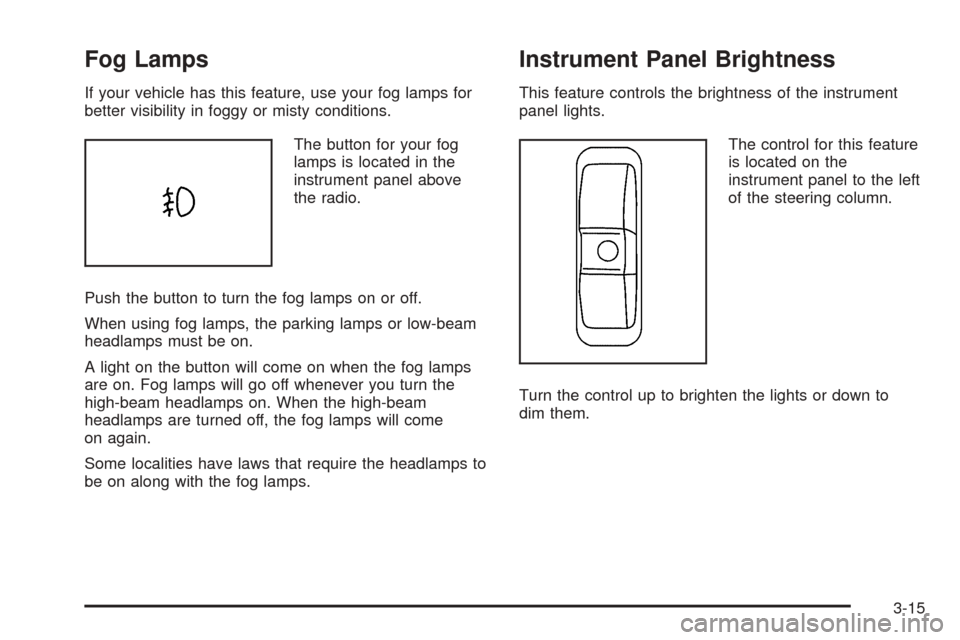
The button for your fog
lamps is located in the
instrument panel above
the radio.
Push the button to turn the fog lamps on or off.
When using fog lamps, the parking lamps or low-beam
headlamps must be on.
A light on the button will come on when the fog lamps
are on. Fog lamps will go off whenever you turn the
high-beam headlamps on. When the high-beam
headlamps are turned off, the fog lamps will come
on again.
Some localities have laws that require the headlamps to
be on along with the fog lamps.
Instrument Panel Brightness
This feature controls the brightness of the instrument
panel lights.
The control for this feature
is located on the
instrument panel to the left
of the steering column.
Turn the control up to brighten the lights or down to
dim them.
3-15
Page 130 of 364
You can also select modes by using the following
buttons:
@(Recirculate):Press the bottom right button to
recirculate cabin air through the vehicle. It can be used
to prevent outside air and odors from entering your
vehicle or to help heat or cool the air inside your vehicle
more quickly. An indicator light above the button will
come on in this mode. Operation in this mode during
periods of high humidity and cool outside temperatures
may result in increased window fogging. If window
fogging is experienced, select the defrost mode.
#(Air Conditioning):Press this button to turn the
air-conditioning system on or off. When this button
is pressed, an indicator light above the button will come
on to let you know the air conditioning is activated.
Air-conditioning can be selected in any mode as long as
the fan switch is on.
The air-conditioning system removes moisture from the
air, so you may sometimes notice a small amount of
water dripping underneath your vehicle while idling
or after turning off the engine. This is normal.
Defogging and Defrosting
Fog or frost on the inside of windows is a result of high
humidity (moisture) condensing on the cool window
glass. This can be minimized if the climate control
system is used properly. Use the defog mode to clear
the windows of fog or moisture and warm the
passengers. Use the defrost mode to remove fog or
frost from the windshield more quickly. When you select
either of these modes (or the oor mode which also
helps defog the windows slightly), the system runs the
air-conditioning compressor and cancels recirculation
mode to dry the air; however, the recirculation light will
stay on. For best results, clear all snow and ice from
the windshield before defrosting.
Turn the right knob to select the defog or defrost mode.
-(Defog):This mode directs half of the air to the
windshield and the side window outlets and half to the
oor outlets.
0(Defrost):This mode directs most of the air to the
windshield and the side window outlets, with some
air directed to the oor outlets.
3-20
Page 131 of 364
Rear Window Defogger
The rear window defogger uses a warming grid to
remove fog from the rear window.
The rear window defogger will only work when the
ignition is in RUN.
<(Rear):Press the button to turn the rear window
defogger on or off. An indicator light above the
button will come on to let you know that the rear window
defogger is activated.
The rear window defogger will only work when the
ignition is in RUN. The rear window defogger will stay
on for approximately 15 minutes after the button is
pressed, unless the ignition is turned to ACC or LOCK.
If turned on again, the defogger will only run for
approximately ve minutes before turning off. The
defogger can also be turned off by pressing the button
again or by turning off the engine.
Notice:Do not use anything sharp on the inside of
the rear window. If you do, you could cut or
damage the warming grid, and the repairs would not
be covered by your warranty. Do not attach a
temporary vehicle license, tape, a decal or anything
similar to the defogger grid.
Outlet Adjustment
Use the louvers located on the air outlets to change the
direction of the airow.
Operation Tips
Clear away any ice, snow, or leaves from the air
inlets at the base of the vehicle that may block
the ow of air into your vehicle.
Use of non-GM approved hood deectors may
adversely affect the performance of the system.
Keep the path under the front seats clear of objects
to help circulate the air inside of your vehicle more
effectively.
Passenger Compartment Air Filter
The passenger compartment outside air is routed
through a passenger compartment lter. The lter
removes certain particles from the air, including pollen
and dust particles. Reductions in airow, which may
occur more quickly in dusty areas, indicate that the lter
needs to be replaced early.
The lter should be replaced as part of routine
scheduled maintenance. SeeScheduled Maintenance
on page 6-4for when to replace the lter.
3-21
Page 309 of 364
They can all be hazardous — some more than
others — and they can all damage the vehicle, too.
Do not use any of these products unless this manual
says you can. In many uses, these will damage the
vehicle:
Alcohol
Laundry Soap
Bleach
Reducing Agents
Cleaning the Inside of Your Vehicle
Your vehicle’s interior will continue to look its best if
it is cleaned often. Although not always visible, dust and
dirt can accumulate on your upholstery. Dirt can
damage carpet, fabric, leather, and plastic surfaces.
Regular vacuuming is recommended to remove particles
from your upholstery. It is important to keep your
upholstery from becoming and remaining heavily soiled.
Soils should be removed as quickly as possible. Your
vehicle’s interior may experience extremes of heat
that could cause stains to set rapidly.
Lighter colored interiors may require more frequent
cleaning. Use care because newspapers and garments
that transfer color to your home furnishings may also
transfer color to your vehicle’s interior.When cleaning your vehicle’s interior, only use cleaners
specically designed for the surfaces being cleaned.
Permanent damage may result from using cleaners on
surfaces for which they were not intended. Use glass
cleaner only on glass. Remove any accidental over-spray
from other surfaces immediately. To prevent over-spray,
apply cleaner directly to the cleaning cloth.
Notice:If you use abrasive cleaners when cleaning
glass surfaces on your vehicle, you could scratch
the glass and/or cause damage to the rear window
defogger. When cleaning the glass on your
vehicle, use only a soft cloth and glass cleaner.
Many cleaners contain solvents that may become
concentrated in your vehicle’s breathing space. Before
using cleaners, read and adhere to all safety
instructions on the label. While cleaning your vehicle’s
interior, maintain adequate ventilation by opening
your vehicle’s doors and windows.
Dust may be removed from small buttons and knobs
using a small brush with soft bristles.
Your GM dealer has a product for cleaning your
vehicle’s glass. Should it become necessary, you can
also obtain a product from your GM dealer to remove
odors from your vehicle’s upholstery.
5-75
Page 321 of 364
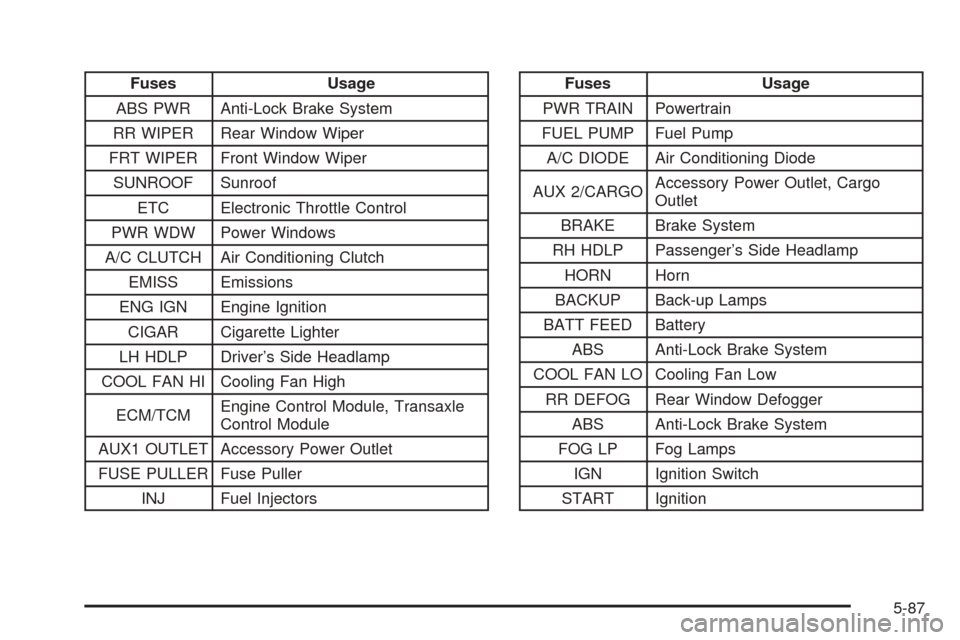
Fuses Usage
ABS PWR Anti-Lock Brake System
RR WIPER Rear Window Wiper
FRT WIPER Front Window Wiper
SUNROOF Sunroof
ETC Electronic Throttle Control
PWR WDW Power Windows
A/C CLUTCH Air Conditioning Clutch
EMISS Emissions
ENG IGN Engine Ignition
CIGAR Cigarette Lighter
LH HDLP Driver’s Side Headlamp
COOL FAN HI Cooling Fan High
ECM/TCMEngine Control Module, Transaxle
Control Module
AUX1 OUTLET Accessory Power Outlet
FUSE PULLER Fuse Puller
INJ Fuel InjectorsFuses Usage
PWR TRAIN Powertrain
FUEL PUMP Fuel Pump
A/C DIODE Air Conditioning Diode
AUX 2/CARGOAccessory Power Outlet, Cargo
Outlet
BRAKE Brake System
RH HDLP Passenger’s Side Headlamp
HORN Horn
BACKUP Back-up Lamps
BATT FEED Battery
ABS Anti-Lock Brake System
COOL FAN LO Cooling Fan Low
RR DEFOG Rear Window Defogger
ABS Anti-Lock Brake System
FOG LP Fog Lamps
IGN Ignition Switch
START Ignition
5-87
Page 357 of 364
Fixed Mast Antenna........................................3-79
Flat Tire........................................................5-63
Flat Tire, Changing.........................................5-64
Flat Tire, Storing.............................................5-72
Fluid
Automatic Transaxle.....................................5-21
Windshield Washer......................................5-31
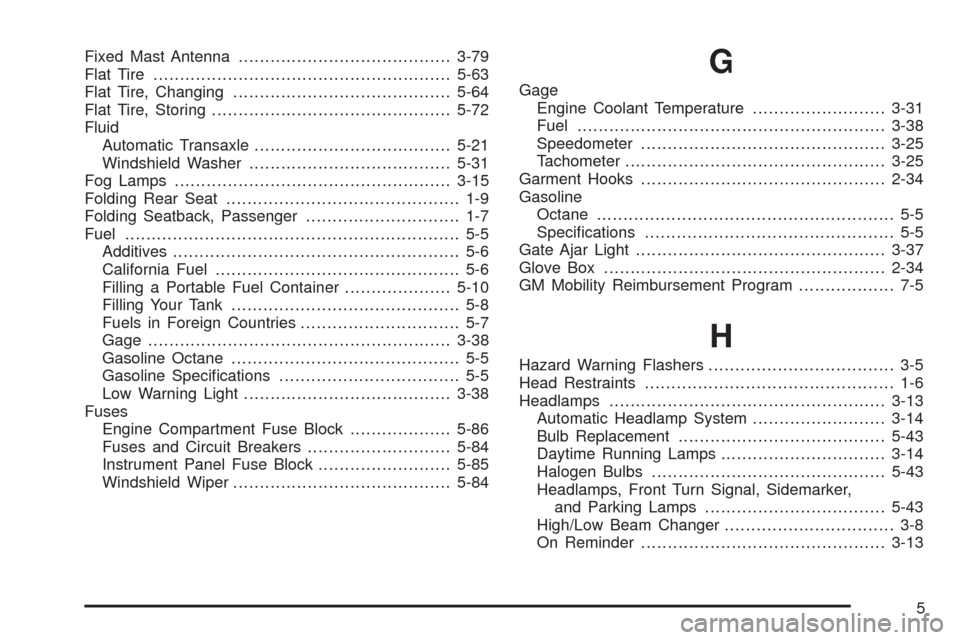
Fog Lamps....................................................3-15
Folding Rear Seat............................................ 1-9
Folding Seatback, Passenger............................. 1-7
Fuel............................................................... 5-5
Additives...................................................... 5-6
California Fuel.............................................. 5-6
Filling a Portable Fuel Container....................5-10
Filling Your Tank........................................... 5-8
Fuels in Foreign Countries.............................. 5-7
Gage.........................................................3-38
Gasoline Octane........................................... 5-5
Gasoline Specications.................................. 5-5
Low Warning Light.......................................3-38
Fuses
Engine Compartment Fuse Block...................5-86
Fuses and Circuit Breakers...........................5-84
Instrument Panel Fuse Block.........................5-85
Windshield Wiper.........................................5-84G
Gage
Engine Coolant Temperature.........................3-31
Fuel..........................................................3-38
Speedometer..............................................3-25
Tachometer.................................................3-25
Garment Hooks..............................................2-34
Gasoline
Octane........................................................ 5-5
Specications............................................... 5-5
Gate Ajar Light...............................................3-37
Glove Box.....................................................2-34
GM Mobility Reimbursement Program.................. 7-5
H
Hazard Warning Flashers................................... 3-5
Head Restraints............................................... 1-6
Headlamps....................................................3-13
Automatic Headlamp System.........................3-14
Bulb Replacement.......................................5-43
Daytime Running Lamps...............................3-14
Halogen Bulbs............................................5-43
Headlamps, Front Turn Signal, Sidemarker,
and Parking Lamps..................................5-43
High/Low Beam Changer................................ 3-8
On Reminder..............................................3-13
5
Page 358 of 364
Heated Seats................................................... 1-4
Heater...........................................................3-19
Height Adjuster, Driver Seat............................... 1-2
Highbeam On Light.........................................3-36
Highway Hypnosis...........................................4-22
Hill and Mountain Roads..................................4-22
Hood
Release.....................................................5-10
Horn............................................................... 3-6
How to Use This Manual...................................... ii
How to Wear Safety Belts Properly...................1-16
I
Ignition Positions.............................................2-16
Infants and Young Children, Restraints...............1-32
Ination -- Tire Pressure..................................5-55
Instrument Panel
Overview..................................................... 3-4
Instrument Panel (I/P)
Brightness..................................................3-15
Cluster.......................................................3-24
J
Jump Starting.................................................5-36
K
Keyless Entry System....................................... 2-3
Keys............................................................... 2-2
L
Labelling, Tire Sidewall....................................5-50
Lamps
Battery Run-Down Protection.........................3-17
Cargo........................................................3-17
Dome........................................................3-16
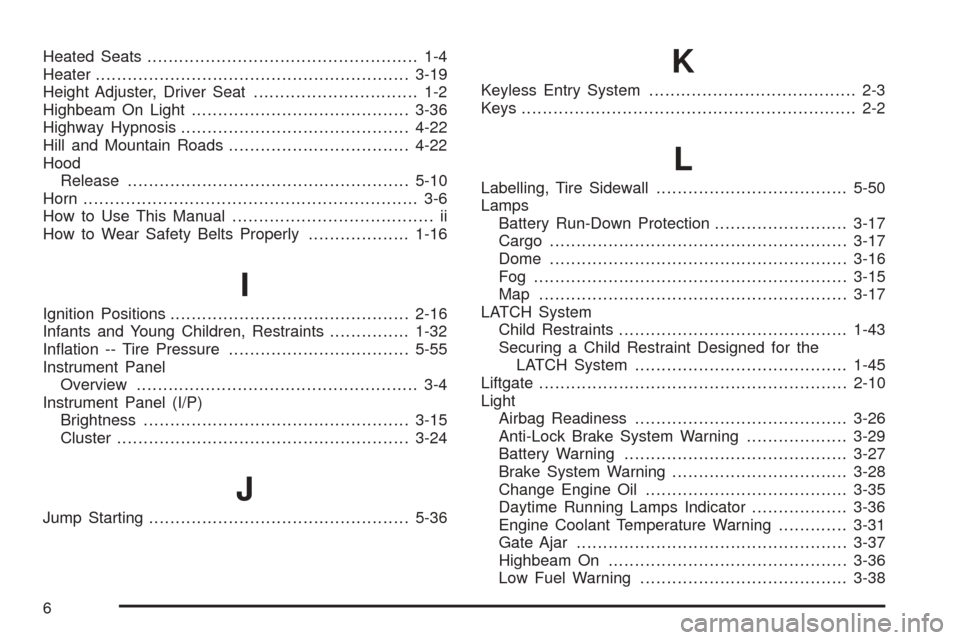
Fog ...........................................................3-15
Map ..........................................................3-17
LATCH System
Child Restraints...........................................1-43
Securing a Child Restraint Designed for the
LATCH System........................................1-45
Liftgate..........................................................2-10
Light
Airbag Readiness........................................3-26
Anti-Lock Brake System Warning...................3-29
Battery Warning..........................................3-27
Brake System Warning.................................3-28
Change Engine Oil......................................3-35
Daytime Running Lamps Indicator..................3-36
Engine Coolant Temperature Warning.............3-31
Gate Ajar...................................................3-37
Highbeam On.............................................3-36
Low Fuel Warning.......................................3-38
6