2005 CHEVROLET EQUINOX towing
[x] Cancel search: towingPage 231 of 364
Passing
You will need more passing distance up ahead when
you are towing a trailer. And, because you are a
good deal longer, you will need to go much farther
beyond the passed vehicle before you can return to
your lane.
Backing Up
Hold the bottom of the steering wheel with one hand.
Then, to move the trailer to the left, just move that hand
to the left. To move the trailer to the right, move your
hand to the right. Always back up slowly and, if possible,
have someone guide you.
Making Turns
Notice:Making very sharp turns while trailering
could cause the trailer to come in contact with the
vehicle. Your vehicle could be damaged. Avoid
making very sharp turns while trailering.
When you are turning with a trailer, make wider turns
than normal. Do this so your trailer will not strike
soft shoulders, curbs, road signs, trees or other objects.
Avoid jerky or sudden maneuvers. Signal well in
advance.
Turn Signals When Towing a Trailer
When you tow a trailer, your vehicle has to have
extra wiring.
The arrows on your instrument panel will ash whenever
you signal a turn or lane change. Properly hooked up,
the trailer lamps will also ash, telling other drivers
you are about to turn, change lanes or stop.
When towing a trailer, the arrows on your instrument
panel will ash for turns even if the bulbs on the trailer
are burned out. Thus, you may think drivers behind
you are seeing your signal when they are not. It’s
important to check occasionally to be sure the trailer
bulbs are still working.
Driving On Grades
Reduce speed and shift to a lower gear before you start
down a long or steep downgrade. If you do not shift
down, you might have to use your brakes so much that
they would get hot and no longer work well.
If you are towing a trailer that weighs more than
1,000 lbs (450 kg), drive in L4 instead of AUTOMATIC
OVERDRIVE (D) or, as you need to, a lower gear.
This will minimize heat build-up and extend the life of
your transaxle.
4-41
Page 233 of 364
Maintenance When Trailer Towing
Your vehicle will need service more often when you are
pulling a trailer. See the Maintenance Schedule for
more on this. Things that are especially important in
trailer operation are automatic transaxle uid, engine oil,
belts, cooling system and brake system. Each of
these is covered in this manual, and the Index will help
you nd them quickly. If you are trailering, it is a
good idea to review these sections before you start
your trip.
Check periodically to see that all hitch nuts and bolts
are tight.
Trailer Wiring Harness
Your vehicle may be equipped with a four-pin trailer
towing harness. This harness has a four-pin trailer
connector that is attached to a bracket on the hitch
platform. The four-wire harness contains the following
trailer circuits:
Yellow: Left Stop/Turn Signal
Dark Green: Right Stop/Turn Signal
Brown: Running Lamps
White: Ground
4-43
Page 260 of 364
Overheated Engine Protection
Operating Mode
This emergency operating mode allows your vehicle to
be driven to a safe place in an emergency situation.
If an overheated engine condition exists, an overheat
protection mode which alternates ring groups of
cylinders helps prevent engine damage. In this mode,
you will notice a signicant loss in power and engine
performance. The temperature gage will indicate
an overheat condition exists. Driving extended
miles (km) and/or towing a trailer in the overheat
protection mode should be avoided.
Notice:After driving in the overheated engine
protection operating mode, to avoid engine damage,
allow the engine to cool before attempting any
repair. The engine oil will be severely degraded.
Repair the cause of coolant loss, change the oil and
reset the oil life system. SeeEngine Oil on
page 5-13.
Cooling System
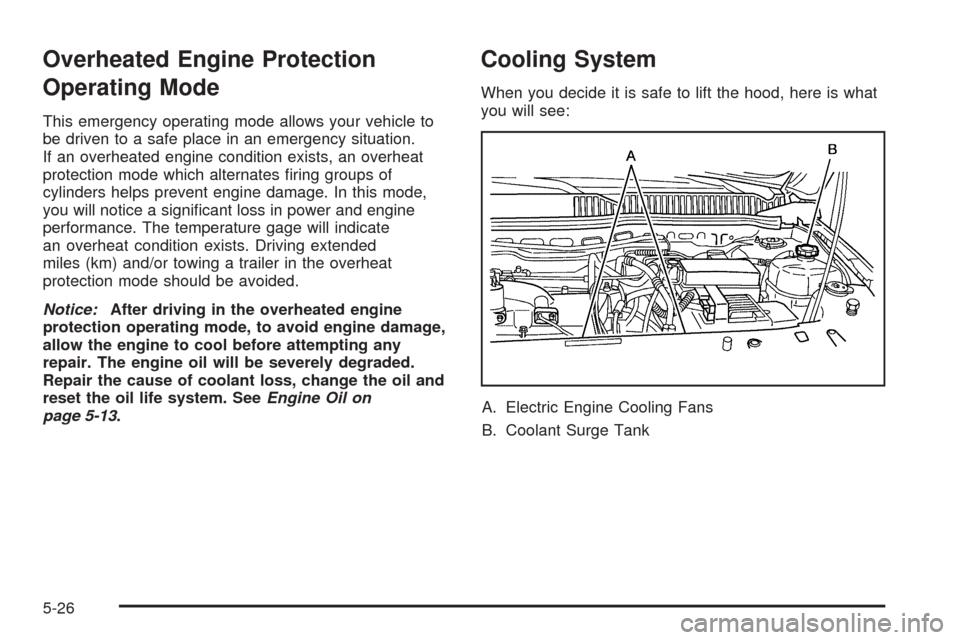
When you decide it is safe to lift the hood, here is what
you will see:
A. Electric Engine Cooling Fans
B. Coolant Surge Tank
5-26
Page 331 of 364
Maintenance Footnotes
(a)Visually inspect brake lines and hoses for proper
hook-up, binding, leaks, cracks, chang, etc. Inspect
disc brake pads for wear and rotors for surface
condition. Inspect drum brake linings/shoes for wear or
cracks. Inspect other brake parts, including drums,
wheel cylinders, calipers, parking brake, etc. Check
parking brake adjustment.
(b)Visually inspect front and rear suspension and
steering system for damaged, loose, or missing parts,
signs of wear. Inspect power steering lines and
hoses for proper hook-up, binding, leaks, cracks,
chang, etc.
(c)Visually inspect hoses and have them replaced if they
are cracked, swollen, or deteriorated. Inspect all pipes,
ttings and clamps; replace with genuine GM parts as
needed. To help ensure proper operation, a pressure test
of the cooling system and pressure cap and cleaning the
outside of the radiator and air conditioning condenser is
recommended at least once a year.
(d)Visually inspect wiper blades for wear or cracking.
Replace wiper blades that appear worn or damaged
or that streak or miss areas of the windshield.(e)Make sure the safety belt reminder light and all your
belts, buckles, latch plates, retractors, and anchorages
are working properly. Look for any other loose or
damaged safety belt system parts. If you see anything
that might keep a safety belt system from doing its
job, have it repaired. Have any torn or frayed safety belts
replaced. Also look for any opened or broken airbag
coverings, and have them repaired or replaced.
The airbag system does not need regular maintenance.
(f)Lubricate all key lock cylinders, hood latch
assemblies, secondary latches, pivots, spring anchor
and release pawl, hood and door hinges, rear folding
seats, and liftgate hinges. More frequent lubrication may
be required when exposed to a corrosive environment.
Applying silicone grease on weatherstrips with a
clean cloth will make them last longer, seal better, and
not stick or squeak.
(g)If you drive regularly under dusty conditions, the
lter may require replacement more often.
(h)Change automatic transaxle uid if the vehicle is
mainly driven under one or more of these conditions:
In heavy city traffic where the outside temperature
regularly reaches 90°F (32°C) or higher.
In hilly or mountainous terrain.
When doing frequent trailer towing.
Uses such as found in taxi, police, or delivery
service.
6-7
Page 361 of 364
R
Radios..........................................................3-39
Care of Your CD Player...............................3-79
Care of Your CDs........................................3-79
Radio with CD....................................3-40, 3-50
Radio with Six-Disc CD................................3-65
Setting the Time..........................................3-40
Theft-Deterrent............................................3-78
Understanding Reception..............................3-79
Rear Compartment Storage Panel/Cover............2-37
Rear Door Security Locks.................................. 2-8
Rear Safety Belt Comfort Guides......................1-27
Rear Seat Passengers, Safety Belts..................1-25
Rearview Mirror, Automatic Dimming with
Compass and Temperature Display................2-29
Rearview Mirror, Automatic Dimming with
OnStar
®, Compass and Temperature
Display......................................................2-27
Rearview Mirrors.............................................2-27
Reclining Seatbacks.......................................... 1-4
Recommended Fluids and Lubricants.................6-12
Recreational Vehicle Towing.............................4-34
Reduced Engine Power Light............................3-36
Remote Keyless Entry System............................ 2-3
Remote Keyless Entry System, Operation............ 2-4
Removing the Flat Tire and Installing the
Spare Tire..................................................5-66
Removing the Spare Tire and Tools...................5-65
Replacement Bulbs.........................................5-47Reporting Safety Defects
Canadian Government..................................7-11
General Motors...........................................7-11
United States Government............................7-10
Restraint System Check
Checking the Restraint Systems....................1-60
Replacing Restraint System Parts After
a Crash..................................................1-61
Retained Accessory Power (RAP)......................2-16
Right Front Passenger Position, Safety Belts......1-25
Roadside
Assistance Program....................................... 7-6
Rocking Your Vehicle to Get it Out....................4-28
Running the Engine While Parked.....................2-26S
Safety Belt
Pretensioners..............................................1-29
Reminder Light............................................3-26
Safety Belts
Care of......................................................5-78
Driver Position............................................1-17
How to Wear Safety Belts Properly................1-16
Questions and Answers About Safety Belts.....1-15
Rear Safety Belt Comfort Guides...................1-27
Rear Seat Passengers.................................1-25
Right Front Passenger Position......................1-25
Safety Belt Extender....................................1-29
9
Page 363 of 364
Stuck in Sand, Mud, Ice or Snow......................4-28
Sun Visors.....................................................2-12
Sunroof.........................................................2-41
T
Table............................................................2-39
Tachometer....................................................3-25
Taillamps
Turn Signal, Stoplamps and Back-up Lamps....5-46
TCS Warning Light..........................................3-30
Theft-Deterrent, Radio.....................................3-78
Theft-Deterrent Systems...................................2-13
Content Theft-Deterrent................................2-13
Passlock
®...................................................2-15
Tilt Wheel........................................................ 3-6
Tires.............................................................5-49
Aluminum Wheels, Cleaning..........................5-80
Buying New Tires........................................5-58
Chains.......................................................5-62
Changing a Flat Tire....................................5-64
Cleaning....................................................5-80
Compact Spare Tire.....................................5-74
If a Tire Goes Flat.......................................5-63
Ination -- Tire Pressure...............................5-55
Inspection and Rotation................................5-56Tires (cont.)
Installing the Spare Tire................................5-66
Removing the Flat Tire.................................5-66
Removing the Spare Tire and Tools...............5-65
Storing a Flat or Spare Tire and Tools............5-72
Tire Sidewall Labelling..................................5-50
Tire Terminology and Denitions....................5-52
Uniform Tire Quality Grading.........................5-59
Wheel Alignment and Tire Balance.................5-60
Wheel Replacement.....................................5-61
When It Is Time for New Tires......................5-57
Top Strap......................................................1-41
Top Strap Anchor Location...............................1-42
Towing
Recreational Vehicle.....................................4-34
Towing a Trailer..........................................4-36
Your Vehicle...............................................4-34
Traction
Control System (TCS).................................... 4-8
Control System Warning Light.......................3-30
Low Light...................................................3-30
Transaxle
Fluid, Automatic...........................................5-21
Transaxle Operation, Automatic.........................2-19
Trip Odometer................................................3-25
Turn and Lane-Change Signals.......................... 3-7
Turn Signal/Multifunction Lever........................... 3-7
11