2005 CHEVROLET EPICA fuel pressure
[x] Cancel search: fuel pressurePage 106 of 340
Hold Mode Light...........................................3-39
Engine Coolant Temperature Gage..................3-40
Tire Pressure Light.......................................3-40
Malfunction Indicator Lamp.............................3-41
Oil Pressure Light.........................................3-44
Cruise Control Light......................................3-45
Highbeam On Light.......................................3-45
Daytime Running Lamps (DRL)
Indicator Light...........................................3-45
Door Ajar Light.............................................3-45
Trunk Ajar Light (Sedan)................................3-46
Fuel Gage...................................................3-46
Low Fuel Warning Light.................................3-47Audio System(s).............................................3-47
Radio with CD (Base Level)...........................3-48
Radio with CD (MP3)....................................3-51
Trunk-Mounted CD Changer...........................3-58
Audio Steering Wheel Controls.......................3-61
Radio Reception...........................................3-61
Care of Your CDs.........................................3-61
Care of Your CD Player................................3-62
Backglass Antenna.......................................3-62
Section 3 Instrument Panel
3-2
Page 187 of 340
The exit ramp can be curved, sometimes quite sharply.
The exit speed is usually posted. Reduce your speed
according to your speedometer, not to your sense
of motion. After driving for any distance at higher
speeds, you may tend to think you are going slower
than you actually are.
Before Leaving on a Long Trip
Make sure you are ready. Try to be well rested. If you
must start when you are not fresh — such as after
a day’s work — do not plan to make too many miles that
first part of the journey. Wear comfortable clothing
and shoes you can easily drive in.
Is your vehicle ready for a long trip? If you keep it
serviced and maintained, it is ready to go. If it needs
service, have it done before starting out. Of course, you
will find experienced and able service experts in GM
dealerships all across North America. They will be ready
and willing to help if you need it.Here are some things you can check before a trip:
•Windshield Washer Fluid:Is the reservoir full?
Are all windows clean inside and outside?
•Wiper Blades:Are they in good shape?
•Fuel, Engine Oil, Other Fluids:Have you checked
all levels?
•Lamps:Are they all working? Are the lenses clean?
•Tires:They are vitally important to a safe,
trouble-free trip. Is the tread good enough for
long-distance driving? Are the tires all inflated to the
recommended pressure?
•Weather Forecasts:What is the weather outlook
along your route? Should you delay your trip a
short time to avoid a major storm system?
•Maps:Do you have up-to-date maps?
4-21
Page 203 of 340
Service............................................................5-3
Doing Your Own Service Work.........................5-4
Adding Equipment to the Outside of
Your Vehicle..............................................5-5
Fuel................................................................5-5
Gasoline Octane............................................5-5
Gasoline Specifications....................................5-6
California Fuel...............................................5-6
Additives.......................................................5-7
Fuels in Foreign Countries...............................5-7
Filling Your Tank............................................5-8
Filling a Portable Fuel Container.....................5-10
Checking Things Under the Hood....................5-11
Hood Release..............................................5-11
Engine Compartment Overview.......................5-12
Engine Oil...................................................5-13
Engine Air Cleaner/Filter................................5-17
Automatic Transaxle Fluid..............................5-19
Engine Coolant.............................................5-19
Coolant Surge Tank Pressure Cap..................5-22Engine Overheating.......................................5-22
Cooling System............................................5-24
Power Steering Fluid.....................................5-29
Windshield Washer Fluid................................5-30
Brakes........................................................5-31
Battery........................................................5-34
Jump Starting...............................................5-35
Headlamp Aiming...........................................5-39
Bulb Replacement..........................................5-39
Halogen Bulbs..............................................5-39
Headlamps..................................................5-40
Front Turn Signal Lamps...............................5-41
Center High-Mounted Stoplamp (CHMSL).........5-42
Parking Lamps.............................................5-43
Taillamps, Turn Signal, Stoplamps and
Back-up Lamps.........................................5-44
Replacement Bulbs.......................................5-44
Windshield Wiper Blade Replacement..............5-45
Section 5 Service and Appearance Care
5-1
Page 252 of 340
Bead:The tire bead contains steel wires wrapped by
steel cords that hold the tire onto the rim.
Bias Ply Tire:A pneumatic tire in which the plies are
laid at alternate angles less than 90 degrees to the
centerline of the tread.
Cold Ination Pressure:The amount of air pressure in
a tire, measured in pounds per square inch (psi) or
kiloPascals (kPa) before a tire has built up heat from
driving. SeeInflation - Tire Pressure on page 5-52.
Curb Weight:This means the weight of a motor vehicle
with standard and optional equipment including the
maximum capacity of fuel, oil and coolant, but without
passengers and cargo.
DOT Markings:A code molded into the sidewall of a
tire signifying that the tire is in compliance with the
U.S. Department of Transportation (DOT) motor vehicle
safety standards. The DOT code includes the Tire
Identification Number (TIN), an alphanumeric designator
which can also identify the tire manufacturer, production
plant, brand and date of production.
GVWR:Gross Vehicle Weight Rating, seeLoading
Your Vehicle on page 4-29.
GAWR FRT:Gross Axle Weight Rating for the front
axle, seeLoading Your Vehicle on page 4-29.GAWR RR:Gross Axle Weight Rating for the rear axle,
seeLoading Your Vehicle on page 4-29.
Intended Outboard Sidewall:The side of an
asymmetrical tire, that must always face outward when
mounted on a vehicle.
KiloPascal (kPa):The metric unit for air pressure.
Light Truck (LT-Metric) Tire:A tire used on light duty
trucks and some multipurpose passenger vehicles.
Load Index:An assigned number ranging
from 1 to 279 that corresponds to the load
carrying capacity of a tire.
Maximum Ination Pressure:The maximum air
pressure to which a cold tire may be inflated. The
maximum air pressure is molded onto the sidewall.
Maximum Load Rating:The load rating for a tire at the
maximum permissible inflation pressure for that tire.
Maximum Loaded Vehicle Weight:The sum of curb
weight; accessory weight; vehicle capacity weight;
and production options weight.
Normal Occupant Weight:The number of occupants a
vehicle is designed to seat multiplied by 150 lbs (68 kg).
SeeLoading Your Vehicle on page 4-29.
Occupant Distribution:Designated seating positions.
5-50
Page 254 of 340
Ination - Tire Pressure
Tires need the correct amount of air pressure to operate
effectively.
Notice:Do not let anyone tell you that
under-ination or over-ination is all right. It is not.
If your tires do not have enough air (under-ination),
you can get the following:
Too much exing
Too much heat
Tire overloading
Premature or irregular wear
Poor handling
Reduced fuel economy
If your tires have too much air (over-ination), you
can get the following:
Unusual wear
Poor handling
Rough ride
Needless damage from road hazardsA Tire and Loading Information label is attached to the
vehicle’s center pillar (B-pillar), below the driver’s
door latch. This label shows your vehicle’s original
equipment tires and the correct inflation pressures for
your tires when they are cold. The recommended
cold tire inflation pressure, shown on the label, is the
minimum amount of air pressure needed to support your
vehicle’s maximum load carrying capacity.
For additional information regarding how much weight
your vehicle can carry, and an example of the tire
and loading information label, seeLoading Your Vehicle
on page 4-29. How you load your vehicle affects
vehicle handling and ride comfort, never load your
vehicle with more weight than it was designed to carry.
5-52
Page 280 of 340
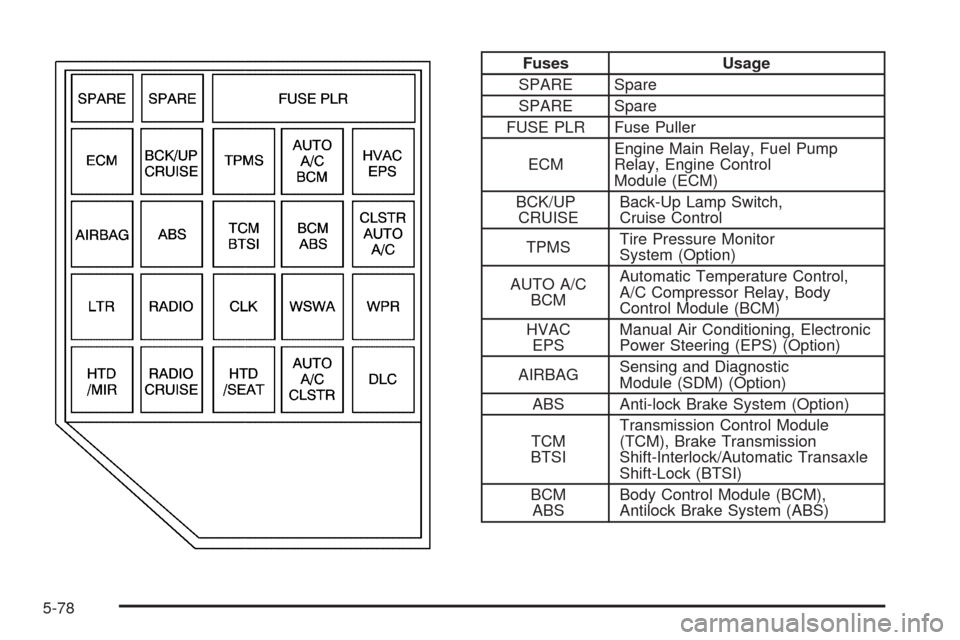
Fuses Usage
SPARE Spare
SPARE Spare
FUSE PLR Fuse Puller
ECMEngine Main Relay, Fuel Pump
Relay, Engine Control
Module (ECM)
BCK/UP
CRUISEBack-Up Lamp Switch,
Cruise Control
TPMSTire Pressure Monitor
System (Option)
AUTO A/C
BCMAutomatic Temperature Control,
A/C Compressor Relay, Body
Control Module (BCM)
HVAC
EPSManual Air Conditioning, Electronic
Power Steering (EPS) (Option)
AIRBAGSensing and Diagnostic
Module (SDM) (Option)
ABS Anti-lock Brake System (Option)
TCM
BTSITransmission Control Module
(TCM), Brake Transmission
Shift-Interlock/Automatic Transaxle
Shift-Lock (BTSI)
BCM
ABSBody Control Module (BCM),
Antilock Brake System (ABS)
5-78
Page 298 of 340
78,000 Miles (130 000 km)
❑Change engine oil and filter (or every 3 months,
whichever occurs first).An Emission Control Service.
❑Rotate tires. SeeTire Inspection and Rotation
on page 5-54for proper rotation pattern and
additional information.(See footnote +.)
81,000 Miles (135 000 km)
❑Change engine oil and filter (or every 3 months,
whichever occurs first).An Emission Control Service.
84,000 Miles (140 000 km)
❑Change engine oil and filter (or every 3 months,
whichever occurs first).An Emission Control Service.
❑Rotate tires. SeeTire Inspection and Rotation
on page 5-54for proper rotation pattern and
additional information.(See footnote +.)
87,000 Miles (145 000 km)
❑Change engine oil and filter (or every 3 months,
whichever occurs first).An Emission Control Service.
90,000 Miles (150 000 km)
❑Change engine oil and filter (or every 3 months,
whichever occurs first).An Emission Control Service.❑Replace passenger compartment air filter. If you
drive regularly under dusty conditions, the filter
may require replacement more often.
❑Replace engine air cleaner filter. SeeEngine Air
Cleaner/Filter on page 5-17for more information.
An Emission Control Service.
❑Rotate tires. SeeTire Inspection and Rotation on
page 5-54for proper rotation pattern and additional
information.(See footnote +.)
❑Replace fuel filter.An Emission Control Service.
(See footnote †.)
❑Inspect drive belts.
❑Drain, flush and refill cooling system. This service
can be complex; you should have your dealer
perform this service. SeeEngine Coolant on
page 5-19for what to use. Inspect hoses. Clean
radiator, condenser, pressure cap and neck. Pressure
test the cooling system and pressure cap.
An Emission Control Service.
❑Inspect EVAP canister, vapor lines and solenoid
valve filter.An Emission Control Service.
(See footnote †.)
❑Inspect PCV system.An Emission Control Service.
(See footnote †.)
❑Change brake fluid (or every 24 months, whichever
occurs first).
6-12
Page 301 of 340
30,000 Miles (50 000 km)
❑Change engine oil and filter (or every 12 months,
whichever occurs first).An Emission Control Service.
❑Replace passenger compartment air filter. If you drive
regularly under dusty conditions, the filter may require
replacement more often.
❑Replace engine air cleaner filter. SeeEngine Air
Cleaner/Filter on page 5-17for more information.
An Emission Control Service.
❑Rotate tires. SeeTire Inspection and Rotation on
page 5-54for proper rotation pattern and additional
information.(See footnote +.)
❑Replace fuel filter.An Emission Control Service.
(See footnote †.)
❑Inspect drive belts.
❑Drain, flush and refill cooling system. This service can
be complex; you should have your dealer perform this
service. SeeEngine Coolant on page 5-19for what to
use. Inspect hoses. Clean radiator, condenser,
pressure cap and neck. Pressure test the cooling
system and pressure cap.
An Emission Control Service.
❑Inspect EVAP canister, vapor lines and solenoid valve
filter.An Emission Control Service.
(See footnote †.)❑Inspect PCV system.An Emission Control Service.
(See footnote †.)
❑Change brake fluid (or every 24 months, whichever
occurs first).
37,500 Miles (62 500 km)
❑Change engine oil and filter (or every 12 months,
whichever occurs first).An Emission Control Service.
❑Rotate tires. SeeTire Inspection and Rotation on
page 5-54for proper rotation pattern and additional
information.(See footnote +.)
45,000 Miles (75 000 km)
❑Change engine oil and filter (or every 12 months,
whichever occurs first).An Emission Control Service.
❑Replace passenger compartment air filter. If you drive
regularly under dusty conditions, the filter may require
replacement more often.
❑Inspect engine air cleaner filter. SeeEngine Air
Cleaner/Filter on page 5-17for more information.
An Emission Control Service. (See footnote †.)
❑Rotate tires. SeeTire Inspection and Rotation on
page 5-54for proper rotation pattern and additional
information.(See footnote +.)
❑Inspect drive belts.
6-15