2005 CHEVROLET CORVETTE fuel
[x] Cancel search: fuelPage 274 of 400
Checking Things Under
the Hood
{CAUTION:
An electric fan under the hood can start up
and injure you even when the engine is not
running. Keep hands, clothing and tools away
from any underhood electric fan.
{CAUTION:
Things that burn can get on hot engine parts
and start a re. These include liquids like fuel,
oil, coolant, brake uid, windshield washer and
other uids, and plastic or rubber. You or
others could be burned. Be careful not to drop
or spill things that will burn onto a hot engine.
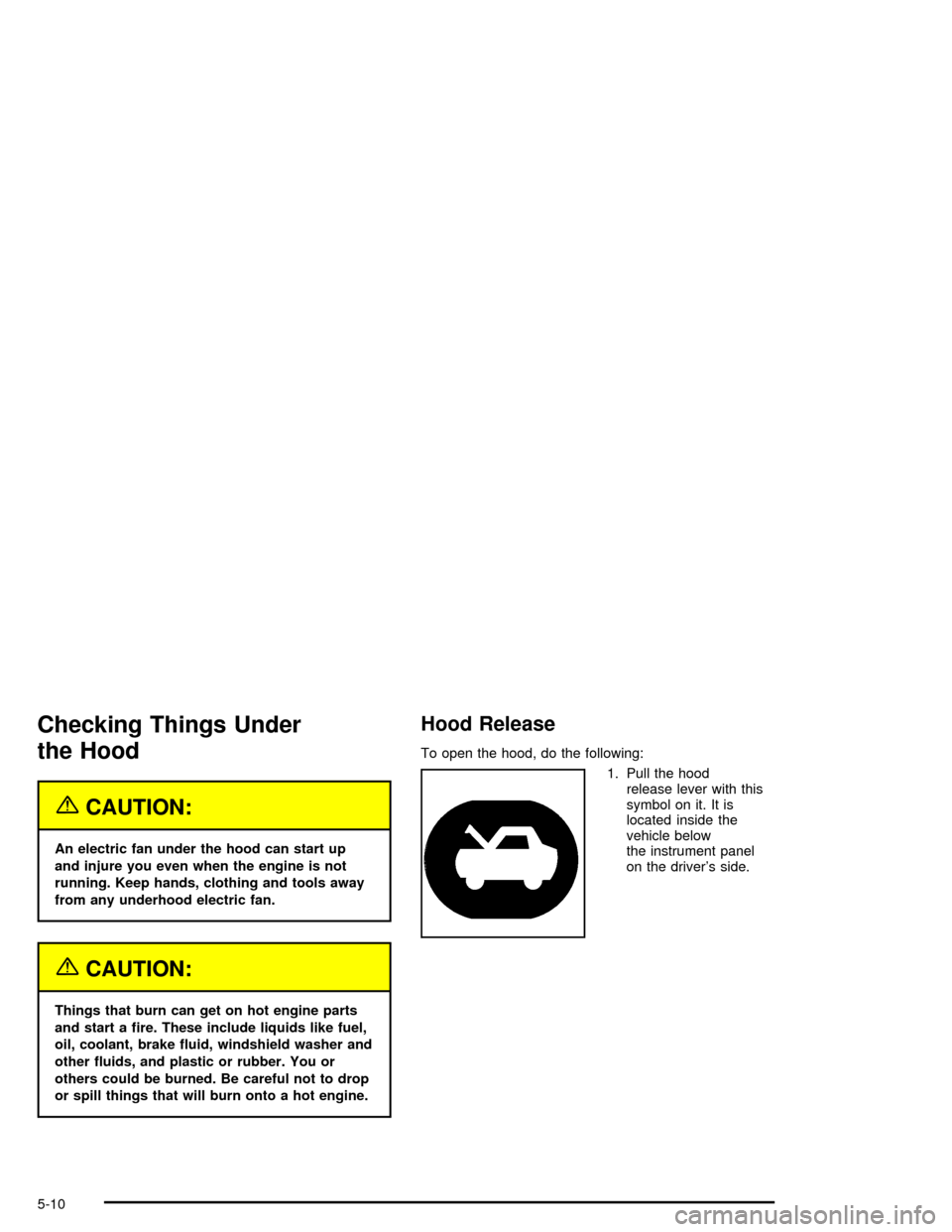
Hood Release
To open the hood, do the following:
1. Pull the hood
release lever with this
symbol on it. It is
located inside the
vehicle below
the instrument panel
on the driver’s side.
5-10
Page 277 of 400

A. Clutch Master Cylinder Reservoir (If Equipped). See
Hydraulic Clutch on page 5-20.
B. Windshield Washer Fluid Reservoir. See “Adding
Washer Fluid” underWindshield Washer Fluid
on page 5-33.
C. Brake Fluid Reservoir. See “Brake Fluid” under
Brakes on page 5-34.
D. Coolant Surge Tank and Pressure Cap. SeeEngine
Coolant on page 5-21.
E. Engine Air Cleaner/Filters. SeeEngine Air
Cleaner/Filter on page 5-18.
F. Power Steering Fluid Reservoir. SeePower Steering
Fluid on page 5-31.
G. Engine Oil Fill Cap. See “When to Add Engine Oil”
underEngine Oil on page 5-13.
H. Engine Oil Dipstick. See “Checking Engine Oil”
underEngine Oil on page 5-13.
I. Engine Compartment Fuse Block. SeeEngine
Compartment Fuse Block on page 5-89.
J. Passenger Compartment Air Filter (Out of View).
SeePassenger Compartment Air Filter on page 3-31.
K. Battery. SeeBattery on page 5-37.Engine Oil
If the LOW OIL LEVEL message on the Driver
Information Center (DIC) comes on, it means you need
to check your engine oil level right away. For more
information, seeDriver Information Center (DIC)
on page 3-49.
You should check your engine oil level regularly; this is
an added reminder.
Checking Engine Oil
It is a good idea to check your engine oil level every
time you get fuel. In order to get an accurate reading,
the oil must be warm and the vehicle must be on
level ground.
The engine oil dipstick handle is a yellow loop. See
Engine Compartment Overview on page 5-12for
the location of the engine oil dipstick.
1. Turn off the engine and give the oil a few minutes
to drain back into the oil pan. If you do not do this,
the oil dipstick might not show the actual level.
2. Pull out the dipstick and clean it with a paper towel
or a cloth, then push it back in all the way. Remove
it again, keeping the tip down.
5-13
Page 318 of 400

(D) Construction Code:A letter code is used to
indicate the type of ply construction in the tire. The letter
R means radial ply construction; the letter D means
diagonal or bias ply construction; and the letter B means
belted-bias ply construction.
(E) Rim Diameter:Diameter of the wheel in inches.
(F) Service Description:These characters represent
the load range and speed rating of the tire. The load
index represents the load carry capacity a tire is certied
to carry. The load index can range from 1 to 279. The
speed rating is the maximum speed a tire is certied
to carry a load. Speed ratings range from A to Z.
Tire Terminology and Denitions
Air Pressure:The amount of air inside the tire pressing
outward on each square inch of the tire. Air pressure
is expressed in pounds per square inch (psi) or
kilopascal (kPa).
Accessory Weight:This means the combined weight
of optional accessories. Some examples of optional
accessories are, automatic transmission, power steering,
power brakes, power windows, power seats, and air
conditioning.
Aspect Ratio:The relationship of a tire’s height to
its width.Belt:A rubber coated layer of cords that is located
between the plies and the tread. Cords may be made
from steel or other reinforcing materials.
Bead:The tire bead contains steel wires wrapped by
steel cords that hold the tire onto the rim.
Bias Ply Tire:A pneumatic tire in which the plies are
laid at alternate angles less than 90 degrees to the
centerline of the tread.
Cold Ination Pressure:The amount of air pressure in
a tire, measured in pounds per square inch (psi) or
kilopascals (kPa) before a tire has built up heat
from driving. SeeInation - Tire Pressure on page 5-58.
Curb Weight:This means the weight of a motor
vehicle with standard and optional equipment including
the maximum capacity of fuel, oil and coolant, but
without passengers and cargo.
DOT Markings:A code molded into the sidewall of a
tire signifying that the tire is in compliance with the U.S.
Department of Transportation (DOT) motor vehicle
safety standards. The DOT code includes the Tire
Identication Number (TIN), an alphanumeric designator
which can also identify the tire manufacturer, production
plant, brand and date of production.
GVWR:Gross Vehicle Weight Rating, seeLoading
Your Vehicle on page 4-31.
5-54
Page 322 of 400

Ination - Tire Pressure
Tires need the correct amount of air pressure to operate
effectively.
Notice:Do not let anyone tell you that
under-ination or over-ination is all right. It is not.
If your tires do not have enough air (under-ination),
you can get the following:
Too much exing
Too much heat
Tire overloading
Premature or irregular wear
Poor handling
Reduced fuel economy
If your tires have too much air (over-ination), you
can get the following:
Unusual wear
Poor handling
Rough ride
Needless damage from road hazardsA Tire and Loading Information label is attached to the
vehicle’s b-pillar. This label lists your vehicle’s original
equipment tires and shows the correct ination
pressures for your tires when they are cold. The
recommended cold tire ination pressure, shown on the
label, is the minimum amount of air pressure needed
to support your vehicle’s maximum load carrying
capacity.
For additional information regarding how much weight
your vehicle can carry, and an example of the tire
and loading information label, seeLoading Your Vehicle
on page 4-31. How you load your vehicle affects
vehicle handling and ride comfort, never load your
vehicle with more weight than it was designed to carry.
When to Check
Check your tires once a month or more.
How to Check
Use a good quality pocket-type gage to check tire
pressure. You cannot tell if your tires are properly inated
simply by looking at them. Radial tires may look properly
inated even when they’re under-inated. Check the tire’s
ination pressure when the tires are cold. Cold means
your vehicle has been sitting for at least three hours or
driven no more than 1 mile (1.6 km).
5-58
Page 325 of 400

Under-ination also reduces fuel efficiency and tire tread
life, and may affect the vehicle’s handling and stopping
ability. Each tire, including the spare, should be
checked monthly when cold and set to the
recommended ination pressure as specied in the
vehicle placard and owner’s manual.
The Tire and Loading Information Label (tire information
placard) is attached to the vehicle’s b-pillar. This
label shows the size of your vehicle’s original tires and
the correct ination pressure for your vehicle’s tires
when they are cold. SeeLoading Your Vehicle on
page 4-31.
Your vehicle’s TPM system can alert you about a low or
high tire pressure condition but it does not replace
normal tire maintenance. SeeInation - Tire Pressure
on page 5-58andWhen It Is Time for New Tires
on page 5-62.
Each TPM sensor has a unique identication code that
is matched to one of the four tire positions on your
vehicle. The tire and wheel assembly positions are, left
front (LF); right front (RF); right rear (RR) and left
rear (LR). Any time you rotate your vehicle’s tires or
replace one or more TPM sensors, the identication
codes will need to be matched to the new tire and wheel
position. The TPM matching process is performed in
a specic sequence and time limit. A special tool is also
required. See your dealer for service.The SERVICE TIRE MONITOR message is displayed
when the TPM system is malfunctioning. For example,
one or more TPM sensors may be inoperable or
missing. Also, the active handling system will be
affected, seeActive Handling System on page 4-10.
See your dealer for service.
The TPM system operates on a radio frequency subject
to Federal Communications Commission (FCC) Rules
and with Industry and Science Canada.
This device complies with Part 15 of the FCC Rules and
with RSS-210 of Industry and Science Canada.
Operation is subject to the following two conditions:
(1) This device may not cause harmful interference, and
(2) this device must accept any interference received
including interference that may cause undesired
operation of the device.
Changes or modications to this system by other than
an authorized service facility could void authorization to
use this equipment.
Tire Rotation
The tires on your vehicle are different sizes front to rear.
Due to this, your tires should not be rotated. Each tire
and wheel should be used only in the position it is in.
5-61
Page 346 of 400

Finish Damage
Any stone chips, fractures or deep scratches in the
nish should be repaired right away.
Minor chips and scratches can be repaired with touch-up
materials available from your dealer or other service
outlets. Larger areas of nish damage can be corrected
in your dealer’s body and paint shop.
Underbody Maintenance
Chemicals used for ice and snow removal and dust
control can collect on the underbody. If these are not
removed, corrosion and rust can develop on the
underbody parts such as fuel lines, frame, oor pan,
and exhaust system even though they have corrosion
protection.
At least every spring, ush these materials from the
underbody with plain water. Clean any areas where mud
and debris can collect. Dirt packed in close areas of
the frame should be loosened before being ushed.
Your dealer or an underbody car washing system can
do this for you.
Fiberglass Springs
Notice:If you use acidic or corrosive cleaning
products, engine degreasers or aluminum cleaning
agents on berglass springs, you may damage
the springs. The repairs would not be covered by
your warranty. Use only approved cleaners
when cleaning your vehicle’s berglass springs.
Chemical Paint Spotting
Some weather and atmospheric conditions can create a
chemical fallout. Airborne pollutants can fall upon and
attack painted surfaces on the vehicle. This damage can
take two forms: blotchy, ring-shaped discolorations,
and small, irregular dark spots etched into the
paint surface.
Although no defect in the paint job causes this, GM will
repair, at no charge to the owner, the surfaces of
new vehicles damaged by this fallout condition within
12 months or 12,000 miles (20 000 km) of purchase,
whichever occurs rst.
5-82
Page 352 of 400

Fuses Usage
TONNEAU
RELSETonneau Release
TRUNK RELSE Trunk Release
REAR/ FOG Rear Fog Lamps
FUEL DR
RELSEFuel Door Release
BLANK Not Used
BLANK Not Used
Fuses Usage
CIG LTR Cigarette Lighter
DRVR
HTD SEATDriver’s Heated Seat
WPR DWELL Wiper Dwell
BLANK Not Used
AUX PWR Auxiliary Power
Fuses Usage
PASS
HTD SEATPassenger’s Heated Seat
BLANK Not Used
PWR WNDWS/
FUEL RELSEPower Windows, Fuel Door Release
TRUNK RELSE Trunk Release
PWR LUMBAR Power Lumbar
BLANK Not Used
PWR SEATS
MEMORY
SEATSPower Seats, Memory Seats
BLANK Not Used
BLANK Not Used
WPR/WASHER Windshield Wiper/Washer
BLANK Not Used
5-88
Page 354 of 400

Fuse Usage
1Transmission Control
Module/Transmission
2 Horn, Alternator Sense
3 Anti-lock Brakes/Real Time Damping
4 Wiper
5 Stoplamps/Back-Up Lamps
6 02 Sensor
7 Battery Main 5
8 Park Lamps
9Powertrain Relay Input/Electronic
Throttle Control
10 Manual Transmission Solenoids
11Engine Control Module/Transmission
Control Module/Easy Key Module
12 Odd Numbered Fuel Injectors
13 Real Time Damping
14Canister Purge Solenoid, Mass Air
Flow Sensor
15 Air Conditioner Compressor
16 Even Numbered Fuel Injectors
17 Windshield WasherFuse Usage
18 Headlamp Washer
19 Right Low-Beam
20 Fuel Pump
21 Left Low-Beam
22 Front Fog Lamp
23 Right High-Beam
24 Left High-Beam
J-Style Fuses Usage
25 Cooling Fan
26 Battery Main 3
27 Anti-Lock Brake System
28Heating/Ventilation/Air Conditioning
Blower
29 Battery Main 2
30 Starter
31 Audio Amplier
32 Blank
33 Battery Main 1
5-90