Page 270 of 414
Doing Your Own Service Work
If you want to do some of your own service work,
you will want to use the proper service manual. It tells
you much more about how to service your vehicle
than this manual can. To order the proper service
manual, seeService Publications Ordering Information
on page 7-11.
Your vehicle has an airbag system. Before attempting
to do your own service work, seeServicing Your
Airbag-Equipped Vehicle on page 1-74.
You should keep a record with all parts receipts and
list the mileage and the date of any service work
you perform. SeeMaintenance Record on page 6-15.{CAUTION:
You can be injured and your vehicle could be
damaged if you try to do service work on a
vehicle without knowing enough about it.
Be sure you have sufficient knowledge,
experience, the proper replacement parts,
and tools before you attempt any vehicle
maintenance task.
Be sure to use the proper nuts, bolts,
and other fasteners. English and metric
fasteners can be easily confused. If you
use the wrong fasteners, parts can later
break or fall off. You could be hurt.
5-4
Page 279 of 414
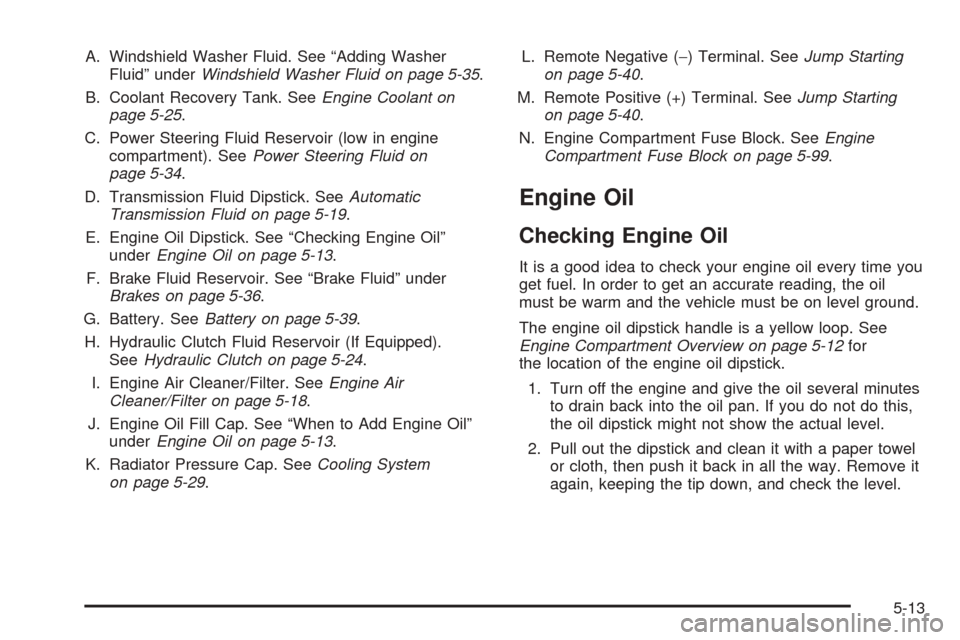
A. Windshield Washer Fluid. See “Adding Washer
Fluid” underWindshield Washer Fluid on page 5-35.
B. Coolant Recovery Tank. SeeEngine Coolant on
page 5-25.
C. Power Steering Fluid Reservoir (low in engine
compartment). SeePower Steering Fluid on
page 5-34.
D. Transmission Fluid Dipstick. SeeAutomatic
Transmission Fluid on page 5-19.
E. Engine Oil Dipstick. See “Checking Engine Oil”
underEngine Oil on page 5-13.
F. Brake Fluid Reservoir. See “Brake Fluid” under
Brakes on page 5-36.
G. Battery. SeeBattery on page 5-39.
H. Hydraulic Clutch Fluid Reservoir (If Equipped).
SeeHydraulic Clutch on page 5-24.
I. Engine Air Cleaner/Filter. SeeEngine Air
Cleaner/Filter on page 5-18.
J. Engine Oil Fill Cap. See “When to Add Engine Oil”
underEngine Oil on page 5-13.
K. Radiator Pressure Cap. SeeCooling System
on page 5-29.L. Remote Negative (−) Terminal. SeeJump Starting
on page 5-40.
M. Remote Positive (+) Terminal. SeeJump Starting
on page 5-40.
N. Engine Compartment Fuse Block. SeeEngine
Compartment Fuse Block on page 5-99.
Engine Oil
Checking Engine Oil
It is a good idea to check your engine oil every time you
get fuel. In order to get an accurate reading, the oil
must be warm and the vehicle must be on level ground.
The engine oil dipstick handle is a yellow loop. See
Engine Compartment Overview on page 5-12for
the location of the engine oil dipstick.
1. Turn off the engine and give the oil several minutes
to drain back into the oil pan. If you do not do this,
the oil dipstick might not show the actual level.
2. Pull out the dipstick and clean it with a paper towel
or cloth, then push it back in all the way. Remove it
again, keeping the tip down, and check the level.
5-13
Page 364 of 414
Electrical System
Add-On Electrical Equipment
Notice:Don’t add anything electrical to your
vehicle unless you check with your dealer rst.
Some electrical equipment can damage your vehicle
and the damage wouldn’t be covered by your
warranty. Some add-on electrical equipment can
keep other components from working as they
should.
Your vehicle has an air bag system. Before attempting
to add anything electrical to your vehicle, see
Servicing Your Airbag-Equipped Vehicle on page 1-74.
Windshield Wiper Fuses
The windshield wiper motor is protected by a circuit
breaker and a fuse. If the motor overheats due to heavy
snow or ice, the wiper will stop until the motor cools.
If the overload is caused by some electrical problem,
be sure to get it xed.
Power Windows and Other Power
Options
Circuit breakers protect the power windows and other
power accessories. When the current load is too heavy,
the circuit breaker opens and closes, protecting the
circuit until the problem is xed or goes away.
Power and Heated Seat Circuit
Breakers
There is a circuit breaker located underneath the
driver’s side front seat that controls the power and
heated seat functions.
5-98
Page 365 of 414
Fuses and Circuit Breakers
The wiring circuits in your vehicle are protected from
short circuits by a combination of fuses and circuit
breakers. This greatly reduces the chance of res
caused by electrical problems.
Look at the silver-colored band inside the fuse. If the
band is broken or melted, replace the fuse. Be sure you
replace a bad fuse with a new one of the identical
size and rating.
If you ever have a problem on the road and do not have
a spare fuse, you can borrow one that has the same
amperage. Just pick some feature of your vehicle
that you can get along without — like the radio or
cigarette lighter — and use its fuse, if it is the correct
amperage. Replace it as soon as you can.
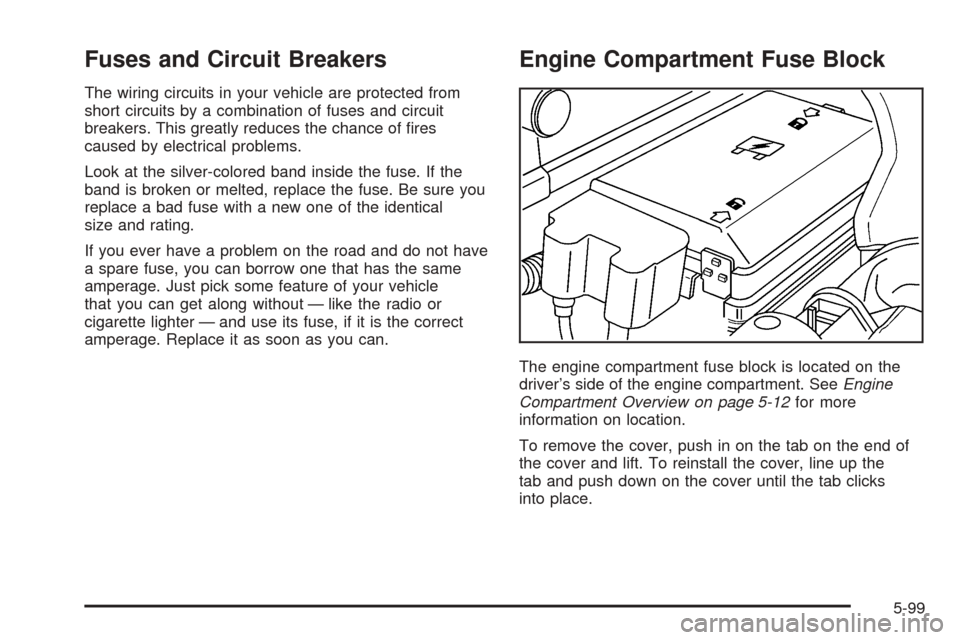
Engine Compartment Fuse Block
The engine compartment fuse block is located on the
driver’s side of the engine compartment. SeeEngine
Compartment Overview on page 5-12for more
information on location.
To remove the cover, push in on the tab on the end of
the cover and lift. To reinstall the cover, line up the
tab and push down on the cover until the tab clicks
into place.
5-99
Page 366 of 414
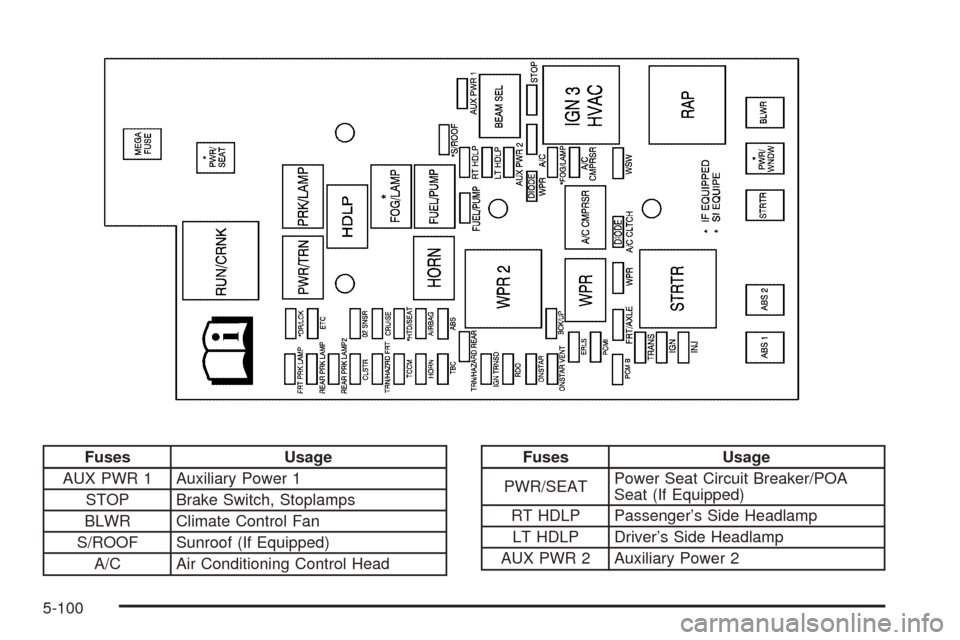
Fuses Usage
AUX PWR 1 Auxiliary Power 1
STOP Brake Switch, Stoplamps
BLWR Climate Control Fan
S/ROOF Sunroof (If Equipped)
A/C Air Conditioning Control HeadFuses Usage
PWR/SEATPower Seat Circuit Breaker/POA
Seat (If Equipped)
RT HDLP Passenger’s Side Headlamp
LT HDLP Driver’s Side Headlamp
AUX PWR 2 Auxiliary Power 2
5-100
Page 367 of 414

Fuses Usage
FOG/LAMP Fog Lamps (If Equipped)
A/C CMPRSR Air Conditioning Compressor
WSW Wiper/Washer Switch
PWR/WNDW Power Windows (If Equipped)
FUEL/PUMP Fuel Pump
STRTR Starter Solenoid Relay
WPR Wiper
ABS 2Anti-lock Brake System 2
(ABS Pump)
DR/LCK Power Door Locks (If Equipped)
ETC Electronic Throttle Control (ETC)
02 SNSR Oxygen Sensors
CRUISECruise Control Switch, Inside
Rearview Mirror, Transfer Case
Control Module, Brake Switch,
Clutch Disable
HTD/SEAT Heated Seat (If Equipped)
AIRBAGSupplemental Inatable Restraint
System, Sensing and Diagnostic
Module, Airbag Off Switch
ABSAnti-lock Brake System (ABS),
ABS module, Four-Wheel Drive,
Gravity Sensor
BCK/UP Back-up Lights
FRT/AXLE Front Axle ActuatorFuses Usage
TRN/HAZRD
REARRear Turn/Hazard Lights
ERLSERLS, Map Sensor, Can Purge
Solenoid
PCMI Powertrain Control Module (PCM)
TRANS Transmission Solenoid
IGNIgnition, Clutch Starter Switch,
Neutral Safety Back-Up Switch,
Ignition Coils 1-5, Air Conditioning
Relay
INJ Injectors
ABS 1Anti-lock Brake System 1
(ABS Logic)
FRT PRK
LAMPFront Park/Turn Lamps, Driver and
Passenger’s Side Power Window
Switches Lighting
REAR PRK
LAMPRear Parking Lamp 1, Passenger’s
Side Taillamp, License Plate Lamps
REAR PRK
LAMP2Driver’s Side Rear Taillamp,
Passenger Side Airbag Indicator
Lighting, Instrument Panel Dimming
Power (2WD/4WD switch lighting)
CLSTR Cluster
TRN/HAZRD
FRTTurn/Hazard/Courtesy/Cargo
Lamps/Mirrors
TCCM Transfer Case Control Module
5-101
Page 368 of 414
Fuses Usage
HORN Horn
TBC Truck Body Controller
IGN TRNSD Ignition Transducers
RDO Radio
ONSTAR OnStar
®
CNSTR VENT Fuel Canister Vent Solenoid
PCM B Powertrain Control Module (PCM) B
Relays Usage
BEAM SEL Beam Selection
IGN 3 HVACIgnition 3, Climate Control,
Climate Control Head Fuse
RAPRetained Accessory Power
(Power Window Fuse,
Wiper/Washer Switch Fuse)
PRK/LAMPFront Parking Lamp Fuse,
Rear Parking Lamps
HDLP Headlamps
Relays Usage
FOG/LAMP Fog Lamps (If Equipped)
FUEL/PUMP Fuel Pump, Fuel Pump Fuse
A/C CMPRSR Air Conditioning Compressor
RUN/CRNKRun/Crank, Airbag System Fuse,
Cruise Control Fuse, Ignition Fuse,
Back-Up Lamps, ABS Fuse, ERLS,
Front Axle, PCM-1, Injectors Fuse
PWR/TRNPowertrain, Electronic Throttle
Control Fuse, Oxygen Sensor Fuse
HORN Horn
WPR 2 Wiper 2 (High/Low)
WPR Wipers (On/Off)
STRTR Starter Relay (PCM Relay)
Miscellaneous Usage
WPR Diode — Wiper
A/C CLTCH Diode — Air Conditioning, Clutch
MEGA FUSE Mega Fuse
5-102
Page 405 of 414
E
Electrical System
Add-On Equipment......................................5-98
Engine Compartment Fuse Block...................5-99
Fuses and Circuit Breakers...........................5-99
Power Windows and Other Power Options......5-98
Windshield Wiper Fuses...............................5-98
Engine
Air Cleaner/Filter.........................................5-18
Battery.......................................................5-39
Check and Service Engine Soon Light............3-30
Coolant......................................................5-25
Coolant Heater............................................2-20
Coolant Temperature Gage...........................3-30
Engine Compartment Overview......................5-12
Exhaust.....................................................2-33
Fan Noise..................................................5-34
Oil .............................................................5-13
Oil Life System...........................................5-16
Overheating................................................5-28
Starting......................................................2-18
Event Data Recorders (EDR)............................. 7-9
Exit Lighting...................................................3-17
Extender, Safety Belt.......................................1-31
Exterior Cargo Lamps......................................3-16
Exterior Lamps...............................................3-13
F
Filter
Engine Air Cleaner......................................5-18
Finish Damage...............................................5-95
Fixed Mast Antenna........................................3-72
Flash-to-Pass................................................... 3-9
Flat Tire........................................................5-67
Flat Tire, Changing.........................................5-68
Flat Tire, Storing.............................................5-83
Fluid
Automatic Transmission................................5-19
Manual Transmission....................................5-22
Power Steering...........................................5-34
Windshield Washer......................................5-35
Fog Lamps....................................................3-16
Four-Wheel Drive....................................2-25, 5-44
Front Armrest Storage Area..............................2-41
Front Axle......................................................5-45
Fuel............................................................... 5-5
Additives...................................................... 5-6
California Fuel.............................................. 5-6
Filling a Portable Fuel Container....................5-10
Filling Your Tank........................................... 5-8
Fuels in Foreign Countries.............................. 5-7
Gage.........................................................3-35
Gasoline Octane........................................... 5-5
Gasoline Specications.................................. 5-5
5