2005 CHEVROLET BLAZER instrument panel
[x] Cancel search: instrument panelPage 257 of 436
1. Follow the dolly manufacturer’s instructions to
attach and secure the vehicle being towed to
the dolly and then the loaded dolly to the tow
vehicle.
2. Firmly set the parking brake.
3. Put an automatic or a manual transmission in
NEUTRAL (N).
{CAUTION:
Shifting a four-wheel-drive vehicle’s transfer
case into NEUTRAL can cause your vehicle to
roll even if the transmission is in Park (P) for
an automatic transmission, or if your vehicle is
in gear, for a manual transmission. You or
others could be injured. Make sure the parking
brake is rmly set before you shift the transfer
case to NEUTRAL.4. Shift the transfer case to Neutral. SeeFour-Wheel
Drive on page 2-29for how to shift the transfer case.
5. Release the parking brake only after the vehicle
being towed is rmly attached to the towing
vehicle.
Notice:Do not exceed the posted speed limit when
towing your vehicle. If you do, your vehicle could
be badly damaged.
Notice:If you tow your vehicle from the front for
more than 50 miles (80 km) on a dolly, you could
damage it. Never dolly tow your vehicle from
the front more than 50 miles (80 km).
6. Turn the ignition to OFF. To prevent your battery
from draining while towing, remove the RDO BATT
and CLSTR fuses from the instrument panel
fuse block. Be sure to replace the fuse when you
reach your destination SeeInstrument Panel
Fuse Block on page 5-98.
4-55
Page 258 of 436
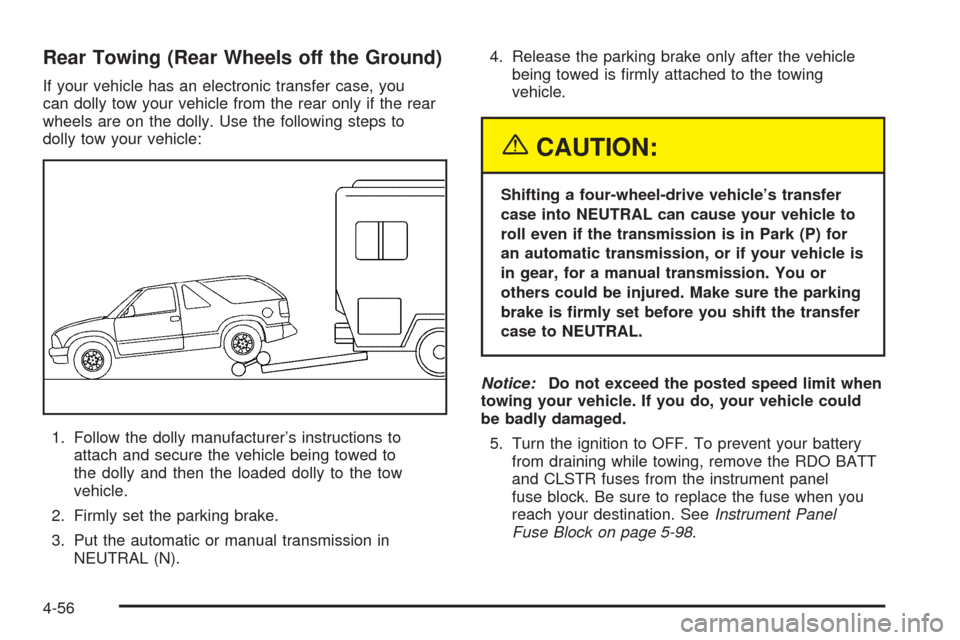
Rear Towing (Rear Wheels off the Ground)
If your vehicle has an electronic transfer case, you
can dolly tow your vehicle from the rear only if the rear
wheels are on the dolly. Use the following steps to
dolly tow your vehicle:
1. Follow the dolly manufacturer’s instructions to
attach and secure the vehicle being towed to
the dolly and then the loaded dolly to the tow
vehicle.
2. Firmly set the parking brake.
3. Put the automatic or manual transmission in
NEUTRAL (N).4. Release the parking brake only after the vehicle
being towed is rmly attached to the towing
vehicle.
{CAUTION:
Shifting a four-wheel-drive vehicle’s transfer
case into NEUTRAL can cause your vehicle to
roll even if the transmission is in Park (P) for
an automatic transmission, or if your vehicle is
in gear, for a manual transmission. You or
others could be injured. Make sure the parking
brake is rmly set before you shift the transfer
case to NEUTRAL.
Notice:Do not exceed the posted speed limit when
towing your vehicle. If you do, your vehicle could
be badly damaged.
5. Turn the ignition to OFF. To prevent your battery
from draining while towing, remove the RDO BATT
and CLSTR fuses from the instrument panel
fuse block. Be sure to replace the fuse when you
reach your destination. SeeInstrument Panel
Fuse Block on page 5-98.
4-56
Page 259 of 436
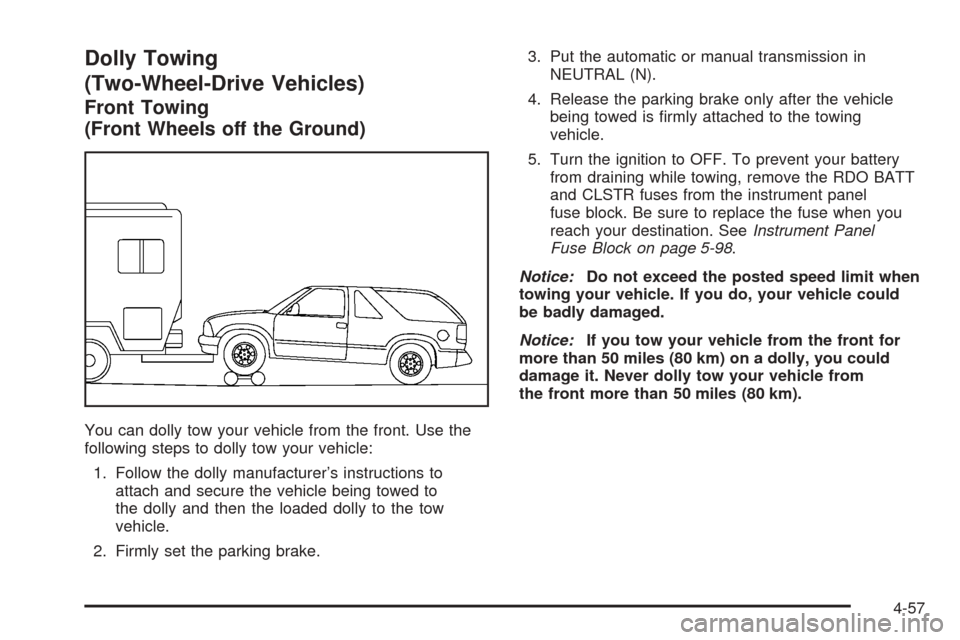
Dolly Towing
(Two-Wheel-Drive Vehicles)
Front Towing
(Front Wheels off the Ground)
You can dolly tow your vehicle from the front. Use the
following steps to dolly tow your vehicle:
1. Follow the dolly manufacturer’s instructions to
attach and secure the vehicle being towed to
the dolly and then the loaded dolly to the tow
vehicle.
2. Firmly set the parking brake.3. Put the automatic or manual transmission in
NEUTRAL (N).
4. Release the parking brake only after the vehicle
being towed is rmly attached to the towing
vehicle.
5. Turn the ignition to OFF. To prevent your battery
from draining while towing, remove the RDO BATT
and CLSTR fuses from the instrument panel
fuse block. Be sure to replace the fuse when you
reach your destination. SeeInstrument Panel
Fuse Block on page 5-98.
Notice:Do not exceed the posted speed limit when
towing your vehicle. If you do, your vehicle could
be badly damaged.
Notice:If you tow your vehicle from the front for
more than 50 miles (80 km) on a dolly, you could
damage it. Never dolly tow your vehicle from
the front more than 50 miles (80 km).
4-57
Page 260 of 436
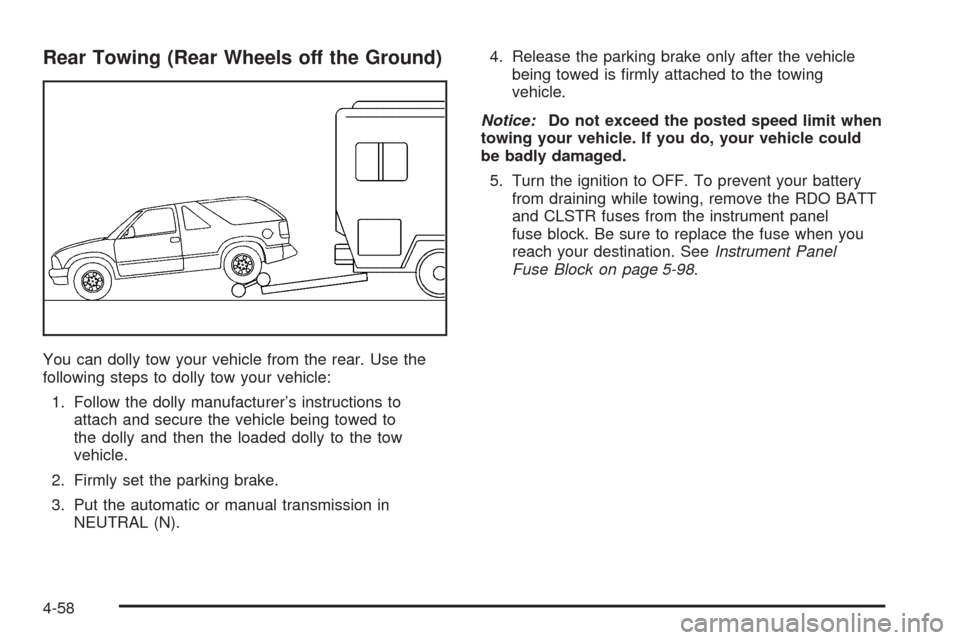
Rear Towing (Rear Wheels off the Ground)
You can dolly tow your vehicle from the rear. Use the
following steps to dolly tow your vehicle:
1. Follow the dolly manufacturer’s instructions to
attach and secure the vehicle being towed to
the dolly and then the loaded dolly to the tow
vehicle.
2. Firmly set the parking brake.
3. Put the automatic or manual transmission in
NEUTRAL (N).4. Release the parking brake only after the vehicle
being towed is rmly attached to the towing
vehicle.
Notice:Do not exceed the posted speed limit when
towing your vehicle. If you do, your vehicle could
be badly damaged.
5. Turn the ignition to OFF. To prevent your battery
from draining while towing, remove the RDO BATT
and CLSTR fuses from the instrument panel
fuse block. Be sure to replace the fuse when you
reach your destination. SeeInstrument Panel
Fuse Block on page 5-98.
4-58
Page 263 of 436
Tow/Haul Mode
Your vehicle may be equipped with a tow/haul feature.
Tow/haul is designed to assist while your vehicle is
pulling a large or heavy load or trailer. Tow/haul is most
useful while pulling such a load in rolling terrain at
speeds less than 55 mph (88 km/h), in stop-and-go
traffic, or when you need improved low-speed control,
such as when parking. The purpose of the tow/haul
mode is to do the following:
Reduce the frequency and improve the predictability
or transmission shifts
provide the same solid shift feel while pulling a
heavy load as while the vehicle is unloaded, and
improve control of vehicle speed while requiring less
throttle pedal activity
Press the button on the end of the shift lever to turn
tow/haul mode on and off. While activated, the indicator
light on the instrument panel will be on. Tow/haul
mode will turn off automatically when the ignition is
turned off. SeeTow/Haul Mode Light on page 3-34.
Tow/haul mode is most effective when the vehicle and
load combined weight is at least 75 percent of the
vehicle’s Gross Vehicle Weight Rating (GVWR) and the
maximum trailer weight rating for the vehicle. See
“Weight of the Trailer” later in this section.Driving with tow/haul activated without a heavy load will
cause reduced fuel economy and unpleasant engine
and transmission driving characteristics, but will
not cause damage.
Weight of the Trailer
How heavy can a trailer safely be?
It depends on how you plan to use your rig. For
example, speed, altitude, road grades, outside
temperature and how much your vehicle is used to pull
a trailer are all important. And, it can also depend
on any special equipment that you have on your vehicle.
The following chart shows how much your trailer can
weigh, based upon your vehicle model and options.
Maximum trailer weight is calculated assuming the driver
and one passenger are in the tow vehicle and it has
all the required trailering equipment. The weight
of additional optional equipment, passengers and cargo
in the tow vehicle must be subtracted from the
maximum trailer weight. The weight of the trailer tongue
also affects the maximum trailer weight. See “ Weight
of the Trailer Tongue ” later in this section.
4-61
Page 269 of 436
Following Distance
Stay at least twice as far behind the vehicle ahead as
you would when driving your vehicle without a trailer.
This can help you avoid situations that require
heavy braking and sudden turns.
Passing
You’ll need more passing distance up ahead when
you’re towing a trailer. And, because you’re a good deal
longer, you’ll need to go much farther beyond the
passed vehicle before you can return to your lane.
Backing Up
Hold the bottom of the steering wheel with one hand.
Then, to move the trailer to the left, just move that hand
to the left. To move the trailer to the right, move your
hand to the right. Always back up slowly and, if possible,
have someone guide you.
Making Turns
Notice:Making very sharp turns while trailering
could cause the trailer to come in contact with the
vehicle. Your vehicle could be damaged. Avoid
making very sharp turns while trailering.
When you’re turning with a trailer, make wider turns
than normal. Do this so your trailer won’t strike
soft shoulders, curbs, road signs, trees or other objects.
Avoid jerky or sudden maneuvers. Signal well in
advance.
Turn Signals When Towing a Trailer
When you tow a trailer, your vehicle has to have extra
wiring and a heavy-duty turn signal asher (included
in the optional trailering package).
The arrows on your instrument panel will ash whenever
you signal a turn or lane change. Properly hooked up,
the trailer lamps will also ash, telling other drivers
you’re about to turn, change lanes or stop.
When towing a trailer, the arrows on your instrument
panel will ash for turns even if the bulbs on the trailer
are burned out. Thus, you may think drivers behind
you are seeing your signal when they are not. It’s
important to check occasionally to be sure the trailer
bulbs are still working.
4-67
Page 274 of 436
Tire Chains..................................................5-70
If a Tire Goes Flat........................................5-71
Changing a Flat Tire.....................................5-72
Removing the Spare Tire and Tools................5-73
Removing the Flat Tire and Installing the
Spare Tire................................................5-75
Storing a Flat or Spare Tire and Tools............5-81
Spare Tire...................................................5-84
Appearance Care............................................5-86
Fabric/Carpet...............................................5-86
Vinyl...........................................................5-88
Leather.......................................................5-88
Instrument Panel..........................................5-88
Interior Plastic Components............................5-88
Wood Panels...............................................5-89
Glass Surfaces.............................................5-89
Care of Safety Belts......................................5-89
Weatherstrips...............................................5-89
Washing Your Vehicle...................................5-90
Cleaning Exterior Lamps/Lenses.....................5-90
Finish Care..................................................5-90Windshield, Backglass, and Wiper Blades.........5-91
Aluminum Wheels.........................................5-92
Tires...........................................................5-92
Sheet Metal Damage.....................................5-93
Finish Damage.............................................5-93
Underbody Maintenance................................5-93
Chemical Paint Spotting.................................5-93
Vehicle Care/Appearance Materials..................5-94
Vehicle Identication......................................5-95
Vehicle Identication Number (VIN).................5-95
Service Parts Identication Label.....................5-96
Electrical System............................................5-96
Add-On Electrical Equipment..........................5-96
Headlamps..................................................5-96
Windshield Wiper Fuses................................5-97
Power Windows and Other Power Options.......5-97
Fuses and Circuit Breakers............................5-97
Instrument Panel Fuse Block..........................5-98
Engine Compartment Fuse Block....................5-99
Capacities and Specications........................5-102
Section 5 Service and Appearance Care
5-2
Page 283 of 436
Hood Release
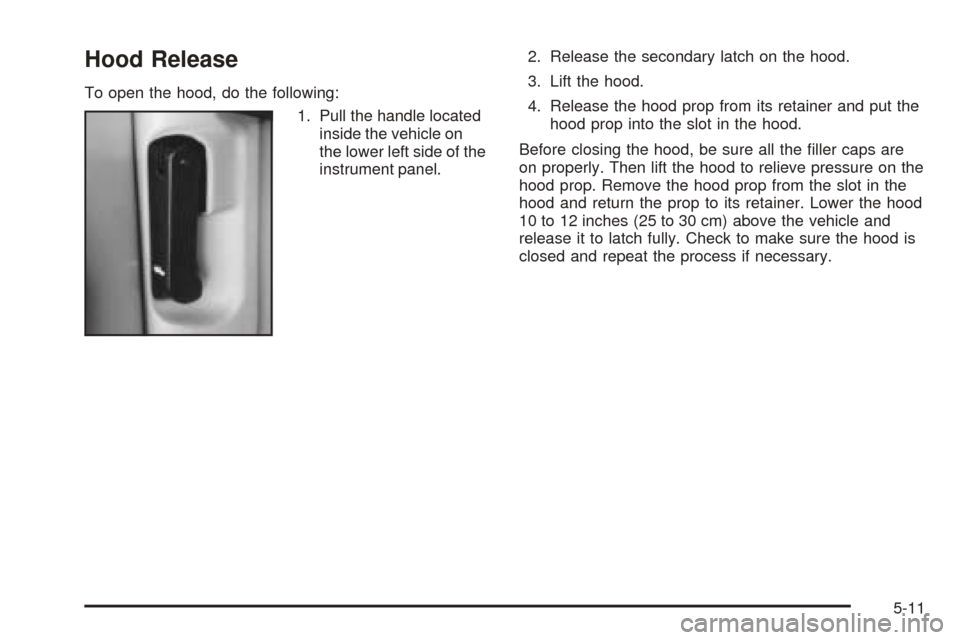
To open the hood, do the following:
1. Pull the handle located
inside the vehicle on
the lower left side of the
instrument panel.2. Release the secondary latch on the hood.
3. Lift the hood.
4. Release the hood prop from its retainer and put the
hood prop into the slot in the hood.
Before closing the hood, be sure all the ller caps are
on properly. Then lift the hood to relieve pressure on the
hood prop. Remove the hood prop from the slot in the
hood and return the prop to its retainer. Lower the hood
10 to 12 inches (25 to 30 cm) above the vehicle and
release it to latch fully. Check to make sure the hood is
closed and repeat the process if necessary.
5-11